



HCPCS code E0198: Water pressure pad billing guide
HCPCS code E0198 is a water pad for a standard mattress HCPCS code E0198 is the ...

Last Updated: Oct 13, 2026
CPT code 31295 is the surgical code for nasal/sinus endoscopy with balloon dilation of the maxillary sinus ostium, performed transnasally or through the canine fossa. It is a standalone code, reported once per maxillary sinus dilated. It is never reported with endoscopic sinus surgery on that same sinus.
Two errors cost ENT practices money on this code. One is reporting the wrong sinus-site code. The other is operating before the payer’s authorization covers what the surgeon actually did in the room.

CPT code 31295 describes surgical endoscopic balloon dilation of the maxillary sinus ostium, reported once per maxillary sinus treated.
CPT 31298 is a standalone code covering the frontal and sphenoid ostia together. It is not an add-on code and not a FESS companion code.
Medicare pays far more for 31295 in the office than in a facility, because the office practice expense absorbs the balloon device cost.
Most commercial payers require prior authorization plus documented failure of conservative treatment before they approve a balloon sinuplasty claim.
Pabau’s claims management software tracks prior auth status, pairs ICD-10 codes automatically, and submits claims electronically to reduce CPT 31295 denials.
CPT code 31295 covers nasal/sinus endoscopy, surgical, with dilation of the maxillary sinus ostium, transnasal or via canine fossa.
The descriptor’s parenthetical names balloon dilation as the example technique. The code sits in the AMA’s CPT code set under Endoscopy Procedures on the Accessory Sinuses, a range that now runs 31231 to 31298.
Clinically, the surgeon uses an endoscope to visualize the maxillary sinus opening, then expands the ostium with a balloon catheter. The goal is to restore natural drainage without removing bone or mucosal tissue.
That absence of tissue removal is what separates balloon dilation from functional endoscopic sinus surgery (FESS). The procedure is also called balloon sinuplasty or balloon sinus ostial dilation.
CPT code 31295 is one of four balloon dilation codes the AMA created to separate balloon sinuplasty from conventional FESS billing. Knowing where 31295 sits in the family prevents the two most common errors: reporting the wrong site code, and treating 31298 as an add-on. Per the AAPC Codify CPT lookup, each of the four codes maps to a defined sinus site or pair of sites.
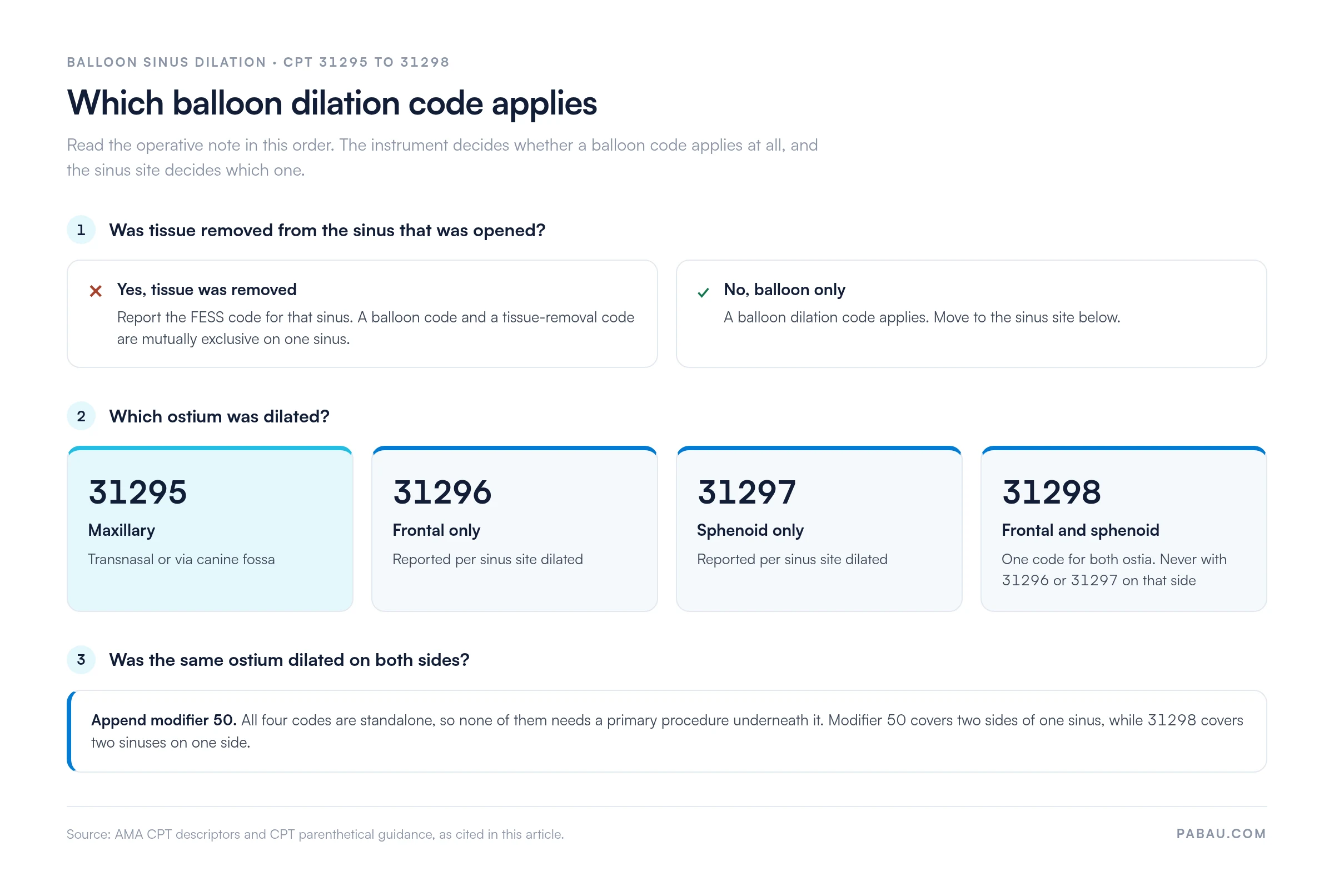
All four balloon dilation codes are standalone. None carries the CPT add-on symbol, none needs a primary procedure code underneath it, and each one can be billed by itself. CPT 31295, 31296, and 31297 are reported per sinus site dilated.
CPT 31298 is the combination code the AMA introduced for CY 2018. It bundles what used to be reported as 31296 plus 31297. Report 31298 alone when a session dilates both the frontal and the sphenoid ostium. Do not add 31296 or 31297 to it on the same side.
CPT’s parenthetical guidance also tells you what 31298 cannot accompany. Do not report it with ipsilateral FESS codes 31235, 31237, 31253, 31257, 31259, 31276, 31287, 31288, 31296, or 31297. The same principle governs 31295: a balloon code and a tissue-removal code are mutually exclusive on one sinus.
On the Medicare Physician Fee Schedule, 31298 carries its own work RVU of roughly 4.4, which is what a standalone code looks like. Add-on codes sit on the schedule too, but they pay only alongside a primary. Modifier 50 applies to 31298 when both sides are dilated. The chart below runs these checks in the order the operative note supplies them.
Medicare reimbursement for CPT code 31295 comes from the CMS Physician Fee Schedule and varies by geographic payment locality and billing setting.
Verify current figures in the CMS PFS Look-Up Tool before you submit, since RVUs and the conversion factor change annually. The FastRVU 2026 RVU lookup breaks the same values into work, practice expense, and malpractice components by locality.
Both rates matter at the point the case is scheduled, because the setting decides most of the payment. The remittance advice from the payer confirms which of the two was applied once the claim adjudicates.
The non-facility rate is higher because the practice buys the balloon device and absorbs the room, staff, and supply costs. In a hospital outpatient department or an ambulatory surgical center, the facility bills those costs on its own claim. The physician fee then drops to the professional work alone.
The two rates are nowhere near each other. In recent fee schedules the office payment for 31295 has run close to ten times the facility payment. The practice expense RVU drives almost all of that difference, which makes site of service the biggest variable in what this code earns.
Note: RVU values are set by annual CMS rulemaking, and dollar amounts vary by geographic payment locality. Use the CMS PFS Look-Up Tool or FastRVU for the exact figures that apply to your locality before billing.
CPT 31295 is a unilateral code, so laterality drives most of the modifier decisions on a balloon sinuplasty claim. The modifiers below cover the scenarios ENT billers meet most often. Payer rules differ, so confirm the preferred format before the claim goes out.
Modifier 50 handles both sides of one sinus. CPT 31298 handles two different sinuses on one side. They answer different questions, so neither one substitutes for the other on a claim.
Every modifier above attaches to a single surgical date. Rented equipment is billed differently, since K0877 runs as a capped rental over 13 months with KH, KI, and KJ marking each claim’s position.
The ICD-10-CM diagnosis code on a CPT code 31295 claim must support medical necessity for balloon dilation. Chronic sinusitis of the maxillary sinus is the primary indication. An acute sinusitis code (J01.x) without documented chronic disease usually triggers a denial.
Confirm each code’s validity and specificity in the ICD-10-CM code library before the claim goes out. The CMS ICD-10 code files carry the official annual update for the same code set.
The diagnosis code has to match the sinus site named in the operative report. A claim billing 31295 for the maxillary sinus, paired only with J32.1 for frontal sinusitis, creates a site mismatch. Payers flag that on automated edits.
Most payers require documented failure of conservative treatment before they approve a balloon sinuplasty claim. Thresholds vary by policy, but the criteria below reflect what commercial medical policies commonly ask for, including Anthem’s CG-SURG-73.
Some payers also want the record to show that nasal polyps are absent or minimal, since extensive polyposis points toward FESS instead. Criteria are revised periodically, so always check the payer’s current clinical policy document.
Pull the payer’s current medical policy PDF before the patient’s pre-authorization appointment. Anthem CG-SURG-73, for example, is updated annually. Citing an outdated policy version in your authorization request is a common cause of delays that practices wrongly blame on the payer.
The operative report decides whether a 31295 claim survives review. Balloon dilation codes describe a specific technique, so the note has to prove that technique was the one used. The elements below belong in every balloon sinuplasty record.
If tissue was removed from the same sinus, the FESS code applies and the balloon code does not. One line in the operative note settles that question. A report saying only “sinus surgery” leaves the coder guessing, which is how 31295 claims end up denied.
Prior authorization for CPT code 31295 is required by most commercial payers and many Medicare Advantage plans. Traditional Medicare fee-for-service does not currently require it for balloon sinuplasty in most jurisdictions, but Medicare Advantage plans set their own rules.
Running insurance eligibility verification at the first ENT consultation shows which plan type applies and whether authorization is mandatory.
Authorize the codes you expect to bill, not just the one on the schedule. If the plan changes in the operating room and the surgeon dilates the frontal and sphenoid ostia as well, the claim carries 31298 alongside 31295. An authorization naming only 31295 will not cover it.
The billing workflow for balloon sinuplasty starts with the operative report and ends with the modifier. The errors below account for most of the claim rejections ENT practices see on this code family.
Sorting denials by reason code shows which of these errors your practice repeats. Repeated CO-4 denials, meaning the procedure is inconsistent with the modifier, usually point to bilateral cases billed without modifier 50. Reading the remittance advice that closely turns a denial pattern into a fix.
Commercial coverage for balloon sinuplasty is broadly positive but policy-specific. The table below summarizes positions from the most recent publicly available policy documents. Retrieve the current version from each payer’s provider portal before submitting, because criteria and policy numbers change.
The administrative load on CPT code 31295 sits in two places. One is tracking prior authorization status across payers. The other is getting the right ICD-10 code onto the claim without a site mismatch.
Practice management software like Pabau covers both. Pabau’s claims management software shows prior auth expiry dates next to scheduled procedures, so staff can catch an expired authorization before the patient arrives.
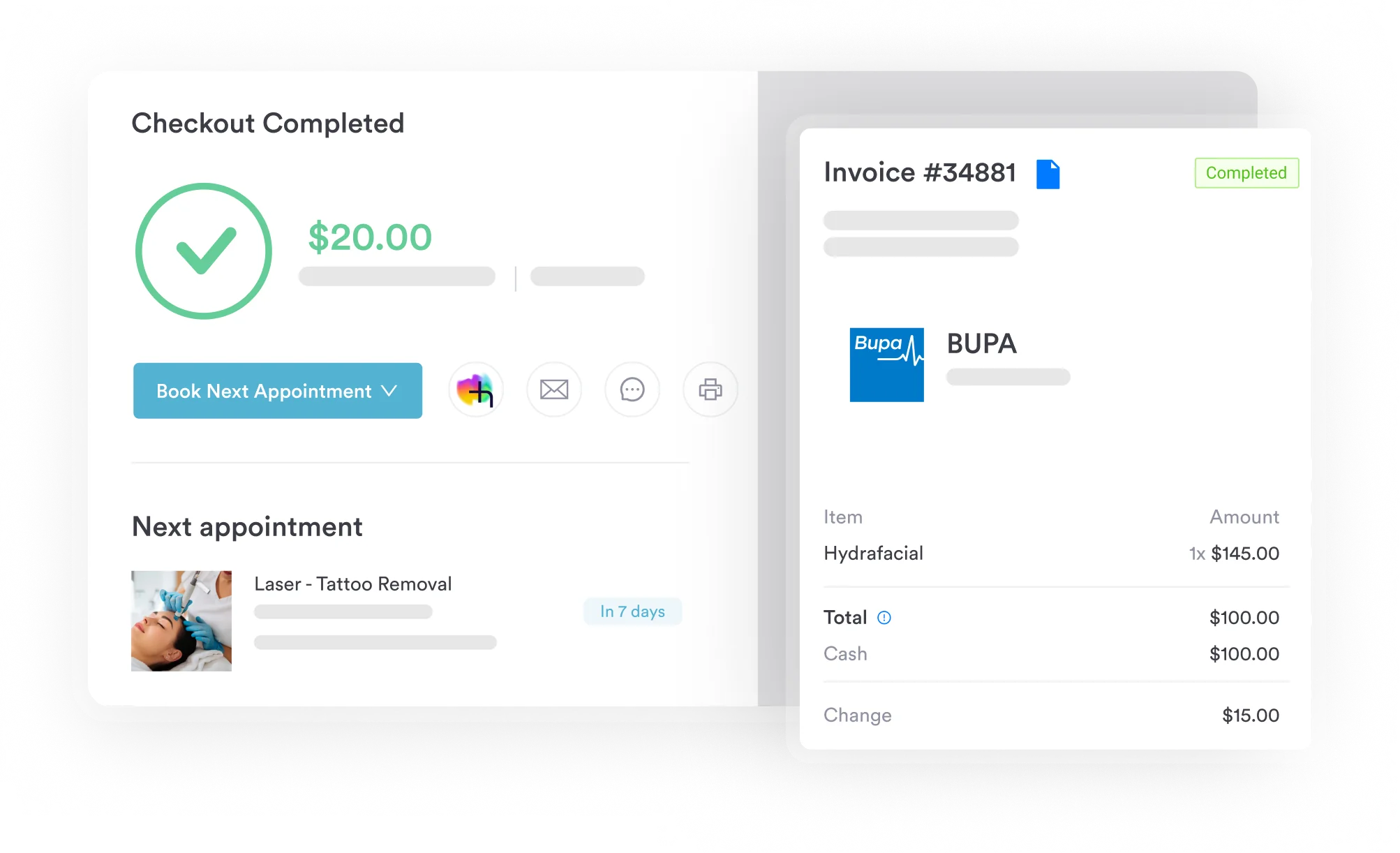
Electronic submission through Claim.MD, Pabau’s integrated US clearinghouse partner, applies claim edits at submission that catch CPT-to-diagnosis mismatches before the payer sees them. A 31295 claim paired with a frontal sinusitis code gets flagged at the scrub stage, not three weeks later at adjudication.
Pabau also builds the superbill with CPT and ICD-10 codes pre-populated from the visit record, which cuts manual transcription errors. The same workflow submits 837P claim files and receives 835 remittances in one platform, so your team reconciles payments where the claim was built.
Run a monthly denial analysis filtered to CPT 31295 and sorted by CARC reason code. Repeated CO-97 denials, meaning the benefit is included in another service, usually signal a bundling problem with same-day diagnostic endoscopy. Repeated CO-4 denials point at bilateral cases billed without modifier 50.

Pabau connects prior auth tracking, ICD-10 pairing, and electronic claim submission in one workflow. See how ENT practices use Pabau to reduce CPT 31295 denial rates.

CPT code 31295 pays reliably when three things line up. The sinus-site code must match the operative report. The authorization must cover every code billed. The J32.x diagnosis must name the sinus that was dilated. Remember that all four balloon codes stand alone, including 31298 for a combined frontal and sphenoid session.
Each step is simple on its own. Holding all three steady across a busy ENT schedule is what needs a system. Pabau brings prior auth tracking, ICD-10 pairing, and clean-claim submission into one platform, so your billing team spends less time reworking denials. Book a demo to see how Pabau handles sinus and ENT billing in your practice.

Need to understand how claim errors reach the payer? Medical claims clearinghouse guide explains how clearinghouses scrub and route claims before payer adjudication.
Want to benchmark your billing operations? Best medical billing software for US practices covers the leading platforms for ENT and surgical specialty billing.
Credentialing affecting your reimbursement? How to get credentialed with insurance companies walks through the payer enrollment process step by step.
CPT code 31295 covers nasal/sinus endoscopy, surgical, with balloon dilation of the maxillary sinus ostium, performed transnasally or via the canine fossa. It does not cover the frontal sinus (31296) or the sphenoid sinus (31297), which have their own standalone codes.
The difference is the sinus site treated: 31295 is the maxillary ostium, 31296 the frontal ostium, and 31297 the sphenoid ostium. All three are standalone codes billed per site. CPT 31298 is standalone as well, and it covers the frontal and sphenoid ostia together in a single code.
Yes, most commercial payers and Medicare Advantage plans require prior authorization for CPT 31295. Traditional Medicare fee-for-service generally does not, though the medical record must still document medical necessity. Medicaid rules vary by state. NC Medicaid, for example, requires prior authorization for 31295, 31296, and 31297.
The most common pairing is J32.0, chronic maxillary sinusitis. J32.4, chronic pansinusitis, applies when several sinus sites are involved. J32.9, chronic sinusitis unspecified, is used only when documentation cannot support a more specific code. The diagnosis must match the sinus site treated.
CMS sets the RVUs for CPT 31295 annually, and the facility and non-facility totals differ sharply. The work RVU is the same in both settings. The office practice expense RVU carries the balloon device cost, which lifts the office payment well above the facility payment. Look up current values in the CMS Physician Fee Schedule tool.
Yes. Both are standalone codes, so 31295 for the maxillary ostium can be reported with 31298 for the frontal and sphenoid ostia in the same session. CPT 31298 is not an add-on code and needs no primary procedure. It is never reported with 31296 or 31297 on the same side.
No. CPT 31295 is unilateral, so dilating the maxillary ostium on both sides calls for modifier 50. Some payers prefer RT and LT on two separate lines instead. Billing a single unit for a bilateral case underpays the procedure and is a frequent cause of CO-4 denials.



