

CPT Code 52352: Ureteroscopic stone removal billing guide
CPT Code 52352: Official descriptor and procedure overview CPT Code 52352 descri...

Last Updated: Oct 30, 2026
31253 is the CPT code for endoscopic total ethmoidectomy with frontal sinus exploration. The descriptor reads "Nasal/sinus endoscopy, surgical with ethmoidectomy; total (anterior and posterior), including frontal sinus exploration, with removal of tissue from frontal sinus, when performed." The surgeon clears both ethmoid compartments and explores the frontal sinus in the same procedure.
The frontal sinus work separates 31253 from 31255, a total ethmoidectomy without it. Common denials trace back to an operative note that omits the frontal exploration, or a chart without failed medical management.
Let Pabau's smart automation suggest the right codes, reduce claim denials, and keep your practice compliant—effortlessly.
Automate repetitive tasks and focus on what matters most—your patients.
Reduce coding errors and ensure compliance with the latest regulations.
Clean claims, fewer denials, and faster reimbursements.
Powerful insights and reporting to help your practice thrive.
HIPAA compliant SOC 2 certified GDPR-compliant Trusted by 4,000+ clinics worldwide

CPT code 31253 covers endoscopic total ethmoidectomy (anterior and posterior), including frontal sinus exploration, with frontal sinus tissue removal when performed.
Medical necessity requires documented failure of medical management (antibiotics, nasal steroids) before payers will accept the claim.
Diagnostic nasal endoscopy (31231) is bundled into 31253 by NCCI and cannot be billed separately in the same session.
Pabau’s claims management software tracks each CPT code 31253 claim from submission to payment. It submits claims through Claim.MD to thousands of US payers.
CPT code 31253 is endoscopic sinus surgery with a total ethmoidectomy and frontal sinus exploration.
The descriptor reads “Nasal/sinus endoscopy, surgical with ethmoidectomy; total (anterior and posterior), including frontal sinus exploration, with removal of tissue from frontal sinus, when performed”. It comes from the American Medical Association’s CPT code set, in force since 2018. The code sits in the endoscopy of the accessory sinuses family (codes 31231-31298).
Using a rigid nasal endoscope, the surgeon removes the anterior and posterior ethmoid air cells completely and explores the frontal sinus in the same procedure. Frontal sinus tissue removal is included when it is performed. The frontal exploration is what separates 31253 from 31255, so the operative report must document it explicitly.
CPT code 31253 is used in functional endoscopic sinus surgery (FESS) for patients with chronic sinusitis that has not responded to medical treatment. The endoscopic approach distinguishes it from open ethmoidectomy procedures coded elsewhere in the surgical schedule.
The costliest error in this family is reporting 31253 when the operative note shows a total ethmoidectomy with no frontal sinus work. That case is 31255, which carries a lower work RVU. CPT 31254 is a partial (anterior) ethmoidectomy only. CPT 31253 applies once both ethmoid compartments are cleared and the frontal sinus is explored in the same procedure.
Let the operative report dictate the code across this family. Read the documented ethmoid extent first, then the frontal and sphenoid work, before choosing between 31253, 31254, 31255, 31257 and 31259. The chart below walks through that decision for one side.
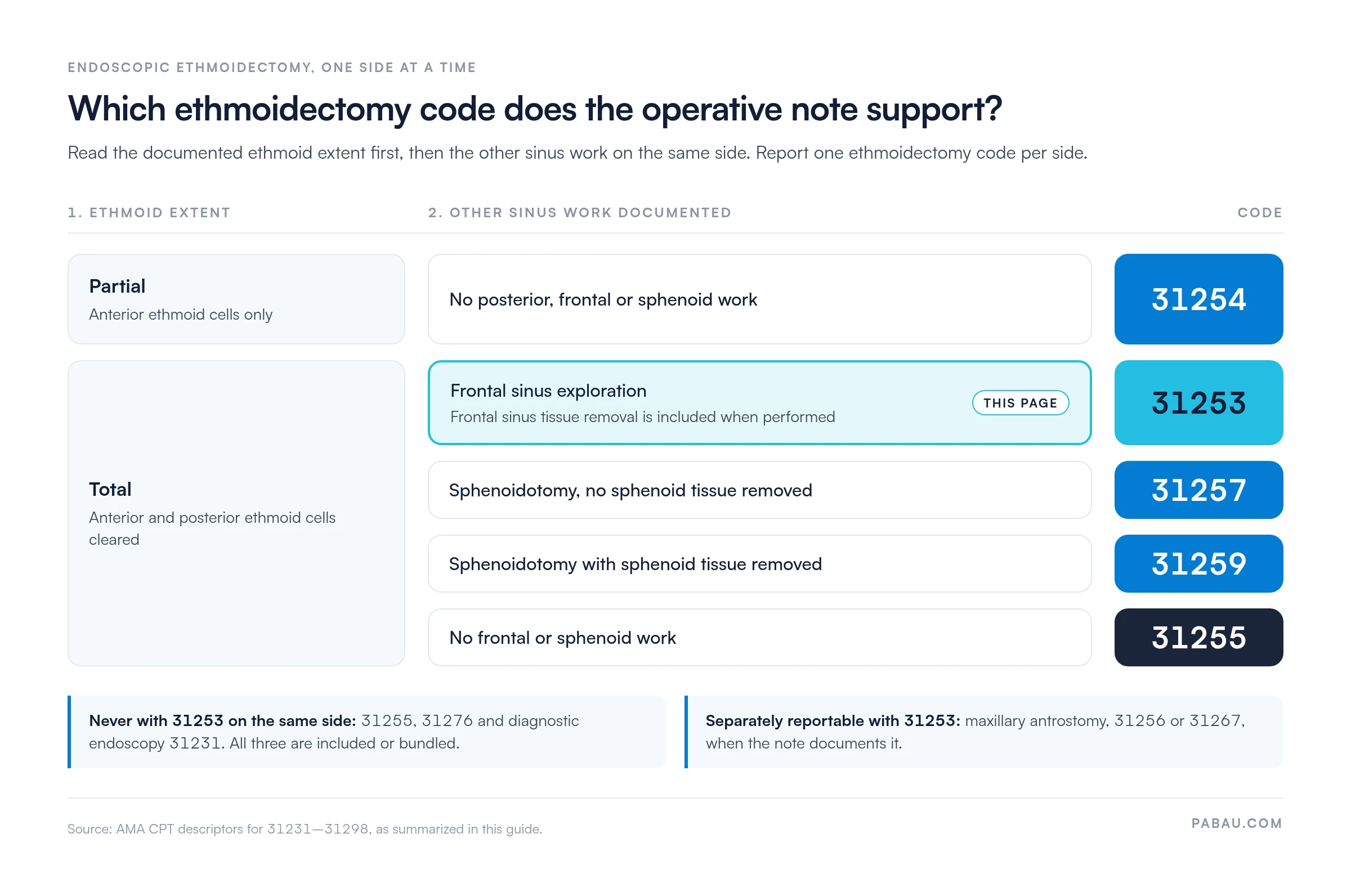
Medical necessity for CPT code 31253 hinges on an appropriate chronic sinusitis or nasal polyp diagnosis. Payers expect the ICD-10-CM code to match the anatomical site documented in the operative note. An ethmoidectomy supported only by maxillary sinusitis (J32.0) without corresponding ethmoidal involvement is a predictable denial target.
All ICD-10-CM codes are updated annually on October 1. Verify each code against the current fiscal year’s tabular list before submitting. A code that was valid in FY 2024 may carry a revised descriptor or additional specificity requirement in FY 2025 or later.
The operative report is the primary claim support document for CPT code 31253. Incomplete documentation is one of the most common denial drivers. The surgical note may not confirm a total ethmoidectomy with frontal sinus exploration, or it may omit laterality. Just as often, the chart has no reference to pre-surgical medical management.
A complete operative note supporting clean claim submission for 31253 should include each of the following elements:
Payers conducting post-payment audits compare the operative note against the CPT descriptor word for word. A note that documents a total ethmoidectomy but no frontal sinus exploration supports only 31255. A note that says “ethmoidectomy” without stating the extent gives the auditor grounds to downcode to 31254 or deny entirely.
Before submitting a CPT code 31253 claim, run a documentation checklist against the operative note. Confirm it includes (1) the endoscopic approach, (2) total ethmoidectomy, (3) frontal sinus exploration, (4) laterality, (5) failed medical management, and (6) CT imaging. Flag any note missing items 2, 3 or 4 for a surgeon addendum before submission.
CPT code 31253 is an inherently unilateral procedure code. When the surgeon operates on both sides in the same session, bilateral billing rules apply. The modifier convention depends on the payer.
Verify bilateral modifier requirements with each commercial payer before submission. Sending modifier 50 to a payer that expects RT/LT, or the reverse, triggers a technical denial. That denial needs a resubmission, not a simple appeal.
The National Correct Coding Initiative (NCCI) bundles diagnostic nasal endoscopy (CPT 31231) into all surgical sinus endoscopy codes, including CPT code 31253. Billing 31231 separately in the same session generates an automatic NCCI edit rejection. The same bundling applies across every surgical FESS code.
NCCI edits are updated quarterly by CMS. Any specific code-pair bundling statement should be verified against the current CMS NCCI table rather than a static reference. Key bundling principles for 31253:
ENT surgeons commonly perform multiple sinus procedures in a single operative session. Bill the most extensive ethmoidectomy code once per side. Then add separate codes for distinct sinus sites when the operative record supports each one independently.
When CPT code 31253 is the primary ethmoidectomy code, it can be reported alongside maxillary antrostomy codes (31256 or 31267) in the same session. Each additional procedure must be documented separately in the operative note. Medicare applies its endoscopy-family rule to these codes. The highest-valued endoscopy pays 100%, and each further code in the family pays its value minus the 31231 base value.
Prior authorization requirements for CPT code 31253 vary by payer and plan. The payer type tells your team where to check, so triage authorization before you book the surgery date.
Sound medical billing compliance means confirming authorization status when the surgery is scheduled, well before the day of the procedure. A missing PA is a common, preventable denial reason for 31253 claims, and a pre-scheduling check stops it.
Medicare payment amounts for CPT code 31253 are set annually through the Medicare Physician Fee Schedule (MPFS). The figures below reflect reported Medicare national values. Verify current amounts using the CMS Physician Fee Schedule lookup tool for your MAC jurisdiction and fee schedule year before quoting any amount.
Use the FastRVU lookup tool to check current work, practice expense, and malpractice RVU components for 31253 by fee schedule year. Commercial rates for 31253 are negotiated separately and may be multiples of the Medicare allowable depending on the contracted rate.
Six denial patterns come up most often in CPT code 31253 rejections. Each has a specific root cause and a corresponding fix that prevents the denial from recurring.
Tracking medical billing denial codes by reason across your FESS claims reveals which of these patterns is most common in your practice. Denial management workflows that sort rejections by root cause let you fix the process upstream. That beats appealing one claim at a time.
Review 31253 denial patterns quarterly. Sort denied claims by remark code, then group by root cause. If more than 20% of 31253 denials share the same remark code, treat it as a workflow problem. Fix the intake or scheduling step upstream rather than appealing each claim individually.
ENT practices billing CPT code 31253 deal with documentation-heavy claims, bilateral modifier decisions, and multi-code same-session billing on a routine basis. Pabau, the practice management platform we build, handles that work through its claims management software. Its integration with the Claim.MD clearinghouse submits claims electronically to thousands of US payers and returns real-time eligibility results. It also processes 835 remittance files, so your team sees denial reasons without logging into multiple payer portals.
The revenue cycle management workflow in Pabau tracks each claim from submission to payment posting. It flags rejections with the remark codes your billing team needs to act quickly. For practices running high volumes of FESS procedures, that visibility helps shorten days in accounts receivable. It also keeps 31253 claims moving without manual follow-up on every case.

Pabau helps ENT practices submit clean FESS claims, track prior authorization status, and manage billing workflows from one platform. Connect with Claim.MD to reach thousands of US payers electronically.

CPT code 31253 pays for more work than 31255, and that extra value rests on one documented step: the frontal sinus exploration. If the operative note doesn’t record it, the claim supports only 31255. Build a pre-submission check for ethmoid extent, frontal work and laterality, and the most common 31253 denials stop before they reach the payer.
Pabau’s claims management and Claim.MD integration let ENT billing teams submit 31253 claims cleanly and resolve rejections faster. They also show denial patterns by remark code. Book a demo to see how Pabau handles FESS billing workflows from documentation through payment posting.

Need guidance on medical billing denial workflows? Our denial management guide covers how to categorize, track, and resolve claim rejections systematically across ENT and surgical specialties.
Looking for clean claim submission best practices? The clean claim guide explains the exact elements payers validate before processing a claim, including modifier and diagnosis code matching requirements.
Want to understand the Claim.MD clearinghouse? Our Claim.MD clearinghouse overview explains how electronic claim submission, ERA processing, and real-time eligibility work for US practices billing CPT codes.
Billing frontal sinus work on its own? CPT code 31276 covers frontal sinus exploration when no ethmoidectomy is performed.
Coding a diagnostic nasal endoscopy? CPT code 31231 explains when the diagnostic scope is billable and when it bundles into surgery.
CPT code 31253 covers endoscopic total ethmoidectomy with frontal sinus exploration. The descriptor reads “Nasal/sinus endoscopy, surgical with ethmoidectomy; total (anterior and posterior), including frontal sinus exploration, with removal of tissue from frontal sinus, when performed”. The surgeon clears both ethmoid compartments endoscopically and explores the frontal sinus. It is used for chronic sinusitis or nasal polyp disease that has not responded to medical treatment.
CPT 31254 covers a partial (anterior) ethmoidectomy only, with no posterior or frontal work. CPT 31253 requires a total ethmoidectomy, anterior and posterior, plus frontal sinus exploration. If the note shows a total ethmoidectomy without frontal work, the correct code is 31255, not 31253.
Yes, when the procedure is performed on both sides in the same session, bill 31253-50 on a single line for Medicare. Many commercial payers prefer 31253-RT and 31253-LT on separate lines. Confirm the bilateral modifier convention with each payer before submission, as submitting the wrong format results in a technical denial requiring resubmission.
The strongest medical necessity pairing is J32.2 (chronic ethmoidal sinusitis) as the primary diagnosis. J32.4 (chronic pansinusitis) and J32.0 (chronic maxillary sinusitis with documented ethmoidal involvement) are also acceptable. J33.0 or J33.9 may be added as secondary codes when nasal polyps are present and documented in the operative note.
Medicare payment amounts for CPT 31253 change annually with the Physician Fee Schedule update. Verify the current non-facility and facility rates for your MAC jurisdiction using the CMS MPFS lookup tool. The work RVU is 8.78, and the total RVU varies by geographic adjustment factor.
The operative report must explicitly confirm the endoscopic approach, a total anterior and posterior ethmoidectomy, frontal sinus exploration, laterality, and CT imaging findings. The patient record must also document failed medical management (antibiotics and/or nasal steroids) before surgery. A note that omits the frontal sinus exploration supports only 31255.



