

HCPCS Code E0272: Foam rubber mattress billing guide
HCPCS Code E0272: official descriptor and code overview HCPCS Code E0272 is the ...

Last Updated: Nov 6, 2026
C1726 is the HCPCS Level II code for catheter, balloon dilatation, non-vascular. It reports the balloon catheter that widens a narrowed passage outside the blood vessels, such as the esophagus, bile duct or ureter.
Under OPPS, C1726 is a packaged device code with status indicator N in the October 2026 Addendum B listing. Its cost is bundled into the dilation procedure's APC payment, so the line is not paid separately. Its transitional pass-through status, granted in 2001, expired in the early 2000s.
Let Pabau's smart automation suggest the right codes, reduce claim denials, and keep your practice compliant—effortlessly.
Automate repetitive tasks and focus on what matters most—your patients.
Reduce coding errors and ensure compliance with the latest regulations.
Clean claims, fewer denials, and faster reimbursements.
Powerful insights and reporting to help your practice thrive.
HIPAA compliant SOC 2 certified GDPR-compliant Trusted by 4,000+ clinics worldwide

HCPCS code C1726 reports a non-vascular balloon dilatation catheter, the device used to widen a narrowed GI, biliary or urinary passage.
C1726 is a packaged device code with status indicator N, so it gets no separate OPPS payment. Its pass-through status ended in the early 2000s.
Report C1726 on the same hospital outpatient claim as the dilation procedure, and recheck its status indicator in each quarterly OPPS Addendum B.
Pabau’s billing software keeps device details and claims on one patient record, so the catheter line travels with its procedure.
HCPCS code C1726 is the CMS Level II code for a catheter, balloon dilatation, non-vascular. Hospitals report it when a balloon-tipped catheter widens a narrowed passage outside the blood vessels, such as the esophagus, a bile duct or a ureter.
Per the CMS HCPCS Level II code set, C-codes are reported on institutional outpatient claims. They are not CPT codes, and they do not belong on professional claims.
C1726 started life in 2001 as one of the original transitional pass-through device categories. That status expired in the early 2000s. Today CMS packages the catheter’s cost into the payment for the dilation procedure, so the C1726 line carries no separate payment.
The table below summarizes the key attributes of the code.
C1726 carries status indicator N (packaged) in the October 2026 OPPS Addendum B. CMS can change it in any quarterly update, so recheck each quarter.
C1726 covers the balloon dilatation catheter itself when it is used outside the vascular system. The code applies when the device meets these characteristics.
The code does not cover the following:
When a device does not match the descriptor exactly, find the correct HCPCS code before the claim goes out. A balloon tissue dissector, for example, belongs under C1727. A mismatched C-code distorts the cost data CMS uses to set procedure rates, and it can surface in a RAC or MAC audit.
C1726 is reported alongside the CPT code for the dilation procedure. The CPT code describes the service, and C1726 records the catheter used to perform it. For esophageal dilation during EGD, that pairing is usually CPT 43249 plus C1726.
Typical non-vascular dilation procedures include the ones below. The CPT examples are common pairings, not a fixed list, so confirm each one against the operative note.
Vascular angioplasty is not C1726 territory. Those catheters fall under C1725 and related codes, so check the descriptor on the device label before you assign one.
On the UB-04, the procedure code and C1726 belong on the same claim. Hospitals typically report the catheter under a supply revenue code, such as 0272 (sterile supply) or 0270 (general classification), per their chargemaster and MAC guidance.
C-codes were created for the OPPS framework. CMS uses them to capture device costs on hospital outpatient claims, which is why the care setting decides whether C1726 belongs on a claim.
When a hospital outpatient department reports C1726, the claim is filed on the UB-04 and adjudicated under OPPS. The catheter line typically processes with no separate payment. That is expected for a packaged code, and it is not a denial.
Pass-through payment is a CMS mechanism that pays separately for new, costly devices for a limited period, on top of the procedure’s APC rate. C1726 was one of the original device categories CMS created for it in 2001.
That status was transitional by design. Pass-through for C1726 expired in the early 2000s, and CMS then folded the catheter’s cost into the procedure payments. C1726 is not on the current list of devices with pass-through status (status indicator H).
How the code works today:
Followed through one esophageal dilation claim, the path looks like this.
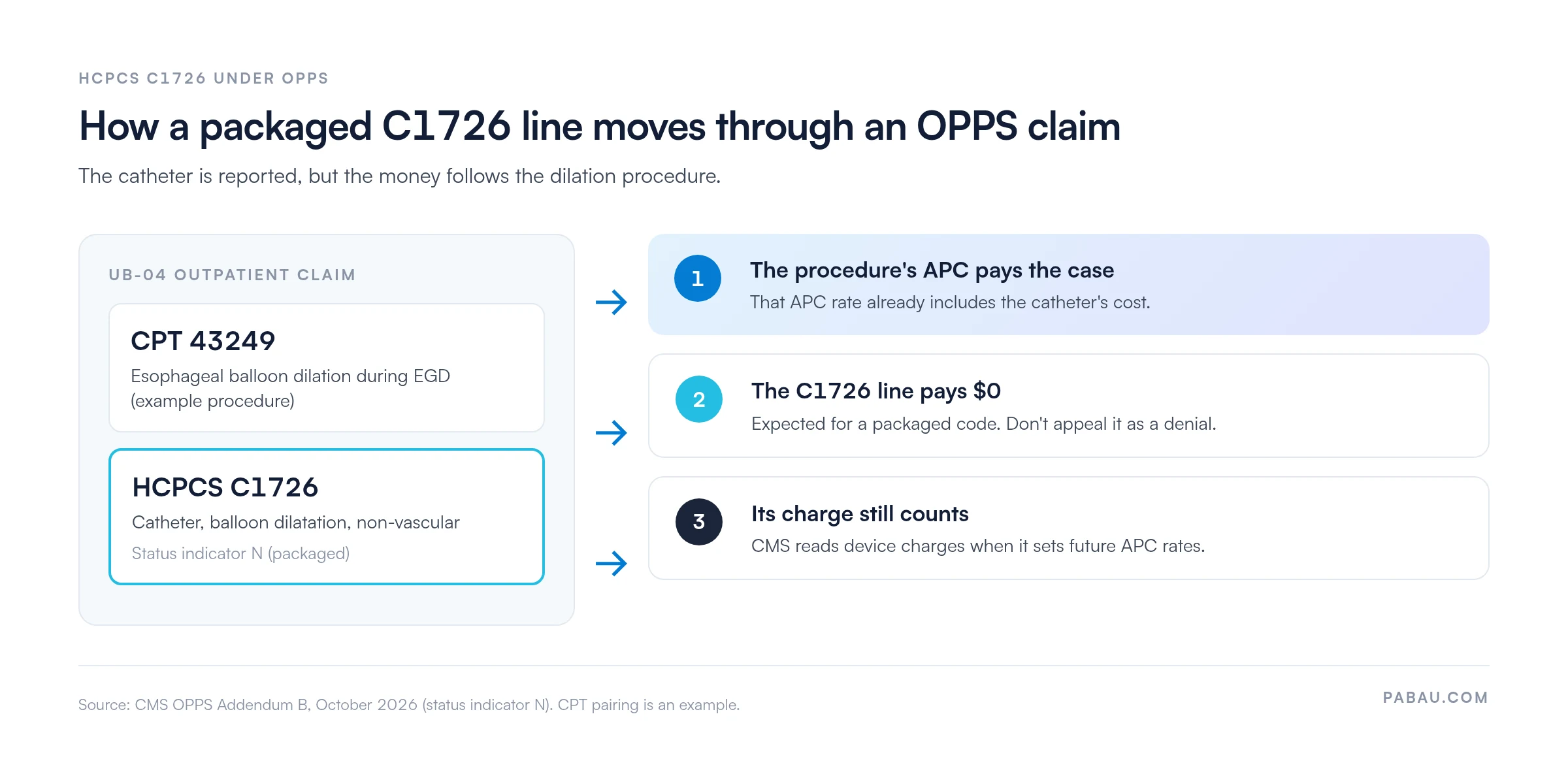
Because the line is packaged, there is no C1726 dollar amount to chase. Payment questions belong to the procedure’s APC. The October 2026 OPPS Addendum B lists C1726 with status indicator N (packaged). CMS can change it in any quarterly update, so recheck each quarter before you build billing rules around it.
C1726 and C1713 are both HCPCS Level II C-codes reported on hospital outpatient claims, but they describe very different devices. Both sit near the start of the C-code device range, so they turn up side by side in code lookups and chargemaster files.
The distinction matters because the two codes represent structurally different devices used in different procedures. Reporting one in place of the other is a descriptor mismatch, and auditors treat it as a coding error. Verify each code’s exact CMS descriptor against the AAPC HCPCS Level II code lookup or the official CMS HCPCS file before billing.
Medicare OPPS claims that include HCPCS code C1726 follow standard institutional outpatient claim rules. The hospital must be enrolled as an OPPS provider. The claim goes on a UB-04 with the correct revenue code, and the device documentation stays on file.
Prior authorization requirements vary by payer and by the underlying procedure. Some Medicare Administrative Contractors (MACs) and commercial payers set coverage criteria for endoscopic or urologic dilation. Key payer requirements to verify in advance include:
Billing teams that track eligibility and prior authorization in software built for claims reduce the risk of a C1726 claim failing a payer’s coverage criteria. The check happens before the procedure date rather than after the denial arrives.
The documentation for HCPCS code C1726 must establish three things. The catheter was used during a covered outpatient procedure, it matches the C1726 descriptor, and the procedure met medical necessity requirements.
Required documentation elements:
C1726 is a packaged line, so a modifier will not unlock separate payment for it. Run National Correct Coding Initiative (NCCI) checks on the procedure codes instead, where bundling edits can still cost you money.
Before billing HCPCS code C1726, run a short pre-submission check. Confirm the operative note names a non-vascular balloon dilatation catheter, and that the dilation CPT code sits on the same UB-04. Then confirm the status indicator in the current OPPS Addendum B. A zero-paid C1726 line on a packaged code is expected, so don’t appeal it.
The diagnosis on a C1726 claim explains why the passage needed dilating. The codes below are common examples, not a complete list, so always code from the clinical record.
Pick the most specific code the documentation supports. A stricture with hydronephrosis, for example, takes a different code from N13.5.
C1726 problems cluster around a predictable set of errors. Because the line is packaged, most of them cost money through the procedure line or through bad cost data, not through the C1726 line itself. Strong denial management processes for device codes stop these patterns from recurring.
When a C1726 claim comes back with problems, start the clean claim review with the claim type and the procedure line. Those two checks resolve most issues without a full medical record review. For recurring edits on the procedure line, check the denial codes in medical billing tied to the edit. Then document the modifier rationale in the clinical record.
Device lines go wrong at the point of capture. The catheter sticker sits on a paper sheet, the operative note sits in another system, and the coder sees neither.
Pabau, the practice management platform we build, keeps treatment notes, consent forms and custom device fields on one patient record. Staff record the catheter type, size and lot number while the case is still open.
Pabau’s claims management tools sit on that same record. The coder builds the claim from the documented case, so the catheter line goes out with the procedure it belongs to.
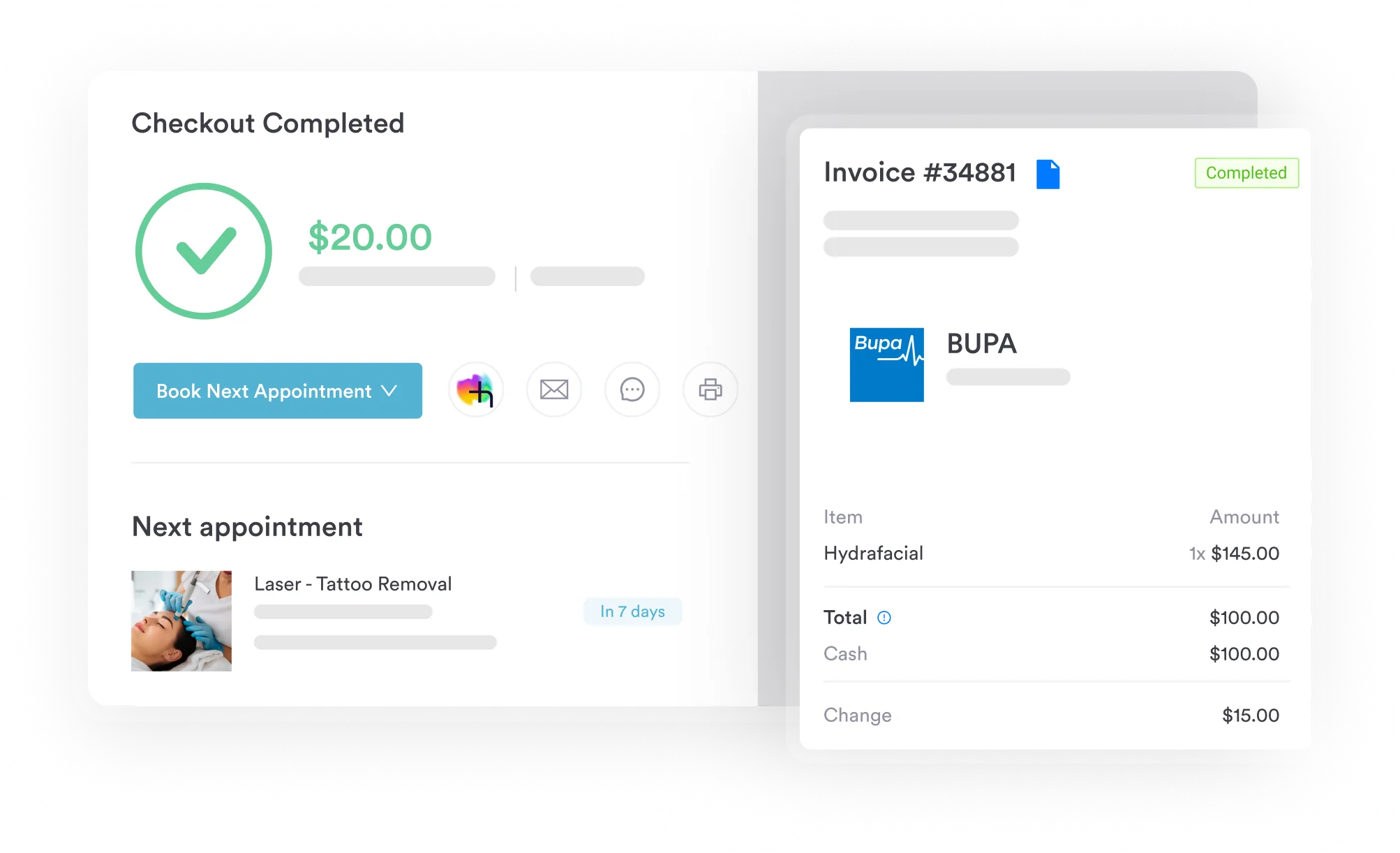

Pabau brings treatment notes, custom device fields and claims onto one patient record. Your team documents the catheter once, so coders and auditors find it without chasing paper.

C1726 will not change your OPPS payment for a dilation procedure, because the catheter’s cost is packaged into the procedure. Treat any guide that promises a separate pass-through payment for it as out of date. The code’s value now lies in accurate cost data and a clean audit trail.
Build the habit into your chargemaster and your coding checks. Confirm the status indicator each quarter, keep the catheter on the same claim as its procedure, and let a zero-paid line stand. Book a demo to see how Pabau keeps device details, notes and claims on one patient record.

Need to understand how OPPS claims move through the revenue cycle? What is revenue cycle management covers the end-to-end process from patient encounter to final payment posting.
Working through a high volume of OPPS claim denials? Electronic remittance advice explains how to read ERA 835 files to identify and categorize denial patterns efficiently.
Want a reference on compliant institutional billing practices? Medical billing compliance outlines the documentation and coding standards that keep hospital outpatient claims audit-ready.
HCPCS code C1726 covers a catheter, balloon dilatation, non-vascular. It reports the balloon catheter used to widen a narrowed passage outside the blood vessels, such as the esophagus, a bile duct or a ureter. Hospitals report it on institutional outpatient claims under OPPS.
No. C1726 is a packaged device code, so its cost is included in the payment for the dilation procedure. Hospitals still report it on the UB-04 with the procedure code, because device charges feed CMS rate-setting. It carries status indicator N in the October 2026 OPPS Addendum B.
C1726 covers a non-vascular balloon dilatation catheter. C1713 covers an anchor or screw implant used for bone-to-bone or soft tissue-to-bone fixation. Both are HCPCS Level II C-codes reported on hospital outpatient claims, but they describe structurally different devices. Substituting one for the other is a descriptor mismatch and can lead to a denial or audit finding.
C1726 is reported with non-vascular dilation procedures. Common examples include esophageal dilation during EGD, biliary or pancreatic duct dilation during ERCP, and ureteral stricture treatment during ureteroscopy. Confirm each pairing against the operative note and any applicable LCD before billing.
Most C1726 problems come from billing it on a professional claim, separating it from its procedure, or a descriptor mismatch. Procedure lines that fail medical necessity criteria also cause denials. A zero-paid C1726 line is usually not a denial, because the code is packaged.
No. C1726 was one of the original transitional pass-through device categories created in 2001, and that status expired in the early 2000s. It is not on the current pass-through device list (status indicator H). The October 2026 OPPS Addendum B lists it with status indicator N (packaged).
No. C-codes, including C1726, are reported on institutional claims from hospital outpatient departments. Physician offices bill under the Medicare Physician Fee Schedule, which does not use C-codes. Billing C1726 on a professional claim (CMS-1500) leads to a rejection or denial.
The official source is the CMS HCPCS Level II code set, which CMS updates quarterly. For payment status, use the OPPS Addendum B, which lists each code’s status indicator. Commercial tools such as the AAPC HCPCS code search also show the descriptor, but the CMS files are the authority for billing.




