

CCSD code G5100: Bypass of duodenum billing guide
CCSD code G5100 bills a bypass that leaves the duodenum in place CCSD code G5100...

Last Updated: Oct 16, 2026
CPT code 31276 covers a surgical nasal/sinus endoscopy with frontal sinus exploration, with or without removal of tissue from the frontal sinus. The surgeon works through the frontal recess and explores the frontal sinus under endoscopic view. Tissue removal is optional, so an exploration with nothing taken still qualifies.
The frontal sinus is the hardest sinus to reach, and payers look closely at claims for it. Medicare assigns the code a 0-day global period, and most commercial payers want prior authorization first. Getting the anatomy, the side and the code pair right is what turns a 31276 claim into a payment. The sections below follow that claim from operative note to payment.
Let Pabau's smart automation suggest the right codes, reduce claim denials, and keep your practice compliant—effortlessly.
Automate repetitive tasks and focus on what matters most—your patients.
Reduce coding errors and ensure compliance with the latest regulations.
Clean claims, fewer denials, and faster reimbursements.
Powerful insights and reporting to help your practice thrive.
HIPAA compliant SOC 2 certified GDPR-compliant Trusted by 4,000+ clinics worldwide

CPT code 31276 reports endoscopic frontal sinus exploration, with or without tissue removal, and applies only to the frontal sinus.
The operative note must show frontal recess entry, exploration of the frontal sinus, any tissue removed, and the side treated.
Bilateral cases take modifier 50 or paired RT and LT lines, depending on what the payer accepts.
CPT 31276 carries a 0-day (000) global period under Medicare, and commercial payers commonly require prior authorization.
Never report 31276 with 31253 on the same side, because a total ethmoidectomy already includes frontal sinus exploration.
CPT code 31276 is a surgical nasal/sinus endoscopy with frontal sinus exploration, with or without removal of tissue from the frontal sinus. It sits in the endoscopy section for the accessory sinuses of the AMA’s CPT code set.
In plain clinical terms, an otolaryngologist uses an endoscope to pass through the frontal recess and explore the frontal sinus. The surgeon may remove polyps, diseased mucosa, or bony partitions, but doesn’t have to. An exploration with no tissue taken still supports the code.
Here is what CPT 31276 covers at a glance:
Coders often reach for 31276 when the note says “FESS with frontal involvement.” Read further first. If the surgeon only worked in the ethmoid or maxillary sinuses, 31276 doesn’t apply.
A note that says “frontal sinus addressed” won’t survive an audit. Here is the sequence a billable 31276 note should walk through.
Steps 2 and 3 are the anchors. Without them, auditors will question why 31276 was chosen.
Payers deny vague 31276 notes fast. A clean claim for this code needs each element below in the record.
If your surgeons use templated operative notes, add prompts for frontal sinus exploration and the side treated. A generic “FESS completed” line won’t hold up under payer review.
Ask surgeons to add one standard line to every frontal sinus note. It should name the frontal recess, the frontal sinus explored, the side, and any tissue removed. That one line answers the three questions payers ask most.
The frontal sinus code sits in a crowded family of endoscopic sinus codes. Picking the wrong neighbor is the most common FESS coding error. The table shows the codes most often confused with 31276.
The 31276 vs 31267 mix-up costs the most. CPT 31267 is a maxillary antrostomy with tissue removed from the maxillary sinus. CPT 31276 is frontal sinus exploration, with or without tissue removal. When the surgeon treats both sinuses in one session, both codes may be reported, subject to bundling and modifier rules.
The 31276 vs 31296 distinction comes up when the surgeon uses a balloon. CPT 31296 is frontal sinus ostium dilation by balloon. Its siblings are 31295 for the maxillary sinus and 31297 for the sphenoid. If tissue was also removed from the frontal sinus, check current NCCI edits before billing both.
The panel below shows how to work through a frontal case one side at a time.
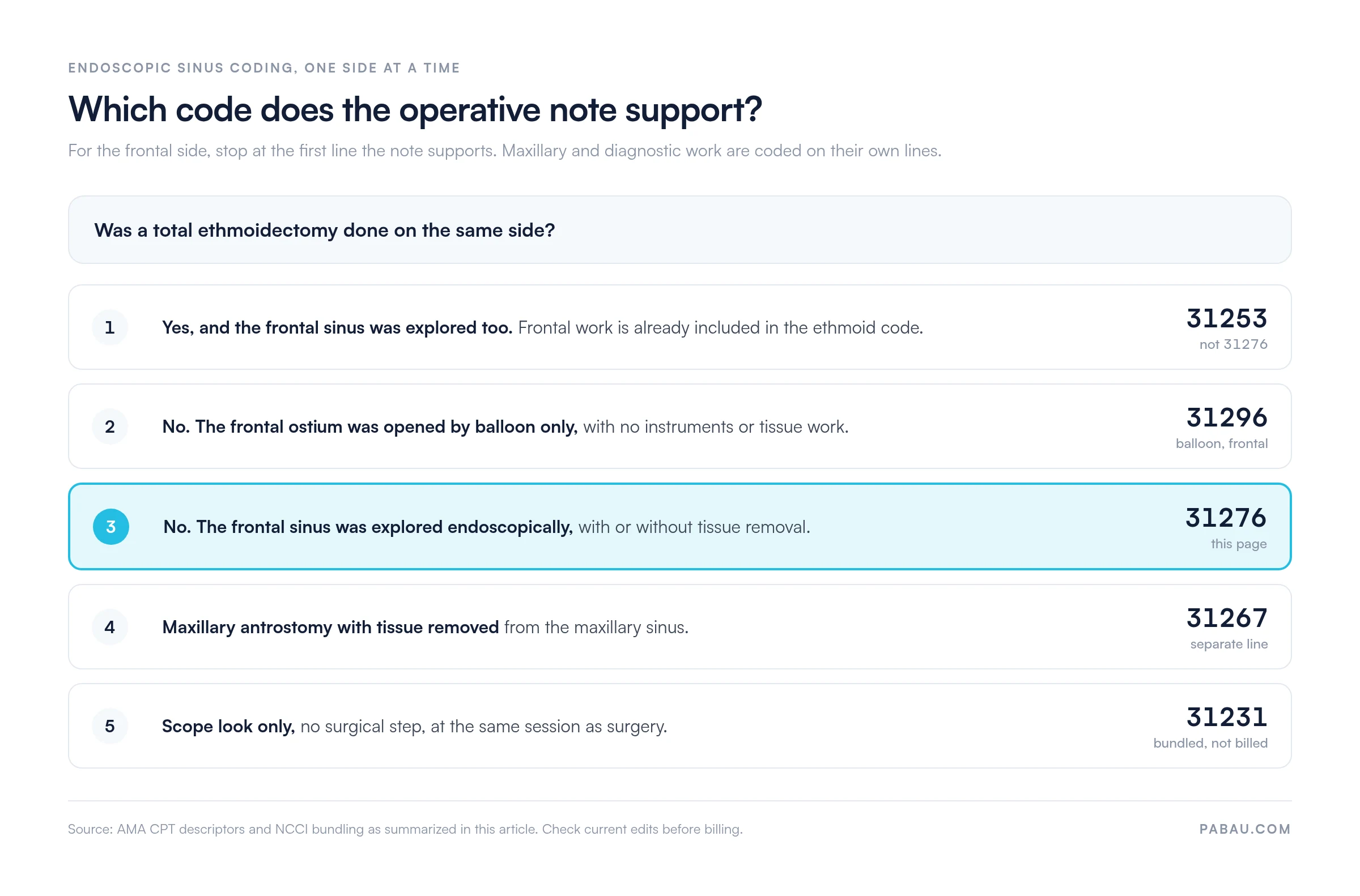
The National Correct Coding Initiative (NCCI) decides which sinus codes bundle into 31276. Payment for each code then follows the CMS Medicare Physician Fee Schedule.
Codes you can’t bill with 31276 on the same side:
Codes that may be billed separately, with the right modifier:
NCCI edits update every quarter. Treat the guidance here as general principles, and check the current CMS NCCI Policy Manual before you submit.
Your modifier depends on the side, the case’s complexity, and what else happened in the session. A wrong or missing modifier is a direct path to denial.
Billing a bilateral case: Medicare accepts 31276 with modifier 50 on one line and pays 150% of the unilateral allowable. Many commercial payers want two lines instead, one with RT and one with LT. Check the payer’s rules before you choose.
Two setups always fail. Billing 31276 twice with no modifier gets denied. So does sending modifier 50 to a payer that wants RT and LT.
Medicare sets payment for CPT 31276 through the CMS fee schedule, which updates every January. The figures below are general parameters. Check the current-year rate before you quote it to a surgeon or submit a claim.
Use the FastRVU 2026 RVU lookup tool to pull the current work, practice expense, and malpractice RVUs for 31276. Then apply your locality’s GPCI to get the Medicare allowable for your area.
Most 31276 claims follow the same path. Each handoff is a point where it can stall.
A two-minute review catches most 31276 errors. Run it on every claim, and keep the superbill lined up with the note.
Frontal sinus claims draw denials because the documentation rules are specific and the code is easy to mix up. Keep a list of common denial codes handy to read remittances fast.
Audit your 31276 claims every quarter. Pull the last 90 days, then sort denials by reason code. Fix the top reason first, whether it’s a missing modifier (CO-4), missing information (CO-16), medical necessity (CO-50), or no authorization (CO-197).
Prior authorization rules for CPT 31276 vary by payer type, plan, and state. Never assume either way. Confirm with the plan before scheduling surgery.
The diagnosis must justify surgery on the frontal sinus specifically. An acute or unspecified sinusitis code weakens the case when the record shows chronic disease.
No diagnosis code guarantees approval on its own. Payers weigh the full record, their own policy, and whether the code matches the documented condition. Use the most specific code the imaging and clinical notes support.
Many 31276 denials start with a claim keyed by hand from a scanned operative note. A missing authorization number or a mistyped side can sit unnoticed until the remittance comes back.
Pabau, the practice software our team builds for specialty practices, starts the claim from the patient record instead. Its claims software for practices pre-fills the CMS-1500, so the CPT and ICD-10 codes attached to the visit land on the claim. Built-in code libraries let your coder confirm 31276 and its diagnosis on the same screen.
The claim won’t send until required fields, such as the authorization number, are complete. US practices submit through Claim.MD to thousands of US payers, with real-time eligibility checks and ERA posting. So your team tracks each claim’s status without chasing payers by phone.
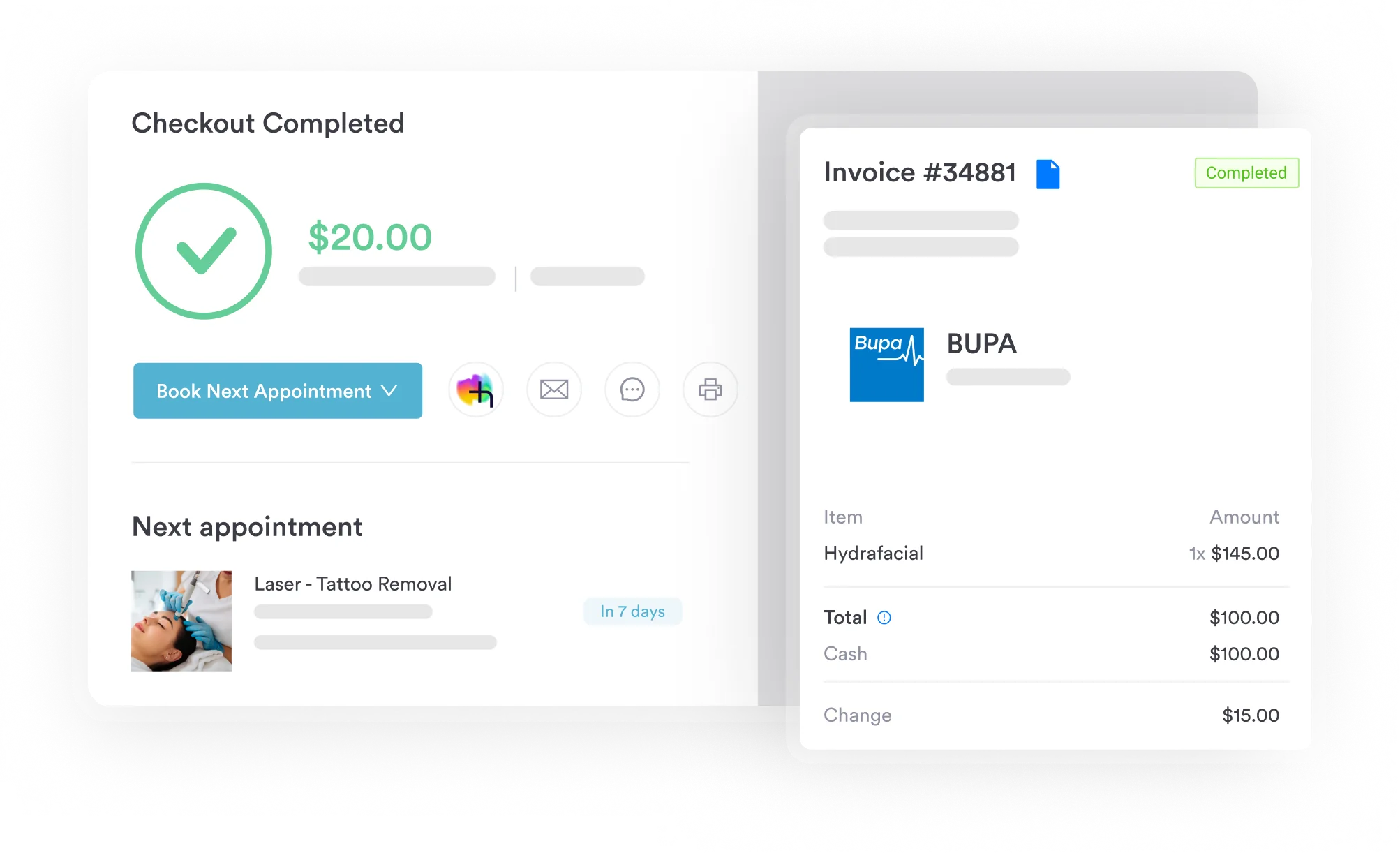

Pabau pre-fills each claim from the patient record and holds it until required fields are complete. US practices submit through Claim.MD and track every claim’s status.

CPT 31276 rewards precision. Get the frontal anatomy, the side, and the code pair right in the note, and most denials never happen.
Start with the operative note template. Add a line for frontal sinus exploration and one for the side. Then check every 31276 claim against 31253 and 31231 before it goes out. That review adds a minute per case, which is far cheaper than an appeal.
Book a demo to see how Pabau pre-fills and tracks your sinus surgery claims straight from the patient record.

Need a framework for managing high-denial surgical codes? Denial management in healthcare covers systematic workflows for reducing claim rejections across surgical billing.
Want to understand how clearinghouses validate CPT claims? How medical claims clearinghouses work explains eligibility checks and claim validation before a payer sees the claim.
Looking to streamline ENT superbill documentation? Superbill documentation guide covers what belongs on a surgical superbill and how to connect operative findings to submitted CPT codes.
Worried about audit exposure on surgical codes? Medical billing compliance walks through the records and controls that keep a coding team audit-ready.
New to the revenue cycle side of ENT? What is medical billing explains how a claim travels from the encounter to the payment posted.
No. The descriptor reads frontal sinus exploration, with or without removal of tissue from the frontal sinus. An exploration with no tissue taken still supports 31276. The note must show the surgeon reached and explored the frontal sinus itself.
The sinus. CPT 31276 is frontal sinus exploration, with or without tissue removal. CPT 31267 is a maxillary antrostomy with tissue removed from the maxillary sinus. Both can be billed at one session when the note documents work in each sinus.
Medicare lists CPT 31276 with a 0-day global period, shown as 000. Pre- and postoperative work on the day of surgery is included in the payment. There is no 90-day postoperative window, so visits on later days are not bundled into the procedure.
Not on the same side. CPT 31253 is a total ethmoidectomy that already includes frontal sinus exploration, so report 31253 alone for that side. If the other side had frontal work only, 31276 can apply there with the matching side modifier.
Usually, yes. Add-on code +61782 covers computer-assisted navigation and is reported once per session. Medicare packages it into the facility payment, and commercial payers set their own coverage rules. Document that navigation was used.



