HCPCS Code J1110: Dihydroergotamine mesylate injection billing guide
HCPCS Code J1110: Official descriptor and drug overview HCPCS Code J1110 is the ...

Last Updated: Oct 29, 2026
31298 is the CPT code for nasal/sinus endoscopy, surgical; with dilation of frontal and sphenoid sinus ostia (eg, balloon dilation). It applies when the frontal and sphenoid ostia on the same side are both dilated in one session.
Added to CPT in 2018, it is the combination code in a four-code balloon family. The others are 31295 for the maxillary ostium, 31296 for the frontal and 31297 for the sphenoid. Report 31298 instead of 31296 plus 31297 on the same side. When the maxillary ostium is also dilated, report 31295 alongside it.
Let Pabau's smart automation suggest the right codes, reduce claim denials, and keep your practice compliant—effortlessly.
Automate repetitive tasks and focus on what matters most—your patients.
Reduce coding errors and ensure compliance with the latest regulations.
Clean claims, fewer denials, and faster reimbursements.
Powerful insights and reporting to help your practice thrive.
HIPAA compliant SOC 2 certified GDPR-compliant Trusted by 4,000+ clinics worldwide

CPT code 31298 reports endoscopic dilation of both the frontal and sphenoid sinus ostia on the same side, replacing 31296 plus 31297 for that side.
Many commercial plans and some state Medicaid programs require prior authorization for 31298, and the approval should name this code rather than 31296 or 31297.
Medicare gives 31298 bilateral indicator 1, so modifier 50 pays 150% of the single-side fee schedule amount. Some commercial payers want RT and LT lines instead.
Pabau, the practice management platform we build, submits and tracks 31298 claims through Claim.MD once your coder has chosen the code.
CPT code 31298 describes “Nasal/sinus endoscopy, surgical; with dilation of frontal and sphenoid sinus ostia (eg, balloon dilation).” It is the only combination code in the 31295-31298 balloon dilation family, published in the American Medical Association CPT code set. The AMA added it for CY2018 because surgeons so often dilate these two ostia together.
The code covers two sites on one side of the nose: the frontal sinus ostium and the sphenoid sinus ostium. It has no maxillary component.
If only one of the two ostia is dilated, report 31296 for the frontal or 31297 for the sphenoid instead. When the maxillary ostium on that side is dilated as well, report 31295 in addition to 31298.
Balloon ostial dilation uses a flexible catheter advanced endoscopically into the target sinus. Once positioned at the sinus ostium, a small balloon is inflated to widen the natural drainage pathway. Fluoroscopic or image guidance may be used to confirm catheter placement. The technique is distinct from traditional functional endoscopic sinus surgery (FESS) because it does not remove tissue.
The operative report must document each sinus site accessed, the side, and the dilation technique applied. For 31298, it must show that both the frontal and the sphenoid ostia on the same side were dilated. Coders cannot assume a site was treated unless the operative note describes it explicitly.
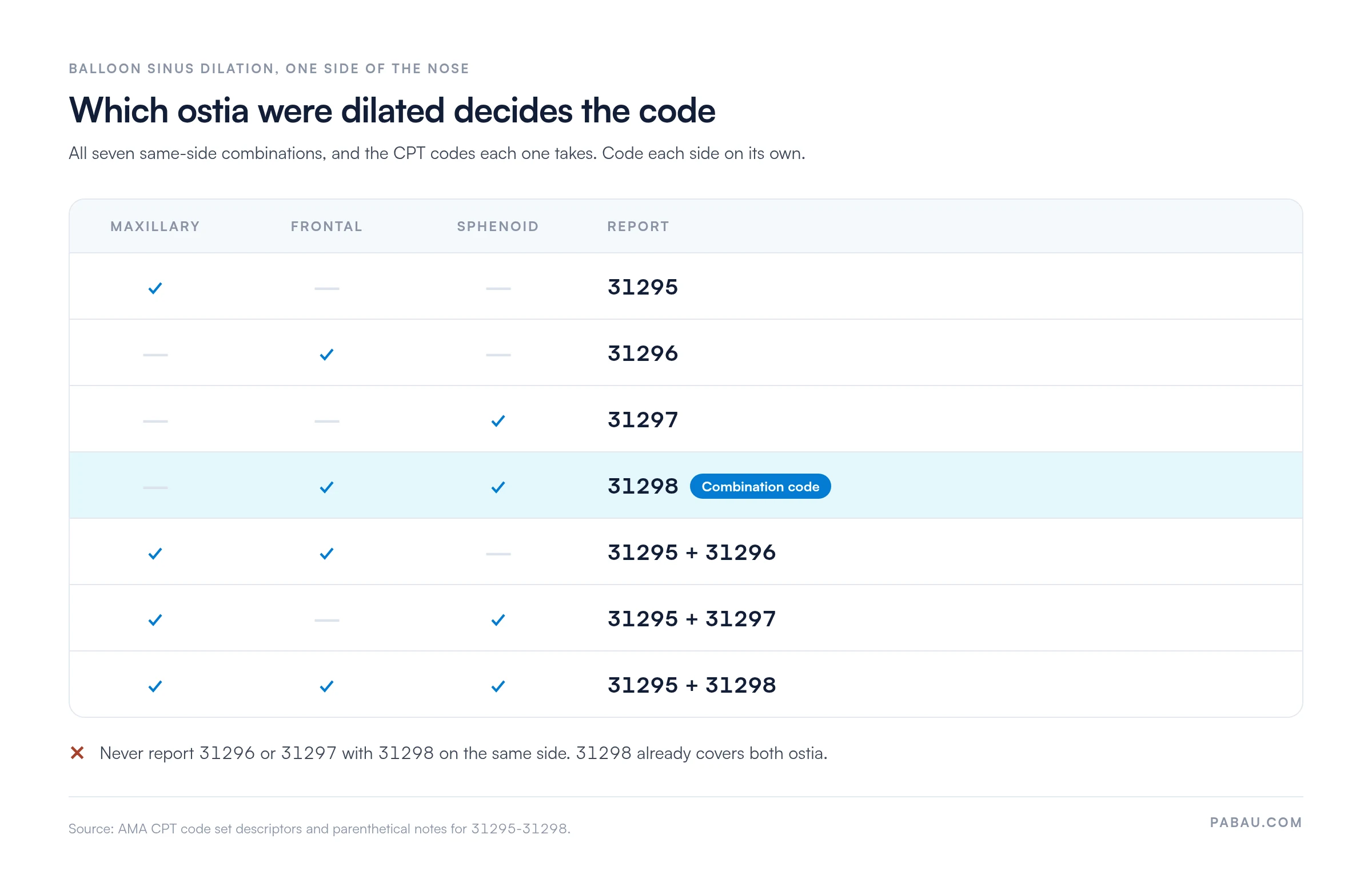
The four codes in this family are told apart by which sinus ostia were dilated on each side, not by technique. Three cover a single ostium, and 31298 covers the frontal and sphenoid ostia together.
Key rule: 31298 replaces 31296 and 31297 when both are dilated on the same side. The CPT parenthetical bars reporting 31296 or 31297 with 31298 on that side.
It does not replace 31295, because 31298 has no maxillary component. Frontal, maxillary and sphenoid dilation on one side is therefore 31295 plus 31298. The matrix below maps all seven same-side combinations to the codes they take.
Reporting 31298 with 31296 or 31297 on the same side and date of service will trigger a National Correct Coding Initiative (NCCI) edit. The same applies to conventional frontal and sphenoid procedures on that side. Examples are 31276 for frontal sinus exploration and 31287 or 31288 for sphenoidotomy.
Pairing 31298 with 31295 on the same side is allowed. Check the current CMS NCCI procedure-to-procedure edits before submitting claims with more than one sinus endoscopy code.
CPT 31298 bilateral billing applies when the surgeon dilates the frontal and sphenoid ostia on both the left and right sides in the same session. The correct claim format depends on the payer.
Always confirm the bilateral billing policy in the payer’s provider manual before claim submission. A wrong modifier format usually leads to a denial that a corrected claim can resolve without a formal appeal.
The CMS Medicare Physician Fee Schedule publishes the allowed amounts for CPT 31298 each year. The values below come from the CY2026 relative value file (October release, RVU26D). Use the FastRVU lookup tool to apply the geographic adjustment for your locality.
Commercial payer rates are set by contract and often differ from Medicare. Practices using claims management software can post each ERA against its claim and compare expected and received payments per code. A 31298 payment below the contracted rate then shows up as soon as the remittance arrives.
Check the place of service before billing 31298. The CY2026 fee schedule gives it 88.79 total RVUs in the office but 6.46 in a hospital or ASC. A wrong place-of-service code shifts the Medicare payment by thousands of dollars per claim.
Prior authorization for CPT 31298 depends on the payer. Many commercial plans and some state Medicaid programs require it for balloon sinus dilation, while traditional Medicare generally does not. Insurance eligibility verification should confirm the auth rule when the procedure is scheduled, not on the day of service.
Approvals are usually code-specific, so an approval for 31296 or 31297 alone may not cover 31298. Name each planned code on the prior authorization form, including 31295 when the maxillary ostium may also be dilated. If the operative plan changes and a different code becomes appropriate, reauthorize before proceeding where possible. Otherwise, document the intraoperative finding that changed the approach.
Pairing 31298 with an ICD-10 diagnosis code that does not match the sinus sites in the operative report is a common claim error. Because 31298 covers the frontal and sphenoid ostia, the diagnoses on the claim should support disease at those two sites.
For 31298, the usual pairing is J32.1 with J32.3, or J32.8 or J32.4 where the documentation supports them. Avoid J32.9 when a site-specific code is supported by the clinical record. Some payer coverage policies treat it as insufficient to establish medical necessity for balloon dilation.
Medical billing compliance for surgical sinus procedures requires a complete pre-operative and operative record. Submitting a clean claim begins with ensuring every required document exists before the procedure date, not after the denial arrives.
Each denial reason below traces back to a step that can be checked before the claim goes out. A structured denial management workflow builds those checks into scheduling, coding and submission. Check common denial codes in your ERA files to identify patterns specific to your payer mix.
Run a quarterly audit of 31298 claims against your ERA denial codes. If site mismatches or bundling edits appear in your top five denial reasons, schedule a coder education session on this code family. Corrected claims resolve these error types faster than appeals.
Coding errors on 31298 tend to begin in the operative note. A single-site note gets coded as the combination code, or a frontal and sphenoid case gets split into 31296 and 31297. Pabau keeps clinical notes, uploaded CT reports and treatment history on one patient record for the coder to check.
Once the coder has chosen the code, Pabau’s claims management pulls the data already on the record into a pre-filled claim. It then submits and tracks that claim through Claim.MD, our US clearinghouse integration, and posts the remittance when the ERA arrives.
Pabau does not select CPT codes or obtain authorizations. Your team keeps that decision, and Pabau keeps the finished claim moving and visible.
The result is fewer claims lost between the procedure room and the payer, and a denial list your team can sort by reason code.

Pabau’s claims management submits and tracks ENT claims through Claim.MD and posts remittances, so your team can follow each 31298 claim from submission to payment.

Code 31298 from the operative note, never from the surgical plan. A note naming both the frontal and sphenoid ostia on one side supports 31298, and a maxillary dilation on that side adds 31295. A note naming only one of them belongs to 31296 or 31297.
The rest of the payment risk sits upstream of coding. Confirm the payer’s auth rule and bilateral format at scheduling, and match every ICD-10 code to a sinus the note says was treated.
Pabau’s claims management tracks each sinus dilation claim through Claim.MD and posts the remittance against it, so a short payment surfaces early. To see that workflow on your own ENT claims, book a demo with the team.

Need to verify what your clearinghouse sends on an ENT claim? Understanding the 837 claims file explains the electronic transaction format used to transmit CPT and diagnosis code data to payers.
Getting denials with no clear reason code? Electronic remittance advice (ERA) explained breaks down how to read 835 remittance files and act on adjustment reason codes.
Want a structured approach to reducing balloon sinuplasty write-offs? Revenue cycle management for medical practices covers the end-to-end workflow from eligibility check to final payment posting.
Planning an auth request for a sinus procedure? The prior authorization process walks through each step from the payer check to the approval.
CPT code 31298 describes surgical nasal/sinus endoscopy with dilation of the frontal and sphenoid sinus ostia, usually by balloon. It is reported when both ostia on the same side are dilated in one session. It has no maxillary component, so a maxillary dilation is reported separately with 31295.
Yes, Medicare covers CPT 31298 when medical necessity is established through documentation of chronic rhinosinusitis unresponsive to conservative therapy. Traditional Medicare generally does not require prior authorization for this code, but complete clinical documentation must be available for audit. Reimbursement rates are published annually in the Medicare Physician Fee Schedule.
Yes. Medicare gives 31298 bilateral surgery indicator 1, so bill one line with modifier 50 and one unit. Medicare then pays 150% of the single-side fee schedule amount, or the billed charge if lower. Some commercial payers require two lines with RT and LT modifiers instead.
Required documentation includes a pre-operative CT of the paranasal sinuses and office notes showing at least 12 weeks of failed conservative therapy. The operative report must name the side, show that both the frontal and sphenoid ostia were dilated, and confirm patency afterward. Missing or mismatched documentation is a common cause of post-payment audit recoupment.
31298 can be billed with 31295 on the same side, because 31298 has no maxillary component. It cannot be billed with 31296 or 31297 on the same side, since it already covers both of those ostia. On the opposite side, code that side’s sites on their own with RT or LT modifiers.