

HCPCS Code L0472: Hyperextension TLSO billing guide
HCPCS code L0472: Official descriptor and device definition HCPCS code L0472 des...

Last Updated: Nov 5, 2026
28485 is the CPT code for open treatment of metatarsal fracture, includes internal fixation, when performed, each. It is reported once per metatarsal treated through an incision, from the 1st to the 5th, whether or not plates, screws or wires were placed.
The code carries a 90-day global period. Closed and percutaneous treatment of the same fracture is coded 28470, 28475 or 28476 instead, and great-toe phalanx fractures use 28490 to 28505.
Let Pabau's smart automation suggest the right codes, reduce claim denials, and keep your practice compliant—effortlessly.
Automate repetitive tasks and focus on what matters most—your patients.
Reduce coding errors and ensure compliance with the latest regulations.
Clean claims, fewer denials, and faster reimbursements.
Powerful insights and reporting to help your practice thrive.
HIPAA compliant SOC 2 certified GDPR-compliant Trusted by 4,000+ clinics worldwide

CPT code 28485 covers open treatment of a fracture of any metatarsal, 1st through 5th, and is reported once per fractured metatarsal.
Great-toe phalanx fractures use their own codes: 28490, 28495 or 28496 for closed or percutaneous treatment, and 28505 for open treatment.
A 90-day global period applies, so routine post-op E&M visits are bundled and cannot be billed separately during that window.
Most payers want modifier LT or RT. A second or later metatarsal treated open in the same session also needs modifier 59 or XS.
Pabau’s claims management software checks claims for missing or invalid details, verifies eligibility through Claim.MD, and attaches prior authorizations at booking.
CPT code 28485 is defined by the American Medical Association’s CPT code set as: Open treatment of metatarsal fracture, includes internal fixation, when performed, each. “When performed” means the code applies whether or not fixation hardware was placed, as long as the approach was open. “Each” means it is reported once per fractured metatarsal.
“Open treatment” means a skin incision was made to directly visualize and reduce the fracture. That separates it from closed manipulation performed through intact skin. Internal fixation refers to hardware placed during surgery: plates and screws, Kirschner wires (K-wires), or an intramedullary nail. The code covers any metatarsal, from the 1st to the 5th.
Knowing which components of CPT code 28485 are bundled and which are separately reportable prevents both under-coding and NCCI bundling violations. The global surgical package already wraps a defined set of services into the base payment.
Bone graft harvested through a separate incision is easy to miss as a separately billable service. If the operative note documents it, report CPT 20900 or 20902 in addition to 28485. NCCI edit pairs change during the year, so check them each quarter and confirm payment indicators in the CMS Physician Fee Schedule lookup tool.
The metatarsal fracture codes run from 28470 to 28485, and the great-toe codes 28490 to 28505 sit right next to them. Picking the wrong one is a costly documentation error in foot fracture billing. The deciding variables are approach (open or closed), whether manipulation was performed, and the anatomical site.
Confusing closed and open treatment is a commonly flagged audit error in foot fracture billing. The decision path below follows the operative note one question at a time.
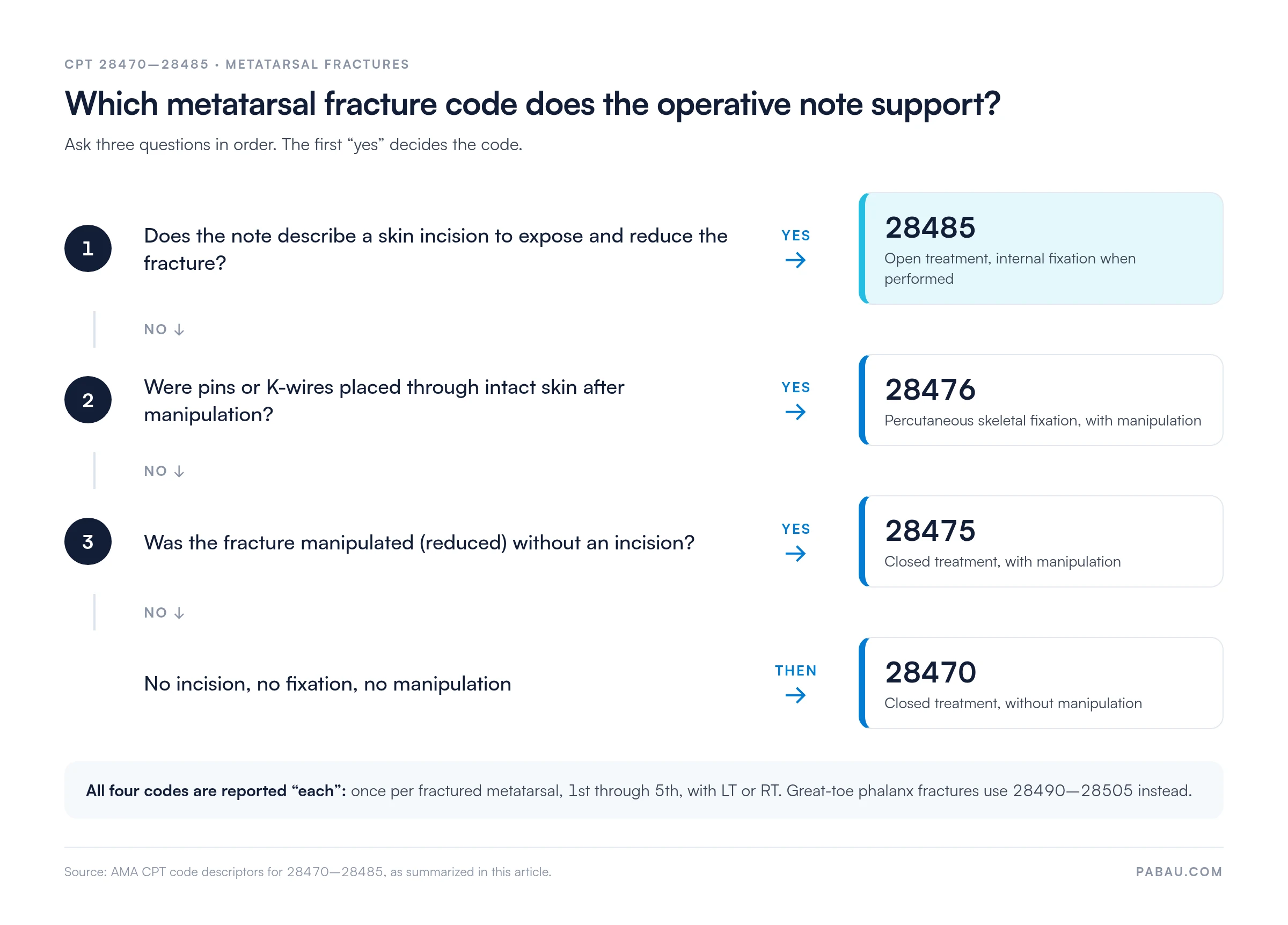
For 28485 to be supportable, the operative note must describe a skin incision. If the surgeon performed closed manipulation only and the note mentions no incision, code 28475 or 28476. That holds whatever fixation was used.
Flag every operative note where the procedure description uses ‘percutaneous’ or ‘closed’ alongside K-wire placement. Percutaneous K-wire insertion is not open treatment and should be coded 28476, not 28485. Misidentifying the approach is a common cause of downcoded or denied claims in this code family.
Payers reviewing CPT code 28485 claims expect the operative note to confirm several elements before paying at the open-treatment rate. Missing one of them can lead to a CO-50 denial (not medically necessary as documented). Good medical billing compliance starts with knowing what the auditor’s checklist contains.
Submitting a clean claim for CPT code 28485 requires all documentation to be in the system before the claim leaves the practice. A clear operative note template for metatarsal ORIF procedures standardizes documentation across surgeons and reduces retrospective audit exposure.
Metatarsal fracture ICD-10-CM codes fall under category S92.3, which covers metatarsals 1 to 5. S92.31- codes the 1st metatarsal, S92.32- through S92.35- the 2nd through 5th, and S92.30- an unspecified metatarsal. Three variables must match the operative note exactly: laterality, displacement status, and encounter type.
The 7th character “A” applies to the initial surgical encounter and to any visit that is active treatment. Use “B” instead when the fracture itself was open, meaning the injury broke the skin. Open treatment does not turn a closed fracture into an open one.
Follow-up visits use “D” for routine healing, “G” for delayed healing, “K” for nonunion, and “P” for malunion. A routine post-op visit for a displaced right 2nd metatarsal fracture, for example, is coded S92.321D. The CDC/NCHS ICD-10-CM system updates the codes every October 1. Check laterality and displacement codes against the current fiscal year’s tables before submission.
Wrong or missing modifiers are a primary denial trigger on CPT code 28485 claims. Each modifier serves a specific function and needs its own documentation support.
When two or more metatarsal fractures need open treatment in the same session, CPT code 28485 is reported once per metatarsal treated. That follows from the word “each” in the descriptor. Getting it wrong triggers both underpayment and NCCI violations.
Correct billing sequence for two metatarsals (same session, same foot):
Three metatarsals treated open in the same session follow the same pattern. The third unit of 28485 again carries modifier 59, and its payment also drops to 50%. The 100%/50%/50% structure is the Medicare multiple surgery rule in the Medicare Claims Processing Manual, Chapter 12, section 40.6.
The global surgery period for CPT code 28485 is 90 days, beginning the day after the operative date. During that window, routine post-operative evaluation and management (E&M) services are bundled into the procedure payment and cannot be billed separately.
Billing routine post-op visits without a modifier during the 90-day global period is commonly flagged in surgical audits. Start a global period tracker for every CPT code 28485 claim on the day of surgery, not retrospectively.
Medicare reimbursement for CPT code 28485 is calculated from relative value units (RVUs) set annually in the Medicare Physician Fee Schedule (MPFS). Rates vary by geographic practice cost index (GPCI), so the figures below are approximate national values from the FastRVU 2026 RVU lookup tool. Verify them on the CMS PFS search tool for your locality before you rely on them.
These figures reflect CMS payment to the physician or surgeon only and exclude facility fees paid to the ASC or hospital. Commercial payers typically reimburse at a multiple of the Medicare rate, commonly 110% to 200% depending on the payer contract.
Prior authorization (PA) requirements for CPT code 28485 depend on payer type. Traditional Medicare (fee-for-service) does not require PA for surgical fracture repair in most cases. Medicare Advantage plans are a different matter. CMS lets MA plans require prior authorization for services that traditional Medicare covers without it, and many do for orthopedic surgery.
Thorough insurance eligibility verification before surgery should include a check on whether the patient’s specific plan requires PA for surgical codes in the 28xxx range. The documentation typically requested includes:
For Medicaid, PA requirements vary significantly by state managed care organization. Commercial insurers often require PA for surgical procedures above a defined complexity threshold. Missing or expired prior authorization is a commonly flagged denial reason for 28485 claims, especially where no one tracks authorizations systematically.
Build a PA checklist for CPT code 28485 that your scheduling team completes at surgical booking, not on the day of surgery. Capture the PA number, approval date, and expiration date in the patient’s record. An expired PA discovered after surgery is one of the most preventable revenue leaks in orthopedic billing.
Systematic denial management workflows for CPT code 28485 start with the CARC (Claim Adjustment Reason Code) that comes with each rejection. Each denial type has a distinct corrective action.
CO-97 is a frequent denial on CPT code 28485 claims. It means “the benefit for this service is included in the payment/allowance for another service or procedure that has already been adjudicated.” The usual cause is a post-op visit billed during the global period. Another cause is a separately reportable code, such as a bone graft harvest, sent without the modifier that unbundles it.
For codes outside this table, our CARC reference for billers maps each adjustment reason to the corrective action.
Podiatric and orthopedic practices billing CPT code 28485 tend to lose money at three points. Claims go out with missing details, eligibility is checked too late, and prior authorization isn’t tracked when the surgery is booked. Purpose-built claims management software catches these before submission rather than after a denial.
Pabau, the practice management platform we build, scrubs every claim for missing or invalid details before it leaves the system. US claims go out as CMS-1500s through Claim.MD to thousands of payers. Insurance eligibility verification runs through Claim.MD before the visit, so coverage problems surface ahead of the surgery date.
Each prior authorization is stored in Pabau as a case. Attach the case when booking the surgery, and the authorization code follows the appointment through to the claim. If a claim still comes back rejected, Pabau flags it as Needs action so your billing team can correct it.

Pabau checks each claim for missing or invalid details, verifies eligibility through Claim.MD, and attaches prior authorizations at booking. Your billing team spends less time reworking denied foot surgery claims.

The incision decides a 28485 claim. If the operative note shows one over a named metatarsal, report 28485 once per bone with laterality and distinct-procedure modifiers. If it doesn’t, code closed or percutaneous treatment, however much hardware went in.
The cheapest fixes sit upstream of the claim. A standard operative note template and an authorization check at booking head off most of the denial scenarios in this guide. Start the 90-day clock on the surgery date, and follow-up visits stop leaking into rejected claims.
Want claim validation, eligibility checks and authorization cases in one billing workflow for your foot surgery claims? Book a demo to see how Pabau handles it.

Need to understand how clearinghouse validation works? Medical claims clearinghouse guide explains how claims are scrubbed, transmitted, and adjudicated before reaching the payer.
Working through a denied surgical claim? Denial codes in medical billing maps CARC and RARC codes to corrective actions for common surgical procedure denials.
Want a step-by-step on submitting 837P claims electronically? 837 file guide covers the electronic transaction standard for professional claims, including loop and segment requirements.
Planning authorization before the surgery date? Prior authorization process walks through each step from request to approval.
Billing a larger graft alongside the fracture repair? CPT code 20902 covers major or large bone graft harvest and how it differs from 20900.
CPT code 28485 covers open treatment of a fracture of any metatarsal, 1st through 5th, and includes internal fixation when performed. It is reported once per fractured metatarsal. It includes the skin incision, fracture exposure, reduction, hardware placement when performed, intraoperative imaging, and wound closure. Great-toe phalanx fractures use their own codes, 28490 through 28505. Bone graft harvest and deep implant removal are reported separately.
CPT 28470 covers closed treatment of a metatarsal fracture without manipulation, while CPT 28485 requires an open surgical approach with a skin incision. The operative note is the deciding document. If no incision is described and the fracture was managed non-operatively, 28470 applies. If the surgeon opened the fracture site, 28485 is correct regardless of whether hardware was placed.
The global period for CPT code 28485 is 90 days, beginning the day after surgery. All routine post-operative E&M visits related to the fracture repair are bundled into the procedure payment during that window. Visits for unrelated conditions may be billed separately with modifier 24, and return-to-OR complications use modifier 78.
Traditional Medicare does not require prior authorization for CPT 28485 in most cases. Medicare Advantage plans frequently do, and commercial insurers and Medicaid managed care organizations typically require PA for surgical procedures. Always verify PA requirements with the patient’s specific plan before scheduling the procedure, not on the day of surgery.
Yes, CPT code 28485 can be billed for both feet in the same session, though bilateral foot surgery in one session is uncommon. Report 28485 with modifier LT on one claim line for the left foot. Report 28485 with modifier RT on a second line for the right foot. Some payers also want modifier 51 or 59 on the second line, so check each payer’s policy. The second procedure is typically paid at 50% under the multiple-procedure reduction.
Not always. ORIF (open reduction internal fixation) implies that fixation hardware was placed, while CPT 28485 covers open treatment and includes internal fixation when performed. If the surgeon opened the fracture, reduced it, and stabilized it with a cast rather than hardware, 28485 is still the correct code. The phrase “when performed” in the descriptor means fixation is not required to bill this code.
The most common denials are an open-approach code billed when the operative note describes a closed approach, and missing or expired prior authorization (CO-15). ICD-10 laterality or displacement mismatches (CO-11) and routine post-op visits billed during the 90-day global period (CO-97) are also frequent. Each has a distinct corrective action, from re-coding to modifier correction to appeal with supporting records.



