ICD-10 Code S42.444P: Medial epicondyle fracture, right humerus
ICD-10 Code S42.444P: full descriptor and code validity ICD-10 Code S42.444P car...

Last Updated: Oct 13, 2026
Billable Code Specific Code
S92.321D is the billable ICD-10-CM code for displaced fracture of second metatarsal bone, right foot, subsequent encounter for fracture with routine healing.
Coders get the 7th character wrong more often than any other part of this code. Bill S92.321A at a six-week follow-up and the payer reads it as initial-encounter care, then denies the line.
Let Pabau's smart automation suggest the right codes, reduce claim denials, and keep your practice compliant—effortlessly.
Automate repetitive tasks and focus on what matters most—your patients.
Reduce coding errors and ensure compliance with the latest regulations.
Clean claims, fewer denials, and faster reimbursements.
Powerful insights and reporting to help your practice thrive.
HIPAA compliant SOC 2 certified GDPR-compliant Trusted by 4,000+ clinics worldwide

ICD-10 code S92.321D describes a displaced fracture of the second metatarsal bone, right foot, at a subsequent encounter with routine healing.
The 7th character D applies to follow-up visits once the fracture is healing normally, and billing A instead is a leading denial cause.
S92.321D is billable for FY2026, the year running October 1, 2025 through September 30, 2026.
Subsequent encounter codes are exempt from Present on Admission reporting, so no POA indicator is needed on the claim.
Practice management software like Pabau keeps encounter type in the record, so coders pick the right 7th character without a provider query.
S92.321D is a billable, valid ICD-10-CM diagnosis code for FY2026. The table below summarizes the administrative attributes coders need before submitting a claim.
Verify billable status each year against the CMS ICD-10 codes page, since validity and descriptions can change with the fiscal year update. The CDC/NCHS ICD-10-CM web tool also gives year-specific tabular lookups from the official source.
ICD-10-CM fracture codes follow a hierarchical structure, and each segment of S92.321D encodes one clinical attribute. Coders who know the structure can build the correct code from the documentation instead of memorizing individual codes.
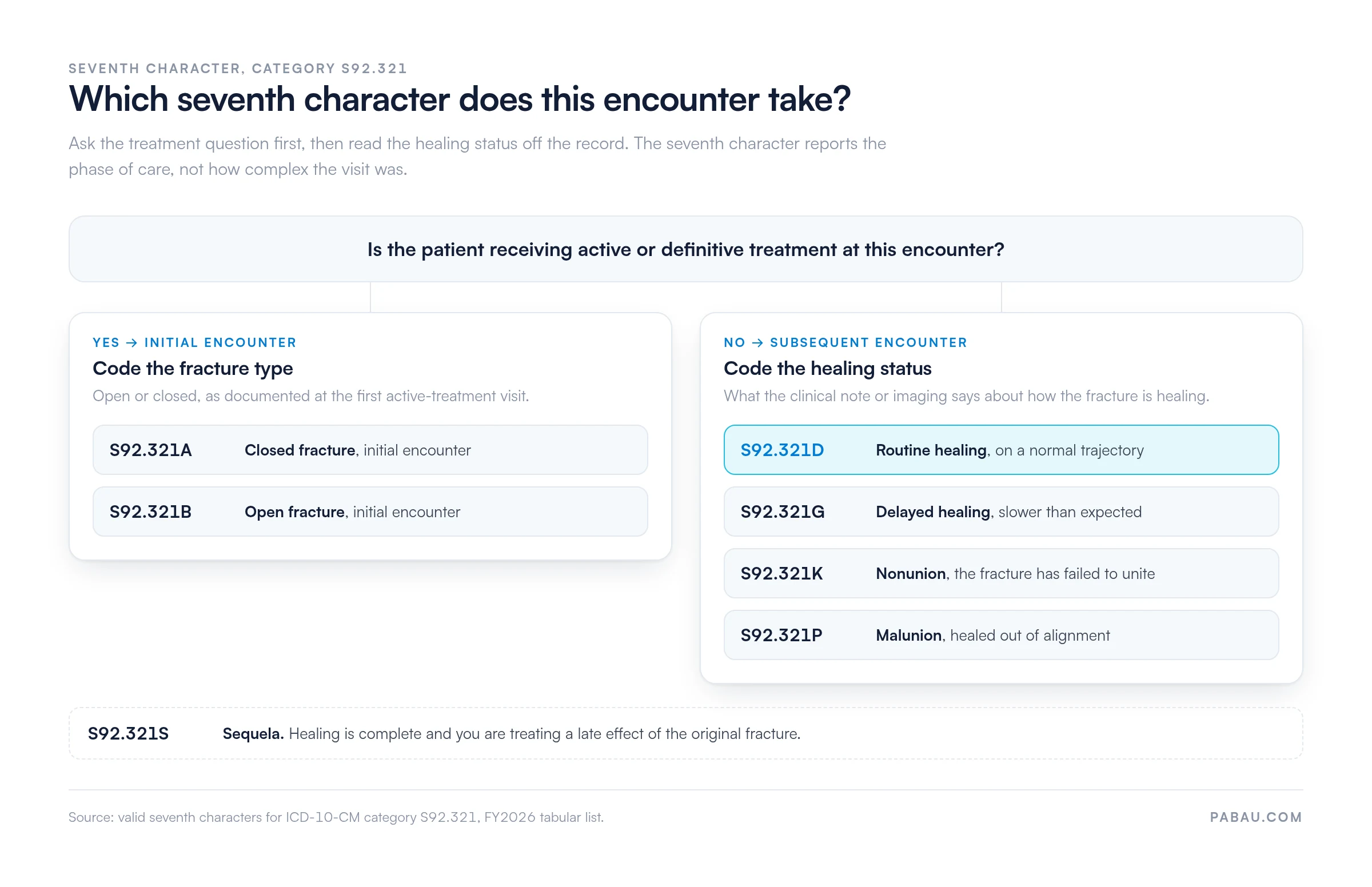
The parent code S92.321 is a non-billable header code, so it is not valid on a claim without a 7th character. Every claim carries the full 7-character code, and the 7th character has to match the encounter type and healing status in the record.
The ICD-10-CM Official Guidelines define a subsequent encounter as any visit after the patient has received active or definitive treatment. Care at that point is routine, during the healing or recovery phase.
Follow-up visits, cast checks, fracture care oversight, and physical therapy coordination all qualify, even when a different provider delivered the original treatment.
A wrong character here is one of the more preventable denials in fracture billing. Good denial management catches it at the coding stage rather than on appeal. All valid 7th characters for S92.321 are listed below.
Key distinction: D applies whenever the fracture is healing on a normal trajectory. Switch to G when imaging or clinical assessment shows delayed healing. Nonunion (K) and malunion (P) need documented radiographic or clinical findings behind them.
Using D where G, K, or P is more accurate understates the complexity of the care being given. Work the choice in that order, treatment question first, then healing status.
A displaced fracture of the second metatarsal is a break where the bone fragments have shifted out of normal anatomical alignment. The second metatarsal is the longest of the five and carries heavy load during gait, which makes it prone to traumatic and stress fracture alike.
Common causes include a direct crush injury, twisting trauma, or a high-energy impact. Laterality is a required documentation element. The right foot has to be stated in the initial assessment note and carried through every subsequent note.
The following clinical terms all map to ICD-10 Code S92.321D and may appear in operative reports, discharge summaries, or consultation notes:
Documentation has to support three elements before S92.321D can be used, and the checklist below sets them out. Per the ICD-10-CM Official Guidelines for Coding and Reporting, a subsequent encounter is any encounter after active treatment has been provided. The current provider does not have to be the one who delivered that treatment.
The 7th character reports the phase of care, not the severity of the visit. A complex follow-up with a new X-ray and a change in management still takes D, as long as healing is progressing normally. Only a documented complication moves the character to G, K, or P.
A referral note on its own is not enough to assign S92.321D. The treating clinician’s documentation at the encounter has to support every element above. If healing status is missing, query the provider before coding.
S92.321D is exempt from Present on Admission (POA) reporting. Subsequent encounter codes carry an inherent temporal component, because by definition the fracture occurred before the current encounter.
CMS therefore excludes them from the POA reporting requirement on inpatient claims. That removes one administrative step, though coders should still confirm their facility’s POA policies, since some payers add requirements beyond the CMS baseline.
MS-DRG assignment depends on the principal diagnosis, secondary diagnoses, procedures performed, and patient age and sex. The code alone never determines a DRG.
Where S92.321D is the principal diagnosis on an inpatient claim, it typically maps to the foot and ankle fracture groupings inside Major Diagnostic Category 8. Weights and groupings shift with each fiscal year update to the CMS MS-DRG Definitions Manual, so check the active version rather than a prior-year table.
S92.321D shows up far more often in outpatient settings, where MS-DRG does not apply at all. Outpatient claims for subsequent fracture encounters group under the Ambulatory Payment Classification (APC) system instead, which follows different clean-claim rules from inpatient DRG logic.
Track each patient’s fracture encounter type in the clinical record from day one. Label the initial visit clearly as ‘initial encounter, active treatment’ and document healing progression at every subsequent visit. When the record is clear, the coder can select the correct 7th character without a provider query – saving time on both sides of the encounter.
S92.321D sits inside a set of closely related codes that share the same clinical category. Coders working foot fracture encounters cross-reference these codes to confirm laterality, displacement status, and encounter type.
For code lookups and crosswalk verification, the AAPC Codify ICD-10-CM lookup gives free access to the full S92 category with DRG grouper integration.
Subsequent encounters for a displaced second metatarsal fracture usually involve evaluation and management, fracture care oversight, or an adjunctive procedure. The codes below are the ones most often paired with S92.321D at follow-up.
Check medical necessity pairing against the payer’s Local Coverage Determination (LCD) first, because coverage rules vary. Our CPT code reference covers the wider procedure-code families that foot and ankle follow-up visits draw on.
Global fracture care packages include routine follow-up visits within the global period, and CPT 28470 for closed treatment of a metatarsal fracture is one example. Say the initial treatment was billed under a global fracture care code. A separate E/M inside the global period then needs modifier -24, unless a specific exception applies.
Verify global period days with the ResDAC coding resources guide or the CMS Physician Fee Schedule before billing separately.
S92.321D arrived with the ICD-10-CM implementation and has been billable since ICD-10-CM replaced ICD-9-CM in October 2015. The code has stayed stable through the annual updates since.
Its FY2026 validity period runs from October 1, 2025 through September 30, 2026, as confirmed by the CMS and NCHS annual update process. Check the CDC/NCHS tabular list each October for revisions to the S92 category before the new fiscal year starts.
Set a calendar reminder each September to review the CMS ICD-10-CM FY update files for the S92 fracture category. Annual updates occasionally add, revise, or retire codes in this section. Catching a change before October 1 prevents billing errors on day one of the new fiscal year.
In a paper or split-system workflow, the encounter type lives only in the clinician’s narrative. The coder reads the note, works out whether active treatment already happened, then often queries the provider before the claim goes out. Every one of those queries is a day of aging on the account.
Practice management software like Pabau keeps the appointment, the treatment note, and the claim in one record. Pabau’s claims software for coders carries the diagnosis code from the note onto the claim. The 7th character then travels with the visit it describes, and billing staff can see at a glance which encounters already had active treatment.

The outcome is fewer follow-up claims going out with an initial-encounter character on them. Fewer denials means less rework for the billing team and faster payment on fracture care. Nobody has to chase a note to work out which visit came first.

Pabau helps podiatry and orthopedic teams manage ICD-10-CM coding, clean claim submission, and follow-up encounter tracking in one platform. See how it fits the way your practice already works.

The 7th character is a documentation problem before it is a coding problem. If the record names the phase of care and the healing status, S92.321D either fits or it does not. The coder never has to guess, and the claim goes out right the first time.
So the work worth doing sits upstream of the claim. Label the initial visit as active treatment while it is happening, then document healing progression at every follow-up. The correct 7th character falls out of a record kept that way, and a look at the S92 category each October keeps it current.
Book a demo to see how Pabau keeps encounter type and healing status in the record your coders bill from.

Need to understand how claims move from code to payment? What is revenue cycle management walks through every stage of the billing lifecycle, from coding to ERA reconciliation.
Submitting foot fracture claims electronically? 837 file guide explains how electronic claim files are structured and transmitted to payers via clearinghouse.
Getting claims denied on follow-up fracture visits? Denial codes in medical billing covers the most common CARC denial reasons and how to appeal or prevent them.
S92.321D is the ICD-10-CM diagnosis code for a displaced fracture of the second metatarsal bone, right foot, at a subsequent encounter. It applies while the fracture is healing with routine, normal progress. The code is valid for FY2026, from October 1, 2025 through September 30, 2026, and is billable for claim submission.
The 7th character D indicates a subsequent encounter for fracture with routine healing. Per the ICD-10-CM Official Guidelines, that is any visit after the patient has received active or definitive treatment. Care at that point is routine, during the healing phase. It contrasts with A for the initial encounter, and with G, K, and P, which report delayed healing, nonunion, and malunion.
Yes. S92.321D is a specific, billable ICD-10-CM code valid for claim submission in FY2026. The parent code S92.321 is not billable on its own, because the full 7-character code is required on every claim.
Yes. S92.321D is POA exempt. CMS excludes subsequent encounter codes from the POA reporting requirement, because these codes describe conditions that existed before the current encounter. Confirm your facility’s own POA policies, as some payers add supplemental requirements.
Use S92.321A for the initial encounter, where the patient receives active treatment for the displaced right second metatarsal fracture. Use S92.321D for every subsequent follow-up visit once that treatment has been delivered and the patient is healing routinely. Billing A on a follow-up visit is one of the most common causes of denial for foot fracture codes.
Key related codes include S92.322D for the same fracture in the left foot and S92.323D for an unspecified foot. S92.321G, S92.321K, and S92.321P report delayed healing, nonunion, and malunion. The full S92.3 subcategory covers all metatarsal bone fractures. The S92.31 to S92.39 range covers first through fifth metatarsals, with displacement and laterality variations.