CCSD Code H3334: Low anterior resection billing guide
CCSD Code H3334: Definition and clinical scope CCSD Code H3334 covers an open an...

Last Updated: Oct 16, 2026
28292 is the CPT code for hallux valgus correction (bunionectomy) with resection of the proximal phalanx base, when performed, any method. Surgeons know it as the Keller-type bunionectomy. The surgeon removes the base of the big toe's first bone to decompress and straighten the joint. A sesamoidectomy may be part of it, but it never decides the code.
What matters for coding is what 28292 leaves out. It has no metatarsal osteotomy, no joint fusion, and no phalanx osteotomy, so chevron, Lapidus, and Akin corrections belong to sibling codes. Read the operative note for the technique, then choose the code that names it. The code carries a 90-day global period.
Let Pabau's smart automation suggest the right codes, reduce claim denials, and keep your practice compliant—effortlessly.
Automate repetitive tasks and focus on what matters most—your patients.
Reduce coding errors and ensure compliance with the latest regulations.
Clean claims, fewer denials, and faster reimbursements.
Powerful insights and reporting to help your practice thrive.
HIPAA compliant SOC 2 certified GDPR-compliant Trusted by 4,000+ clinics worldwide

CPT code 28292 reports a Keller-type bunionectomy, where the surgeon resects the base of the big toe’s proximal phalanx.
No metatarsal osteotomy belongs in 28292. Chevron, Lapidus, Akin, and double osteotomy corrections each have their own code.
Sesamoidectomy is “when performed” in 28292 and in 28295 through 28299, so it never decides between them.
The code carries a 90-day global period, so separate post-op services need modifier 24, 58, 78, or 79.
Pair it with M20.11 or M20.12, and make the side match the operative note and any side modifier.
CPT code 28292 reports hallux valgus correction (bunionectomy) with resection of the proximal phalanx base, when performed, by any method. Surgeons still call it the Keller procedure. The surgeon removes the base of the big toe’s first bone, which decompresses the joint and lets the toe settle straighter.
The full descriptor also says “with sesamoidectomy, when performed.” That clause appears in every sibling code, so it tells you nothing about which one to pick. The AMA’s CPT code set removed eponyms like Keller from these descriptors in 2017. The technique stayed, now described in plain anatomical terms.
What sets 28292 apart is the bone it cuts. The work happens on the phalanx, and the first metatarsal is not cut. Keller-type resection is usually reserved for older, lower-demand patients or salvage cases.
Coders choose 28292 from the technique the surgeon documents. Complexity, time, and the bunion’s severity do not change the code. So before you assign it, find these points in the note:
Now look for what should not be there. A named metatarsal cut, such as a chevron or a basal osteotomy, points to another code. The same goes for a fusion of the first metatarsal and medial cuneiform. In those cases, 28292 is the wrong choice, however the note is titled.
Each of the six codes (28292 and 28295 through 28299) starts with the same hallux valgus wording. From there, each descriptor names a different primary technique, so the bone work in the note picks the code.
The decision path below starts from that bone.
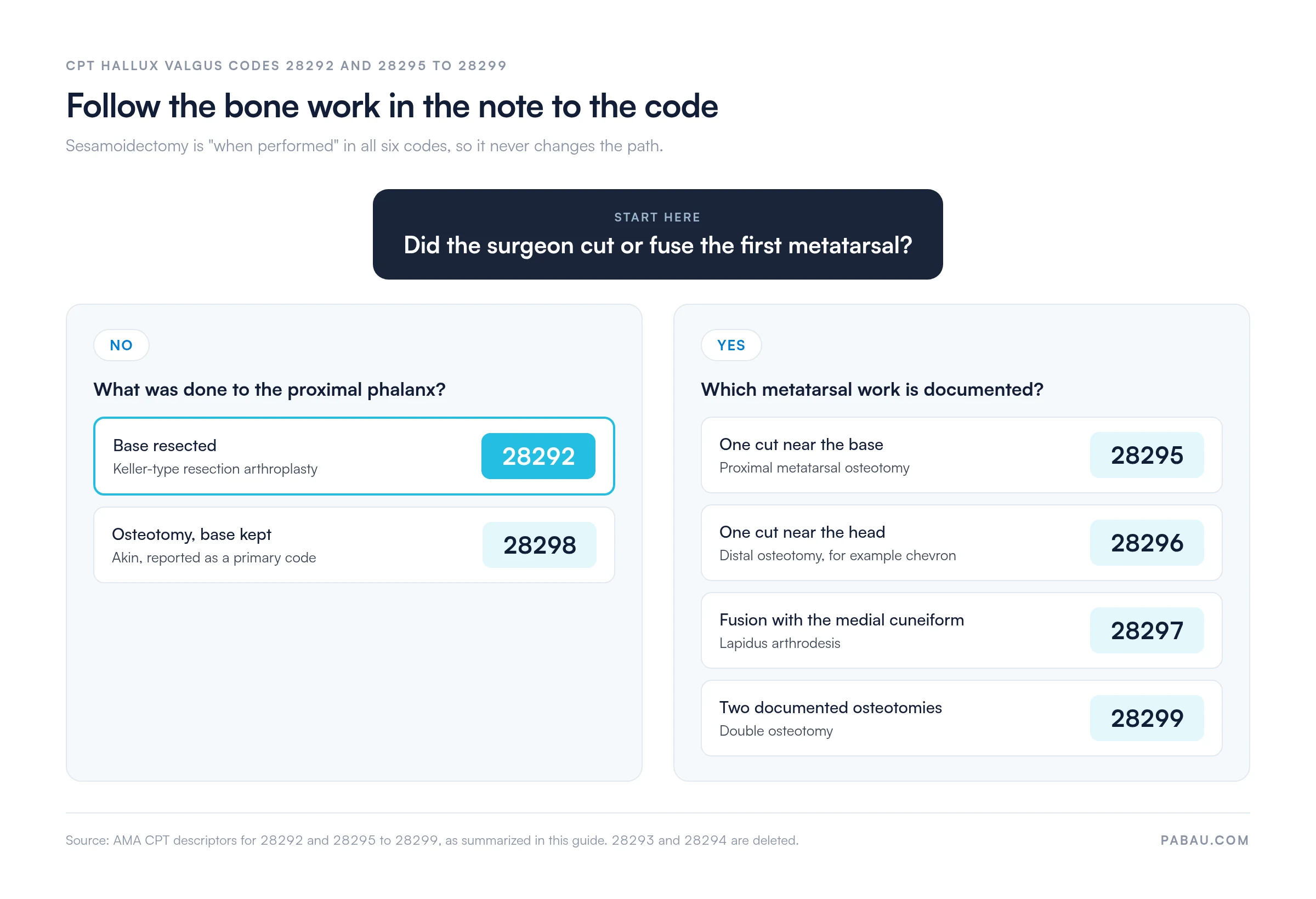
The table adds what sets each sibling apart from 28292.
Sesamoidectomy appears as “when performed” in all six codes. It can’t move a claim from one code to another.
The phalanx can mislead too. An Akin osteotomy cuts it without resecting the base, so that case goes to 28298. If the diagnosis is hallux rigidus rather than hallux valgus, review 28289 and 28291 before you settle on a code.
Payers check that the diagnosis side, the modifier, and the operative note agree. A right-foot procedure billed with a left-foot code is an easy denial.
Lead with M20.11 or M20.12 whenever the note supports it. The bunion codes add detail, but some payer policies won’t accept them alone for medical necessity.
Medicare prices 28292 with relative value units (RVUs) from the Physician Fee Schedule. The 2026 figures below use the $33.4009 conversion factor, before any locality adjustment. Confirm current values in the CMS Physician Fee Schedule lookup.
Those national figures are starting points. Your Medicare Administrative Contractor (MAC) locality shifts them up or down, and commercial contracts set their own rates.
Run the fee schedule lookup with your own MAC locality selected. The same 28292 claim pays differently in Manhattan and in rural Iowa because of GPCI differences.
Most 28292 modifier questions fall into two groups. Some modifiers tell the payer which foot or toe was treated. Others explain a service that lands inside the 90-day global period.
The National Correct Coding Initiative (NCCI) pairs 28292 with codes that it already includes. Edits change every quarter, so check the current CMS NCCI edit tables before each unusual claim.
When you override an edit with 59 or XS, the note must separate the procedures clearly. Auditors look for overrides that the documentation does not support.
The 090 global period covers routine aftercare from the surgery date. Wound checks, dressing changes, suture or wire removal, and related visits are not billed separately. Our guide to medical billing basics explains how global payments fit the wider claim cycle.
For a bilateral case done in one session, both globals start on the same date. Post-op notes should still name the foot being managed.
Traditional Medicare does not usually require prior authorization for 28292. Medicare Advantage, Medicaid managed care, and commercial plans often do, so check each payer before booking surgery.
Strong medical billing compliance starts in the pre-op chart. Coverage policies commonly ask for:
Required thresholds and timeframes vary by payer. Read the policy that applies to each patient instead of relying on a single rule of thumb.
Most 28292 denials repeat the same few errors. Good denial management fixes the cause at coding, not at appeal.
Track your denial codes by reason. Patterns show whether coding, documentation, or authorization needs attention.
Run through this list before releasing a clean claim for 28292.
Coders still decide between 28292 and its siblings, so that judgment stays with your team. The slower work comes after coding, when staff check coverage, send the claim, and match payments.
Pabau, the practice management platform we build, handles that stretch with its end-to-end claims management. In the US, it submits claims through the Claim.MD clearinghouse, checks patient eligibility, and posts 835 electronic remittances. The code you assign, the patient record, and the payment then sit in one place.


Pabau submits claims through Claim.MD, runs eligibility checks, and posts 835 remittances, so your team spends less time chasing bunionectomy payments.

Code 28292 only when the note describes a resection of the proximal phalanx base. If the surgeon cut or fused the metatarsal, or cut the phalanx without resecting its base, a sibling code fits better. Sesamoid work and case difficulty won’t settle the choice either way.
Build that check into your coding routine, and many avoidable 28292 denials never reach your desk. Book a demo to see how Pabau helps podiatry teams submit and track surgical claims.

Need to understand the claims submission workflow? Claim.MD clearinghouse overview explains how electronic claim submission works end-to-end for US medical practices.
Tracking remittances after 28292 claims pay? Electronic remittance advice guide covers how to read and reconcile 835 ERA files from Medicare and commercial payers.
Want to reduce revenue cycle delays? Revenue cycle management fundamentals walks through the full claim lifecycle from eligibility through payment posting.
Did the note describe two bone cuts? CPT code 28299 billing guide covers double osteotomy bunion correction and how it differs from 28292.
Treating a bunionette rather than a bunion? CPT code 28110 billing guide explains coding for the fifth metatarsal head ostectomy.
Yes. A Keller-type bunionectomy, which resects the base of the proximal phalanx, is reported with 28292. The current descriptor drops the Keller name but describes the same technique.
Not when it’s routine. Wire removal during the 90-day global period is part of the 28292 payment. An unplanned return to the operating room for a related problem takes modifier 78.
Usually not on the same foot. Both are primary hallux valgus codes, and 28298 is not an add-on. Check current NCCI edits and payer policy before reporting both.
For 2026, the work RVU is 7.25. Total RVUs are 13.77 in a facility and 21.05 outside one. Confirm the current figures on the CMS fee schedule.
Check the bilateral indicator on the CMS fee schedule, then follow the payer’s rules. Some payers want modifier 50, while others want two lines with RT and LT.