

CCSD code G5100: Bypass of duodenum billing guide
CCSD code G5100 bills a bypass that leaves the duodenum in place CCSD code G5100...

Last Updated: Oct 16, 2026
28110 is the CPT code for ostectomy, partial excision, fifth metatarsal head (bunionette) (separate procedure). It covers removal of the bony prominence on the outer side of the fifth metatarsal head to correct a bunionette, also called a tailor bunion.
Use 28110 when the operative note describes resecting that lateral eminence. A bone cut through the metatarsal neck or shaft is an osteotomy, which reports as 28308 instead. Medicare assigns the code a 90-day global surgery period.
Let Pabau's smart automation suggest the right codes, reduce claim denials, and keep your practice compliant—effortlessly.
Automate repetitive tasks and focus on what matters most—your patients.
Reduce coding errors and ensure compliance with the latest regulations.
Clean claims, fewer denials, and faster reimbursements.
Powerful insights and reporting to help your practice thrive.
HIPAA compliant SOC 2 certified GDPR-compliant Trusted by 4,000+ clinics worldwide

CPT code 28110 describes partial excision of the fifth metatarsal head to correct a bunionette (tailor bunion), separate from first-ray bunionectomy codes.
Pair it with ICD-10-CM M21.621 (right foot) or M21.622 (left foot), because unspecified M21.629 raises audit risk.
The Medicare global surgery period for 28110 is 90 days, so unrelated post-op visits need modifier 24 or 79.
In 2026, Medicare pays about $467 for 28110 in a non-facility setting and about $282 in a facility.
Pabau’s claims management software keeps a claim from sending until details like authorization codes are in place.
CPT code 28110 is defined by the American Medical Association (AMA) as Ostectomy, partial excision, fifth metatarsal head (bunionette) (separate procedure). The code describes this fifth metatarsal head resection directly, so it applies only to bunionette surgery on the fifth ray.
The “(separate procedure)” label matters at billing time. It means 28110 is reported on its own only when it isn’t an integral part of a larger procedure at the same site. When it is distinct from another procedure on the same foot, modifier 59 or XS tells the payer why.
A bunionette (tailor bunion) is an enlargement of the lateral prominence of the fifth metatarsal head, causing pain, skin irritation, and difficulty fitting footwear. Surgical correction removes the bony prominence through a partial ostectomy or exostectomy. The code sits in the CPT musculoskeletal surgery section, under foot and toes (28001-28899).
The operative report is the coder’s main source for justifying CPT code 28110. Most bunionette ostectomy notes follow the same five steps.
Phrases such as “lateral eminence resection,” “fifth metatarsal head exostectomy,” and “bunionette correction via ostectomy” point to 28110. Language describing a metatarsal shaft osteotomy or bone cuts through the neck of the fifth metatarsal instead signals CPT 28308, not 28110.
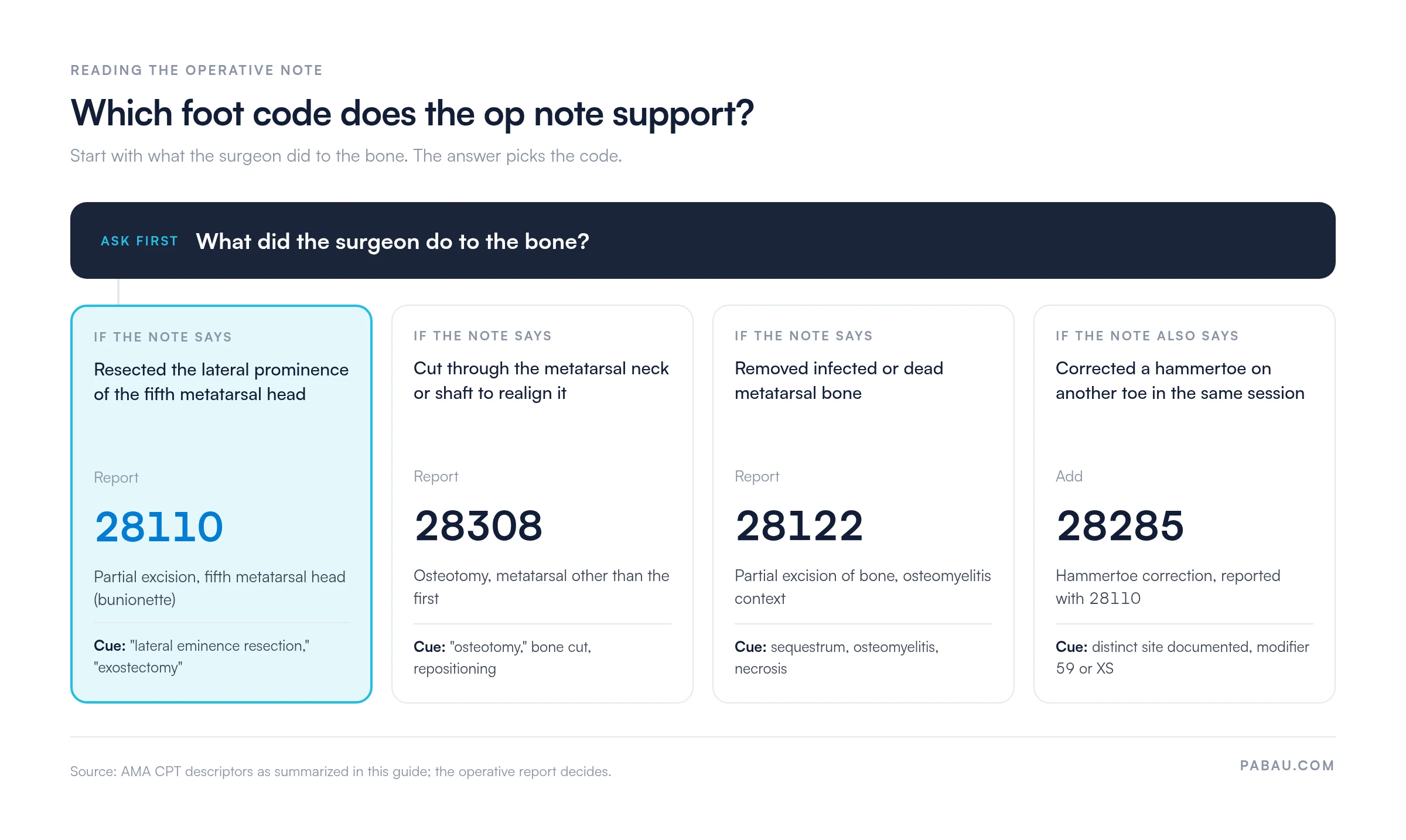
Coders often mix up 28110 with 28122, 28308 and 28285. In each case, the deciding factor is what the operative report says the surgeon did to the bone. Use this table when the op note is ambiguous.
Check the AAPC CPT code lookup when you compare adjacent foot surgery codes during a pre-bill audit. If the surgeon cut through the metatarsal shaft or neck (an osteotomy) instead of removing the surface prominence, 28308 is correct, not 28110. The decision path below follows the order a coder reads the op note in.
Every CPT code 28110 claim needs laterality. Reporting M21.629 (unspecified foot) when the op note names the foot is a documentation error. It invites audits and can draw a medical necessity denial from payers that require site specificity. Use the CrossCoder CPT-to-diagnosis crosswalk to check ICD-10 pairings against local coverage determinations (LCDs) before billing.
Some MAC LCDs separate an acquired bunionette (M21.62x) from congenital or post-traumatic bony deformities. Check the pre-operative diagnosis in the chart against your region’s LCD before you default to M21.62x as the primary code.
Modifier selection for CPT code 28110 affects both reimbursement and audit exposure. The four modifiers coders encounter most often on bunionette claims are listed below.
Yes, CPT 28110 can be billed bilaterally when the surgeon operates on both fifth metatarsal heads at the same session. Under Medicare, report one line of 28110-50, paid at 150% of the single-procedure allowable. Several commercial payers, however, require two separate line items (28110-RT and 28110-LT) rather than modifier 50. Always verify the payer’s bilateral billing preference in the provider manual or by calling the payer before submitting.
Medicare payment for CPT code 28110 comes from the Medicare Physician Fee Schedule (MPFS). The figures below are 2026 national rates at the $33.4009 conversion factor, before geographic adjustment. Check current-year rates in the CMS MPFS Look-Up Tool, because they change with each annual update.
Use the FastRVU 2026 lookup tool to verify current wRVU values and apply geographic practice cost index (GPCI) adjustments for your locality. Work and malpractice RVUs are the same in both settings, so practice expense drives the whole $185 difference. Facility rates apply when the procedure is performed in a hospital or ASC; non-facility rates apply in a physician office setting.
CPT code 28110 carries a 90-day global surgery period under the Medicare Physician Fee Schedule, classifying it as major surgery. Confirm the global period in the CMS MPFS database before submitting claims, since assignments can change with annual updates. Flag the surgery date on each superbill so staff can see which follow-up visits fall inside the global window.
During the 90-day global period, the following are bundled and cannot be billed separately:
Post-operative visits that CAN be billed separately require modifier 24 (unrelated E/M during global period) or modifier 79 (unrelated procedure during global period). A separate, unrelated diagnosis driving the visit is required to support the modifier.
Most payers require prior authorization for CPT code 28110. A documented prior authorization process helps front-desk staff gather the evidence before the patient reaches the OR. Requirements vary by payer and plan year, so verify them with the payer before scheduling surgery.
Common pre-authorization requirements for 28110:
Medicare coverage for 28110 follows the LCDs your Medicare administrative contractor (MAC) publishes for podiatric surgery. LCDs differ by jurisdiction (CGS, Noridian, Palmetto, WPS, Novitas), so confirm which MAC administers claims for your practice location before advising patients on expected coverage.
Auditors start with the operative report on a CPT code 28110 claim. A clean claim for 28110 depends on the op note establishing three elements: Site, technique, and pre-operative diagnosis. Auditors from Medicare and commercial payers specifically look for these when reviewing 28110 claims.
Notes written to this standard protect the practice against post-payment audits and recoupment demands.
The National Correct Coding Initiative (NCCI) publishes column 1/column 2 code pairs that Medicare bundles automatically. Check the current CMS NCCI tables before each 28110 claim, because the edit pairs change every quarter.
The pairings below raise most bundling questions, especially 28110 with a hammertoe correction under 28285.
Denials on 28110 claims follow predictable patterns. Good denial management sorts each one by root cause, so the same error doesn’t repeat on the next claim. The medical billing denial codes guide shows which claim adjustment reason codes (CARCs) and remark codes (RARCs) signal each failure.
Build a pre-submission checklist for CPT 28110 and run it before every claim drops to the biller. Confirm the prior authorization is active and the ICD-10 laterality matches the operative report. Then check that conservative treatment is in the chart, the payer’s modifier 50 or RT/LT rule is applied, and the NCCI pair check is done.
Without a claims system, a podiatry biller checks each 28110 claim by hand. That means confirming the prior authorization, matching ICD-10 laterality to the op note, and logging in to a payer portal for status.
Pabau, the practice management platform we build, keeps that work in one place. Its claims management software stores the patient’s insurer and policy on the patient record, so each invoice routes to the right payer. Before a claim goes out, Pabau checks that membership numbers and authorization codes are present. The Send button stays disabled until they are.
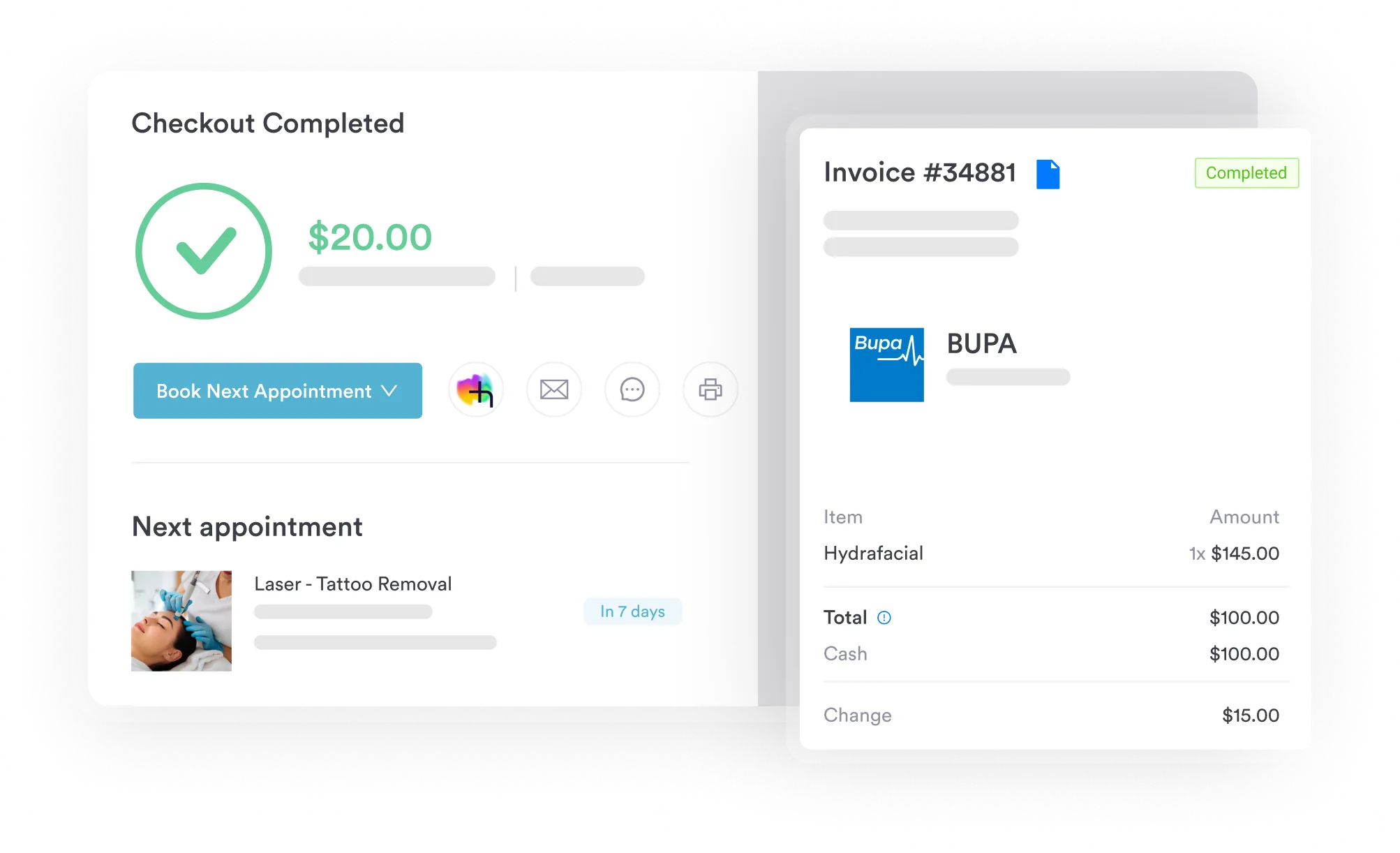
In the US, Pabau connects to Claim.MD for real-time eligibility checks, electronic submission, and electronic remittance advice (ERA) posting. Each claim shows its stage, from pending to paid or error, so staff see a rejected bunionette claim as soon as it comes back.

Pabau checks authorization codes and insurer details before a claim goes out, then tracks it to payment. Your billing team spends less time reworking denied foot surgery claims.

CPT code 28110 is easy to code once the op note proves three facts. The fifth metatarsal head was resected, on a named foot, after failed conservative care. When one of those is missing, the claim drifts toward 28308, an unspecified diagnosis, or a medical necessity denial.
So the fix starts before the claim exists. Ask surgeons to dictate site, technique, and conservative care history in every bunionette note, and check each payer’s bilateral rule before surgery. Those extra minutes per chart cost far less than appealing a denied surgical claim.
Book a demo to see how Pabau tracks every 28110 claim from prior authorization to payment.

Need to understand how medical billing denials get resolved? Denial management in healthcare walks through denial root-cause analysis and appeal workflows for surgical claims.
Looking for a complete list of denial reason codes? Medical billing denial codes covers CARC and RARC codes that appear on remittance advice for foot surgery claims.
Want to understand how a clearinghouse fits into surgical billing? How Claim.MD clearinghouse works explains how electronic claim submission reduces manual errors on CPT 28110 claims.
Coding a first-ray bunion instead? CPT code 28299 covers double osteotomy bunionectomy and the documentation that separates it from fifth-ray surgery.
Spending hours on surgical authorizations? Prior authorization software compares tools that track payer approvals before foot surgery is scheduled.
CPT code 28110 is the procedure code for partial excision of the fifth metatarsal head to correct a bunionette deformity. The AMA descriptor is “Ostectomy, partial excision, fifth metatarsal head (bunionette) (separate procedure).” It is distinct from first-ray bunionectomy codes and from osteotomy codes like 28308.
CPT 28110 covers resection of the fifth metatarsal head prominence for a bunionette deformity. CPT 28122 covers partial excision of infected, dead, or necrotic bone, typically in an osteomyelitis context. Using 28122 for a routine bunionette correction is an unbundling error. The diagnosis and the op-note language decide it, and 28110 applies when the problem is a bony prominence, not infection.
Yes, CPT code 28110 is covered by Medicare when medical necessity is documented and applicable MAC LCD criteria are met. Coverage typically requires evidence of failed conservative treatment (3-6 months), radiographic confirmation of the deformity, and functional impairment. Medicare coverage terms are governed by the applicable MAC’s Local Coverage Determination for the podiatric surgery category in your jurisdiction.
Yes, when both fifth metatarsal heads are operated on at the same session. Under Medicare, append modifier 50 to a single line of 28110 for reimbursement at 150% of the single-procedure allowable. Many commercial payers instead require two separate claim lines (28110-RT and 28110-LT). Verify the specific payer’s bilateral billing preference in the provider manual before submitting to avoid rejections.
CPT 28110 carries a 90-day global surgery period under Medicare, classifying it as major surgery. Routine post-operative visits within those 90 days are bundled into the procedure payment and cannot be billed separately. Post-op services for an unrelated condition require modifier 24 (unrelated E/M service) or modifier 79 (unrelated surgical procedure), with documentation supporting the unrelated diagnosis.
The approximate 2026 national Medicare payment for CPT 28110 is about $467 in a non-facility setting and about $282 in a facility (hospital or ASC). Those figures rest on approximately 14 total RVUs (non-facility) and 8.5 (facility) at the $33.4009 conversion factor. Payment varies by locality (GPCI adjustments) and by year. Confirm current rates in the CMS Physician Fee Schedule lookup tool before quoting them to physicians.



