HCPCS Code V2755: UV lens billing guide
HCPCS Code V2755: Quick reference HCPCS Code V2755 reports a UV-protective lens,...

Last Updated: Nov 6, 2026
V2629 is the HCPCS Level II code for a prosthetic eye, other type. It reports a new prosthetic eye that no other code in the V2623-V2629 range describes. The usual case is a stock eye, selected from inventory instead of fabricated from an impression of the socket.
A custom plastic eye is V2623, and work on an eye the patient already wears falls to V2624 through V2626. Medicare covers V2629 under the Part B prosthetics benefit. An enrolled DMEPOS supplier bills it to the DME MAC, with an RT or LT modifier for the side.
Let Pabau's smart automation suggest the right codes, reduce claim denials, and keep your practice compliant—effortlessly.
Automate repetitive tasks and focus on what matters most—your patients.
Reduce coding errors and ensure compliance with the latest regulations.
Clean claims, fewer denials, and faster reimbursements.
Powerful insights and reporting to help your practice thrive.
HIPAA compliant SOC 2 certified GDPR-compliant Trusted by 4,000+ clinics worldwide

HCPCS Code V2629 is “Prosthetic eye, other type”. It reports a prosthetic eye no other code describes, such as a stock eye that is not custom fabricated.
A new custom plastic eye is V2623. Polishing, enlargement and reduction of an existing eye are V2624, V2625 and V2626.
Medicare covers eye prostheses under Part B, paid by the DME MAC. LCD L33737 typically allows one replacement every five years.
Z90.01, acquired absence of eye, has no laterality. The RT or LT modifier on the claim line carries the side.
Pabau, the practice management platform we build, keeps the order, fitting notes and claim on one patient record. Each V2629 claim then goes out with its paper trail.
HCPCS Code V2629 is the Level II code for a prosthetic eye of a type that no other code in the range describes. The Centers for Medicare and Medicaid Services maintains it within the V-code series for vision items.
The official descriptor is “Prosthetic eye, other type”. It works as a catch-all, and the descriptor says nothing about custom fabrication. The usual example is a stock eye, which is prefabricated and selected from inventory, not fabricated from an impression of the patient’s socket.
A new custom plastic eye has its own code, V2623. The range has no glass code and no separate stock code, so a stock eye falls to V2629. V2629 never means “custom made”.
V2629 covers a new prosthetic eye that does not fit the description of V2623. In practice, that is most often a stock or prefabricated eye fitted to an anophthalmic socket.
Several related items fall outside V2629’s scope:
Payers need a documented medical reason for the missing eye before they approve a V2629 claim. The diagnosis has to appear in the patient record, not only on the claim.
Purely cosmetic use without a documented medical indication is not covered. Keep the physician’s order and the operative or pathology report on file before the fitting.
The diagnosis on a V2629 claim has to show why the patient needs an eye prosthesis. Policy Article A52462 publishes no restricted diagnosis list, so the record and the code together must establish absence of the eye.
Z90.01 has no laterality. One-sided and bilateral loss both use Z90.01, and the RT or LT modifier on the HCPCS line carries the side.
Watch the neighboring codes in the Z90.0- subcategory. They describe the absence of other head and neck parts, so none of them belongs on a prosthetic eye claim. Check any diagnosis you are unsure of in our ICD-10-CM library for coders.
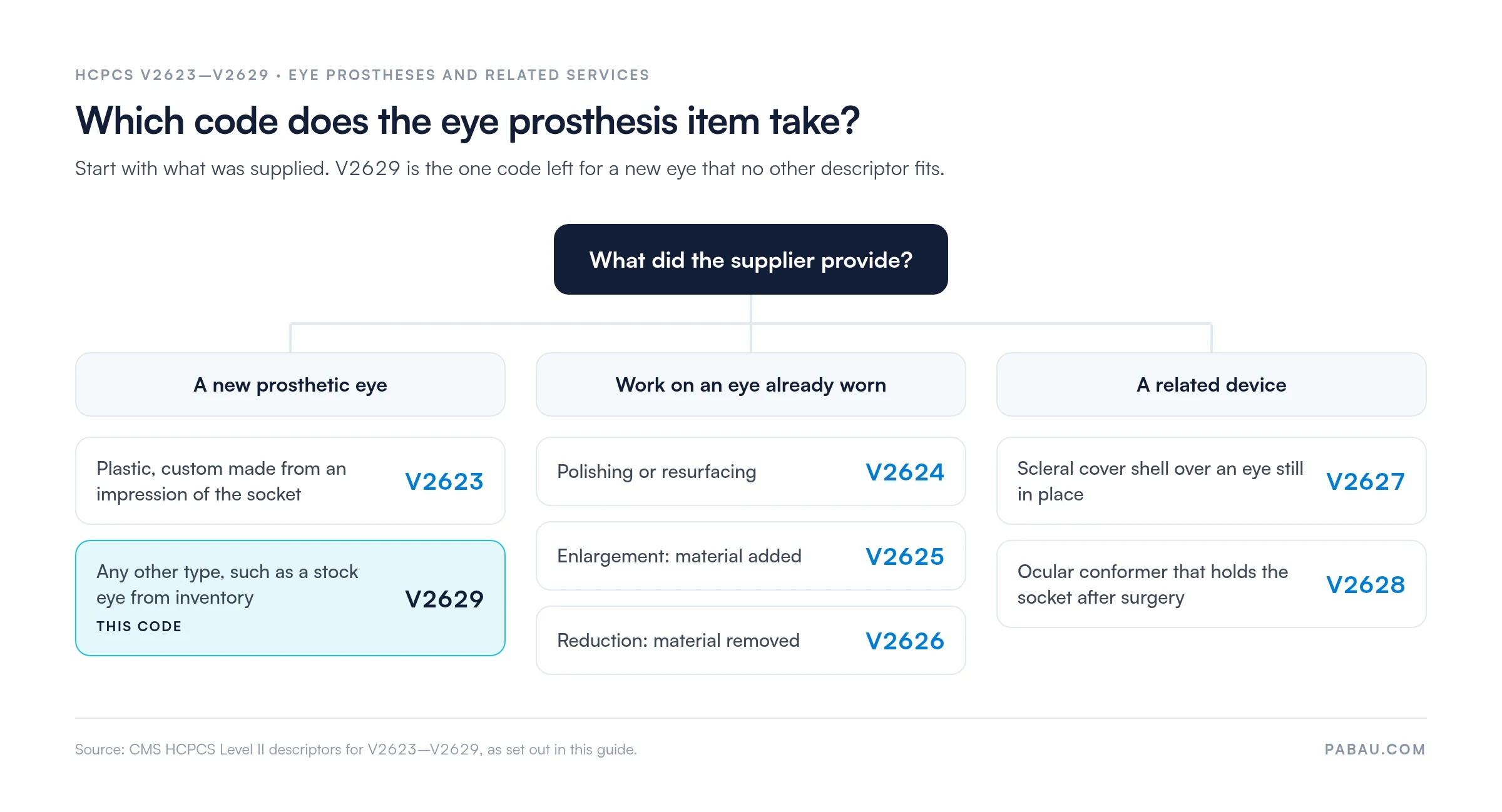
The V2623-V2629 range covers new prostheses, maintenance, modifications and the temporary devices used after surgery. Code choice turns on whether the item is new and how it was made. The table uses the official CMS HCPCS descriptors.
When V2629 applies: the item is a new prosthetic eye, and none of the six codes above describes it. A stock eye that is not custom fabricated is the common case. The chart below sorts all seven codes by what the supplier provided.
Record how the eye was made in the fitting notes. Payers check the code against the supplier’s work order. A stock eye billed as V2623, or a custom plastic one billed as V2629, will not survive an audit.
A hydroxyapatite (porous orbital) implant and an ocular prosthesis are two separate items on two separate billing pathways. Conflating them is an unbundling risk.
The surgeon places the orbital implant inside the orbit during enucleation or evisceration. It is reported on the surgical claim, with the procedure code that describes the operation.
The external prosthetic eye fitted over the implant is a separate item. When it is a stock or other-type eye, the supplier bills it as V2629 under the Part B prosthetics benefit.
Medicare covers eye prostheses as a Part B prosthetics benefit, not as durable medical equipment. The DME MACs apply LCD L33737 Eye Prostheses together with Policy Article A52462 to V2629 claims.
The LCD sets the coverage criteria and the replacement frequency. The policy article carries the coding guidance and the documentation requirements that support them.
Under LCD L33737, a prosthetic eye is typically replaced once every five years. An earlier replacement needs documented medical necessity, such as damage beyond repair, loss, or socket changes that spoil the fit.
The five-year rule comes from the LCD, not from Policy Article A52462. Confirm the current limits with your DME MAC before you submit an early-replacement claim.
Check whether your DME MAC or the patient’s plan lists V2629 in an active prior authorization program before you fit the eye. Medicare Advantage and Medicaid plans set their own rules.
Commercial payers write their own eye prosthesis policies. Aetna, for example, publishes its criteria in Clinical Policy Bulletin 0619, which lists the V2623-V2629 range.
Check each payer’s written policy for prior authorization, replacement frequency, and in-network supplier rules. Never apply the Medicare five-year rule to a private claim without checking that payer’s terms.
Medicare pays V2629 through the DMEPOS fee schedule, not the Physician Fee Schedule. CMS publishes the CMS DMEPOS fee schedule file each quarter, with amounts set by state.
Prosthetic eyes are excluded from the DMEPOS Competitive Bidding Program. Payment therefore does not vary by competitive bidding area, and your state’s fee schedule amount is the figure to check.
Medicare pays 80% of the lesser of the submitted charge or the fee schedule amount. The patient, or their supplemental insurance, owes the remaining 20% once the Part B deductible is met.
Look up the current V2629 amount before you quote the patient’s share. Amounts change each quarter, so a figure copied from last year’s file will mislead the estimate.
A V2629 claim needs a specific documentation package, assembled before the claim date. Building these records first is the core of medical billing compliance for a DMEPOS supplier.
Laterality is the modifier that matters on every V2629 claim, and missing it causes avoidable denials.
For a patient with both eyes absent, bill each prosthesis on its own claim line with its own RT or LT modifier. Z90.01 supports both lines.
V2629 is billed by an enrolled DMEPOS supplier with an active Medicare supplier number. The supplier must meet every Medicare supplier standard and hold current DMEPOS accreditation.
The billing NPI must belong to the enrolled supplier that dispensed the eye. A claim from an NPI with no DMEPOS enrollment will deny for provider type.
Most V2629 denials are preventable. Tracking them through a structured denial management workflow stops the same error from repeating across claims.
Run a short check on every V2629 claim before it leaves your clearinghouse. (1) The fitting notes show the eye is not a custom V2623 item. (2) RT or LT is on the claim line. (3) The diagnosis is Z90.01 or Q11.1. (4) The billing NPI belongs to an enrolled DMEPOS supplier.
Submit V2629 claims to the DME MAC on a CMS-1500 form or an 837P electronic transaction. A clean claim on the first pass avoids the rework that eats into a small supplier’s margin.
Ocularist and ophthalmic practices bill in a documentation-heavy setting. The order, the operative report and the fitting notes often sit in different places, and one goes missing at claim time.
Pabau keeps those documents on the patient record, next to the encounter. Pabau’s claims software for specialty practices builds the claim from that same record, so nobody re-keys the fitting details.
With billing and the clinical record in one system, the RT or LT check and the document check happen before the claim goes out. A missing order surfaces while the claim is built, not weeks later as a denial. If your team is newer to DMEPOS work, the basics of medical billing explain where each document fits.

Pabau keeps the order, operative report and fitting notes on the patient record, next to the claim. Practices that bill eye prostheses send cleaner claims and chase fewer denials.

V2629 is a catch-all, and its risk sits in the code beside it. A new custom plastic eye is V2623, and a stock eye or another type no code describes is V2629. Work on an eye the patient already wears belongs to V2624 through V2626.
The fitting notes decide which code is right, so write them to say plainly what the patient received. Pair the claim with Z90.01 or Q11.1, let RT or LT carry the side, and the rest is enrollment and timing. Book a demo to see how Pabau keeps orders, fitting notes and claims together.

Want to understand how claims flow from submission to payment? What is revenue cycle management explains the end-to-end claims lifecycle relevant to specialty practices.
HCPCS Code V2629 is “Prosthetic eye, other type”. It reports a new prosthetic eye that no other code in the V2623-V2629 range describes, most often a stock eye that is not custom fabricated. A custom plastic eye is V2623.
V2623 is a prosthetic eye made of plastic and custom fabricated from an impression of the patient’s socket. V2629 is the catch-all for a prosthetic eye of any other type, such as a stock eye. V2629 is not a custom code, so check the fitting notes before choosing between them.
Yes, when medical necessity is documented. Under LCD L33737, a prosthetic eye is typically replaced once every five years. An earlier replacement needs a documented reason, such as damage beyond repair, loss, or socket changes.
Use Z90.01, acquired absence of eye, for an eye removed by surgery, or Q11.1, other anophthalmos, for congenital absence. Z90.01 has no laterality, so the RT or LT modifier carries the side.
The most common causes are a wrong code from the V26xx range and a missing RT or LT modifier. A billing NPI with no DMEPOS supplier enrollment is the third. Missing documentation and early replacement without a documented reason follow close behind.
An enrolled DMEPOS supplier with an active Medicare supplier number bills V2629. That is usually an ocularist supplier, but a physician enrolled as a DMEPOS supplier may also bill eye prostheses under Policy Article A52462. An ordering physician without that enrollment cannot.