

CCSD code G5100: Bypass of duodenum billing guide
CCSD code G5100 bills a bypass that leaves the duodenum in place CCSD code G5100...

Last Updated: Oct 16, 2026
Billable Code Specific Code
28297 is the CPT code for correction, hallux valgus with bunionectomy, with sesamoidectomy when performed; with first metatarsal and medial cuneiform joint arthrodesis, any method.
Known as the Lapidus bunionectomy, the procedure fuses the first tarsometatarsal joint to realign the first ray and control hypermobility. Codes 28295, 28296, 28298 and 28299 correct the same deformity with an osteotomy instead of a fusion. Sesamoidectomy is included in 28297 when performed and is never reported separately.
Let Pabau's smart automation suggest the right codes, reduce claim denials, and keep your practice compliant—effortlessly.
Automate repetitive tasks and focus on what matters most—your patients.
Reduce coding errors and ensure compliance with the latest regulations.
Clean claims, fewer denials, and faster reimbursements.
Powerful insights and reporting to help your practice thrive.
HIPAA compliant SOC 2 certified GDPR-compliant Trusted by 4,000+ clinics worldwide

CPT code 28297 reports a Lapidus bunionectomy, which fuses the first metatarsal and medial cuneiform joint instead of cutting the bone.
Sesamoidectomy is included in 28297 when performed and is never separately reportable.
The Akin osteotomy (CPT 28298) is a standalone hallux valgus code, so pairing it with 28297 follows current NCCI edits and payer policy.
CPT 28297 carries a 90-day global period, and related post-op E&M visits in that window are bundled into the surgical fee.
Pabau’s billing software checks eligibility in real time and submits CMS-1500 claims through Claim.MD, so coverage is confirmed before the surgery date.
CPT code 28297 describes the Lapidus bunionectomy, a hallux valgus correction that fuses the first metatarsal and medial cuneiform joint. The fusion controls hypermobility at the first tarsometatarsal (TMT) joint. The American Medical Association maintains this code in its musculoskeletal surgery section. The descriptor’s “with sesamoidectomy when performed” wording means a sesamoid excision is included when the surgeon does one, and it is never reported separately.
CPT code 28297 is the right choice when the surgeon fuses the first metatarsal and medial cuneiform joint. The neighboring codes correct the same deformity with a bone cut at a specific site instead. The surgical technique documented in the operative report decides the code, not the severity of the deformity.
The operative note must document fusion of the first TMT joint, including the fixation used, to support 28297. Without a fusion, the osteotomy site decides the code. A proximal metatarsal cut reports as 28295, and a distal metatarsal cut reports as 28296. An osteotomy of the proximal phalanx reports as 28298, and a double osteotomy as 28299. The label on the surgical schedule does not change that.
CPT 28290, the old simple bunionectomy code, has been deleted. A bunionectomy without an osteotomy or fusion now reports under 28292, which also covers resection of the proximal phalanx base when performed. The diagram below maps each code to the part of the first ray the surgeon works on.
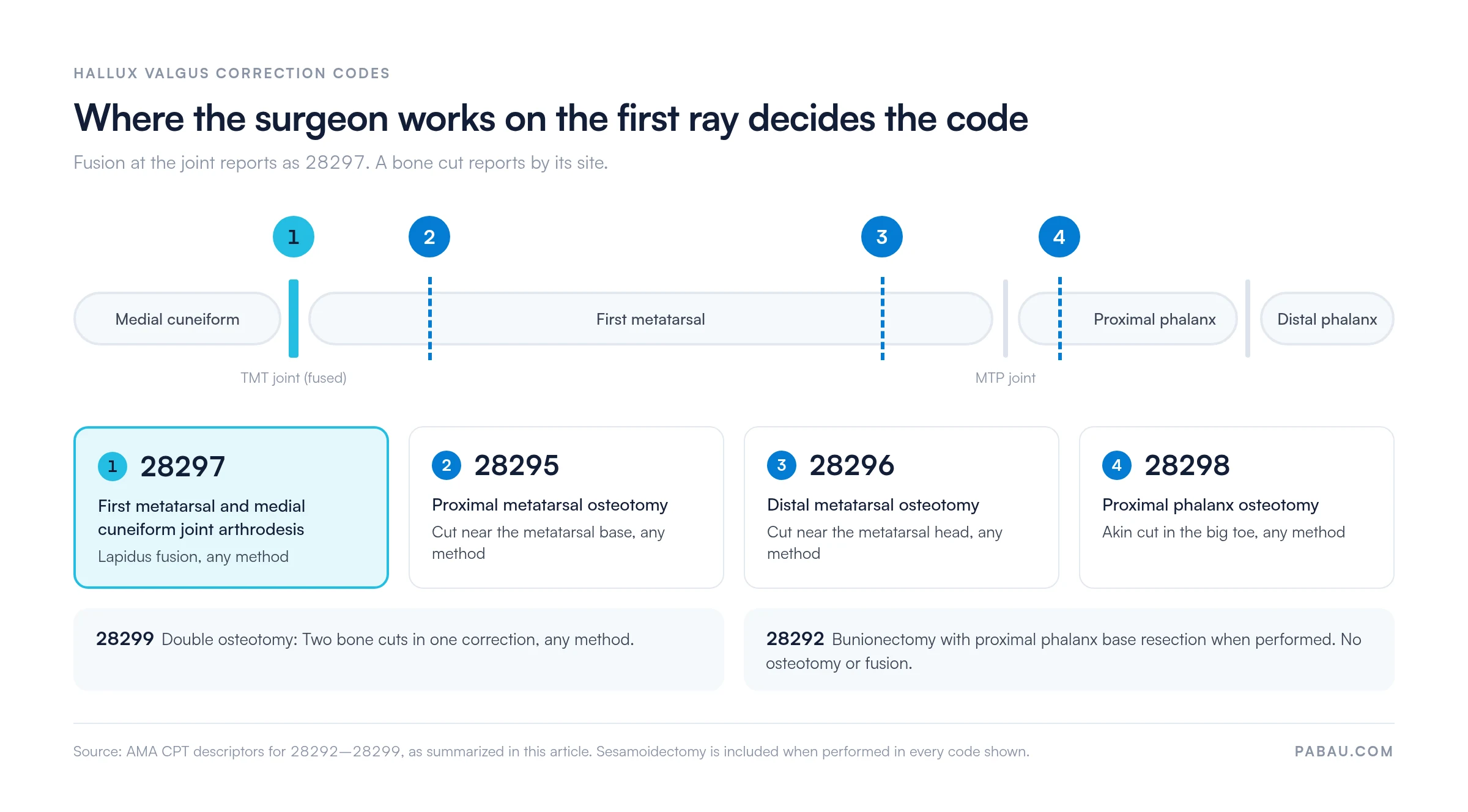
The descriptor’s “with sesamoidectomy when performed” wording settles the most common bundling question. A sesamoid excision done during the Lapidus correction is included in 28297 and is never separately reportable. Billing CPT 28315 (sesamoidectomy, first toe) as its own line item breaks a National Correct Coding Initiative (NCCI) edit. Verify current NCCI pairings against the CMS Physician Fee Schedule before submission, because the edits update quarterly.
Modifier selection for CPT code 28297 depends on laterality, concurrent procedures, and circumstances that change the work involved. The table below covers the modifiers coders apply most often to 28297.
CMS guidance distinguishes modifier 59 from the X-modifier set (XS, XU, XE, XP). Many Medicare Administrative Contractors (MACs) now prefer XS (separate structure) over 59 for anatomically distinct companion procedures. A hammer toe correction on another digit is a common example. Check your MAC’s local policy before defaulting to 59.
When billing CPT 28297 with 28285 in the same session, document the separate digit in the operative note before attaching modifier 59 or XS. An NCCI edit override without supporting operative-report language is the fastest path to a technical denial.
Medical necessity is a common denial reason for CPT code 28297. Payers require objective evidence that conservative treatment failed and that the deformity meets clinical thresholds before approving a Lapidus fusion. Building a clean claim for 28297 starts with the pre-operative record, not the operative note.
The documentation checklist below reflects the elements most commercial payers and Medicare review contractors look for during medical necessity audits.
The primary pairing for CPT code 28297 is hallux valgus (acquired). Report M20.11 for the right foot, M20.12 for the left foot, or M20.10 when laterality is undocumented. The bunion codes M21.611, M21.612 and M21.619 are an alternative family, not a companion, because M20.1- carries an Excludes1 note for M21.6-.
Laterality is required by most payers. Submitting an unspecified code when the operative note documents a right or left foot procedure is a preventable denial. These codes update annually on October 1, so verify them against the CDC/NCHS ICD-10-CM web tool before each new fiscal year.
Code the family the clinical record supports, and never report both on one claim. If a claim denies on diagnosis grounds, check whether the payer’s local coverage determination (LCD) or coverage policy names the code family it accepts.
Medicare reimbursement for CPT code 28297 is based on the Medicare Physician Fee Schedule (MPFS), which uses relative value units (RVUs) to calculate payment. The work, practice expense, and malpractice RVUs are each adjusted for the practice location. Their sum is then multiplied by the annual conversion factor.
Use the FastRVU lookup tool to retrieve current work, practice expense, and malpractice RVU values for 28297 by year and locality. National averages are only a reference point. Reimbursement varies by locality through the geographic practice cost index (GPCI).
CPT 28297 carries a 90-day global period, classifying it as major surgery under the MPFS global surgery rules. The 90 days begin the day after the procedure. The following evaluation and management (E&M) visits and services are bundled into the surgical fee during this window. They may not be billed separately to Medicare.
Document the reason for any post-op visit clearly. Payers audit global-period claims and will recoup E&M payments for visits that lack documentation showing an unrelated diagnosis or complication requiring distinct management.
Traditional Medicare Part B does not require prior authorization (PA) for CPT 28297. Medicare Advantage plans (Part C) set their own PA rules, and many require it for elective foot surgery. Assuming Medicare never needs PA leads to denied claims for Medicare Advantage patients.
Commercial payers vary widely. Many require PA for a Lapidus bunionectomy, given the procedure’s elective classification and significant RVU weight. Common commercial PA criteria include the following.
Track PA status per patient and per payer in a structured workflow. A denied PA that goes unnoticed until claim submission costs the practice the full procedure fee.
CPT code 28297 denials cluster around a predictable set of causes, and each one is preventable with the right pre-submission workflow. Knowing the common denial codes for surgical procedures helps billing teams spot the pattern before a claim goes out the door.
Tracking 28297 denial reasons by payer over time shows which plans flag claims on the same grounds. That record lets your team target appeals and adjust claims before the next submission.
Podiatric surgery billing runs on paperwork, and each manual handoff between the schedule, the operative note and the claim invites a denial. Good claims management software confirms coverage before the case is booked and follows each claim through to payment.
Pabau, the practice management platform we build, routes CPT 28297 claims through its Claim.MD clearinghouse integration. It submits CMS-1500 claims to thousands of US payers and checks eligibility in real time when you schedule the surgery. That way your team can confirm coverage and start the PA request before the case is booked.

Claim status updates and electronic remittance advice (ERA) come back into Pabau. Your team can follow each 28297 claim from submission to payment in one place, without chasing payers by phone.

Pabau checks eligibility in real time, submits CMS-1500 claims through Claim.MD, and returns claim status and ERA data. See how podiatric practices use it to get 28297 claims paid.

Report 28297 only when the operative report documents a fusion of the first metatarsal and medial cuneiform joint. If the note describes a bone cut instead, the site of that cut picks the code, and rewording the claim cannot change it.
The money on a Lapidus case is protected long before submission. Lock in the hallux valgus diagnosis, the imaging angles and the prior authorization at scheduling, and the claim becomes routine.
Pabau checks eligibility in real time and submits CMS-1500 claims through Claim.MD, so your team catches coverage problems before the surgery date. Book a demo to see how it handles podiatric surgery billing from scheduling to remittance.

Need to understand how clearinghouse submission works for surgical codes? Pabau’s clearinghouse integration guide explains how claims route through Claim.MD to thousands of US payers.
Billing a hammer toe correction in the same session? CPT code 28285 covers how to report the hammer toe procedure itself.
Wondering how electronic remittance advice speeds up 28297 reconciliation? Electronic remittance advice (ERA) overview covers how 835 files map payment and adjustment codes back to surgical claims.
Looking for a complete revenue cycle walkthrough for your podiatric practice? Revenue cycle management guide covers the end-to-end process from eligibility check through payment posting.
CPT code 28297 includes correction of hallux valgus with bunionectomy through first metatarsal and medial cuneiform joint arthrodesis, by any method. Sesamoidectomy is included when performed and is never billed as a separate line item. Internal fixation hardware and routine bone preparation are also included.
CPT 28296 reports a distal first metatarsal osteotomy, such as an Austin or chevron, with no joint fusion. CPT 28297 reports arthrodesis of the first metatarsal and medial cuneiform joint, and the operative report must document that fusion. Without a fusion, the osteotomy site decides between 28295, 28296, 28298 and 28299.
CPT 28297 carries a 90-day global period beginning the day after surgery. Routine post-operative visits, pre-operative care the day before surgery, and the day-of-surgery evaluation are all bundled into the surgical fee. E&M visits for unrelated conditions during this window require modifier 24 to be separately reportable.
LT or RT for laterality is required by most payers and should always be appended. Modifier 59 or XS applies when a hammer toe correction (28285) on another digit is billed in the same session. A Lapidus with an Akin osteotomy (28298) must follow current NCCI edits and payer policy, because 28298 is a standalone hallux valgus code. Modifier 22 applies to unusually complex cases. Modifier 78 covers a return to the OR for a complication during the global period.
Traditional Medicare Part B does not require prior authorization for 28297, but Medicare Advantage plans often do. Commercial payers frequently require PA for this elective surgical procedure. Verify PA requirements with the specific payer and plan at the time of scheduling, as requirements vary and change annually.
Yes, 28297 and 28285 can be billed together when a hammer toe correction is performed in the same session on a different digit. Modifier 59 or XS must be appended to 28285 to bypass the NCCI bundling edit. The operative report must separately document the hammer toe procedure as a distinct service on a different anatomical site.
Yes, CPT 28297 is the standard code for the Lapidus bunionectomy. Its formal description, first metatarsal and medial cuneiform joint arthrodesis for hallux valgus correction, matches the AMA descriptor for 28297. The operative report must confirm the TMT joint fusion to support the code.
Medicare reimbursement for CPT 28297 varies by geographic location and changes annually with the Medicare Physician Fee Schedule update. Use the CMS Physician Fee Schedule lookup or a tool such as FastRVU to find the current RVU values for your locality. National averages are only a baseline. Your allowable depends on the GPCI for your practice location.



