HCPCS Code V2788: Presbyopia-correcting IOL billing and Medicare rules
HCPCS Code V2788: Official descriptor and code details HCPCS Code V2788 reports ...

Last Updated: Nov 6, 2026
V2755 is the HCPCS Level II code for a U-V lens, per lens. It reports a UV-protective coating applied to one spectacle lens, billed on top of a separate base lens code, so a pair takes two units.
Anti-reflective coating is a different code, V2750. Medicare excludes routine eyewear but covers UV protection on the one pair dispensed after cataract surgery. It denies V2755 on polycarbonate lenses, which already block UV.
Let Pabau's smart automation suggest the right codes, reduce claim denials, and keep your practice compliant—effortlessly.
Automate repetitive tasks and focus on what matters most—your patients.
Reduce coding errors and ensure compliance with the latest regulations.
Clean claims, fewer denials, and faster reimbursements.
Powerful insights and reporting to help your practice thrive.
HIPAA compliant SOC 2 certified GDPR-compliant Trusted by 4,000+ clinics worldwide

V2755 reports a UV-protective coating applied to one spectacle lens. Its official descriptor is “U-V lens, per lens”, so a pair takes two units.
Anti-reflective coating has its own code, V2750. Scratch-resistant coating is V2760, and tint, mirror and polarization each have their own codes too.
Medicare excludes routine eyeglasses, but it covers UV protection on the one pair dispensed after cataract surgery with an intraocular lens.
Medicare denies V2755 billed with a polycarbonate or Trivex lens (V2784), because UV protection is already built into that material.
Pabau’s claims management software flags a missing laterality modifier or base lens code before an optical practice sends the claim.
HCPCS Code V2755 reports a UV-protective lens, billed per lens as an add-on to a spectacle lens code. The table sets out the billing facts to check first. Descriptors come from the CMS HCPCS Level II code set, which the Centers for Medicare and Medicaid Services (CMS) updates every year.
The official CMS descriptor for HCPCS Code V2755 is “U-V lens, per lens.” It describes ultraviolet protection added to a spectacle lens, usually as a UV coating applied by the optical laboratory. The code sits in the V-series of HCPCS Level II, which covers vision supplies, eyewear and related services.
Two qualifiers in that short descriptor drive how the code is billed.
V2755 describes a treatment added to a lens, not the lens itself. The base lens is coded separately, for example from V2100 to V2199 for single-vision lenses or V2200 to V2299 for bifocals. V2755 is not a CPT code, and it never stands alone on a claim.
V2755 covers one treatment only: UV protection added to a spectacle lens. Every other lens treatment has its own per-lens code, so a lab order listing several treatments becomes several claim lines.
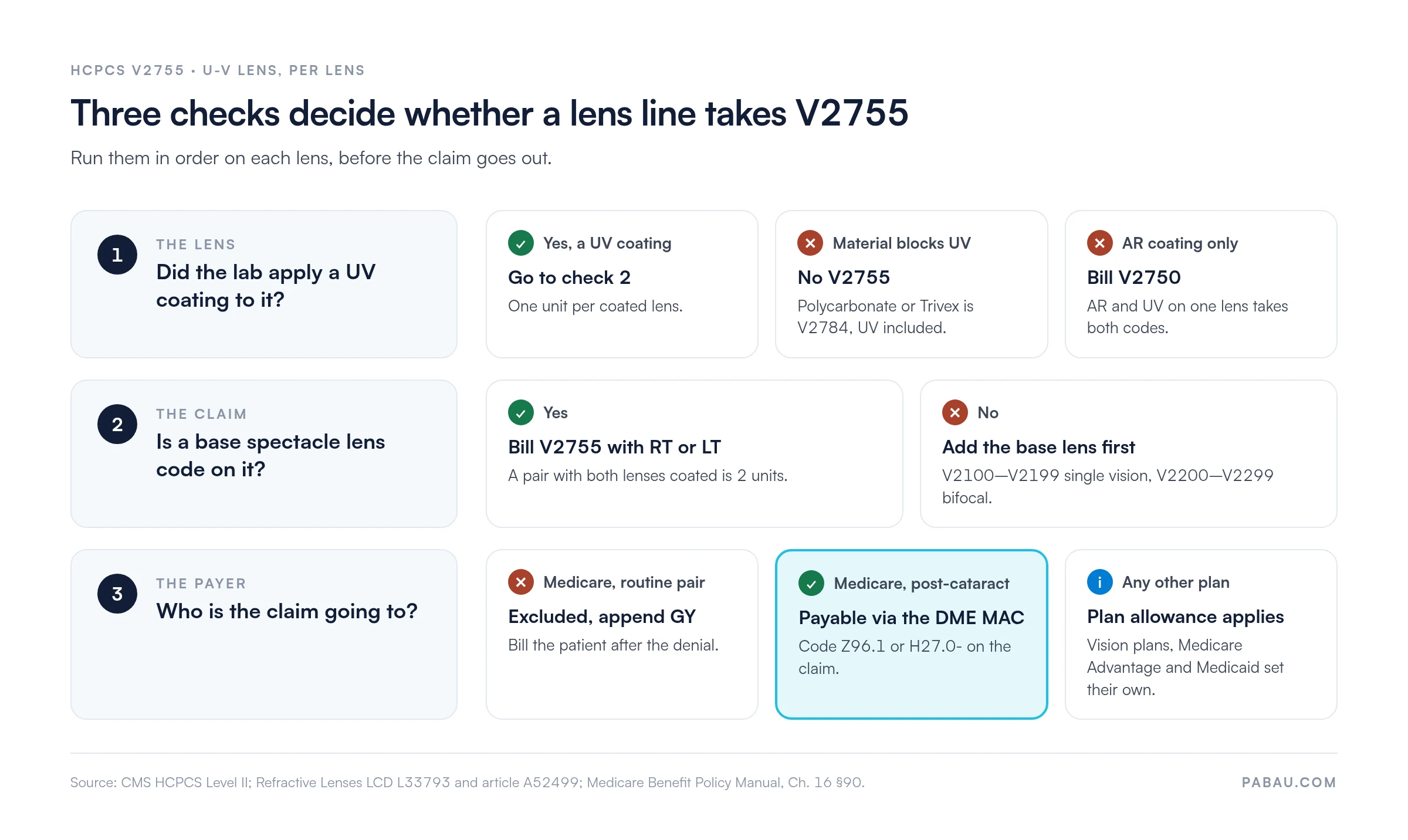
The most common mix-up is billing an AR-coated lens under V2755. V2750 is the anti-reflective coating code, and a lens with both AR and UV coating takes both codes. Document each treatment on the lab order so the two lines can be matched to what the lab applied.
Traditional Medicare does not cover routine eyeglasses or the lens treatments added to them. The exclusion sits in the CMS Medicare Benefit Policy Manual, Chapter 16, “General Exclusions From Coverage,” Section 90. A routine V2755 claim to Medicare is therefore a statutorily excluded service.
There is one important exception. Medicare covers refractive lenses as prosthetic devices for patients who are aphakic or pseudophakic. For a patient with pseudophakia, that means one pair of eyeglasses or contact lenses after each cataract surgery with an intraocular lens (IOL).
On that covered pair, V2755 is payable. The Refractive Lenses LCD (L33793) calls UV protection reasonable and necessary after cataract extraction. No justification is needed beyond listing it on the order.
These claims go to the DME MAC for the patient’s region, not to the Part B carrier. Noridian runs Jurisdictions A and D, and CGS runs B and C. All four apply the same LCD and its policy article (A52499).
Outside traditional Medicare, coverage depends on the plan. Running insurance eligibility verification before the visit is the most reliable way to confirm it.
V2755 claims are submitted on a CMS-1500 claim form or its electronic equivalent, the 837P transaction. The dispensing practice is normally the billing entity, unless the lab holds its own billing contract with the payer.
Three checks decide whether a lens line takes V2755 at all, and who pays for it. The chart runs them in the order a biller meets them.
Modifier rules for V2755 depend on the payer. Medicare’s DME MACs require RT or LT on every lens code, and they use the G-modifiers to signal coverage.
Omitting RT or LT on a Medicare lens line is a leading cause of CO-4 denials. CO-4 means the procedure code is inconsistent with the modifier, or a required modifier is missing.
The patient record and the claim together must show what was ordered, what the lab applied, and when the patient received it.
A clean claim has every field populated and every modifier correct, with the documentation on file before it is filed. Chasing paperwork after a denial adds work and delays payment.
Before you add V2755 to a claim, read the lens material on the lab order. A polycarbonate or Trivex lens already blocks UV, so a V2755 line on that lens is a Medicare denial waiting to happen.
V2755 sits among several per-lens option codes in the V2700-V2799 range. Using the wrong one is a billing error, and a repeated pattern can draw a payer’s data-analysis review.
Blue-light filtering has no dedicated HCPCS code. Some vision plans, such as UnitedHealthcare’s Spectera, ask for V2799 (vision item or service, miscellaneous) with modifier BL. Check the plan’s own billing guide before using it.
The V2784 pairing deserves special care. Medicare’s Refractive Lenses LCD states that UV coating is not reasonable and necessary on a polycarbonate lens. A claim carrying both codes on the same lens is denied.
V2755 denials cluster around a short list of errors, and nearly all of them can be caught before submission.
Tracking V2755 denials by payer over a quarter shows whether errors are systemic or one-off data-entry slips. Read the CARC on each remittance against our denial codes in medical billing reference, then fold the fix into a denial management workflow.
Prior authorization rules for lens options vary by payer and plan year. Traditional Medicare does not require prior authorization for refractive lenses.
Commercial vision plans such as VSP, EyeMed and Davis Vision usually confirm lens options through their portals when the lab order is placed. Medicaid programs that cover eyewear may require authorization for options above the basic benefit.
A V2755 authorization request should include the patient’s ICD-10 diagnosis, the base lens code, the treating provider’s NPI and the planned dispensing date.
No single reimbursement rate applies to V2755 across payers. Each payer type sets its own allowable, and the figures change every year.
Look up the current figure for each payer rather than relying on a number from last year. Recording each plan’s V2755 allowable at the start of the year also flags a payer whose rate drops unexpectedly.
Most V2755 denials come from checks done by hand on a busy dispensing day. Is the lens already UV-blocking, is the base lens on the claim, and does each line carry RT or LT?
Pabau keeps the prescription, lab invoice, delivery record and claim together on the patient’s record. Its claims management software handles eligibility checks, submission and claim status in that same place.
Your billing team works from the dispensing record itself, not a re-keyed summary. That makes a V2755 line on a polycarbonate lens, or a missing modifier, easy to spot before the payer sees it.

Pabau keeps the lens order, lab invoice and claim on one patient record. Your team checks modifiers, units and base lens codes before submission.

V2755 is the narrowest of the lens option codes. It reports one treatment only, a UV coating added to a single lens. Anti-reflective coating is V2750, and a lens whose material already blocks UV takes no V2755 at all.
If you change one habit, read the lens material before adding the code. That single check prevents the polycarbonate denial on Medicare and keeps the patient from paying for protection the lens already has.
For Medicare patients, remember the post-cataract exception. UV protection on that one covered pair is payable, so a blanket “Medicare never pays” rule loses money. Book a demo to see how Pabau checks lens option claims before they reach the payer.

Need a full picture of how medical billing works? What is medical billing explains the end-to-end claims process from coding through payment posting.
Seeing a pattern of claim rejections? Clean claim submission best practices covers the checklist that prevents the most common adjudication failures.
HCPCS Code V2755 covers a UV-protective lens, billed per lens. Its official descriptor is “U-V lens, per lens.” Use it when a UV coating is applied to a spectacle lens, alongside a separate base lens code. It does not cover anti-reflective coating, which is V2750.
No. Anti-reflective coating has its own code, V2750, anti-reflective coating, per lens. V2755 reports UV protection only. A lens with both an AR coating and a UV coating takes both codes, one unit each per lens.
Only on the eyeglasses dispensed after cataract surgery. Medicare excludes routine eyeglasses under Benefit Policy Manual Chapter 16, Section 90. For a pseudophakic patient, it covers one pair after each cataract surgery with an IOL. The Refractive Lenses LCD treats UV protection on that pair as reasonable and necessary.
Not to Medicare. Polycarbonate and Trivex lenses, billed with V2784, already block UV light. The Refractive Lenses LCD says UV coating is not reasonable and necessary on them, so V2755 with V2784 is denied. Use V2755 only when the lab applies a UV coating.
RT or LT goes on each lens line, and Medicare requires one on every refractive lens code. Add GY for routine eyewear billed to Medicare. Add GA or GZ when Medicare may find the coating not reasonable and necessary, depending on whether an ABN is on file.
The most common reasons are a missing RT or LT modifier and no base lens code on the claim. Others are a plan that excludes lens options, V2755 billed with a polycarbonate lens, and missing documentation on audit. A pre-submission check catches most of them.
It depends on the payer. Medicare pays a covered post-cataract V2755 from the DMEPOS fee schedule, which varies by state. Medicare Advantage, Medicaid and commercial vision plans each set their own allowables. Check the current figure with each payer every year.