HCPCS Code G0163: Skilled nursing observation and assessment
What is HCPCS Code G0163? HCPCS Code G0163 is a deleted Level II code for skille...

Last Updated: Oct 15, 2026

CPT 28299 covers hallux valgus correction by double osteotomy, with sesamoidectomy bundled in when the surgeon performs it.
The two cuts can fall on the same bone or on two different bones, and both belong in the operative note.
Total RVUs run 31.03 in the office and 16.87 in a facility, which pays about $1,036 and $563 in 2026.
Laterality drives denials, so LT or RT has to agree with the M20.11 or M20.12 on the diagnosis line.
A 90-day global period follows the surgery, so routine post-operative visits are already paid for.
CPT code 28299 covers correction of hallux valgus (bunionectomy), with sesamoidectomy when performed, by double osteotomy, any method.
The operative note has to show two bone cuts. Those cuts can sit on the same bone or on two different bones, as long as the surgeon documents both.
Podiatrists and orthopedic surgeons use 28299 for the most involved bunion corrections, and Medicare’s 2026 non-facility rate lands just above $1,000. Reaching for it over single-osteotomy 28296 without a note to back it up is a classic upcoding finding on audit.
CPT code 28299 sits in the Surgery section of the CPT code set, under Musculoskeletal System, Foot and Toes. The American Medical Association publishes the official descriptor each year. Its exact wording decides more here than in most code families.
The full descriptor reads: Correction, hallux valgus (bunionectomy), with sesamoidectomy, when performed; with double osteotomy, any method.
Four phrases in that line carry coding weight.
Count the osteotomies in the operative report and the choice between CPT 28296 and CPT code 28299 makes itself. Two cuts means 28299. One cut means 28296, whatever else the surgeon did that session.
A double osteotomy qualifies when both cuts fall inside the first metatarsal. It also qualifies when one cut sits in the metatarsal and the other in the proximal phalanx. The familiar pairing is an Austin (chevron) osteotomy with an Akin osteotomy of the phalanx. A proximal and a distal cut in the same metatarsal counts too.
The rest of the hallux valgus family divides the same way, on what the surgeon cut rather than on how hard the case was.
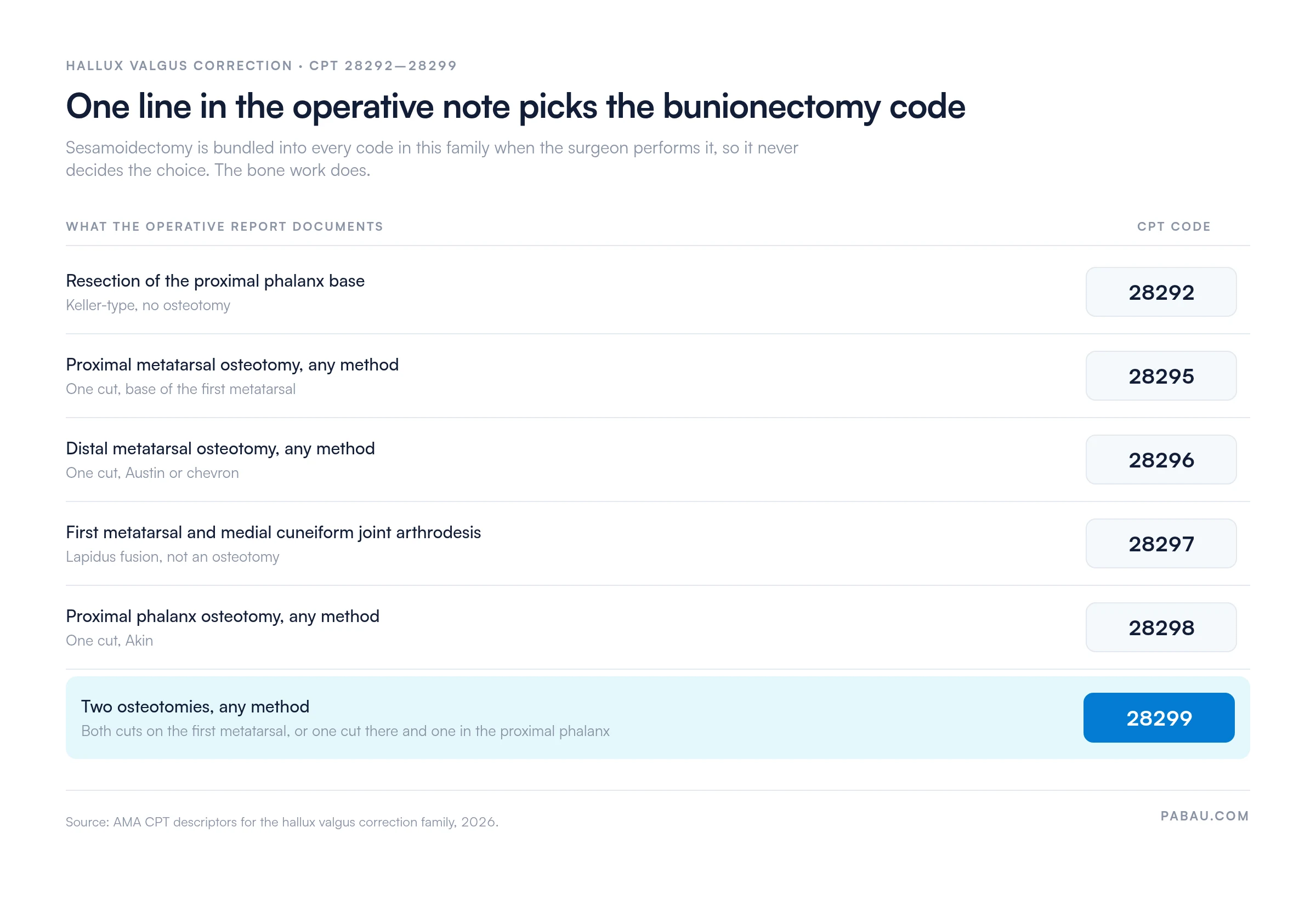
Billing 28299 on a single-cut note is upcoding, and auditors read operative reports. Billing 28296 on a two-cut note quietly costs the practice several hundred dollars a case. These codes also carry a medically unlikely edit of 1, so a second unit on the same line will not pay.
Sesamoidectomy is conditionally included under the “when performed” language. Three rules follow from that.
Every 28299 claim needs LT or RT, and that one modifier causes more denials than the rest of the set combined. Three others come up often enough to plan for.
Bilateral bunionectomies are the case most often built wrong. Check the payer’s policy before you split the claim, because the modifier 50 route and the LT/RT route pay differently.
CPT 28299 carries 31.03 total RVUs in the office and 16.87 in a facility. Practice expense explains the whole difference, because an office absorbs the supplies, instruments and staff time a hospital bills for itself. The FastRVU lookup tool confirms current values by code and locality.
Watch the source you copy from. Several published tables still show a work RVU near 15 for this code, which inflates every estimate built on it. CMS revises the values each year in the Physician Fee Schedule final rule. Confirm them through the CMS Physician Fee Schedule lookup tool before you rebuild a fee schedule.
Medicare’s 2026 national average is about $1,036 in the office and about $563 in a facility. Place of service drives that entire spread. Geography then moves it again, because the geographic practice cost index adjusts each RVU component to your locality.
The math is short enough to do by hand. Multiply total RVUs by the conversion factor, which gives 31.03 × $33.40 = $1,036.40 in the office and 16.87 × $33.40 = $563.46 in a facility. CMS set two conversion factors for 2026, $33.40 for most practices and $33.57 for qualifying APM participants.
Commercial rates usually run above Medicare on surgical codes this size, though contracts vary widely. Track the paid-to-billed ratio by payer for 28299 instead of assuming the contract holds.
Run your own locality through the CMS Physician Fee Schedule lookup before you set a billed charge for 28299. High-cost localities pay meaningfully above the national average, and rural ones pay below it. Peg your charge master to a sustainable multiple of your local Medicare rate, never to the national figure.
CPT 28299 carries a 090 global indicator. That covers the day before surgery, the day of surgery and the 90 days after it. Routine follow-up inside the window is already paid for, so dressing changes, wound checks and suture removal do not get billed again.
Work that falls outside the routine still gets paid, as long as a modifier says why.
Missing one of these is a quiet revenue loss. The claim comes back denied as bundled, and denials that look like a global-period rejection rarely get reworked.
Every 28299 claim needs an ICD-10-CM diagnosis that establishes medical necessity, and for this procedure that is the M20.1x group, hallux valgus (acquired). The final digit sets the laterality.
Our ICD-10-CM codes library covers the wider set when the chart carries more than one foot diagnosis.
Three places record the side. The diagnosis line, the procedure line modifier and the operative note all have to agree. A mismatch between any two of them is one of the most common denials in foot surgery.
Denials and downcodes on 28299 nearly always trace back to the operative report rather than to the claim form. Six elements do the heavy lifting.
Practices working from an electronic record can build these six prompts into the operative note template. The surgeon then confirms each one before signing, rather than reconstructing it weeks later for an appeal.
Run the claim past this list before it leaves the practice. It catches the errors that otherwise surface on a remittance three weeks later.
A clean claim rate above 95% on 28299 is achievable, and this check is most of how practices get there.
Six failure points account for most denied and recouped 28299 claims.
Sorting denials by reason code after each remittance cycle shows which of the six is costing you. Two cycles is usually enough to see the pattern.
28299 sits at the top of a family that runs from 28292 to 28299, with a few neighbors that often appear on the same claim. Knowing the range prevents both the accidental downcode and the combination that gets bundled.
When 28299 and 28285 are performed in the same session on different sites, they can go on one claim with modifier 59 on 28285. The sites here are the first metatarsophalangeal joint and a lesser digit. Check the AAPC CPT code reference for the current edits on that pair.
Check the National Correct Coding Initiative edit tables before you put 28299 on a claim with any other foot surgery code for the same date. CMS updates them quarterly, and a pair that paid last quarter can become bundled without notice. The check costs a minute and prevents the recoupment letter that follows a post-payment audit.
A 28299 claim passes through five steps before it pays. Eligibility, the operative note, the coded claim, the clearinghouse and the remittance each live in a different place in most practices. The manual handoffs between them are where laterality mismatches and missing modifiers get in.
Practice management software like Pabau keeps that run inside one record. Pabau’s claims management software runs electronic eligibility checks ahead of the date of service. It then submits the claim through an integrated clearinghouse and posts the remittance back to the same patient record.
It will not pick the code for you. Pabau does not validate a CPT and ICD-10 pairing, and it does not read an operative note. The osteotomy count and the laterality check stay with your coder. What it removes is the re-keying between systems, which is where most 28299 denials start.
For a podiatry or orthopedic practice, one episode of care spans the surgery, the post-operative visits and often therapy. Holding them in a single record keeps the global period visible to whoever books the next appointment.

Pabau brings scheduling, clinical notes and claims submission into one record, so podiatry and orthopedic teams spend less time rekeying data and chasing denials.

28299 is a documentation code before it is a payment code. Two osteotomies named in the note, matching laterality on both lines, and a clear sesamoidectomy statement will carry almost every claim through. The arithmetic after that takes a minute to check.
The money usually leaks after the coding decision, during the 90 days that follow. A global-period modifier gets missed, or a denial sits unworked until the filing window closes. Build both checks into the workflow once and the code stops being a problem.
Pabau links the operative note, the claim and the remittance in one patient record. A 28299 case never has to be rebuilt from three systems later. Book a demo to see how it handles surgical billing for podiatry and orthopedic practices.

Want to understand claim errors before they become recoupments? Denial codes in medical billing explains the most common CARC denial reason codes and how to respond to each.
Need a primer on how clearinghouses process surgical claims? Medical claims clearinghouse covers the 837P transaction flow, payer enrollment, and how ERA files return to your practice.
Looking to benchmark your billing operation? Best medical billing software for US practices evaluates the leading platforms against real-world RCM criteria.
Yes, but not as two full payments. Medicare treats a bilateral procedure as a single line with modifier 50, paid at 150% of the allowed amount. Some commercial payers still want two lines carrying LT and RT. Check the policy before you build the claim, because the two formats pay differently.
Most commercial payers require it for bunion surgery, and many deny the claim outright when it is missing. Medicare does not pre-authorize physician surgical services, but it still expects documented failure of conservative care. Start the authorization when the surgical decision is made, not the week before surgery.
Yes. Podiatrists and orthopedic surgeons both report 28299, provided the procedure sits inside the provider’s state scope of practice. The documentation standard is identical either way, so the operative note still has to show two osteotomies and the side operated on.
Use 11 for an office, 22 for hospital outpatient and 24 for an ambulatory surgical center. That code decides whether the claim pays the non-facility rate or the facility rate, a difference of roughly $470 on 28299. Sending an office case with a facility place of service is a common underpayment.