Pabau Engage inbox

Pabau Engage is here: every patient conversation in one inbox.

Learn more
Book a demo Book a demo
☰
CPT Code

CPT code 28090 – Foot lesion excision including synovectomy


Code Definition

28090 is the CPT code for excision of a lesion, tendon, tendon sheath, or capsule, including synovectomy, on the foot. In most practices, it's the code for removing a ganglion cyst from the top or sole of the foot.

The detail that matters most is location. 28090 covers the foot only, so toe lesions go to 28092 and ankle lesions to 27630. Get the site, side, and diagnosis right, and Medicare pays about $469 for an office-based case in 2026. Below, we follow the claim from op note to payment, including the steps where denials start.

Section
10004-69990 Surgery
Subsection
20100-29999 Musculoskeletal system
Code range
28001-28899 Foot and Toes
Billable
No
Code also known as
ganglion cyst excision foot, foot ganglion removal, tendon sheath excision foot, foot cyst surgery
Save time. Improve accuracy. Get paid faster.
Automate coding with Pabau

Let Pabau's smart automation suggest the right codes, reduce claim denials, and keep your practice compliant—effortlessly.

  • AI-powered code suggestions
  • Real-time compliance checks
  • Faster claims, fewer denials
Why practices choose Pabau
Save hours every week

Automate repetitive tasks and focus on what matters most—your patients.

Improve accuracy

Reduce coding errors and ensure compliance with the latest regulations.

Get paid faster

Clean claims, fewer denials, and faster reimbursements.

Grow with confidence

Powerful insights and reporting to help your practice thrive.

HIPAA compliant SOC 2 certified GDPR-compliant Trusted by 4,000+ clinics worldwide

Key takeaways

Key takeaways

CPT code 28090 covers the excision of foot lesions from a tendon, tendon sheath, or joint capsule. Ganglion cysts are the usual case.

Location decides the code, so toe lesions go to 28092, ankle or leg lesions to 27630, and non-tendon soft-tissue tumors to 28039-28045.

The code carries a 90-day global period, so routine post-op visits are part of the surgical payment.

Most payers want LT or RT on the claim line, and a missing side modifier is a common reason 28090 claims come back.

Pabau’s claims software pre-fills the claim from the patient record and checks required fields before the claim is sent.

CPT code 28090 covers lesions of foot tendons, sheaths, and capsules

CPT code 28090 is the code for surgically removing a lesion that grows from a tendon, tendon sheath, or joint capsule on the foot. The AMA descriptor reads: excision of lesion, tendon, tendon sheath, or capsule (including synovectomy) (eg, cyst or ganglion); foot.

In day-to-day billing, that mostly means ganglion cysts on the top of the foot. The code also covers synovial cysts, fibromas, and similar lesions attached to the same structures. Synovectomy done during the excision is part of 28090, so it never gets a claim line of its own.

Here are the reference details you need at a glance.

Attribute Detail
Code 28090
Code set CPT (Current Procedural Terminology)
Section Musculoskeletal system, Foot and Toes (28001-28899), Excision (28039-28175)
Global period 090 (90 days)
Billing Report once per site, with LT or RT for laterality
2026 Medicare national rate $469.28 non-facility, $294.60 facility
Common specialties Podiatry, orthopedic foot and ankle surgery

What happens during a 28090 excision, step by step

Knowing the surgery helps you read the op note the way a payer will. The procedure usually runs in four steps.

  1. Positioning: the patient is placed to expose the top (dorsal) or sole (plantar) of the foot, depending on where the lesion sits.
  2. Exposure: the surgeon cuts directly over the lesion and dissects down to the tendon sheath or joint capsule it grows from.
  3. Excision: the lesion comes out with its base, including any attached sheath or capsule. Inflamed synovial tissue is removed in the same step.
  4. Closure and pathology: the wound is closed, and the specimen usually goes to pathology to confirm what it was.

Each step leaves a trace in the operative report. Next, those details tell you what is already paid inside 28090.

What 28090 bundles, and what you can still bill separately

Most of the day’s work is already inside 28090. Under CMS NCCI policy, the services below can’t be billed on their own in the same session.

  • Included: local anesthesia at the site, simple wound closure, synovectomy done with the excision, and routine post-op care within the 90-day global period.
  • Surgical pathology: billable on the specimen, usually as 88304 for a ganglion or synovial cyst.
  • Complex closure: billable as CPT 13131-13133 on the foot, when the repair is documented as complex.
  • Nerve block: billable when a separate anesthesia provider gives it and documents it.
  • E/M services: evaluation and management visits on a separate date, for a problem unrelated to the surgery.

The classic unbundling mistake is adding a separate synovectomy code to 28090. Because the descriptor already includes synovectomy, the pair triggers an NCCI edit and the extra line is denied.

Foot, toe, or ankle? Pick the code by location first

Location is the first question, and the descriptors are strict about it. 28090 is for the foot only, while its neighbors split up the rest of the anatomy.

CPT code Descriptor (summary) Use when
28090 Excision of lesion, tendon, tendon sheath, or capsule, including synovectomy; foot Ganglion, cyst, or similar lesion arising from a tendon, sheath, or capsule on the foot
28092 Excision of lesion, tendon, tendon sheath, or capsule, including synovectomy; toe(s), each Lesion on a toe. Report it once per toe, as a standalone code with its own 90-day global
28043 Excision, tumor, soft tissue of foot or toe, subcutaneous; less than 1.5 cm Soft-tissue tumor in the subcutaneous layer that does not arise from a tendon, sheath, or capsule (28039 at 1.5 cm or greater)
28045 Excision, tumor, soft tissue of foot or toe, subfascial (eg, intramuscular); less than 1.5 cm Deeper soft-tissue tumor below the fascia (28041 at 1.5 cm or greater)
27630 Excision of lesion of tendon sheath or capsule; leg and/or ankle Lesion at the ankle or lower leg, not the foot
26160 Excision of lesion of tendon sheath or joint capsule; hand or finger The same procedure on the hand or finger

The chart below walks through the same choice as two quick questions.
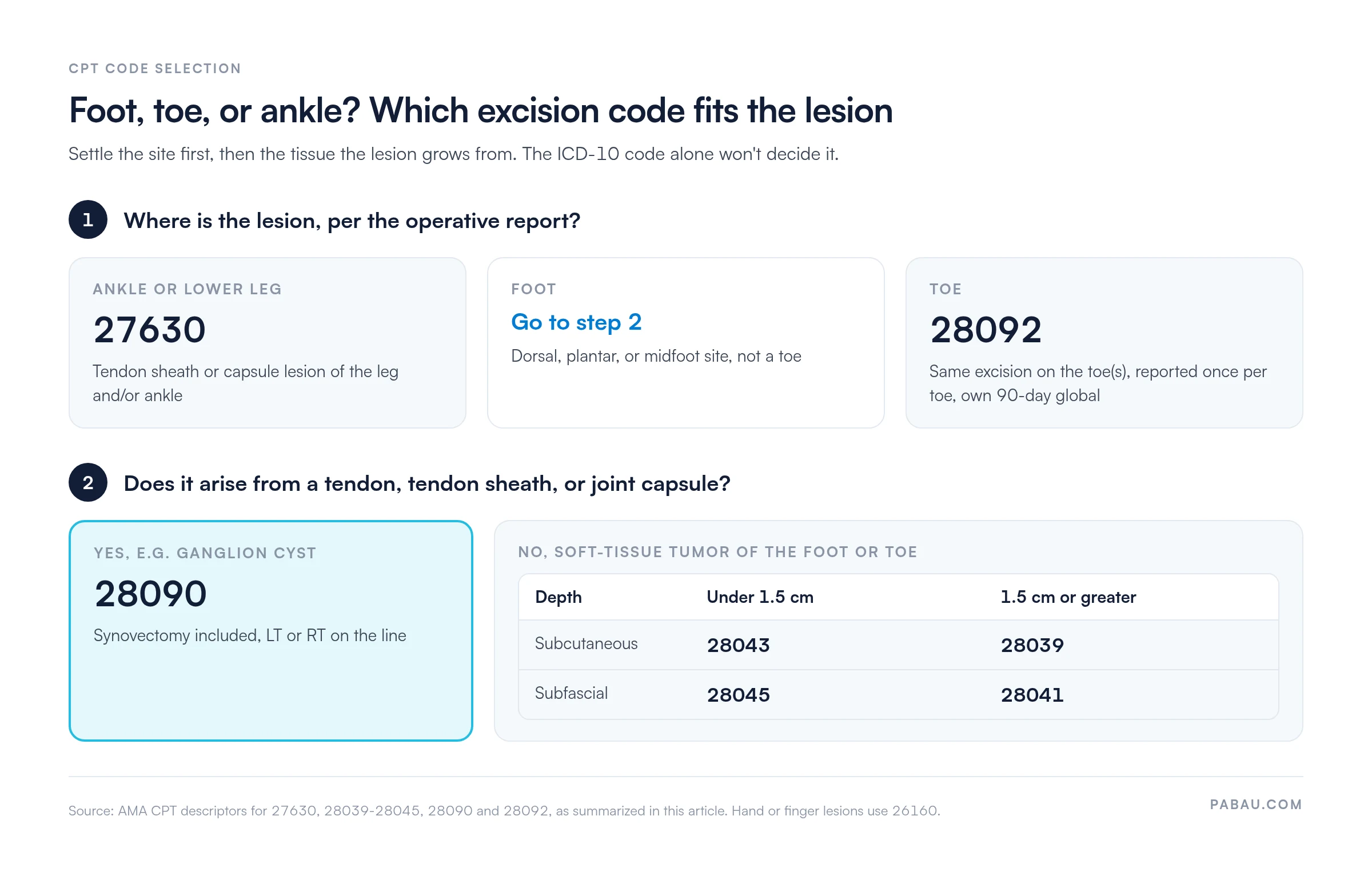
Decision chart for foot excision codes
Settle the site before the tissue type, because a toe or ankle lesion never reaches the 28090 question. Codes follow the AMA CPT descriptors.

The 28090 vs. 27630 split causes the most coder errors. If the operative report places the lesion at the ankle or lower leg, 27630 is correct. Watch the diagnosis too, since M67.47- covers the ankle and foot together. That means the ICD-10 code can’t settle the CPT code, and only the surgeon’s description of the site can.

The same logic runs up the body. A ganglion on a hand or finger tendon sheath goes to 26160 instead.

Diagnosis codes that prove medical necessity for 28090

Every 28090 claim needs an ICD-10-CM code that supports the surgery. Laterality matters under ICD-10-CM coding guidelines, so use the unspecified code only when the record doesn’t say which foot.

ICD-10-CM code Description Use when
M67.471 Ganglion, right ankle and foot Ganglion cyst confirmed on the right foot or ankle
M67.472 Ganglion, left ankle and foot Ganglion cyst confirmed on the left foot or ankle
M67.479 Ganglion, unspecified ankle and foot Laterality not documented in the clinical record
D21.2 Benign neoplasm of connective and other soft tissue of lower limb Fibroma or other benign soft-tissue lesion confirmed as a neoplasm on pathology
M79.89 Other specified soft tissue disorders Secondary use only, when the lesion is atypical and no more specific code applies

M79.89 works as a secondary code only. As the primary diagnosis on a 28090 claim, it invites a medical necessity review.

Modifiers that decide whether 28090 pays the first time

Modifiers are where many 28090 claims slip. The table shows when each one applies.

Modifier Name When to apply
LT / RT Left / Right Required by most payers for foot procedures to show laterality
51 Multiple procedures When 28090 is reported with another surgical procedure in the same session
59 Distinct procedural service When 28090 is done at a separate anatomic site from another same-day procedure
22 Increased procedural services Recurrent excision with documented heavy adhesions or scar tissue, backed by a detailed op note
78 Unplanned return to OR A complication needs a return to the operating room during the global period
79 Unrelated procedure during global period A separate, unrelated surgery during the 90-day global period

Modifier 50 (bilateral procedure) rarely fits 28090. Most payers want LT and RT on separate lines instead, so confirm each payer’s preference before you bill both feet.

What Medicare pays for CPT code 28090 (2026)

Medicare pays 28090 under the Medicare Physician Fee Schedule (MPFS), which the Centers for Medicare and Medicaid Services updates each year. The values below are the 2026 national unadjusted figures, using a conversion factor of $33.4009. Geographic adjustments apply, so your local payment will differ.

RVU component Value (2026)
Work RVU (wRVU) 4.44
Practice expense RVU (non-facility) 9.13
Practice expense RVU (facility) 3.90
Malpractice RVU 0.48
Total RVU (non-facility) 14.05
Total RVU (facility/ASC) 8.82
Estimated national payment (non-facility) $469.28
Estimated national payment (facility) $294.60

In plain terms, an office-based excision pays about $469 before local adjustment. When the case runs in a hospital or ASC, the surgeon’s payment drops to about $295. Many commercial contracts are built from Medicare rates, so these figures make a handy benchmark when you check a remittance.

Pro Tip

Compare your 28090 fee schedule at the start of each year. CMS publishes the new MPFS in November, and commercial payers often reset contracted rates on January 1. A 10-minute review catches a rate change before a run of underpaid claims builds up.

Documentation that holds up when a payer asks for the op note

Thin operative notes drive many medical necessity denials on 28090. A clean claim for this code starts with an op report that spells out each of these points.

  • Anatomic site and laterality: right or left foot, plus the exact location (dorsal, plantar, or metatarsal region).
  • Lesion type: ganglion cyst, synovial cyst, fibroma, or similar, never just “lesion” or “mass.”
  • Structure involved: whether it arose from the tendon, tendon sheath, joint capsule, or more than one.
  • Synovectomy: if performed, a clear note that it was part of the excision.
  • Lesion size: the greatest dimension in centimeters, which matters if pathology points to a tumor code instead.
  • Pathology: whether the specimen went to pathology.
  • Anesthesia type: local, general, or regional. Local is bundled, while a separate anesthesia service needs its own record.

Prior authorization: What payers ask for before a foot excision

Traditional Medicare generally doesn’t require prior authorization for 28090. Commercial insurers and Medicare Advantage plans vary, and many of them do. A missed authorization hurts most because the surgery is done before the denial arrives.

Confirm coverage through insurance eligibility verification before you book the case. Payers that require authorization usually ask for these items.

  • Diagnosis code with laterality (M67.471, M67.472)
  • Notes showing failed conservative care, such as aspiration (20612), physical therapy, or orthotics
  • Imaging that confirms the cyst, usually ultrasound or MRI
  • Provider NPI and site of service (office, ASC, or hospital outpatient)
  • Procedure code 28090 and the planned date of service

Record the authorization number before the surgery date. If the date moves, check that the authorization is still active.

How a 28090 claim moves from the OR to payment

Here’s the path a clean 28090 claim follows, and where each step can go wrong.

  1. The surgeon signs the op note. Coding waits for it, because the site and the tissue type decide the code.
  2. The coder assigns the codes. That means 28090, the side modifier, and the diagnosis. A toe or ankle site points to 28092 or 27630 instead.
  3. Pathology reports back. If it names a fibroma rather than a ganglion, switch the diagnosis to D21.2 before you send.
  4. The claim goes out with the authorization number. Leaving it off is an easy denial on a plan that required one.
  5. The 90-day global period starts. Flag the patient so routine follow-up visits aren’t billed by mistake.
  6. The remittance arrives. Compare the payment with your fee schedule, and route any denial by its reason code.

Before you submit: A quick 28090 checklist

Run through these seven checks before the claim leaves your practice.

  • The op note names the foot, not a toe or the ankle.
  • LT or RT sits on the 28090 line.
  • The ICD-10 code matches the side and the pathology result.
  • No separate synovectomy code appears next to 28090.
  • Complex closure, if billed, is documented as complex.
  • The prior authorization number is on the claim and still active.
  • A second procedure carries modifier 51 or 59 where the payer needs it.

Five common 28090 denials and how to fix each one

Even with the checklist, some claims come back. Start with the reason code, and a guide to denial codes helps you translate it. From there, good denial management sorts each denial by root cause before anyone resubmits.

Denial reason Root cause Appeal action
Medical necessity not established Records lack proof that conservative treatment failed Resubmit with office notes showing aspiration attempts, PT referrals, and imaging
Missing or incorrect modifier LT/RT left off, or modifier 50 used when the payer wants LT/RT Correct the modifier and resubmit. No appeal letter is needed for a pure modifier fix
Incorrect code selected 28090 billed for a toe lesion (28092 applies), or when 28043 (soft-tissue tumor) or 27630 (ankle) fit Check the op report against the CPT descriptors, then rebill the corrected code or appeal with the anatomic detail
Prior authorization not obtained A commercial or Medicare Advantage plan required pre-auth that wasn’t obtained File a retro-authorization request right away, with clinical urgency notes if they apply
NCCI bundling edit Synovectomy billed separately alongside 28090 Remove the separate synovectomy code and resubmit

Recurrent ganglion cysts still bill as 28090

Ganglion cysts often come back, and the repeat excision at the same foot site is still 28090. There is no separate code for a recurrent excision. What changes is the documentation, because payers look harder at repeat surgery.

  • Say “recurrent”: the op report should use the word and reference the earlier surgery at that site.
  • Record the extra difficulty: note the adhesions, scar tissue, distorted anatomy, and any extra time the dissection took.
  • Use modifier 22 sparingly: add it only when the op note shows substantially more work, and attach a letter that explains it. Payers audit routine use.
  • Expect a review: keep the original op report, pathology results, and the current note ready before you submit.

The 90-day global period: what’s bundled and what isn’t

CPT code 28090 carries a 90-day global period under the MPFS. For major surgery like this, the window opens the day before surgery and runs 90 days after it.

Routine post-op visits, dressing changes, suture removal, and uncomplicated wound care are all part of the 28090 payment. You can still bill these services during the window.

  • An E/M visit for an unrelated problem, with modifier 24 and notes that show it’s unrelated
  • A return to the OR for a related complication, with modifier 78
  • An unrelated surgical procedure, with modifier 79
  • An emergency visit for a condition unrelated to the surgery

Billing a routine follow-up without a modifier during the window is a common audit finding in foot surgery. It often ends in a recoupment request.

Pro Tip

Flag every 28090 procedure in your practice management system with its global period end date on the day of surgery. Then hold post-op visit codes for that patient until the 90-day window closes. The hold stops accidental global period billing before it reaches the claim.

How Pabau keeps 28090 claims moving from note to payment

Most of the steps above happen in different places. The op note sits in one system, the codes in another, and the claim in a clearinghouse portal. Each hand-off is a chance to drop the side modifier or the authorization number.

Pabau, the practice management platform we build, keeps those steps on one patient record. Its claims management software pre-fills the claim form from the record, with CPT and ICD-10 lookup libraries built in. It also checks that required fields, such as the authorization code, are complete before the claim can go.

For US practices, claims go out through Claim.MD with real-time eligibility checks, ERA posting, and claim-status tracking. So your team can confirm coverage before surgery and match each payment to the fee schedule without manual lookups.
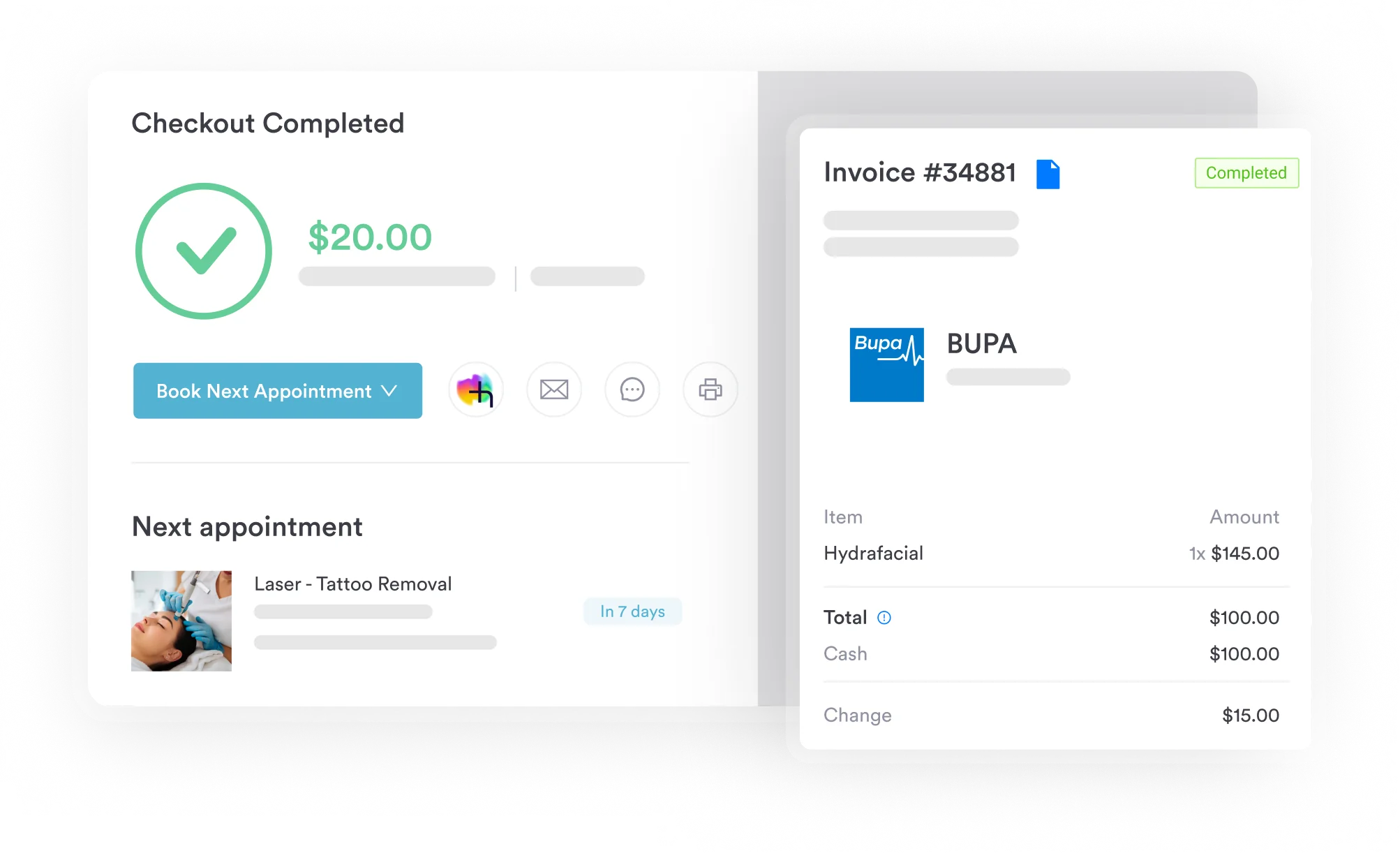

Pabau claims screen for building and sending an insurance claim
Pabau’s claims screen fills the claim from the patient record and holds it until required fields are complete. That means fewer errors on 28090 claims.

Send cleaner 28090 claims from the patient record

Pabau pre-fills claims from the patient record and checks required fields before sending. In the US, it also handles eligibility checks, ERA posting, and claim status through Claim.MD.

Pabau claims management dashboard

Conclusion

CPT code 28090 rewards one simple habit: code from the op note, not from the diagnosis. Confirm the foot, the tissue, and the side first, and most denials never start.

The trade-off is a few extra minutes at charge entry. That time costs far less than a corrected claim, an appeal letter, or a recoupment months later.

If you’d like to see a 28090 claim move from note to payment in one place, book a demo with the Pabau team.

Continue your research

Continue your research

Need to understand the broader claims submission process? What is medical billing covers the end-to-end revenue cycle from encounter to payment posting.

Want to reduce denial rates across your practice? Denial management in healthcare outlines the workflows and categorization systems that prevent recurrent denials.

Planning a surgery that needs payer approval? The prior authorization process walks through each step from request to approval.

Treating the cyst before surgery? CPT code 20612 covers ganglion cyst aspiration and injection, often the first step before excision.

Coding the same excision on the hand? CPT code 26160 covers tendon sheath and joint capsule lesions of the hand or finger.

Frequently asked questions

What is the CPT code for ganglion cyst removal on the foot?

Use 28090 when the cyst comes from a tendon, tendon sheath, or joint capsule on the foot. A cyst on a toe uses 28092, reported per toe, and one at the ankle uses 27630.

Can a podiatrist bill CPT 28090?

Yes. Medicare treats podiatrists as physicians for services within their state scope of practice, and foot ganglion excision usually falls within it. Check your state’s scope rules if the lesion sits near the ankle.

Can you bill an office visit on the day of a 28090 excision?

Only when that visit is where the decision to operate was made. Because 28090 has a 90-day global period, report that E/M visit with modifier 57. A routine pre-op check that day or the day before is bundled.

How is CPT 20612 different from 28090?

20612 covers needle aspiration or injection of a ganglion cyst at any site. 28090 is the open surgical excision. Payers often want to see a failed aspiration before they approve surgery.

Who bills the pathology on a 28090 specimen?

The pathologist or lab that reads the tissue usually bills it, separately from the surgeon’s claim. A ganglion or synovial cyst is typically reported as 88304.
×