CPT Code 99509: Home health aide visit for ADL assistance
CPT code 99509: official descriptor and service definition The AMA’s CPT c...

Last Updated: Oct 27, 2026
27630 is the CPT code for excision, lesion of tendon sheath or capsule (e.g., cyst or ganglion), leg and/or ankle. It covers removal of a ganglion, synovial cyst, or similar lesion arising from a tendon sheath or joint capsule between the knee and the foot.
The code applies to the leg and ankle only. The same lesion on the foot is reported with 28090, and a cyst in the tibia or fibula itself with 27635. The procedure carries a 90-day global period, and the LT or RT modifier reports the side.
Let Pabau's smart automation suggest the right codes, reduce claim denials, and keep your practice compliant—effortlessly.
Automate repetitive tasks and focus on what matters most—your patients.
Reduce coding errors and ensure compliance with the latest regulations.
Clean claims, fewer denials, and faster reimbursements.
Powerful insights and reporting to help your practice thrive.
HIPAA compliant SOC 2 certified GDPR-compliant Trusted by 4,000+ clinics worldwide

CPT code 27630 covers excision of a lesion from a tendon sheath or joint capsule in the leg or ankle. Foot lesions use 28090.
Ganglion cysts and Achilles tendon sheath lesions are the most common clinical scenarios billed under this code.
Missing LT or RT modifiers and site errors, such as a foot lesion documented as leg, are the top denial triggers for 27630.
The 2026 Medicare facility RVUs for 27630 total 10.38, and the code carries a 90-day global period.
Pabau, the practice management system we build, submits claims electronically through Claim.MD and tracks each claim’s status.
CPT code 27630 describes excision of a tendon sheath or capsule lesion in the leg or ankle, as defined in the AMA’s CPT code set. Within Surgery CPT codes, it sits in the Musculoskeletal System section. Specifically, its subsection is Excision Procedures on the Leg (Tibia and Fibula) and Ankle Joint, range 27613-27647.
The parenthetical examples in the descriptor (“e.g., cyst or ganglion”) are examples only, not a full list. Also, any distinct lesion starting from a tendon sheath or joint capsule in the leg or ankle can qualify. However, the operative note has to support the excision.
CPT code 27630 covers surgical removal of a benign lesion that originates from a tendon sheath or joint capsule in the leg or ankle. In other words, the structure being excised must be the sheath or capsule itself, not overlying soft tissue or skin.
Common lesion types covered:
In practice, the covered region is the lower leg and ankle, running from below the knee to (but not including) the foot proper. So when the ganglion or cyst lies at the ankle, 27630 applies. However, when the same cyst type is located on the dorsum of the foot or at the MTP joint, another code governs.
Two facts set the code’s limit: the tissue the lesion arises from, and its site. The decision chart below routes each case to its code, and the table then explains why 27630 fails for each alternative.
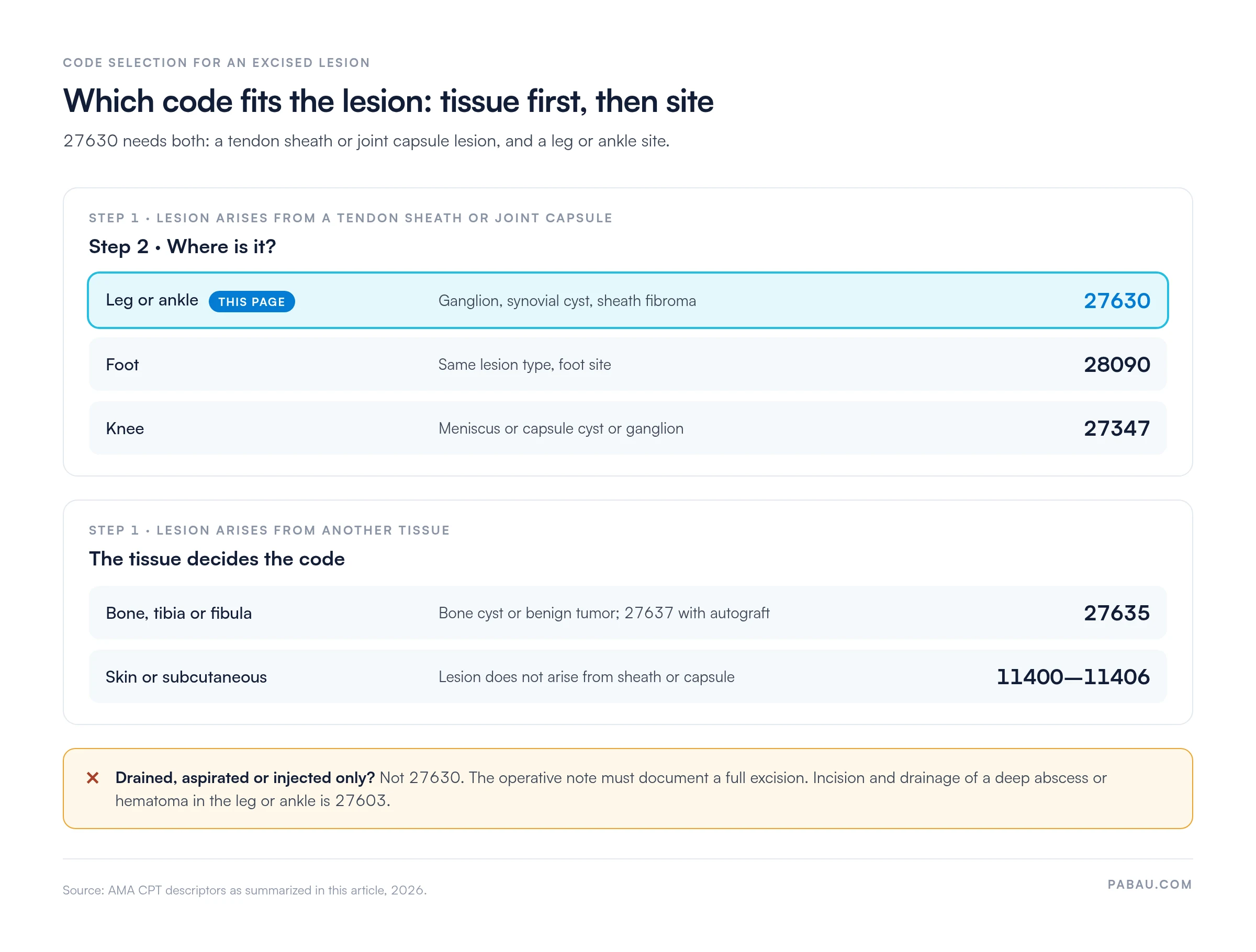
The operative note is the claim’s foundation. A well-constructed note for CPT code 27630 supports clean claim submission. As a result, it prevents the most common denials tied to documentation.
The note must therefore establish all of these:
Next, include a superbill that maps the confirmed diagnosis to the CPT code. Payers cross-reference the operative note against the claim. Therefore, mismatches between the two are a main audit trigger.
Selecting the right ICD-10-CM diagnosis code is as important as the CPT code itself. For this reason, payer edits check that the diagnosis and procedure are clinically linked. The table below also covers the most often paired codes and their laterality variants.
Check ICD-10-CM code pairing rules with each payer. Also, some commercial plans require imaging (MRI or ultrasound) to appear in the record as supporting evidence before approving the diagnosis-to-procedure link.
Modifiers signal clinical context to the payer. In practice, these modifiers are the ones most often required for CPT code 27630.
Modifier 59, in particular, requires careful use. NCCI edits are updated each quarter by CMS, so check current edit pairs before billing 27630 with another code in the same session. Also, check the CMS Physician Fee Schedule lookup tool for the latest bundling restrictions.
Run a quarterly NCCI edit check before billing CPT 27630 with any companion musculoskeletal code. CMS updates the edit tables four times per year. A pair that allowed a modifier 59 bypass last quarter may not allow one this quarter.
The codes most often confused with CPT code 27630 sit in the same musculoskeletal subsection or cover nearby body sites. A side-by-side comparison therefore prevents miscoding.
The split between 27630 and 28090 is the most important in practice. So the operative note must clearly state whether the surgical site is within the leg or ankle or on the foot. In addition, code borderline cases at the ankle-foot junction by the main body structure excised, and document that determination.
Medicare reimbursement for CPT code 27630 is set through the annual CMS Physician Fee Schedule. The 2026 national RVUs below come from the CMS file as listed on FastRVU, and payment varies by geographic pricing locality. Therefore, check with your Medicare Administrative Contractor (MAC) before quoting expected payment to providers.
Commercial payer rates for 27630 vary widely from Medicare national averages. For example, rates often range from 110% to 150% of Medicare based on the contract. Moreover, submitting claims through a clearinghouse reduces submission errors and speeds ERA receipt for this procedure.
Medicare does not require prior authorization for CPT code 27630. However, commercial payers vary: many require pre-authorization for elective soft-tissue excision, especially when the procedure is performed in an ASC setting. Prior authorization rules depend on each plan and region, so check with each payer before booking.
When a commercial plan does require pre-auth, the clinical submission often needs:
Effective denial management in healthcare starts with knowing which errors consistently trigger rejections. Specifically, for CPT 27630, the highest-frequency denial patterns are:
Finally, pair these checks with a medical billing compliance review cycle to catch documentation patterns that create recurring denials.
CPT code 27630 can be billed with other orthopedic codes on the same date, but NCCI edits govern when a separate payment is permitted. In short, the key principle: procedures must be performed at clearly separate body sites, or the pair must not be subject to a column 1/column 2 bundling edit.
Common scenarios and their billing treatment:
Check current edit tables at the AAPC Codify CPT lookup before billing any code pair involving 27630. NCCI edits update each quarter, and commercial payers may also apply their own bundling logic beyond the standard Medicare edits.
The denials in this article share one cause: the operative note and the claim disagree on site, side, or diagnosis. Billing teams often catch that by reading the note against the claim line by line, days after surgery.
In contrast, Pabau keeps the operative note, the diagnosis, and the invoice on the same patient record. Its claims management software then submits the claim electronically through Claim.MD and tracks its status from submission to payment.
As a result, fewer claims are built from memory, and the path from a rejection back to the note is shorter.

Pabau keeps treatment notes and invoices on one patient record, then submits claims electronically through Claim.MD and tracks their status. See how it fits an orthopedic billing workflow.

Code 27630 comes down to two facts in the operative note: what the lesion arose from, and where it sat. Get both on paper before the claim is built, and the foot, knee, bone, and skin alternatives drop away.
The trade-off is a little more time at the point of documentation. However, a surgeon who names the ankle, the sheath, and the side in the note saves the billing team a query and the practice a resubmission.
Pabau keeps that note and the claim on one patient record, then submits through Claim.MD and tracks each claim’s status. Book a demo to see how it fits your orthopedic billing workflow.

Need a systematic approach to claim rejections? Denial management in healthcare covers the framework for tracking, appealing, and preventing recurring claim denials across specialties.
Handling electronic remittance after 27630 claims are paid? Electronic remittance advice explains how to read ERA files, reconcile payments, and identify underpayments from the 835 transaction.
Submitting 27630 claims through a clearinghouse? Medical claims clearinghouse explains how clearinghouses validate claims before they reach payers and which submission formats reduce scrub-related rejections.
CPT code 27630 is the surgical code for excising a lesion from a tendon sheath or joint capsule in the leg or ankle. It applies to ganglion cysts, synovial cysts, and fibromas of the tendon sheath at these anatomical sites, not to foot procedures or bone lesions.
Modifier LT or RT is required by most payers to identify the operative side. Modifier 59 applies when 27630 is billed with another procedure at a distinct site on the same date. Modifier 22 supports billing for substantially increased complexity, and modifier 51 is used for multiple procedures in the same operative session.
Both codes describe excision of a lesion from a tendon sheath or capsule. 27630 applies to the leg or ankle, while 28090 applies to the foot. The anatomical site of the lesion, confirmed in the operative note, determines which code is correct.
Whether a DPM can bill CPT 27630 depends on individual state scope-of-practice laws and payer-specific credentialing requirements. Some payers credential podiatrists for this code when the procedure is within the ankle, while others restrict it to orthopedic surgeons. Verify with each payer before performing and billing the procedure.
No. A ganglion cyst excision at the foot is billed under CPT 28090, not CPT 27630. The anatomical site, leg/ankle versus foot, is the determining factor, and billing 27630 for a foot procedure is a common denial trigger.