HCPCS Code Q4175: Billing, coverage, and documentation guide
HCPCS Code Q4175: Code Description and Product Identity HCPCS Code Q4175 is the ...

Last Updated: Nov 20, 2026
93567 is the CPT code for injection procedure during cardiac catheterization including imaging supervision, interpretation, and report; for supravalvular aortography. It is an add-on code for contrast injected just above the aortic valve to image the aortic root and ascending aorta. It is always reported with a primary heart cath code.
Cardiologists use it to grade aortic regurgitation, size a dilated ascending aorta or define an anomalous coronary origin. An aortic injection made only to find bypass grafts is roadmapping, and the primary code already covers it.
Let Pabau's smart automation suggest the right codes, reduce claim denials, and keep your practice compliant—effortlessly.
Automate repetitive tasks and focus on what matters most—your patients.
Reduce coding errors and ensure compliance with the latest regulations.
Clean claims, fewer denials, and faster reimbursements.
Powerful insights and reporting to help your practice thrive.
HIPAA compliant SOC 2 certified GDPR-compliant Trusted by 4,000+ clinics worldwide

CPT code 93567 is an add-on code for supravalvular aortography, a contrast injection above the aortic valve that images the aortic root and ascending aorta.
It is always reported with a primary cath code that reaches the aorta, such as 93452, 93453 or 93454-93461, and never on its own.
An aortic injection done only to find bypass grafts or the coronary ostia is roadmapping, which the primary code already pays for.
Pulmonary angiography uses different codes: 93568 for a nonselective study, and 93569 or 93573 for selective pulmonary artery work.
The cath report has to say why the physician imaged the aorta, so tie the injection to an indication such as aortic regurgitation.
CPT code 93567 reports supravalvular aortography performed during a cardiac catheterization, including imaging supervision, interpretation and the report.
It is an add-on code, billed with the heart cath that brought the catheter into the aorta. The SCAI coding guidelines for catheterizations pair it with 93452 through 93461, and note that left heart caths don’t include supravalvular aortography.
In the lab, the physician repositions the catheter in the ascending aorta, just above the valve, and power-injects contrast. The run shows the aortic root, the ascending aorta and any contrast leaking back into the left ventricle. That backflow is how aortography grades aortic regurgitation.
A claim that carries 93567 without a primary catheterization code is rejected, because the add-on has nothing to attach to. The table lists the primary codes SCAI pairs with 93567, with a short summary of each descriptor.
Two edge cases need a check against your current CPT book. 93451 is a right heart cath only, so it doesn’t reach the aorta, and SCAI leaves it off its 93567 list. Congenital heart caths moved to 93593-93597 in 2022, so confirm the current parenthetical before pairing 93567 with one of them.
For the primary codes themselves, our guides to CPT code 93458 and CPT code 93459 cover two of the left heart pairings in detail.
93567 belongs to a family of injection add-ons, and each descriptor names the structure being imaged. Choosing the code means reading where the contrast went and why.
Pulmonary work runs through 93568, 93569 and 93573, which were reshaped in the 2023 CPT revision. So a pulmonary embolism or pulmonary hypertension diagnosis on a 93567 line is a mismatch a reviewer will spot quickly.
The biggest overcoding risk with 93567 is billing a quick aortic injection that only guided the catheter. SCAI states that every catheterization code already includes roadmapping angiography to guide catheter placement. Three situations fall on the wrong side of that line.
What makes an aortogram billable is the physician’s intent. AAPC’s Cardiology Coding Alert says 93567 applies to a medically necessary evaluation of the aortic root or ascending aorta.
If the report doesn’t say why the aorta was imaged, a reviewer will read the injection as roadmapping. The diagram below walks through the two questions that settle the code.
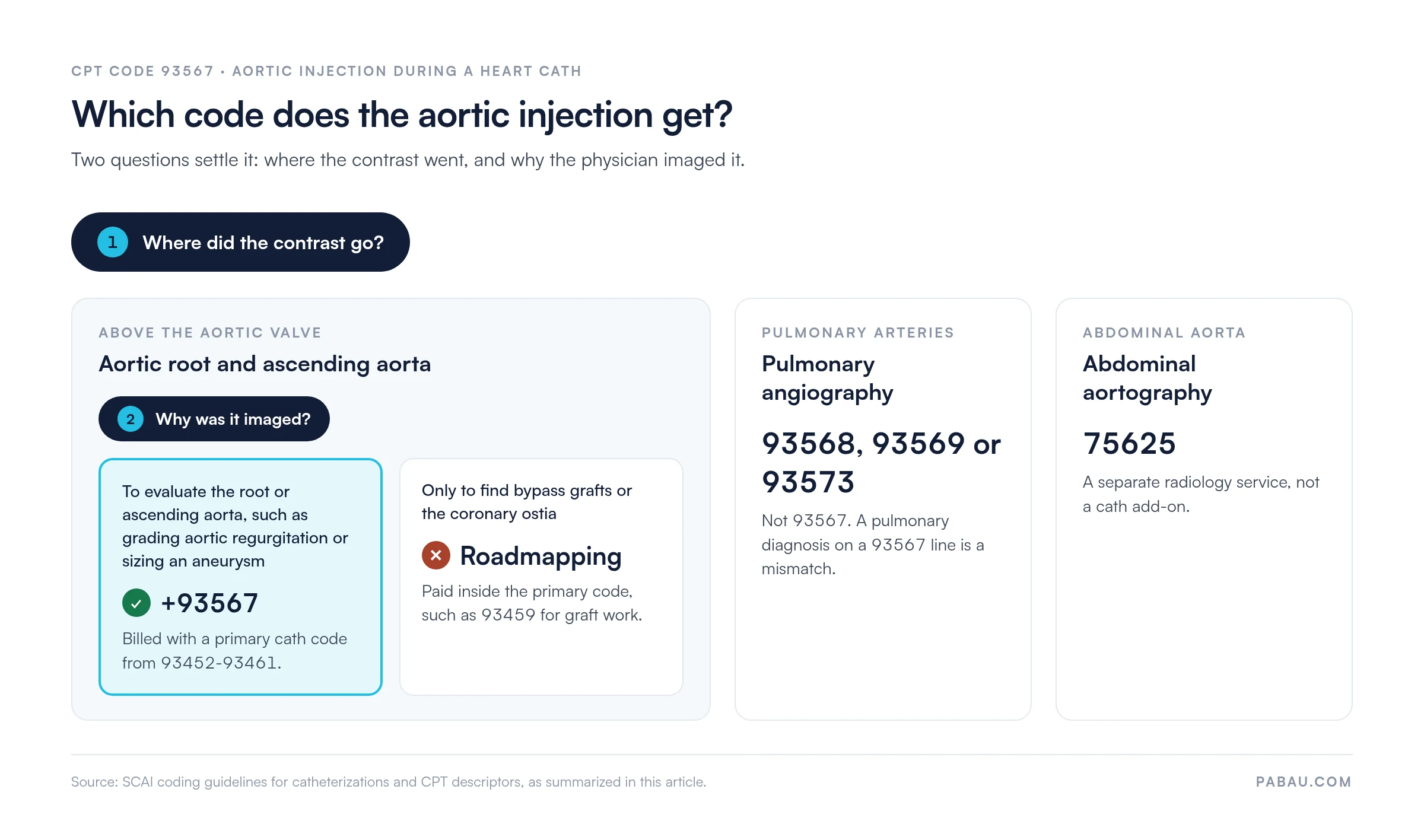
Here is the path a clean 93567 claim takes, and the point where each step can go wrong.
Take an illustrative case. A 68-year-old patient with moderate aortic regurgitation on echo comes in for a planned left heart cath with coronary angiography.
The physician images the coronaries and performs a left ventriculogram. Then the catheter is repositioned above the aortic valve for a power injection, and the report grades the regurgitation as moderate.
The claim reads 93458 for coronary angiography with left heart catheterization, then +93567 for the aortogram. The 93567 line points to I35.1 for the moderate aortic regurgitation.
Change one detail and the coding changes. If the same patient had bypass grafts and the aortic injection only located them, the claim would be 93459 alone.
Medical necessity for 93567 rests on a reason to look at the aortic root or ascending aorta. The codes below fit that purpose. Coverage still varies by payer, so check local policy where one applies.
Auditors read the cath report first. These elements show that the aortogram was a study in its own right.
Medicare pays 93567 under the Physician Fee Schedule as its own line, on top of the primary cath. Rates change every year and by locality, so pull the current figure from the CMS fee schedule lookup rather than a published number.
When a 93567 line is denied, read the CARC and RARC on the remittance first. Our guide to denial codes in medical billing explains the common ones. A missing primary code is fixed with a corrected claim.
A medical necessity denial needs the cath report and a letter tying the aortogram to the diagnosis. Medicare redetermination requests are due within 120 days of receiving the initial determination.
Most 93567 problems start before submission: a lone add-on, a mismatched diagnosis or a report that blurs the aortogram into the graft study. They surface late when charting, charges and claims live in separate systems.
Pabau, a practice management and billing platform, keeps the visit record, the charges and the claim on one patient file. Through its Claim.MD clearinghouse integration, your team checks eligibility in real time and sends electronic claims to thousands of US payers.
Claim statuses and ERAs come back into the same claims management workflow. A denied 93567 line shows up beside the cath it belongs to, so your team can fix it while the appeal window is open.

Pabau connects charting, charges and Claim.MD claim submission, with real-time eligibility checks and ERAs returned to your billing workflow. Spot a denied 93567 line while there is still time to fix it.

Treat 93567 as an aortic study and the coding decisions get simpler. It needs a primary cath that reaches the aorta and a diagnosis that explains the aortic imaging. The report also has to keep the aortogram apart from graft roadmapping.
If one habit changes after reading this, make it the intent check. Before the add-on goes on the claim, find the sentence in the report that says why the physician imaged the aorta. If that sentence is missing, ask for an addendum or leave the code off.
Book a demo to see how Pabau keeps cath claims, eligibility checks and remittances in one place for cardiology practices.

Coding the most common left heart pairing? CPT code 93458 covers coronary angiography with left heart catheterization and its documentation.
Patient has bypass grafts? CPT code 93459 explains how graft angiography changes the primary code.
Left heart cath without coronary angiography? CPT code 93452 walks through the standalone left heart catheterization code.
Want fewer rejections at the clearinghouse? What is a clean claim lists the checks that get a claim paid on first submission.
Seeing a pattern of cath denials? Denial management in healthcare sets out a workflow for tracking and appealing denied lines.
Supravalvular means above the valve. The catheter tip sits in the ascending aorta just above the aortic valve. Contrast then fills the root and shows any backflow into the left ventricle.
Yes, when each injection is a separate, documented study. Check each pairing against the CPT parentheticals and NCCI edits. Extra views of the same structure don’t add another code.
In most cath reports, yes. Aortic root angiography, ascending aortogram and supravalvular aortogram usually describe the same injection above the aortic valve. Code from what was imaged and why it was imaged.
Yes, when the aortogram is medically necessary and billed with a covered primary cath code. Medicare pays it under the Physician Fee Schedule as a separate add-on line.