CPT Code 99509: Home health aide visit for ADL assistance
CPT code 99509: official descriptor and service definition The AMA’s CPT c...

Last Updated: Oct 27, 2026
CPT code 27603 reports incision and drainage of a deep abscess or hematoma of the leg or ankle. Its official descriptor in the AMA’s Current Procedural Terminology code set reads “Incision and drainage, leg or ankle; deep abscess or hematoma.” Medicare assigns it a 90-day global surgical period.
In CPT, the leg is the region between the knee and the ankle, and 27603 covers the ankle as well. An infected bursa in the same region goes to 27604, and the foot has its own incision and drainage codes. A collection that stays in the skin or subcutaneous tissue routes to 10060, 10061 or 10140 instead.

CPT 27603 covers incision and drainage of a deep abscess or hematoma of the leg or ankle, from below the knee down to the ankle.
An infected bursa in the same region is 27604, the foot routes to 28001–28003, and debridement goes to 11042–11047.
The 2026 Medicare Physician Fee Schedule gives 27603 a 90-day global period, so related follow-up care for three months is bundled.
Pabau’s claims management software lets your team check codes, modifiers and diagnosis links before a 27603 claim goes out.
The figures below come from the CMS 2026 relative value file (RVU26D, October 2026 release).
CPT code 27603 covers an open incision into the deep soft tissue of the leg or ankle to drain an abscess or evacuate a hematoma. Deep means the collection lies below the skin and subcutaneous layer, typically beneath the fascia or within muscle.
The anatomical scope runs from just below the knee down to and including the ankle. The procedure typically includes these steps:
Each of these procedures has its own code, even when the site is the leg or ankle:
Three questions decide the code, and the diagram below runs them in the order a coder reads the operative note. Where does the collection sit, how deep does it lie, and is it an abscess or hematoma rather than an infected bursa?
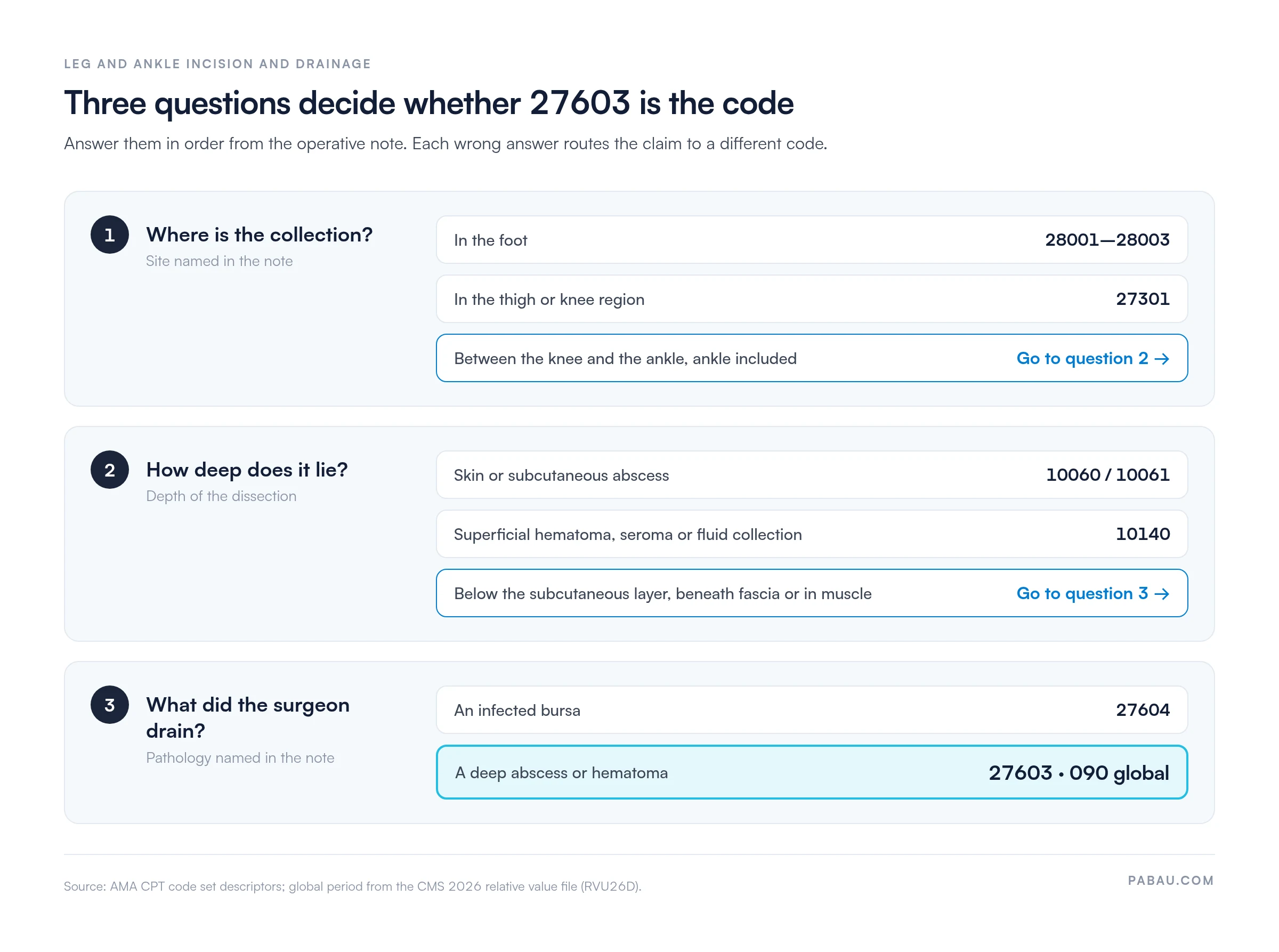
The choice between 27603 and 27604 turns on pathology alone, and the size of the collection plays no part. If the operative note names an infected bursa, report 27604. If it names a deep abscess or hematoma, report 27603.
Medical necessity for 27603 rests on a diagnosis that names a deep abscess, hematoma or infection at the documented site. Local coverage determinations (LCDs) vary, so check your MAC’s current policy before you submit.
Code to the highest specificity the documentation supports. L02.41 needs its sixth character for laterality, and an unspecified code invites a query when the note names the side. An infected bursitis diagnosis, such as M71.17- for the ankle and foot, points to 27604 rather than 27603.
The operative note is the main audit target for a 27603 claim. It should confirm each of these elements:
A superbill that pulls these fields from the operative note stops the coder from guessing. In Pabau, the practice management and billing platform we build, surgical encounter types can carry structured note templates. The required fields are then filled in before the claim is created.
Build a pre-submission check for 27603 claims with five fields. Confirm the site is the leg or ankle and the depth is documented below the subcutaneous layer. Check that the collection is named as an abscess or hematoma. Then confirm laterality and an ICD-10 code that matches the documented diagnosis. A claim that fails any field goes back to the surgeon before coding.
CMS assigns CPT 27603 a 90-day global surgical period in the 2026 Medicare Physician Fee Schedule, per the CMS relative value file. As a major procedure, its package also covers the day before surgery and the day of surgery.
Related postoperative visits, wound checks, packing changes and drain removal over the next 90 days are bundled into the 27603 payment. CMS splits that payment 10% preoperative, 69% intraoperative and 21% postoperative. The split matters when another clinician takes over follow-up care under modifiers 54 and 55.
These modifiers keep a service separately payable inside the global period:
Commercial payers usually follow the CMS global days, but some publish their own lists. Check each contract before you bill a follow-up visit.
Medicare pays 27603 from three relative value units (RVUs). Each one is adjusted by your locality’s geographic practice cost index (GPCI), then multiplied by the annual conversion factor. The 2026 national values are below.
Clinicians who qualify through an advanced APM use the $33.5675 conversion factor. That gives about $547.49 in the office and $373.27 in a facility. Your MAC’s figure changes once your locality’s GPCI is applied, so confirm it in the CMS Physician Fee Schedule lookup tool.
Commercial payers usually pay 27603 as a percentage of the Medicare rate or as a contracted fee. Three variables move that figure:
Traditional Medicare does not generally require prior authorization for an incision and drainage like 27603. Medicare Advantage and commercial plans set their own rules, and some require authorization for musculoskeletal surgery in any setting.
A deep abscess often needs same-day drainage, so check whether the plan accepts notification after an urgent procedure. Record the authorization or notification number on the claim.
Modifier errors on 27603 usually come from laterality, bilateral work, or a second procedure in the same session.
Check the current NCCI procedure-to-procedure edits and the CMS NCCI guidance before you append modifier 59 to a 27603 and 20605 pair.
Use 20605 for the ankle, because the ankle is an intermediate joint. Code 20600 is for small joints such as fingers and toes, and the edit’s modifier indicator decides whether any modifier can bypass it.
Most 27603 denials trace back to the site, the depth or the pathology named in the note. Watch for these seven triggers:
A structured denial management workflow that tracks denial reason codes (CARCs) for 27603 shows which trigger drives your rejections. For a full CARC reference, see common denial codes in medical billing.
Flag every 27603 denial by CARC code for 90 days after a new documentation checklist goes live. If site or pathology denials continue, the cause sits upstream in how the surgeon dictates the note. A short session with the surgical team on site, depth and collection type addresses it at the source.
A coding error on 27603 costs less to fix before the claim is created than during an appeal. That calls for checks on site, depth and modifier pairing at the coding stage.
Pabau’s claims management software lets your billing team code the encounter against the operative note. Your team can then link ICD-10 codes to each line and add modifiers before submission. Claims go out electronically through Claim.MD, our US clearinghouse partner, with eligibility checks before the date of service.
After adjudication, ERA remittance posts automatically and denial reason codes are mapped to categories. Your team sees which 27603 claims failed and why, without reading raw 835 files.
Insurance eligibility verification before each encounter flags authorization and coverage problems while the team can still fix them before the procedure. Combined with consistent coding checks, it raises the share of clean claims that pay on first submission.

Pabau’s claims management software checks codes, modifiers and diagnosis links before submission, so your 27603 claims go out clean the first time.

CPT code 27603 is a narrow code with a clear test. The collection must be a deep abscess or hematoma, and it must sit between the knee and the ankle, ankle included. Superficial, bursal and foot collections each belong to another code.
The 90-day global period is the second point to settle. It bundles three months of related follow-up, so modifiers 24, 57, 58, 78 and 79 decide what stays payable. Practices that confirm site, depth, pathology and global status before coding avoid most rework on this code.
To see how Pabau’s medical billing workflow handles musculoskeletal claims from eligibility to ERA posting, book a demo.

Need a framework for tracking claim rejections by CARC code? Denial management in healthcare covers how to build a structured rejection-tracking workflow that surfaces denial patterns at the code level.
Want to understand how clearinghouse submission works end to end? Medical claims clearinghouse explains how 837P files are validated and routed to payers, and what triggers a front-end rejection before adjudication.
Weighing which clearinghouse to submit through? Claim.MD clearinghouse overview outlines the real-time edit checks and ERA capabilities available through Pabau’s clearinghouse integration.
Is the hematoma superficial rather than deep? CPT code 10140 covers incision and drainage of a hematoma, seroma or fluid collection that stays above the deep tissue.
Aspirating the ankle joint in the same session? CPT code 20605 explains intermediate joint arthrocentesis billing, including the NCCI edits that apply alongside drainage codes.
CPT code 27603 reports incision and drainage of a deep abscess or hematoma of the leg or ankle. The leg runs from below the knee to the ankle, and the ankle is included. A superficial abscess routes to 10060 or 10061, and an infected bursa routes to 27604.
The difference is the pathology. CPT 27603 covers a deep abscess or hematoma of the leg or ankle, and 27604 covers an infected bursa in the same region. The size of the collection plays no part, so the pathology named in the operative note decides the code.
CPT code 27603 carries a 90-day global period in the 2026 Medicare Physician Fee Schedule. Related postoperative visits, wound checks and packing changes for 90 days are bundled into the payment. A decision-for-surgery visit on the day before or the day of surgery needs modifier 57.
Common pairings include L02.415 or L02.416 for an abscess of the right or left lower limb, and M79.81 for a nontraumatic soft-tissue hematoma. Post-traumatic hematomas use S80.11XA or S80.12XA for the lower leg and S90.01XA or S90.02XA for the ankle. T79.3XXA covers a post-traumatic wound infection.
In 2026, CPT 27603 carries 16.31 total RVUs in the office and 11.12 in a facility. At the $33.4009 conversion factor, that is about $544.77 and $371.42 nationally before geographic adjustment. Your locality’s GPCI changes the final figure, so confirm it in the CMS Physician Fee Schedule lookup tool.
It depends on the current NCCI edit for the pair. Use 20605 for the ankle, because the ankle is an intermediate joint, and keep 20600 for small joints such as fingers and toes. Where an edit exists and allows a modifier, 59 or XS can apply when the aspiration and the drainage are at separate sites.
Yes. The 27603 descriptor reads leg or ankle, so a deep abscess or hematoma of the ankle is reported with 27603. Only the foot routes to the foot incision and drainage codes, such as 28001 to 28003. An ankle arthrotomy for joint drainage is reported with 27610.
Common triggers are a site outside the leg or ankle, an infected bursa coded as 27603, and depth the note does not document. Weak ICD-10 linkage, NCCI edits without a valid modifier, and global period conflicts follow. Tracking denial reason codes (CARCs) at the code level shows which trigger affects your practice.