

HCPCS Code Q4185: Cellesta flowable amnion billing guide
HCPCS Code Q4185: definition and official descriptor HCPCS Code Q4185 is the Lev...

Last Updated: Nov 20, 2026
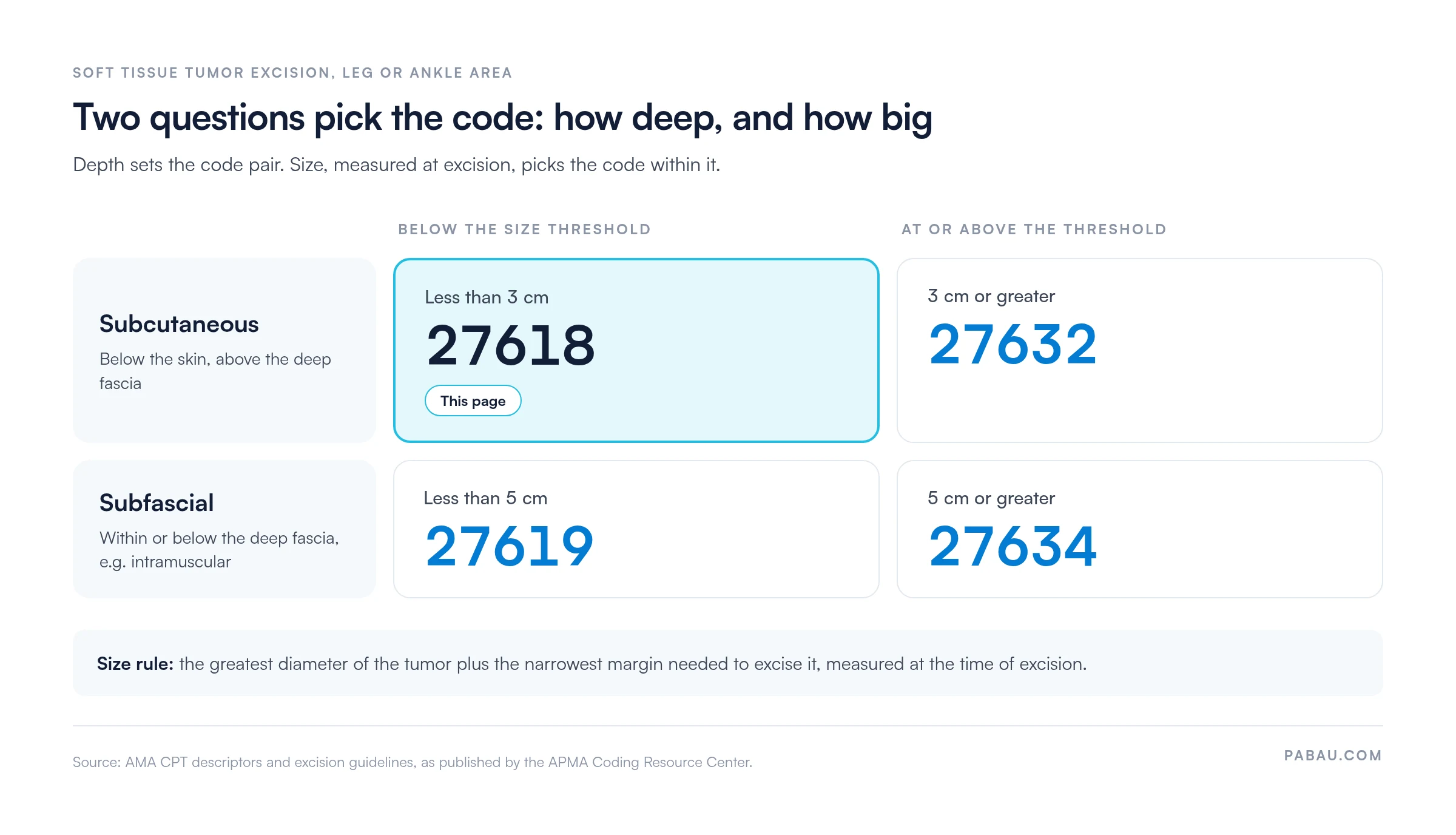
27618 is the CPT code for excision, tumor, soft tissue of leg or ankle area, subcutaneous; less than 3 cm. It covers removal of a mass that sits above the deep fascia of the lower leg or ankle and measures under 3 cm, margin included.
Two facts decide the code: depth and size. A tumor below the fascia takes 27619, and a subcutaneous tumor of 3 cm or more takes 27632. The operative note has to state both facts for these claims to hold up.
Let Pabau's smart automation suggest the right codes, reduce claim denials, and keep your practice compliant—effortlessly.
Automate repetitive tasks and focus on what matters most—your patients.
Reduce coding errors and ensure compliance with the latest regulations.
Clean claims, fewer denials, and faster reimbursements.
Powerful insights and reporting to help your practice thrive.
HIPAA compliant SOC 2 certified GDPR-compliant Trusted by 4,000+ clinics worldwide

CPT code 27618 covers excision of a subcutaneous soft tissue tumor of the leg or ankle area, less than 3 cm including the excision margin.
Depth sets the code pair. Subcutaneous tumors take 27618 or 27632, while subfascial or intramuscular tumors take 27619 or 27634.
Operative notes must document the tumor size measured at excision. A missing or vague size notation is a leading denial trigger.
Claims management software such as Pabau scrubs each claim for missing or invalid details before submission, so fewer excision claims come back for rework.
CPT code 27618 reports the excision of a subcutaneous soft tissue tumor of the leg or ankle area that measures less than 3 cm. The code sits in the Musculoskeletal System section of the CPT codebook, under the Leg (Tibia and Fibula) and Ankle Joint subsection.
The official descriptor is reproduced in APMA’s 2010 CPT code summary. It reads: ‘Excision, tumor, soft tissue of leg or ankle area, subcutaneous; less than 3 cm.’
The anatomy covered is the lower leg (tibia and fibula region) through the ankle joint. Tumors of the foot and the thigh take their own code families.
CPT code 27618 applies to a specific, narrow set of surgical scenarios. Understanding the boundaries prevents both undercoding and upcoding.
Size means the tumor’s greatest diameter plus the narrowest margin needed to remove it. It is measured at the time of excision, not on pre-operative imaging. If that measurement reaches 3 cm, the claim takes 27632 instead of 27618. Payers audit this during post-payment review by comparing the operative note measurement to the billed code.
Payers require operative notes that connect directly to the billed code elements. Each step below corresponds to a documentation element auditors check.
Run a documentation checklist before closing each operative note for a CPT 27618 claim. Check the site with laterality, size in centimeters, subcutaneous depth, and pathology submission. A note missing any one of these elements is likely to generate a medical necessity or coding-level denial.
The subcutaneous vs. subfascial distinction separates 27618 from 27619 and is the most common source of coding errors on soft tissue excision claims. CPT 27632 covers the same subcutaneous excision at 3 cm or greater, so size separates it from 27618.
The decision rule follows the operative note. If the fascia was not opened and the tumor plus margin measured under 3 cm, 27618 is correct. A fascial incision or intramuscular involvement points to 27619 or 27634. A subcutaneous measurement of 3 cm or more points to 27632, as the grid below shows.
Modifier selection for CPT code 27618 affects both payment and audit exposure. Each modifier must be supported by specific documentation in the record.
Laterality modifiers (LT and RT) are required by most Medicare Administrative Contractors (MACs) for bilateral anatomic sites. A claim for CPT code 27618 missing a laterality modifier when no bilateral modifier 50 is present is a frequent edit trigger.
Medicare payment for CPT code 27618 follows the CMS Physician Fee Schedule (MPFS). Rates differ between non-facility settings (office) and facility settings (hospital outpatient or ASC). A clearinghouse such as Claim.MD routes the claim to CMS or to thousands of other US payers.
Medicare rates change with each annual MPFS update. Always verify current figures directly in the CMS MPFS lookup before quoting reimbursement to physicians or practice staff. Commercial payer rates typically range higher than Medicare, but vary significantly by contract.
Payers require a diagnosis code that establishes medical necessity for the excision. A symptom-only ICD-10 code as the primary diagnosis is one of the most consistent denial triggers for CPT code 27618 claims.
Use the most specific ICD-10 code available. If laterality is documented in the operative note, always use the laterality-specific D21.21/D21.22 or D17.23/D17.24 codes rather than the unspecified D21.20. Laterality specificity in the diagnosis code supports the LT/RT modifier on the procedure code and reduces edit exposure.
Prior authorization requirements for CPT code 27618 vary by payer and plan type. Medicare Fee-for-Service generally does not require prior authorization for this procedure. Insurance eligibility verification before scheduling is the fastest way to confirm whether authorization is needed for a specific patient’s plan.
When authorization is required, the submission package should include the clinical note documenting palpable mass characteristics, any available imaging, and a statement of medical necessity. Some commercial payers also ask for documentation of a failed conservative observation period, particularly for smaller lesions.
Most denials on CPT code 27618 are preventable. The six patterns below cover the usual rejections on soft tissue excision claims in the leg and ankle region, each with its workflow fix.
A structured denial management workflow tracks and trends them by denial reason code. The full list of denial codes in medical billing explains the CARC/RARC codes on remittances.
A clean claim for CPT code 27618 clears all six checks before submission. Reviewing against this list at the point of charge capture, rather than after a denial, is the most cost-effective approach. See clean claim submission best practices for the full pre-submission checklist framework.
Set a charge-capture rule that holds CPT 27618 claims until the operative note is finalized. The note needs five elements: laterality, size in cm, subcutaneous depth, a D21 or D17 diagnosis, and the pathology accession number. Releasing charges without all five is the fastest path to a denial queue.
Surgical excision claims carry more documentation dependencies than evaluation and management codes. Depth, size, laterality and diagnosis all have to match between the operative note and the claim form.
Pabau’s claims management software scrubs every claim for missing or invalid details before it goes out. It then tracks each claim’s status, so a rejected 27618 claim surfaces within days instead of at month-end reconciliation.
Modifier logic, ICD-10 specificity and a complete note are the medical billing basics behind a clean 27618 claim, and they stay the coder’s job. Pabau sends claims through the Claim.MD clearinghouse, which connects to thousands of US payers. Eligibility responses and electronic remittance advice come back against the same patient record.

Pabau’s claims management software scrubs every claim for missing or invalid details before submission, then tracks it through to remittance. See how it fits your surgical billing team.

Code 27618 holds up on audit when the operative note states three facts in plain words. The tumor sat above the fascia, it measured under 3 cm with its margin, and the note names the leg. Each fact settles a separate coding decision, so a missing one leaves the payer to decide.
Build those three facts into the note template and hold the charge until they are there. The denials left on this code family are then the ones a note could not have prevented. Book a demo to see how Pabau checks each excision claim for missing details before it reaches the payer.

Need a clearinghouse integration for surgical claims? Claim.MD clearinghouse guide explains how the integration handles CPT claims across thousands of US payers.
Building a denial recovery process? Electronic remittance advice covers how ERA files map CARC and RARC codes back to specific claim lines for faster appeals.
Looking for the 837 transaction format for surgical claims? 837 file guide walks through the EDI transaction structure used for professional claim submission.
CPT code 27618 covers excision of a subcutaneous (above-fascia) soft tissue tumor of the leg or ankle area, less than 3 cm. The size is the tumor plus its margin, measured at excision. Subfascial tumors take 27619 or 27634, and radical resection of a malignant tumor takes 27615 or 27616.
CPT 27618 covers subcutaneous tumors (above the fascia) less than 3 cm. CPT 27619 covers subfascial or intramuscular tumors less than 5 cm in the same anatomic region. The deciding fact is whether the fascia was entered during excision, which the operative note must state explicitly.
The most common are LT or RT for laterality and modifier 50 for bilateral excision in the same session. Modifier 59 marks a distinct procedural service on the same date, and modifier 22 marks increased complexity. Modifier 25 is appended to a same-day E/M code, not to 27618 itself.
Medicare Fee-for-Service generally does not require prior authorization for CPT 27618. Medicare Advantage plans, Medicaid managed care, and many commercial plans commonly require it. Verify authorization requirements for each patient’s specific plan before scheduling the procedure.
The most frequent denials are a wrong depth code (27618 billed when 27619 is correct) and an undocumented tumor size. A symptom-only primary diagnosis, a missing laterality modifier, and a same-day E/M without modifier 25 complete the list.
Yes, a same-day E/M can be billed with CPT 27618 when it is significant and separately identifiable from the surgical decision. Modifier 25 is required on the E/M code. A note that only documents the surgical plan does not support a separate E/M charge.





