Pabau Engage inbox

Pabau Engage is here: every patient conversation in one inbox.

Learn more
CPT Code

CPT code 27635 – Excision or curettage of tibia or fibula bone cyst or tumor


Code Definition

27635 is the CPT code for excision or curettage of a bone cyst or benign tumor of the tibia or fibula, without a graft.

It covers lesions such as unicameral and aneurysmal bone cysts, enchondromas, and giant cell tumors. When the cavity is grafted, the claim moves to 27637 for autograft or 27638 for allograft. Partial excision for osteomyelitis belongs to 27640 or 27641.

Section
10004-69990 Surgery
Subsection
20100-29999 Musculoskeletal system
Code range
27613-27647 Excision procedures on the leg (tibia and fibula) and ankle joint
Billable
No
Code also known as
tibial or fibular bone cyst excision, benign bone tumor curettage of the tibia or fibula
Save time. Improve accuracy. Get paid faster.
Automate coding with Pabau

Let Pabau's smart automation suggest the right codes, reduce claim denials, and keep your practice compliant—effortlessly.

  • AI-powered code suggestions
  • Real-time compliance checks
  • Faster claims, fewer denials
Why practices choose Pabau
Save hours every week

Automate repetitive tasks and focus on what matters most—your patients.

Improve accuracy

Reduce coding errors and ensure compliance with the latest regulations.

Get paid faster

Clean claims, fewer denials, and faster reimbursements.

Grow with confidence

Powerful insights and reporting to help your practice thrive.

HIPAA compliant SOC 2 certified GDPR-compliant Trusted by 4,000+ clinics worldwide

Key takeaways

Key takeaways

CPT code 27635 reports excision or curettage of a bone cyst or benign tumor of the tibia or fibula when no bone graft is placed.

Grafting the cavity changes the code: 27637 covers autograft, including the graft harvest, and 27638 covers allograft.

Partial excision of tibial or fibular bone without a cyst or tumor, such as craterization for osteomyelitis, belongs to 27640 or 27641.

The diagnosis code must name the lesion and the side, such as M85.461 for a solitary bone cyst of the right tibia and fibula.

CMS lists 27635 with a 90-day global period and a 150% bilateral payment rule, and Medicare does not pay an assistant at surgery.

What CPT code 27635 covers

CPT code 27635 covers excision or curettage of a bone cyst or benign tumor of the tibia or fibula, with no bone graft placed. The official AMA CPT code set descriptor reads “Excision or curettage of bone cyst or benign tumor, tibia or fibula.” Two indented child codes share that stem and add a graft: 27637 and 27638.

The lesion defines the code. The surgeon may remove the lesion whole or scrape it out with a curette, and both count as 27635. A malignant tumor removed with a margin of healthy tissue moves to the radical resection codes, 27645 for the tibia and 27646 for the fibula.

Code elementDetail
Code number27635
Official descriptorExcision or curettage of bone cyst or benign tumor, tibia or fibula;
CPT sectionSurgery, musculoskeletal system (20100-29999)
Body regionLeg (tibia and fibula) and ankle joint (27600-27899)
SubsectionExcision procedures on the leg (tibia and fibula) and ankle joint (27613-27647)
GraftNone. A graft moves the claim to 27637 (autograft) or 27638 (allograft).
Global period090 days, per the CMS physician fee schedule relative value file

Surgical technique and clinical context

A typical 27635 case starts with a lesion seen on X-ray or MRI, often after pain, swelling, or a fracture through weakened bone. Common lesions include unicameral and aneurysmal bone cysts, enchondromas, fibrous dysplasia, and giant cell tumors of bone.

The surgeon exposes the bone, opens a cortical window over the lesion, and removes its contents with curettes, a high-speed burr, or both. Some surgeons also treat the cavity wall with a local adjuvant, such as phenol or cryotherapy, to lower the recurrence risk.

  • Approach: Open exposure of the tibia or fibula, with a cortical window large enough to reach the whole cavity.
  • Removal: Excision of the lesion or curettage of its lining, often extended with a burr.
  • Specimen: Tissue goes to pathology, and the final pathology diagnosis drives the ICD-10-CM code.
  • Defect management: An ungrafted cavity stays on 27635. Packing it with bone graft moves the claim to 27637 or 27638.
  • Fixation: Prophylactic fixation of a weakened tibia is a separate procedure (27745) with its own documentation.

27635 vs 27637, 27638, 27640 and 27641: Choosing the correct code

The tibia and fibula excision codes split on two questions. Was the lesion a cyst or benign tumor, and was the cavity grafted? The work RVUs below come from the 2026 CMS relative value file and show how much each answer changes the claim.

CodeOfficial descriptorWhen it appliesWork RVU (CMS 2026)
27635Excision or curettage of bone cyst or benign tumor, tibia or fibula;Cyst or benign tumor removed, cavity left ungrafted7.83
27637with autograft (includes obtaining graft)Same lesion, cavity packed with the patient’s own bone10.05
27638with allograftSame lesion, cavity packed with donor bone10.72
27640Partial excision (craterization, saucerization, or diaphysectomy), bone (eg, osteomyelitis); tibiaPartial removal of tibial bone with no cyst or tumor, such as osteomyelitis11.93
27641Partial excision (craterization, saucerization, or diaphysectomy), bone (eg, osteomyelitis); fibulaPartial removal of fibular bone with no cyst or tumor9.59
27645Radical resection of tumor; tibiaMalignant or aggressive tibial tumor removed with margins26.53
27646Radical resection of tumor; fibulaMalignant or aggressive fibular tumor removed with margins22.63

Use the operative note and the pathology report together to pick the code:

  • Cyst or benign tumor, cavity left empty: Report 27635.
  • Same lesion, the patient’s own bone packed into the defect: Report 27637, which already includes harvesting the graft.
  • Same lesion, donor bone packed into the defect: Report 27638.
  • No cyst or tumor, such as osteomyelitis or a bony spur: Look at 27640 for the tibia or 27641 for the fibula.
  • Malignant tumor resected with margins: Report 27645 or 27646.

Laid out as a decision path, those questions sort every tibia or fibula excision into one of seven codes.
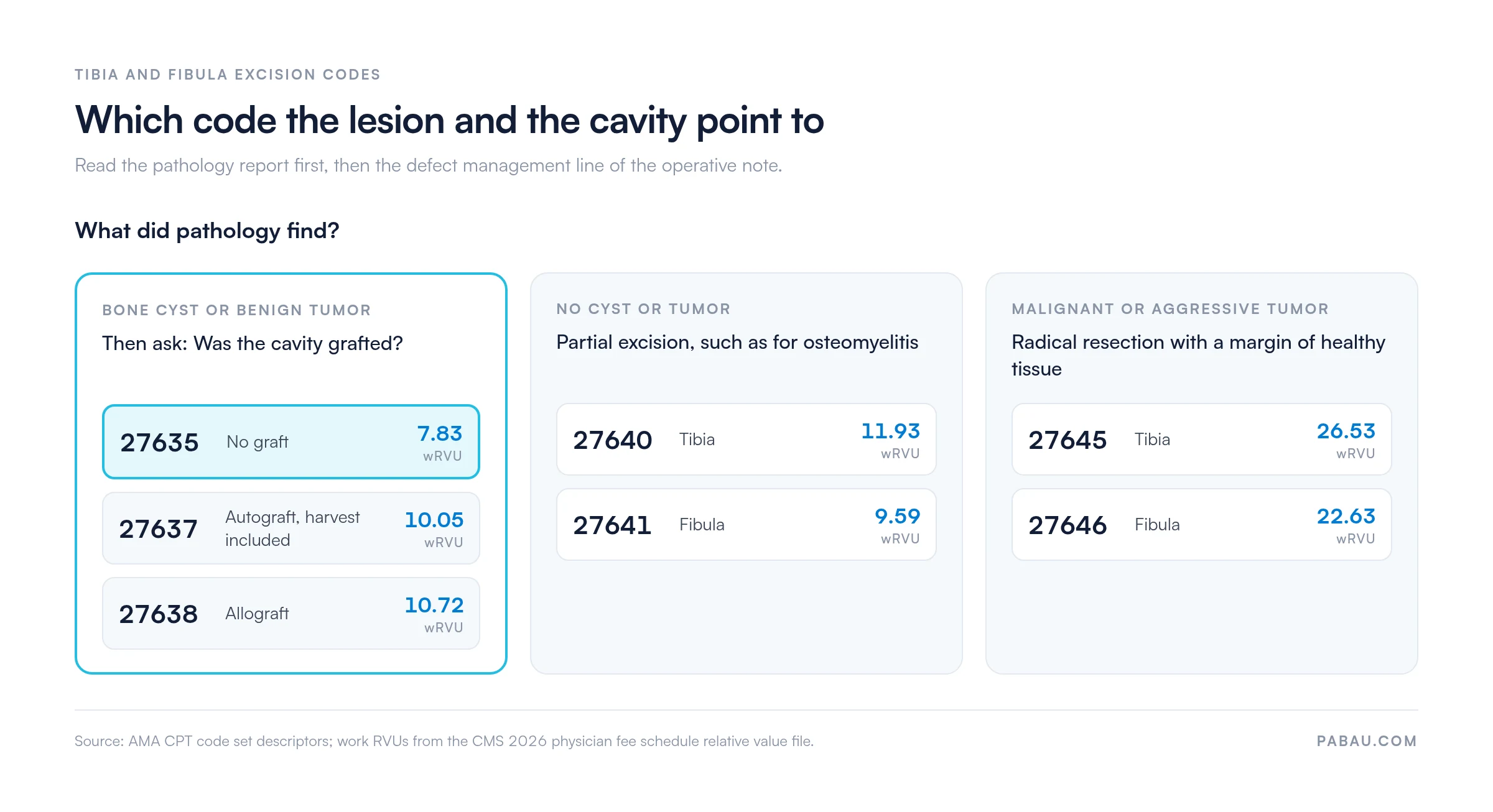
Decision diagram for tibia and fibula excision codes. Bone cyst or benign tumor: 27635 no graft, work RVU 7.83; 27637 autograft, 10.05; 27638 allograft, 10.72. No cyst or tumor, partial excision: 27640 tibia, 11.93; 27641 fibula, 9.59. Malignant or aggressive tumor, radical resection: 27645 tibia, 26.53; 27646 fibula, 22.63.
Pathology picks the branch and the graft picks the code within it, so a missed graft on 27635 under-reports the work. Work RVUs come from the CMS 2026 relative value file.

The same graft split runs through the bone cyst codes for other sites. A clavicle or scapula cyst packed with donor bone, for example, is reported with 23146.

No excludes note in the CPT code set sends spur, osteophyte, or exostosis removal to 27635. If an older reference says otherwise, check it against the current AMA descriptor before you code.

ICD-10-CM codes commonly paired with CPT 27635

Payers expect a diagnosis that names a cyst or benign tumor of the tibia or fibula, with laterality. These ICD-10-CM codes match the lesions 27635 describes:

ICD-10-CM codeDescriptionClinical scenario
M85.461Solitary bone cyst, right tibia and fibulaUnicameral bone cyst, right leg
M85.462Solitary bone cyst, left tibia and fibulaUnicameral bone cyst, left leg
M85.561Aneurysmal bone cyst, right lower legAneurysmal bone cyst, right tibia or fibula
M85.562Aneurysmal bone cyst, left lower legAneurysmal bone cyst, left tibia or fibula
M85.661Other cyst of bone, right lower legOther bone cyst, right leg
M85.662Other cyst of bone, left lower legOther bone cyst, left leg
M85.061Fibrous dysplasia (monostotic), right lower legSingle-bone fibrous dysplasia, right leg
M85.062Fibrous dysplasia (monostotic), left lower legSingle-bone fibrous dysplasia, left leg
D16.21Benign neoplasm of long bones of right lower limbEnchondroma or other benign tumor, right tibia or fibula
D16.22Benign neoplasm of long bones of left lower limbEnchondroma or other benign tumor, left tibia or fibula
D48.0Neoplasm of uncertain behavior of bone and articular cartilageGiant cell tumor of bone (confirm in the ICD-10-CM Index)

Code from the final pathology report once it is available. A lesion treated as a simple cyst can come back as a giant cell tumor, and the diagnosis code must follow the report.

Codes for spurs and other bone disorders do not describe a cyst or tumor. Examples are M89.8X6 (Other specified disorders of bone, lower leg) and M89.8X7 (Other specified disorders of bone, ankle and foot). On their own, they do not support 27635.

Pro Tip

Check the clean claim submission requirements for your MAC before filing. An unspecified-side code such as M85.469 invites a records request when the operative note already names the side.

Modifiers for CPT code 27635

Modifier choice for 27635 depends on the side treated, whether both legs were operated on, and who assisted. The CMS payment indicators in the relative value file settle the bilateral and assistant questions.

ModifierWhen to usePayment impact
RT / LTUnilateral procedure on the right or left legNo change to payment. It identifies the side for edits and audits.
50Lesions treated on both legs in the same sessionCMS bilateral indicator 1 applies. Payment is the lower of the actual charges or 150% of the single-procedure amount.
22Work substantially greater than usual, such as an unusually large or complex cavityExtra payment only with a documented explanation. Expect payer review.
59 / XSA separate lesion or site where an NCCI edit would otherwise bundle a second procedureBypasses the edit only when the operative note supports a distinct service.
80 / 82 / ASAssistant at surgeryCMS assistant indicator 1: Medicare does not pay an assistant on 27635. 27637 and 27638 carry indicator 2, so an assistant may be paid there.
58 / 78 / 79A staged, return-to-OR, or unrelated procedure during the 90-day global periodKeeps the second procedure from being bundled into the 27635 global package.

Some commercial payers want two lines, 27635-RT and 27635-LT, instead of modifier 50. Check the payer’s billing manual before you submit a bilateral claim, because Medicare rules do not carry over automatically.

Medicare payment for CPT code 27635

Medicare pays CPT code 27635 under the physician fee schedule. The figures below come from the 2026 CMS relative value file, October release, before any geographic adjustment.

ItemCMS value for 27635
Work RVU7.83
Facility practice expense RVU7.12
Malpractice RVU1.39
Total facility RVUs16.34
Non-facility pricingNot priced (NA). CMS prices 27635 as a facility procedure.
National facility amountAbout $545.77 at the $33.4009 conversion factor, or $548.49 at the $33.5675 qualifying APM factor
Global period090 days
Payment indicatorsMultiple procedure 2, bilateral 1, assistant at surgery 1, co-surgeons 1

These are national amounts. Your MAC locality’s geographic practice cost indices move the final payment, so pull the locality rate from the CMS physician fee schedule look-up tool. Confirm which conversion factor applies to your practice before you build payer contracts.

Documentation requirements for a 27635 claim

The operative report has to show that a cyst or benign tumor was removed from the tibia or fibula, and that no graft went in. These elements carry the claim through audit:

  • Bone and side: Tibia or fibula, right or left, and where on the bone the lesion sat (proximal, shaft, or distal).
  • Lesion type: The imaging diagnosis and the working diagnosis, such as unicameral bone cyst or enchondroma.
  • Technique: Excision or curettage, the size of the cortical window, and any burr or adjuvant used.
  • Defect management: A clear statement that no graft was placed, or the graft type if one was.
  • Specimen: Confirmation that tissue went to pathology, with the final result added once it returns.
  • Additional procedures: Any biopsy, fixation, or second site, each described on its own.

Reference the preoperative imaging report in the operative note. Payers often request it when they review 27635 for medical necessity. Pabau, the practice management platform we build, keeps that imaging, the operative note, and the claim in one patient record.
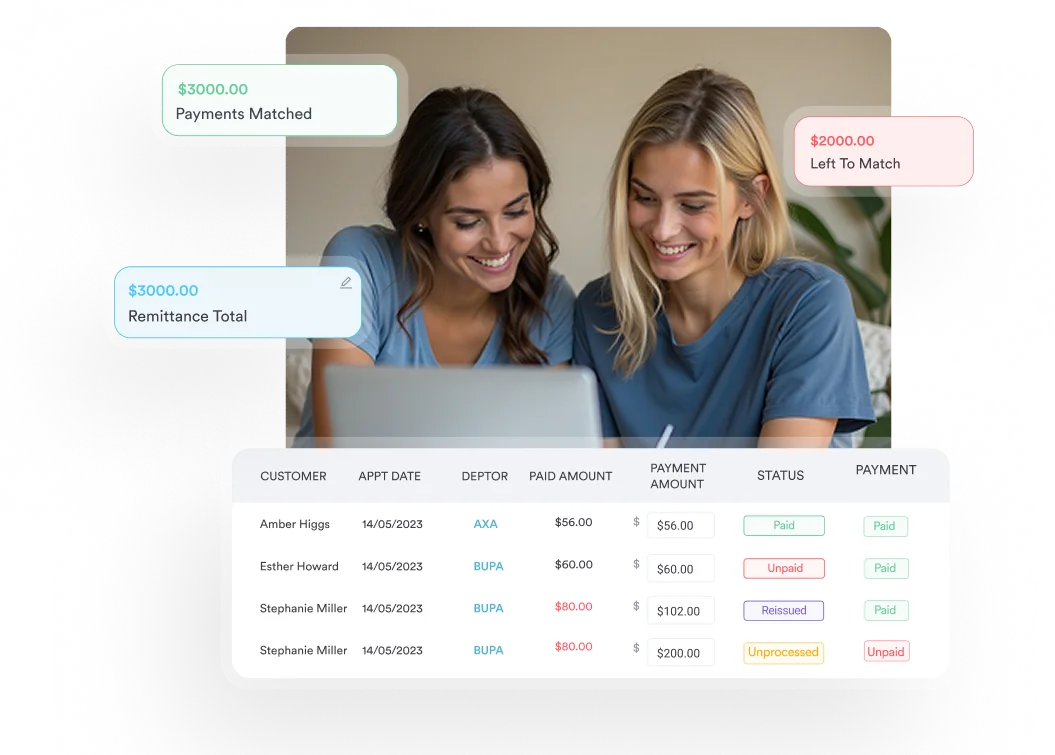
Fully Integrated with Pabau Billing
Pabau’s billing tools keep the operative note and pathology result beside the claim, so the graft and diagnosis lines match before submission.

Prior authorization and payer requirements

Traditional Medicare does not list 27635 in its hospital outpatient prior authorization program. Commercial and Medicare Advantage plans set their own rules, so check each plan’s surgical authorization list before you schedule.

  • Authorize all three graft options: The surgeon often decides on a graft during the operation. Request authorization that covers 27635, 27637, and 27638 so the final code is not left unauthorized.
  • Imaging: Send the X-ray or MRI report that shows the lesion, its size, and its location on the bone.
  • Clinical reason: State why the lesion needs surgery, such as pain, growth on serial imaging, or fracture risk.
  • Medicare Advantage: A plan can require authorization that traditional Medicare does not. Verify it for each plan your practice works with.

Keeping current medical billing compliance protocols for prior authorization cuts surgical cancellations and protects revenue. Record the authorization number, the approval date, and the codes covered in the patient record before the day of surgery.

Common denial reasons for CPT code 27635 and how to avoid them

Common 27635 denials trace back to a code that does not match the operative note or a diagnosis that does not match the code. These are the patterns to watch:

Denial reasonRoot causePrevention step
Graft not reflected in the codeA graft was placed but 27635 was billed, or a separate harvest code was added to 27635Code from the defect management line. 27637 already includes obtaining the graft.
Diagnosis does not support the procedureA spur, osteophyte, or nonspecific bone code sits on the claimMatch the ICD-10-CM code to the final pathology report.
Authorization does not cover the billed codeAuthorization was requested for 27635 only, and a graft was added in surgeryRequest authorization covering 27635, 27637, and 27638.
Modifier errorRT or LT is missing, or modifier 50 was used where the payer wants two linesCheck the payer’s bilateral billing preference before submission.
Assistant at surgery deniedModifier 80, 82, or AS was billed with 27635 to MedicareDo not bill an assistant on 27635 to Medicare. CMS assistant indicator 1 blocks payment.
Bundled into the global periodA second procedure or visit inside the 90 days was billed without a modifierAppend 58, 78, 79, or 24 when the documentation supports it.

A structured denial management strategy for orthopedic claims should track 27635 denials by root cause as well as by code. Grouping them shows whether the fix is coder training, note templates, or payer rules. For a full reference to common denial codes in medical billing, review the CARC table before you write appeal letters.

Pro Tip

Before you appeal a 27635 denial, find the Claim Adjustment Reason Code (CARC) on the remittance. CARC 4 means the procedure code is inconsistent with the modifier used, or a required modifier is missing. CARC 11 means the diagnosis is inconsistent with the procedure. CARC 97 means the service is included in another service already adjudicated. Each one needs a different appeal.

Codes billed with CPT 27635 and NCCI edits

A few codes appear alongside 27635 in bone cyst and benign tumor surgery. NCCI edits decide which pairs are payable and which need a modifier, and they update quarterly. Check the current CMS NCCI procedure-to-procedure edits before you bill any pair.

CodeOfficial descriptorBilling relationship with 27635
20245Biopsy, bone, open; deep (eg, humeral shaft, ischium, femoral shaft)Reported on its own when the open biopsy happens in a separate session. A same-session biopsy of the same lesion is usually part of the excision.
20900Bone graft, any donor area; minor or small (eg, dowel or button)Do not add it to 27635 to show a graft. Report 27637 instead, which includes obtaining the graft.
27637Excision or curettage of bone cyst or benign tumor, tibia or fibula; with autograft (includes obtaining graft)Replaces 27635 for the same lesion. Report one of 27635, 27637, or 27638 per lesion, never two.
27638Excision or curettage of bone cyst or benign tumor, tibia or fibula; with allograftReplaces 27635 for the same lesion when donor bone fills the cavity.
27745Prophylactic treatment (nailing, pinning, plating or wiring) with or without methylmethacrylate, tibiaMay accompany 27635 when a large cavity leaves the tibia at fracture risk. Document the reason and check the NCCI edit first.

How claims management software reduces errors for CPT code 27635

A bone cyst claim can only be coded once the surgery is over. The final code depends on what happened to the cavity and what pathology found, and both arrive after the booking.

In Pabau, the pathology result lands in the same record as the operative note. Its claims software for surgeons lets your billing team check the graft line and the diagnosis before the claim is built.

Claims go out electronically through Claim.MD, with eligibility checks before surgery and remittance posted back to the same record. When a 27635 claim is denied, your team can trace the CARC to its cause and fix it once.

Get bone cyst and tumor claims right the first time

Pabau keeps operative notes, pathology results, and claims in one record, so your team codes 27635, 27637, or 27638 from what happened in surgery.

Pabau claims management dashboard for orthopedic billing

Conclusion

CPT 27635 is a narrow code: One lesion type, two bones, and no graft. The costly errors come from stretching it over procedures it does not describe, such as spur removal or a grafted cyst.

Code from the operative note and the final pathology report, not from the booking. Ask for authorization that covers all three graft options, and remember that Medicare will not pay an assistant at surgery on 27635.

Book a demo to see how Pabau keeps operative notes, pathology, and claims together so your orthopedic claims go out right the first time.

Continue your research

Continue your research

Need to understand how the clearinghouse processes your 27635 claim? Pabau’s Claim.MD clearinghouse guide explains how electronic claims are validated, scrubbed, and routed to payers.

Confused by the 837 file format your clearinghouse requires? 837 file billing guide covers the transaction set structure and common submission errors.

Want to reduce denial rates across your orthopedic billing? Electronic remittance advice (ERA) processing guide shows how automated ERA posting surfaces denial patterns faster than manual EOB review.

Frequently asked questions

What is CPT code 27635?

CPT code 27635 reports excision or curettage of a bone cyst or benign tumor of the tibia or fibula, without a bone graft. It sits in the leg and ankle excision subsection (27613-27647) and carries a 90-day global period.

What is the difference between CPT 27635, 27637 and 27638?

All three describe the same cyst or benign tumor procedure on the tibia or fibula. 27635 has no graft, 27637 adds autograft including the harvest, and 27638 adds allograft.

Is CPT 27635 used for bone spur or osteophyte removal?

No. A spur or osteophyte is not a bone cyst or benign tumor, so it does not fit the 27635 descriptor. Partial excision of tibial or fibular bone is reported with 27640 or 27641.

Which ICD-10 codes support CPT 27635?

A solitary bone cyst pairs with M85.461 or M85.462, and an aneurysmal bone cyst with M85.561 or M85.562. A benign tumor uses D16.21 or D16.22. Code from the final pathology report.

What modifiers are used with CPT code 27635?

RT or LT identifies the leg, and modifier 50 reports both legs in one session at Medicare’s 150% bilateral rate. Medicare does not pay an assistant at surgery on 27635.

How much does Medicare pay for CPT code 27635?

The 2026 CMS relative value file lists 16.34 total facility RVUs for 27635. That is about $545.77 nationally at the $33.4009 conversion factor, before your locality adjustment.

Why would a claim for CPT code 27635 be denied?

Common causes are a graft billed under 27635, a diagnosis that does not describe a cyst or tumor, and modifier errors. An authorization limited to 27635 is another. The CARC on the remittance shows which one applies.
Avatar photo
Maja Popovska
Content Writer

Maja is a Senior Content Writer at Pabau, where she covers everything from practice management and compliance to medical aesthetics and patient experience. Off the clock: binging true crime docuseries, baking and dreaming about travel.
×