HCPCS Code G0163: Skilled nursing observation and assessment
What is HCPCS Code G0163? HCPCS Code G0163 is a deleted Level II code for skille...

Last Updated: Oct 15, 2026
CPT code 27245 covers treatment of an intertrochanteric, peritrochanteric, or subtrochanteric femoral fracture with an intramedullary implant. Interlocking screws and cerclage wire sit inside that descriptor, so neither is billable on a separate line.
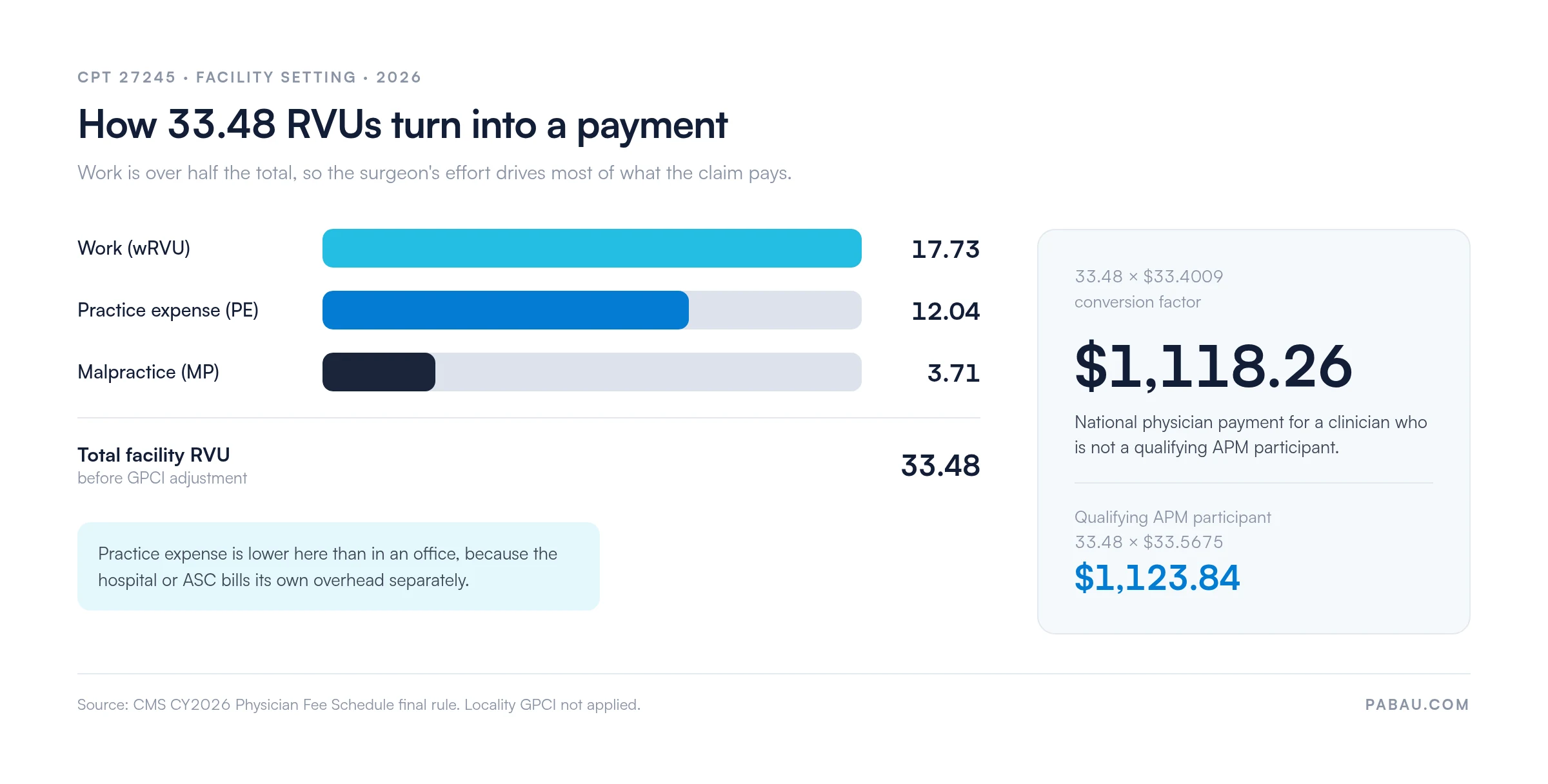
The code carries 33.48 total facility RVUs and a 90-day global period. At the 2026 Medicare conversion factor that works out to roughly $1,118 in national physician payment, before any locality adjustment.
Code selection turns on the fracture location documented in the operative report, not on the implant the surgeon reached for. Femoral neck fixation stays with CPT 27236 even when an intramedullary nail was used.

CPT code 27245 covers intertrochanteric, peritrochanteric, and subtrochanteric femoral fracture repair with an intramedullary implant.
Interlocking screws and cerclage wire are bundled into the descriptor, so billing either separately triggers an NCCI edit.
The code totals 33.48 facility RVUs, which pays about $1,118 nationally at the 2026 conversion factor.
A 90-day global period applies, and modifiers -24, -78, and -79 unlock separately billable services inside it.
Fracture location in the operative report decides between 27245 and 27236, never the implant type on its own.
The American Medical Association (AMA) maintains CPT code 27245 in the Musculoskeletal System section of the CPT manual. It sits under the Pelvis and Hip subsection. The official descriptor reads: Treatment of intertrochanteric, peritrochanteric, or subtrochanteric femoral fracture; with intramedullary implant, with or without interlocking screws and/or cerclage.
Three fracture locations fall under this code. Telling them apart anatomically is the first step to applying it correctly.
The implant in 27245 is an intramedullary (IM) nail or rod inserted into the femoral canal. The descriptor’s “with or without interlocking screws and/or cerclage” language matters for billing, because both techniques are bundled into the code. Billing interlocking screw placement or cerclage wire as a separate line item on the same claim will draw NCCI edit scrutiny.
Confusing CPT 27245 with CPT 27236 is the most common upcoding or downcoding error in hip fracture billing. The boundary between the two codes is clear once you separate the femoral neck from the trochanteric region.
Here is the documentation test. If the operative report describes an intramedullary nail inserted into the trochanteric or subtrochanteric region, CPT 27245 is correct. If it describes femoral neck fixation or prosthetic head replacement, use CPT 27236. Picking either code from the implant alone, without checking the fracture location in the report, is a documentation integrity failure.
Modifier selection for CPT 27245 depends on clinical circumstances, laterality, and whether services fall inside or outside the 90-day global period. The guidance below applies to Medicare. Commercial payers may set different requirements.
The assistant-at-surgery split catches practices out. A physician assisting bills modifier 80, 81, or 82 and is paid 16% of the surgical fee. A PA or NP bills -AS instead, and Medicare pays 85% of that amount, which lands at roughly 13.6% of the surgeon’s fee.
Omitting laterality modifiers is among the top denial triggers for orthopedic surgical claims. Most Medicare Administrative Contractors (MACs) require -LT or -RT on unilateral procedures. Check your MAC’s local coverage documentation before billing.
CPT code 27245 needs a supporting ICD-10-CM diagnosis code that confirms the fracture type matches the descriptor. The primary ranges are S72.1xx for trochanteric fractures and S72.2xx for subtrochanteric fractures. Laterality sits in the 6th character, and the 7th character records the encounter.
Use 7th character “A” for the initial encounter, which covers the active treatment phase and the surgery itself. Subsequent encounters take “D” and sequelae take “S.” Some MACs do not accept every subtrochanteric code, so check your local coverage article where one applies.
CPT 27245 is a high-value orthopedic procedure, and its Medicare payment varies by place of service and geographic locality. The CMS Physician Fee Schedule (MPFS) lookup tool is the authoritative source for 2026 rates. The national amounts below come from the code’s 2026 RVUs and conversion factor, so actual payment will differ by Geographic Practice Cost Index (GPCI) locality.
Verify rates against the CMS MPFS for the specific year and locality before quoting expected reimbursement. Geographic adjustments can move these figures by 15% to 30% depending on where the practice operates. The hospital or ASC then bills its own facility fee on top, under a separate payment system.
Relative value units (RVUs) set Medicare payment. Multiply the total RVU by the annual conversion factor and by the GPCI for the practice’s locality. The three components below come from the CMS CY2026 RVU file, and work alone accounts for over half the total.
The CMS CY2026 final rule sets two conversion factors. It is $33.4009 for clinicians who are not qualifying APM participants, and $33.5675 for those who are. Multiplying 33.48 total facility RVUs by each figure gives $1,118.26 and $1,123.84 respectively, before GPCI. The visualization below traces that build-up.
Use the PCC free 2026 RVU/RBRVS calculator to apply locality multipliers without pulling the CMS data files yourself. These are physician payment figures only. Hospital and ASC facility fees are reimbursed separately.
Claim approval for CPT 27245 depends on an operative report that contains specific elements. Missing any one of them is a common cause of denial or post-payment audit. Solid medical billing compliance for orthopedic surgery starts with structured documentation at the time of service.
Building a superbill with every required procedure and diagnosis code before the claim leaves the office cuts scrub time and denial risk. The 837 claim file is the standard electronic submission format for these hospital outpatient and ASC claims.
CPT 27245 carries a 90-day global period under the CMS MPFS. Routine post-operative care for the fracture repair is bundled into the surgical payment for 90 days after the procedure date.
Billing a post-op visit without one of these modifiers during the global period will deny. The payer’s system bundles payment for that visit into the surgical fee it already paid.
Orthopedic claims for CPT 27245 attract payer scrutiny because of their dollar value. These five errors trigger most denials on hip fracture cases.
Tracking denial reason codes across 27245 claims shows whether the problem is code selection, documentation, or a missing modifier. Fixing the root cause beats resubmitting the same claim twice.
Run a quarterly audit of your CPT 27245 claims. Filter denials by reason code, then read each one against the operative report. Missing laterality on the initial submission is usually the largest single bucket. Add a scrubber rule that flags an absent -LT or -RT on every bilateral-capable orthopedic code, and that bucket mostly disappears.
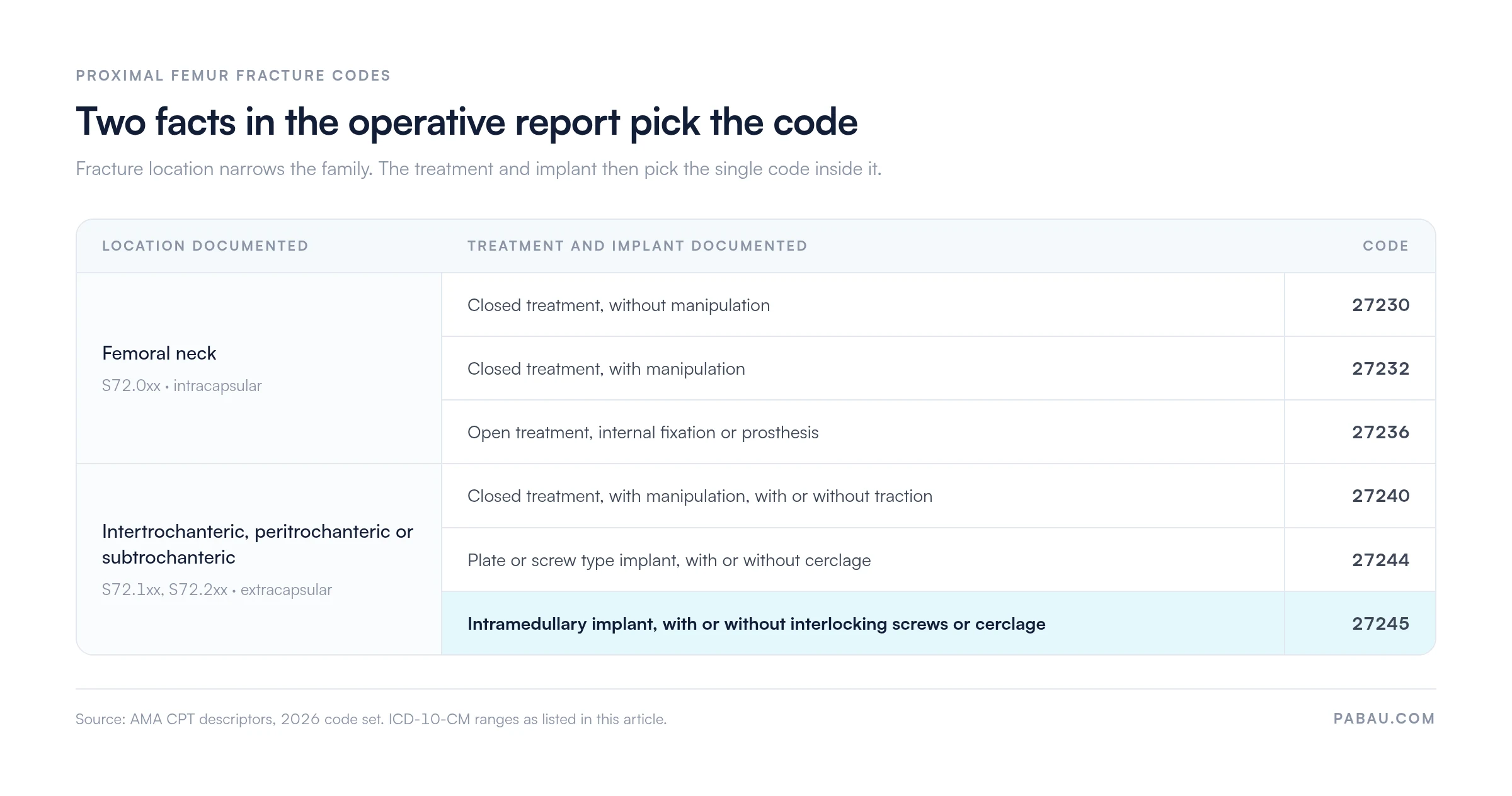
CPT code 27245 sits within a family of hip and proximal femur fracture codes. Picking the right one means knowing which adjacent codes exist and how they differ. The AAPC Codify CPT lookup carries the full hierarchy with official descriptors.
Both 27244 and 27245 cover the same three fracture zones. The construct is what separates them: 27244 is a plate-and-screw implant, and 27245 is an intramedullary nail. Read the whole family as a grid and the selection rule falls out of two documented facts.
Accurate CPT 27245 billing rests on the operative report matching the code. When documentation and billing live in separate systems, a coder has to reconstruct the case. That means digging the fracture location and the implant out of whatever the note happened to say. Pabau is practice management software. Its claims management software connects clinical notes directly to invoicing, so the detail coders need is already structured when the claim goes out.

For orthopedic and surgical practices, Pabau supports revenue cycle management from procedure documentation through claim submission. It handles electronic claims across thousands of US payers, including the 837P format, real-time eligibility verification, and ERA remittance processing. On a high-complexity code like 27245, the audit trail from clinical note to claim helps defend medical necessity when a payer reviews the case.
Pabau serves orthopedic and sports medicine practices alongside medical spas, aesthetic practices, and multi-specialty groups. Every subscription includes the full billing and reporting functionality, with no feature gating by plan tier.

Pabau connects clinical documentation to invoicing. The fracture location, implant detail, and laterality a 27245 claim needs are captured once and carried through to submission. That gives orthopedic practices fewer scrubber holds and a cleaner audit trail.

A CPT 27245 claim is decided in the operative report, long before it reaches a payer. If the note names the fracture location, the implant, and the side, the code and its modifiers follow from what is written. If it says “hip fracture, nail fixation,” a coder is guessing and an auditor will say so.
So the fix sits upstream of billing. Build fracture location, implant identification, and laterality into the operative template itself, and the scrubber has less to catch. That same discipline holds at the 90-day mark, where a post-op service needs -24, -78, or -79 to survive.
The trade-off worth remembering is that 27245 pays well and gets audited accordingly. Book a demo to see how an orthopedic claim moves from operative note to submission inside Pabau.

Need to understand how medical claims move through payers? How a medical claims clearinghouse works explains the role of clearinghouses in electronic claim submission and ERA processing.
Looking for a clean claim checklist before submission? Clean claim submission requirements covers the elements every orthopedic claim needs before it reaches the payer.
Denials piling up on high-value surgical codes? Denial management in healthcare sets out how to work a denial queue by reason code instead of resubmitting blind.
Want to know what the payer actually receives? The 837 claim file explained walks through the electronic format that carries your 27245 line items and modifiers.
CPT code 27245 covers surgical treatment of an intertrochanteric, peritrochanteric, or subtrochanteric femoral fracture using an intramedullary implant, with or without interlocking screws and/or cerclage. The code applies to both open and percutaneous approaches. Interlocking screws and cerclage wire are bundled into the descriptor and cannot be billed separately.
CPT 27236 covers fractures of the femoral neck (intracapsular), typically treated with ORIF plate/screws or prosthetic replacement. CPT 27245 covers trochanteric and subtrochanteric fractures (extracapsular), treated with an intramedullary nail. The fracture location documented in the operative report determines which code applies, not the implant type alone.
CPT 27245 carries 33.48 total facility RVUs for 2026, made up of 17.73 work, 12.04 practice expense, and 3.71 malpractice. At the CY2026 conversion factor that gives about $1,118.26 nationally, or $1,123.84 for a qualifying APM participant. Locality GPCI adjustments can move the figure by 15% to 30%.
Common modifiers include -LT/-RT for laterality, which most payers require, and -22 for increased procedural complexity. Use -51 for multiple procedures on the same day, and -62 for co-surgeons. A physician assisting bills -80, -81, or -82 at 16% of the surgical fee, while a PA or NP bills -AS at about 13.6%. During the 90-day global period, use -24 for unrelated E&M visits, -79 for unrelated surgery, and -78 for return to the OR for a complication.
The primary ICD-10-CM ranges are S72.1xx (trochanteric fractures) and S72.2xx (subtrochanteric fractures). Commonly used codes include S72.141A and S72.142A for an intertrochanteric fracture at the initial encounter, right and left. S72.211A and S72.212A cover a displaced subtrochanteric fracture. Payer policies on accepted codes vary, so verify against your MAC’s local coverage documentation.
CPT 27245 has a 90-day global period under the CMS Physician Fee Schedule. Routine post-operative fracture care during this window is bundled into the surgical payment. Separately billable services during the global period require modifiers -24 (unrelated E&M), -78 (complication requiring return to OR), or -79 (unrelated procedure).
No. The CPT 27245 descriptor explicitly includes “with or without cerclage,” meaning cerclage wire placement is bundled into the code. Billing cerclage as a separate line item on the same claim will trigger an NCCI edit denial. The same applies to interlocking screws, which are also bundled within the descriptor.