27235 is the CPT code for percutaneous skeletal fixation of a femoral neck fracture that is undisplaced, mildly displaced or impacted. The surgeon stabilizes the fracture with screws or pins placed through small incisions under fluoroscopy, without exposing the fracture site.
Open treatment of a femoral neck fracture, including fixation of a displaced fracture, is reported with 27236. Fractures in the trochanteric region take 27244 or 27245 instead.
Related Information
Section
10004-69990 Surgery
Subsection
20100-29999 Musculoskeletal system
Code range
27197-27269 Fracture and/or dislocation procedures on the pelvis and hip joint
27235Percutaneous femoral neck fracture fixationHigh match
Confidence score
98%
Why this code?
Matches patient diagnosis
Supported by clinical notes
Commonly used for this condition
Why practices choose Pabau
Save hours every week
Automate repetitive tasks and focus on what matters most—your patients.
Improve accuracy
Reduce coding errors and ensure compliance with the latest regulations.
Get paid faster
Clean claims, fewer denials, and faster reimbursements.
Grow with confidence
Powerful insights and reporting to help your practice thrive.
HIPAA compliant•SOC 2 certified•GDPR-compliant•Trusted by 4,000+ clinics worldwide
Key takeaways
CPT Code 27235 covers percutaneous fixation of an undisplaced, mildly displaced or impacted femoral neck fracture, and open treatment of the same fracture is 27236.
The diagnosis must name a femoral neck fracture, its laterality and the A seventh character for the initial encounter, such as S72.001A.
27235 carries a 90-day global period, so report an unrelated E/M visit with modifier 24 and a later procedure with modifier 78 or 79.
Medicare assigns 27235 a total of 25.04 RVUs in 2026, which is about $836 nationally at the $33.4009 conversion factor.
Pabau’s claims management sends CMS-1500/837P claims through Claim.MD, checks eligibility first and posts the ERA remittance when the payer responds.
CPT Code 27235: Official descriptor and procedure overview
CPT Code 27235 is the procedure code for percutaneous skeletal fixation of a femoral neck fracture that is undisplaced, mildly displaced or impacted. The code belongs to the AMA CPT code set, which the AMA CPT Editorial Panel maintains. It sits in the Musculoskeletal System chapter, under Pelvis and Hip Joint, in the fracture and dislocation range 27197-27269.
Field
Detail
CPT Code
27235
Official descriptor
Percutaneous skeletal fixation of femoral fracture, proximal end, neck, undisplaced, mildly displaced, or impacted fracture
Code type
CPT Surgical – Major procedure
Anatomical site
Femoral neck (intracapsular region of the proximal femur)
Approach
Percutaneous (minimally invasive, no open arthrotomy)
Global period (CMS)
90 days
Maintained by
American Medical Association (AMA) CPT Editorial Panel
What the procedure involves: Percutaneous fixation of a femoral neck fracture
Percutaneous skeletal fixation of a femoral neck fracture is a minimally invasive technique. The surgeon stabilizes the fracture through small stab incisions rather than a full hip incision.
Coders confirm the percutaneous approach by finding these five elements in the operative report.
Patient positioning: Supine or lateral on a fracture table, with traction applied to reduce the fracture under image intensification.
Fluoroscopic guidance: Continuous or intermittent C-arm imaging confirms reduction and guides wire/screw placement. Note: Fluoroscopic guidance is bundled into 27235 when used for the same hip fracture procedure and cannot be billed separately as CPT 77002.
Guidewire insertion: One or more guidewires are percutaneously advanced across the fracture site into the femoral head under fluoroscopic control.
Cannulated screw fixation: Typically two or three cannulated screws are inserted over the guidewires to compress and stabilize the fracture. A sliding hip screw usually needs an open approach and is not reported with 27235.
Wound closure: Stab incisions are closed, usually with absorbable sutures or Steri-Strips.
The procedure does not involve opening the hip capsule or directly visualizing the fracture. Any approach requiring an incision large enough to expose the fracture site shifts the code to CPT 27236.
What CPT Code 27235 includes and excludes
CPT Code 27235 is a global surgical package. The global period bundles a defined set of services that must not be billed separately.
Bundled (included) services
Pre-operative evaluation on the day of or day before surgery
Intra-operative fluoroscopic guidance used solely for the fracture fixation
Routine post-operative care within the 90-day global period
E/M services on the day of the procedure related to the decision for surgery (if decision was made the same day, modifier -57 applies)
Implant insertion (cannulated screws, pins) is included in the procedure value
Not included (separately billable)
Treatment of a complication requiring a return to the operating room (new procedure code with modifier -78)
Post-op E/M for an unrelated condition within the global period (modifier -24)
Bone grafting, if performed as a separate procedure at a distinct anatomical site
Hemiarthroplasty performed instead of fixation is reported with 27125 (or 27236 for open fracture treatment with prosthetic replacement)
Pro Tip
Check the operative note for any mention of an incision length. Even a 2-3 cm incision used to place a lag screw may technically still be percutaneous if the fracture is not directly visualized. When in doubt, query the surgeon before selecting 27236.
Neighboring codes: How CPT Code 27235 differs from 27232, 27236, 27244 and 27245
The femoral neck and trochanteric fracture codes cover the same region of the hip, so the fracture site and the approach decide between them. The table below maps the key distinctions coders need to avoid upcoding (27236 for a percutaneous procedure) or undercoding (27235 when open reduction was performed).
CPT Code
Descriptor (summary)
Approach
Anatomical site
Key distinction
27235
Percutaneous skeletal fixation of femoral neck fracture
Percutaneous
Femoral neck (intracapsular)
No open incision, and the fracture is not directly visualized
27232
Closed treatment of femoral fracture, proximal end, neck; with manipulation, with or without skeletal traction
Closed
Femoral neck (intracapsular)
Closed reduction with no fixation hardware placed
27236
Open treatment of femoral fracture, proximal end, neck, internal fixation or prosthetic replacement
Open
Femoral neck (intracapsular)
Open approach with direct fracture exposure, then internal fixation or prosthetic replacement
27244
Treatment of intertrochanteric, peritrochanteric, or subtrochanteric femoral fracture; with plate/screw type implant, with or without cerclage
Open or percutaneous
Intertrochanteric, peritrochanteric or subtrochanteric region
Plate/screw implant, such as a sliding hip screw, in the trochanteric region
27245
Treatment of intertrochanteric, peritrochanteric, or subtrochanteric femoral fracture; with intramedullary implant, with or without interlocking screws and/or cerclage
Open or percutaneous
Intertrochanteric, peritrochanteric or subtrochanteric region
Intramedullary nail in the trochanteric region, not the femoral neck
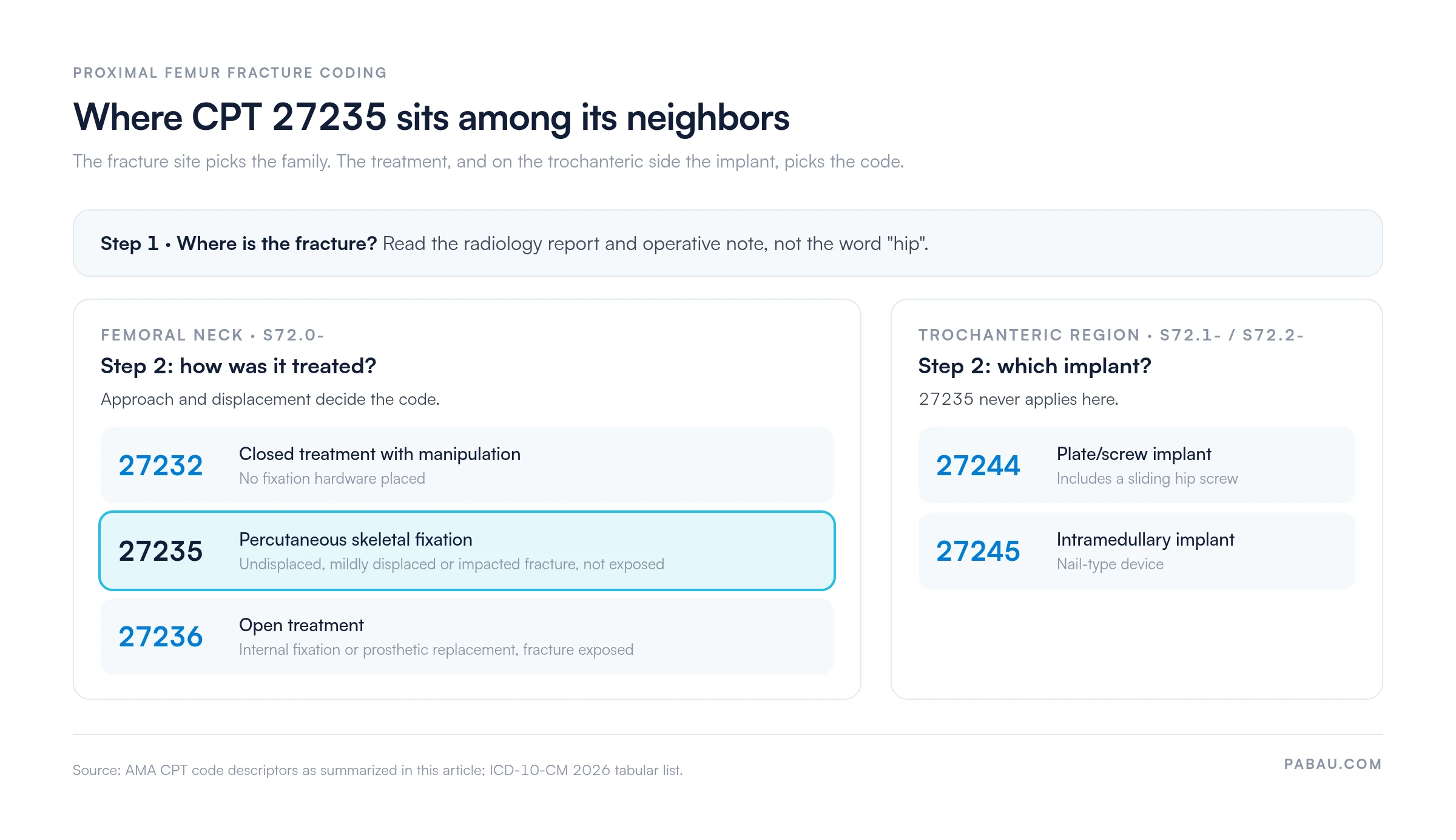
Critical distinction: A radiology report describing a “hip fracture” does not resolve the code. Confirm whether the fracture is at the femoral neck (intracapsular) or the trochanteric region before choosing between 27235/27236 and 27244 or 27245. The decision runs in two steps, site first and then treatment.
A trochanteric fracture never reaches 27235, whatever the approach. Descriptors from the AMA CPT code set and the ICD-10-CM 2026 tabular list.
ICD-10 diagnosis codes that pair with CPT Code 27235
Every CPT 27235 claim requires an ICD-10-CM diagnosis code that documents a femoral neck fracture, the correct laterality, and the encounter type. Payers check the diagnosis code against the CPT code for medical necessity. An intertrochanteric fracture code (S72.1-) on a 27235 claim is likely to be denied.
ICD-10-CM Code
Description
Use for CPT 27235?
S72.001A
Fracture of unspecified part of neck of right femur, initial encounter for closed fracture
Yes
S72.002A
Fracture of unspecified part of neck of left femur, initial encounter for closed fracture
Yes
S72.011A
Unspecified intracapsular fracture of right femur, initial encounter for closed fracture
Yes, when the record says intracapsular without a more specific site
S72.021A
Displaced fracture of epiphysis (separation) (upper) of right femur, initial encounter for closed fracture
Yes, when an epiphyseal fracture is documented
S72.031A
Displaced midcervical fracture of right femur, initial encounter for closed fracture
Yes, when a midcervical fracture is documented
S72.041A
Displaced fracture of base of neck of right femur, initial encounter for closed fracture
Yes, when a base-of-neck fracture is documented (a greater trochanter fracture is S72.12-, which does not pair with 27235)
ICD-10-CM codes a fracture as displaced unless the record says otherwise. A fracture the surgeon documents as nondisplaced takes a 4, 5 or 6 in the sixth character instead, such as S72.024A for the right femur.
Encounter type suffixes: Use suffix “A” for the initial encounter (the operative event). Suffix “D” is for subsequent encounters (follow-up visits after active treatment has begun) and “S” for sequela. The surgical claim should always carry suffix “A”.
Laterality: “1” = right, “2” = left, “9” = unspecified. Avoid unspecified laterality whenever the operative report clearly states which hip was treated.
Modifiers for CPT Code 27235
Modifier selection for CPT Code 27235 follows standard orthopedic surgical rules. The table below covers the most commonly required modifiers and the payer context in which each applies.
Modifier
Meaning
When to use with 27235
-RT
Right side
Mandatory for Medicare and most commercial payers when the right hip is treated
-LT
Left side
Mandatory when the left hip is treated; must match ICD-10 laterality suffix
-62
Two surgeons
When two surgeons of different specialties each perform distinct portions of the procedure. Both bill 27235 with -62, and Medicare asks for documentation of medical necessity.
-80
Assistant surgeon
Medicare does not pay an assistant at surgery on 27235 (assistant-at-surgery indicator 1 in the CMS fee schedule file). Commercial payers set their own rules.
-57
Decision for surgery
On the E/M code billed the same day as surgery when the decision to operate was made that day (applies to 90-day global cases)
-24
Unrelated E/M during global period
For post-op visits addressing a diagnosis unrelated to the hip fracture within the 90-day global period
Bilateral fractures: Simultaneous bilateral femoral neck fractures are rare. Medicare gives 27235 bilateral surgery indicator 1, so report one line with modifier 50 and expect payment at 150% of the single-side amount. Some commercial payers want two lines with -RT and -LT instead, so check the payer policy.
Documentation requirements for a clean CPT Code 27235 claim
A clean claim submission for CPT Code 27235 depends on the operative report answering seven specific questions. Payers auditing orthopedic fracture claims look for each of these elements.
Fracture site confirmed: The report must state “femoral neck” explicitly, not “hip fracture” or “proximal femur fracture” without further anatomical detail.
Displacement status: Undisplaced, mildly displaced or impacted, documented from intraoperative fluoroscopic findings or pre-op imaging. A displaced fracture treated with fixation points to 27236.
Approach documented as percutaneous: The report must describe stab incisions, no open arthrotomy, and fluoroscopic guidance. Any language describing direct visualization of the fracture surfaces contradicts 27235.
Implant type and quantity: Number and type of screws or pins placed (e.g., three cannulated 7.3 mm screws).
Fluoroscopy used: The report confirms intraoperative imaging. It is not billed separately, but its use supports the percutaneous technique.
Reduction achieved: Whether closed reduction was performed before fixation, and the fluoroscopic confirmation of satisfactory reduction before screw insertion.
Laterality: Explicit statement of which hip (right or left) was operated on. This must match the ICD-10 code and any laterality modifier on the claim.
A superbill template with fields for the diagnosis, laterality and modifiers carries those details onto the claim. Missing any one of the seven elements is enough for a payer to downcode or deny it.
Reimbursement rates and RVU values for CPT Code 27235
RVU values and Medicare payment rates for CPT Code 27235 are updated annually through the Medicare Physician Fee Schedule (MPFS). The figures below come from the CMS 2026 relative value file (October release). Check the CMS Physician Fee Schedule lookup tool for your locality before billing.
RVU Component
Value (2026)
Notes
Work RVU (wRVU)
12.68
Reflects surgeon time, skill and intensity
Practice Expense RVU
9.72
Covers overhead and equipment costs. The value is the same in facility and non-facility settings.
Malpractice RVU
2.64
Professional liability component
Total RVU
25.04
Sum of all three components before geographic adjustment
Approx. Medicare national payment
~$836
Total RVU multiplied by the 2026 conversion factor of $33.4009. Qualifying APM participants use $33.5675, which gives about $841. Locality adjustments apply.
Commercial payers negotiate their own rates for 27235, so the Medicare figure is a benchmark rather than a promise. Check each payer contract before you give the patient an estimate.
Prior authorization and payer requirements
Prior authorization requirements for CPT 27235 vary by payer and plan year. Never apply a blanket rule.
Medicare: Generally does not require prior authorization for acute hip fracture fixation. Emergency and urgent surgical cases are covered when medical necessity is documented. Refer to the relevant MAC’s Local Coverage Determination (LCD) for any payer-specific criteria.
Medicare Advantage plans: Many MA plans do require prior authorization even for urgent procedures. Confirm with the specific plan before scheduling. CMS has issued guidance on MA prior auth timelines, but each plan’s criteria differ.
Medicaid: Varies by state. Most state Medicaid programs waive prior auth for emergency fracture surgery but require retro-authorization within 24-72 hours.
Commercial insurers: Most require prior authorization for elective orthopedic cases. For acute fracture care admitted through the emergency department, retroactive authorization within 24-48 hours is typically accepted.
Understanding medical billing fundamentals for surgical procedures helps billing staff identify when to initiate auth before the procedure versus when retroactive auth is permissible. Document every authorization number in the operative record and on the claim form.
Common claim denial reasons for CPT Code 27235 and how to avoid them
Denials on femoral neck fixation claims usually trace back to ICD-10 specificity, modifier sequencing or global-period tracking. The table below maps the most common denial reasons to corrective actions.
Denial reason
Typical CARC
Corrective action
ICD-10 mismatch: Intertrochanteric code on 27235 claim
CO-4 / CO-11
Correct to S72.001A/S72.002A (femoral neck); never use S72.1xx codes with 27235
Missing or mismatched laterality modifier (-RT/-LT)
CO-4 / CO-16
Add -RT or -LT; confirm modifier matches the laterality suffix in the ICD-10 code
Prior authorization not obtained or not on file
CO-15 / CO-197
Obtain retro-auth within payer’s window; include auth number on resubmission
Post-op E/M billed without modifier -24 during global period
CO-97
Add modifier -24 for unrelated E/M; document clearly in the note that the visit is for a condition unrelated to the hip fracture
Remove 77002 from the claim; fluoroscopic guidance is bundled into 27235
Code selected as 27236 (open) when procedure was percutaneous
CO-4 / audit flag
Review operative report; if percutaneous, correct to 27235 and resubmit with supporting documentation
A structured denial management workflow catches these errors before they age past the timely filing limit. Review your practice’s denial codes in medical billing quarterly to identify whether any of the patterns above recur across CPT 27235 claims.
Global surgery period and post-op care for CPT Code 27235
CPT Code 27235 carries a 90-day global surgery period, shown as 090 in the Medicare Physician Fee Schedule global days indicator. The package runs from the day before surgery through the 90 days after it.
What is bundled in the 90-day global period
All routine post-operative visits related to the hip fracture fixation, from the day of surgery through day 90
Minor complications managed in the office without returning to the OR
Removal of sutures, staples, or wound care at the operative site
When separate billing is permitted within the global period
Modifier -24: E/M for a condition entirely unrelated to the hip fracture (e.g., the patient presents with a respiratory infection at a post-op visit)
Modifier -78: Return to the OR for a complication related to the original procedure (e.g., screw back-out requiring revision)
Modifier -79: Unrelated procedure performed during the global period at a different anatomical site
Pro Tip
Set a 90-day calendar reminder from the date of surgery for every CPT 27235 case. Any E/M or related procedure billed against the patient within that window should automatically route to billing review for modifier validation before submission.
How Pabau keeps CPT 27235 claims complete
A 27235 claim needs the diagnosis, the laterality modifier and the authorization number from the surgical booking. When those sit in different systems, someone retypes them before the claim goes out.
In Pabau, the practice management platform we build, claims management for practices sends US claims as CMS-1500/837P files through Claim.MD. It checks the patient’s eligibility before submission, handles secondary claims and posts the ERA remittance when the payer responds.
Authorization codes, dates and sessions sit on the patient’s case, and Pabau warns the team when one is missing. Your coders still choose between 27235 and 27236 from the operative report. The claim then leaves with the payer and authorization details already attached.
Pabau’s checkout ties each invoice to the patient’s insurer and records the patient’s share. The balance on a fracture case lands against the right payer.
Reduce denials on orthopedic surgical claims
Pabau’s claims management sends CPT 27235 claims through Claim.MD, checks eligibility first and posts ERA remittances. Authorization codes sit on the patient’s case, with a warning when one is missing.
Choose 27235 only when the operative report describes percutaneous fixation of an undisplaced, mildly displaced or impacted femoral neck fracture. An exposed fracture, or a displaced one fixed with hardware, belongs to 27236.
That makes the operative note the place to win or lose the claim. When it states the approach, the displacement and the laterality in plain words, the diagnosis code, the modifiers and the global-period dates follow without guesswork.
Book a demo to see how Pabau carries authorization and payer details from the surgical booking to the submitted claim.
Continue your research
Building a charge form for surgical cases?Superbill guide explains which codes, modifiers and patient details a superbill carries.
Confused about how clearinghouses process surgical claims?Medical claims clearinghouse guide explains how EDI transactions move from practice to payer and back.
Want to understand the 837P file format behind CPT claims?837 file overview breaks down the electronic claim structure that carries CPT 27235 to payers.
Frequently asked questions
What is CPT Code 27235?
CPT Code 27235 is the procedure code for percutaneous skeletal fixation of a femoral neck fracture that is undisplaced, mildly displaced or impacted. The surgeon places cannulated screws or pins through small incisions under fluoroscopic guidance, without exposing the fracture. A displaced fracture treated with fixation, or any open approach, is reported with 27236.
How does CPT 27235 differ from CPT 27236?
CPT 27235 is for percutaneous fixation, where the fracture is stabilized through stab incisions without directly visualizing the fracture surfaces. CPT 27236 is for open treatment of the same femoral neck fracture site, requiring a formal incision and direct exposure. Using 27236 for a percutaneous procedure is an upcoding error with audit exposure.
What is the RVU value for CPT Code 27235?
The 2026 work RVU for CPT 27235 is 12.68. Practice expense adds 9.72 and malpractice 2.64, for a total of 25.04 RVUs in both facility and non-facility settings. At the $33.4009 conversion factor, that is about $836 nationally before geographic adjustment.
When should CPT 27245 be used instead of 27235?
CPT 27245 applies to intertrochanteric, peritrochanteric or subtrochanteric femoral fractures treated with an intramedullary implant. A plate/screw implant in the same region is 27244. When the fracture sits in the trochanteric region rather than the femoral neck, report 27244 or 27245 depending on the implant. Never pair 27235 with an S72.1- (trochanteric) ICD-10 code.
Why are CPT 27235 claims commonly denied?
The most common reasons are an ICD-10 laterality mismatch with the RT or LT modifier and missing prior authorization from Medicare Advantage or commercial payers. Post-op E/M visits billed without modifier 24 during the 90-day global period are another. So is fluoroscopic guidance (CPT 77002) billed separately when it is bundled into 27235. A pre-submission checklist prevents each one.