



CCSD code G5100: Bypass of duodenum billing guide
CCSD code G5100 bills a bypass that leaves the duodenum in place CCSD code G5100...

Last Updated: Oct 16, 2026

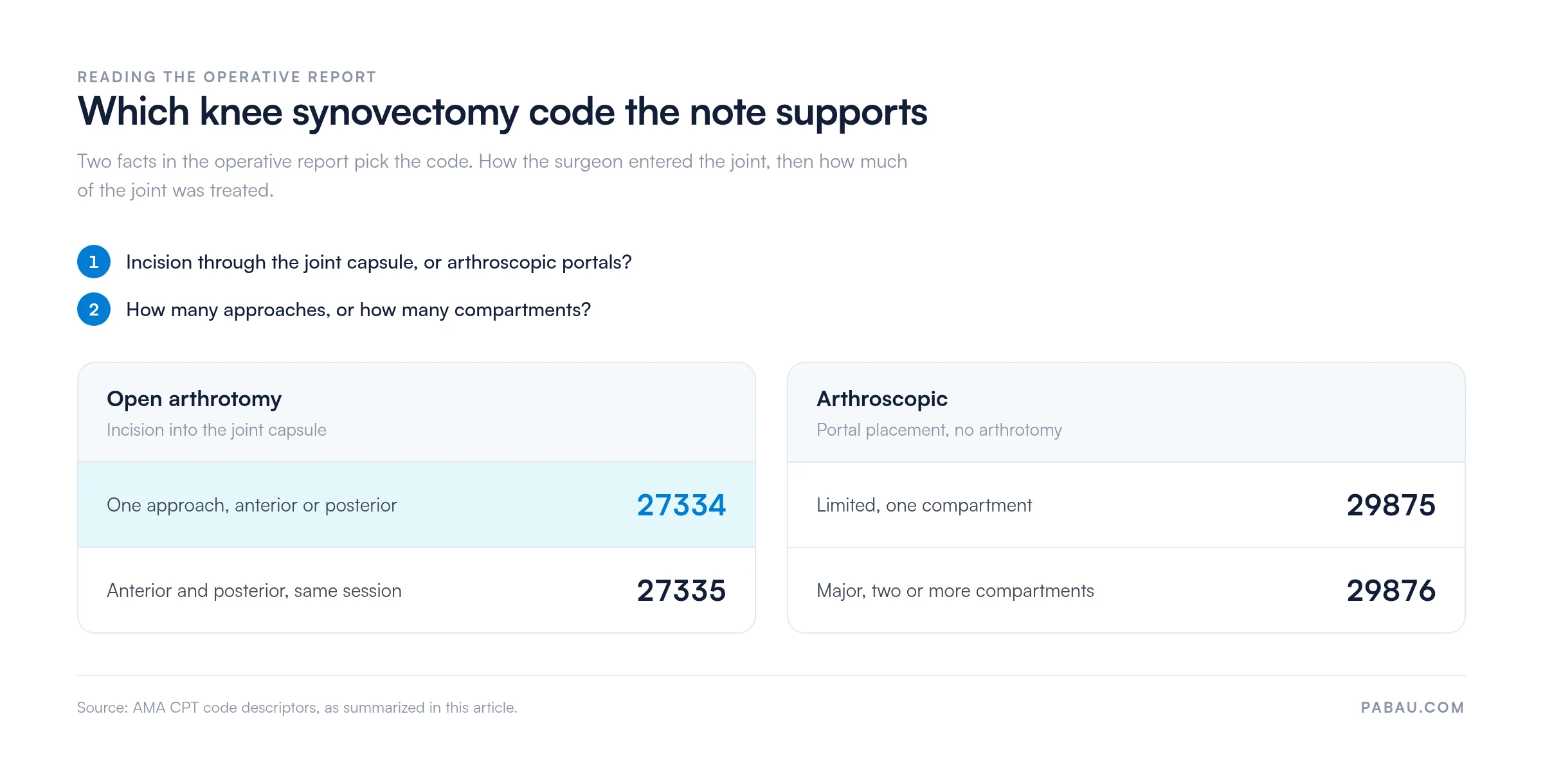
CPT code 27334 describes an open arthrotomy with synovectomy of the knee, done through one approach, either anterior or posterior.
Use 27334 for a single approach. Report 27335 when the surgeon works through both anterior and posterior approaches in one session.
Rheumatoid arthritis (M05, M06), pigmented villonodular synovitis, and juvenile idiopathic arthritis (M08) are the diagnoses that most often support medical necessity.
Pabau’s claims management software pre-fills CPT and ICD-10 codes from the client record, so billing teams re-key less before submission.
CPT code 27334 covers an open arthrotomy with synovectomy of the knee, performed through one approach, either anterior or posterior.
The American Medical Association’s CPT code set places 27334 in the excision procedures on the femur and knee joint. The procedure has two parts. The arthrotomy is the incision into the joint capsule, and the synovectomy is the excision of the diseased synovial lining.
Coders working in physical therapy and orthopedic billing workflows meet this code mostly in inflammatory and proliferative synovial disease. What follows works through the indications, the ICD-10 pairings, the modifiers, the RVUs, and the errors that trigger denials.
Open synovectomy is not a first-line treatment, so payers expect documentation of failed conservative management first. The conditions below are the ones that most often support medical necessity for CPT code 27334.
Local Coverage Determinations (LCDs) from the Medicare Administrative Contractors name the diagnosis codes that support medical necessity in each region.
Check the applicable LCD before you send a 27334 claim to Medicare, because requirements differ by MAC jurisdiction. With the indication settled, the next decision is which of the two open codes the report supports.
The difference is approach count, not complexity. Picking 27335 when the surgeon used one approach, or 27334 when both were used, is the single most common coding error on these claims.
The operative report has to name the approach. A single medial parapatellar arthrotomy is anterior, so it maps to CPT code 27334. If the surgeon adds a separate posterior incision in the same session, the claim moves to 27335. Never infer approach count from surgical time or from complexity language.
Reporting 27334 twice on one claim to capture two approaches does not work either. The descriptor says anterior OR posterior for exactly that reason. Duplicate units on a single claim generate a Correct Coding Initiative (CCI) edit rejection.
CPT code 27334 is an open procedure, so an arthroscopic synovectomy never belongs on it. The approach decides the code family before any other detail matters, and ambiguous operative language is what blurs the two.
Billing 27334 for an arthroscopic case is an audit trigger. Auditors read operative reports against code descriptors, and open-versus-arthroscopic mismatches are among the most frequent errors in musculoskeletal billing. The report needs language confirming an incision through the joint capsule rather than portal placement.
Both tables reduce to two questions about the note, and the chart below asks them in order.
Pairing CPT code 27334 with the right ICD-10-CM diagnosis is what carries medical necessity.
The table below lists the codes linked to this procedure, consistent with AAPC coding crosswalk references and the ICD-10-CM guidelines published by CMS. The medical billing fundamentals behind surgical claims require the diagnosis to support both necessity and procedure appropriateness.
Code to the highest specificity, laterality included. A claim carrying M05.8 when the note documents M05.861 will draw an edit from many payers. Use the medical billing compliance requirements framework to audit diagnosis-to-procedure pairings before submission.
Modifier choice changes both the payment rate and whether the claim adjudicates at all. The table covers the modifiers that come up most on CPT code 27334. Payer rules vary, so check each one against the relevant fee schedule.
Bilateral billing note: modifier 50 pays 150% of the allowable on most Medicare claims. Some commercial payers want two lines carrying LT and RT instead. Check the payer’s bilateral policy first, or the claim splits and one line denies.
Relative Value Units (RVUs) are what physician payment is built from under the Medicare Physician Fee Schedule (MPFS). Three components add up to the total RVU, and the annual conversion factor turns that total into dollars.
The values below are representative CMS figures. Verify current-year numbers with the CMS Physician Fee Schedule Look-Up Tool or an RVU lookup tool before you use them in financial modeling.
The 2026 conversion factor is set each year in the final MPFS rule. Geographic Practice Cost Index (GPCI) adjustments then raise or lower payment by locality. Treat these RVUs as approximate, and check current CMS data before you build a budget on them.
Payment for CPT code 27334 changes with the setting. CMS splits facility from non-facility rates, and locality adjustments add more variation on top.
The figures below are illustrative ranges drawn from published MPFS data. For exact 2026 rates by locality, the CMS fee schedule lookup is the authoritative source.
The place of service (POS) code on the claim decides which rate schedule applies. Open knee synovectomy is almost always done in a facility, either hospital outpatient or an ambulatory surgery center. Facility rates are therefore the norm for this code.
Geographic adjustment matters on a high-RVU surgical code. Practices in high-cost localities such as San Francisco or Manhattan may see 20-30% more than the national average, and rural localities see less.
Send the correct locality code on the CMS-1500, and verify eligibility and reimbursement through the Claim.MD clearinghouse integration before scheduling. Understanding revenue cycle management workflows helps a practice anticipate payment timing from surgery to remittance.
Open knee synovectomy claims fail more often than simpler musculoskeletal codes. Bundling rules, medical necessity documentation, and a 90-day global period all land on the same claim.
The four errors below account for most of the rejections.
Four elements have to appear in the operative report:
Miss one of those and the claim carries post-payment audit risk. Preoperative records matter just as much.
Payers reviewing high-cost surgery for inflammatory disease usually want evidence of failed conservative management, including drug therapy duration, imaging findings, and rheumatology notes.
Working to medical billing compliance requirements and understanding denial management workflows before submission lowers the chance of a reversal at audit.
The Correct Coding Initiative publishes quarterly edit tables showing which codes cannot be billed together without a modifier.
Check the current table for any code you plan to submit alongside 27334. A pair that was separately billable last quarter can be bundled this quarter, with no announcement.
A genuinely distinct procedure alongside 27334 may need modifier 59, or one of the XE, XP, XS and XU variants. Use it only where the procedures are separate and separately documented. Routine modifier 59 use to bypass bundling is an audit red flag.
CPT code 27334 carries a 90-day global period under Medicare. Related services inside that window sit in the global fee and are not separately billable.
An evaluation and management (E&M) visit during the period needs modifier 24, and only when the visit is genuinely unrelated to the surgery.
Tracking global periods by hand across a busy orthopedic practice leaks money in both directions. Billing an included service invites an overpayment finding, and missing a legitimately separate service loses revenue.
Aim at submitting a clean claim with global-period status checked at billing time, not after a denial.
Verify the current CCI table before you submit any code next to 27334. Edits change quarterly, and assuming last quarter’s status is a leading cause of avoidable denials. The common denial codes in medical billing reference covers the reason codes you will see when a surgical claim comes back.
Ask your surgeons to name the approach in the first line of the operative report. Use the descriptor’s own words: anterior arthrotomy, posterior arthrotomy, or both. Coders then read one line instead of hunting through the note. The fact that decides 27334 versus 27335 also sits where an auditor looks first.
The path is short, and each handoff is a place the claim can stall. Here is the sequence a surgical practice runs for every case.
Most claims stop at step two or step three. Either the report never named the approach, or the diagnosis went out one digit short of laterality.
Six checks, and they catch the errors above before a payer does. The work is not difficult, but it is easy to skip when the schedule is full.
Orthopedic surgical billing carries more moving parts than most outpatient coding. A single 27334 claim depends on approach documentation, modifier choice, CCI status, global period tracking, and ICD-10 specificity. Running that by hand across several surgeons and payers multiplies the chance of an error.
Practice management software like Pabau handles the mechanical half of that work. Pabau’s claims management software pre-fills the claim from the client record. The CPT code attached to the service lands on the charge line, and the ICD-10 slots draw from the recorded problem list.
It also carries ICD-10-CM and CPT lookup libraries, and it checks that claim-required fields are complete before the claim can be sent. The code decision stays with your coder, since no software reads an operative note and chooses 27334 over 27335 for you.
Claims go out through Pabau’s Claim.MD clearinghouse integration, which reaches thousands of US payers and returns electronic remittance advice (ERA) files for posting.
Practices sending 837 claim file submissions at volume run the whole cycle in one system, from the operative note to the posted payment. Superbills for orthopedic procedures use superbill documentation workflows that pull CPT and diagnosis codes from the encounter.
The practical benefit is fewer hands on the same data. What the coder enters against the encounter is what reaches the payer, so nobody re-keys a code between systems. For practices handling clearinghouse claim submission across a steady orthopedic volume, that removes the step where most transcription errors start.

Pabau pre-fills CPT and ICD-10 codes from the client record, checks the claim’s required fields, and submits through Claim.MD to thousands of US payers. See how orthopedic practices close the loop from operative note to posted payment.

Three facts decide whether a 27334 claim pays. The approach count picks the code, and the diagnosis carries the necessity. The global period then governs what you can bill for the next 90 days. Get those right and the rest is routine.
The work that remains is clerical, and that is where software helps. Pabau pre-fills the CPT and ICD-10 codes from the record and submits through Claim.MD, so the coder’s decision reaches the payer unchanged.
If you are still comparing systems, explore the best medical billing software options. You can also book a demo to see how a 27334 claim runs end to end in Pabau.

Need a framework for managing insurance claim submissions? Revenue cycle management for medical practices covers the end-to-end workflow from patient registration to payment posting.
Concerned about billing compliance in your surgical practice? Medical billing compliance requirements outlines the documentation standards and audit triggers billing teams need to monitor.
Want to understand how clearinghouses process orthopedic claims? How medical claims clearinghouses work explains the role of clearinghouses in claim validation and routing to payers.
Usually yes with commercial plans and Medicare Advantage, which treat elective open synovectomy as a planned surgical procedure. Traditional Medicare does not require prior authorization for the surgeon’s Part B claim. Confirm the plan’s policy before scheduling, because a missing authorization number denies the claim outright.
Yes, when the work went well beyond a typical case and the operative report says why. Modifier 22 needs a separate note quantifying the extra time, blood loss, or difficulty. Payers review these by hand, so expect slower payment and a request for records.
Send the operative report, the preoperative records showing failed conservative care, and the LCD language supporting the diagnosis. Answer the specific reason code instead of resubmitting the same claim. Most medical necessity denials on this code turn on documentation the payer never saw.
Use modifier 80 when another physician assists, or modifier AS when a physician assistant or nurse practitioner assists. Payment depends on the assistant-at-surgery indicator CMS publishes for the code, so check it before billing.



