CCSD code M0280: Laparoscopic nephrectomy billing guide
CCSD code M0280 means one kidney, removed through keyhole ports CCSD code M0280 ...

Last Updated: Nov 4, 2026
M1110 is the CCSD code for diagnostic endoscopic examination of kidney (including biopsy). It covers an endoscopic look inside the kidney, with or without a tissue sample, when no treatment happens in the same procedure.
If the surgeon goes on to treat a stone or a cyst, the therapeutic code replaces M1110. CCSD also bars billing M1110 with diagnostic ureterorenoscopy (M1120) or endoscopic examination of the ureter (M3000).
Let Pabau's smart automation suggest the right codes, reduce claim denials, and keep your practice compliant—effortlessly.
Automate repetitive tasks and focus on what matters most—your patients.
Reduce coding errors and ensure compliance with the latest regulations.
Clean claims, fewer denials, and faster reimbursements.
Powerful insights and reporting to help your practice thrive.
HIPAA compliant SOC 2 certified GDPR-compliant Trusted by 4,000+ clinics worldwide

CCSD code M1110 covers a diagnostic endoscopic examination of the kidney, and a biopsy taken during that look is part of the code.
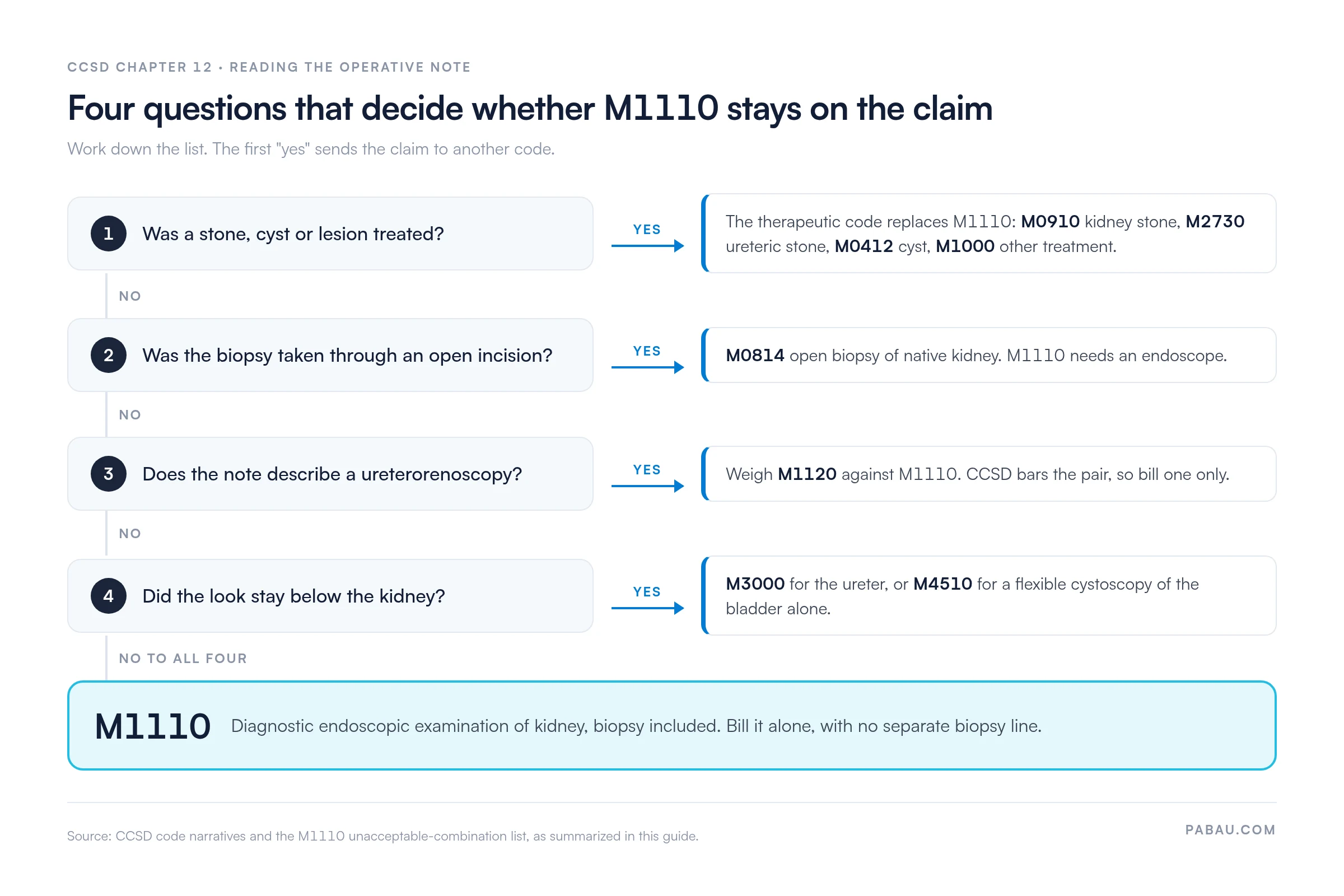
If the surgeon treats a stone or a cyst in the same procedure, the therapeutic code replaces M1110 on the claim.
CCSD lists six unacceptable combinations for M1110, including diagnostic ureterorenoscopy (M1120) and endoscopic examination of the ureter (M3000).
Confirm pre-authorization before the procedure date, and tell the insurer if the code changes from the one it authorized.
Pabau’s claims management software keeps the operative note, the pre-auth reference and the Healthcode submission on one patient record.
CCSD code M1110 is the procedure code UK private insurers use for a diagnostic endoscopic examination of the kidney, including biopsy. The urologist passes an endoscope into the kidney, inspects it and, where needed, takes a tissue sample. No treatment is billed under this code.
The code sits in Chapter 12 of the Clinical Coding and Schedule Development (CCSD) schedule, which covers the urinary system and male reproductive organs. Within that chapter it belongs to sub-chapter 12.1.0, Kidney/Renal Pelvic.
Billing M1110 well comes down to one question, asked of every operative note. Did the surgeon only look, or did they treat something? The answer decides whether M1110 stays on the claim or gives way to another code.
Our index of CCSD codes lists the neighboring kidney, ureter and bladder procedures.
M1110 errors usually start with a code that describes the same organ with a different purpose or route. The table sets the codes most often confused with it side by side, using each code’s CCSD narrative.
The therapeutic side of the same line is covered in our guide to CCSD code M1000.
OPCS-4, the classification the NHS uses, files diagnostic endoscopy of the kidney under category M11. The same category holds retrograde endoscopic examination of the kidney NEC (M11.3), which is where an NHS ureterorenoscopy usually lands.
CCSD splits the two. Diagnostic ureterorenoscopy has its own code, M1120, and it appears on the M1110 unacceptable-combination list. A coder translating from an NHS OPCS code can therefore land on M1110 when the note describes a ureterorenoscopy.
The M1110 narrative does not name an access route, so code from what the note describes. Three quick questions settle most cases:
When the note leaves the route unclear, ask the surgeon before you code. A one-line addendum costs far less than a rejected claim.
Add the open-biopsy check to those three questions and you have a short decision flow to run against every note.
A clean M1110 claim passes through six stages. When one comes back rejected, the cause is usually a check skipped at one of them.
Most UK private medical insurers expect members to authorize a urology procedure before it happens. Rules differ by plan and change between policy years, so treat the table as a starting point and confirm with each insurer.
A diagnostic kidney endoscopy is usually booked because earlier tests left a question open, such as an unexplained finding on imaging. Put that reason on the request, because it is the clinical case for the look.
Our guide to Bupa CCSD codes walks through Bupa’s authorization steps in more detail.
If the surgeon may treat what they find, ask the insurer whether the authorization can name the likely therapeutic code as well as M1110. A change on the day then does not leave the claim without cover.
Insurers audit M1110 against the operative note, so the note must show a diagnostic examination and nothing more. Record each of these items:
A templated note with a field for each item beats free dictation. The surgeon cannot skip a field the form asks for.
CCSD publishes an unacceptable-combination list for M1110. None of the codes below should sit on the same claim as M1110 for one procedure.
CCSD calls its coding principles non-exhaustive guidelines. Each insurer decides whether to adopt a given combination, so a pair missing from this list is not automatically payable.
Rejections on M1110 repeat the same few patterns, and each one is preventable at the desk. For claims that still return, our guide to denial management in healthcare covers tracking and appeals.
A typical case shows how this plays out. A patient is booked for a diagnostic endoscopy under M1110 after an unclear scan. During the procedure, the surgeon finds a small kidney stone and fragments it.
The episode now belongs under M0910, which CCSD bars alongside M1110. The practice calls the insurer, has the authorization moved to M0910, and bills that code alone. Billing both codes, or keeping M1110 after the stone work, would have drawn a rejection.
Coding errors on M1110 tend to be judgment calls made too early or too quickly. Four of them come up again and again:
Before the claim leaves the practice, tick each line. If one fails, fix it first.
In many urology practices, the operative note, the pre-auth reference and the invoice sit in separate places. The coder then rebuilds the episode at billing time, which is where wrong codes and missing references creep in.
Pabau, the practice management platform we build, keeps all three on the same patient record. Its claims management software checks that required fields, such as the membership number and authorization code, are filled in before sending.
Claims then go through Healthcode to insurers such as Bupa, AXA Health and Vitality. The submission stays on the patient’s record, so the note is one click away when an insurer queries the claim.

Pabau keeps the operative note, the pre-auth reference and the CCSD code on one record, then sends the claim through Healthcode to UK insurers.

M1110 is one of the simpler kidney codes to get right. The claim just has to reflect what happened during the procedure, not what was booked.
The habit worth building is a second read of the note before the code goes on the invoice. If something was treated, the code changes and so does the authorization. That check takes a minute and saves a resubmission weeks later.
Book a demo to see how Pabau links operative notes, pre-auth references and Healthcode claims for UK urology practices.

Did the surgeon treat the kidney as well? CCSD code M1000 covers therapeutic endoscopic operations on the kidney.
Was a kidney stone broken up? CCSD code M0910 covers endoscopic fragmentation of kidney stones.
Did the examination stay in the ureter? CCSD code M3000 covers endoscopic examination of the ureter.
Was the biopsy taken through an open incision? CCSD code M0814 covers open biopsy of a native kidney.
Was a renal cyst treated? CCSD code M0412 covers de-roofing and aspiration of a renal para pelvic cyst.
No. CCSD codes are for private and insured patients. NHS activity is coded with OPCS-4, where diagnostic endoscopic examination of the kidney sits under category M11.
Not CCSD. The CCSD Group states that it does not determine reimbursement or fees. Each insurer sets its own rate, so check that insurer’s fee schedule before you quote.
No. M1110 is the surgeon’s procedure code. The anesthetist invoices separately for their part of the episode, under their own provider details.
Not automatically. CCSD describes its coding principles as non-exhaustive guidelines, and each insurer decides whether to adopt a given combination. Check the insurer’s own bundling rules for an unusual pair.
Yes. Insurer fee schedules apply to insured patients only. For self-pay patients, the practice sets the price, and the quote should say whether hospital and histology costs are included.
No. M1110 needs an endoscopic examination. An open biopsy of the kidney has its own code, M0814, and other routes take their own codes too.