CPT code 59618: Cesarean after attempted VBAC billing guide
CPT code 59618 bills a cesarean after a VBAC attempt CPT code 59618 is the globa...

Last Updated: Nov 4, 2026
M0412 is the CCSD code for de-roofing and aspiration of renal para pelvic cyst. CCSD stands for Clinical Coding and Schedule Development, the group that maintains the procedure schedule used by UK private medical insurers. The code covers excising part of the cyst wall and draining its fluid in one operation.
M0412 sits in Chapter 12 of the CCSD schedule, Urinary system and male reproductive organs, with a Major complexity rating. Bupa, AXA Health, Aviva and Vitality price the code against their own fee schedules. Claims usually pair it with ICD-10 code N28.1, cyst of kidney.
Let Pabau's smart automation suggest the right codes, reduce claim denials, and keep your practice compliant—effortlessly.
Automate repetitive tasks and focus on what matters most—your patients.
Reduce coding errors and ensure compliance with the latest regulations.
Clean claims, fewer denials, and faster reimbursements.
Powerful insights and reporting to help your practice thrive.
HIPAA compliant SOC 2 certified GDPR-compliant Trusted by 4,000+ clinics worldwide

CCSD Code M0412 covers de-roofing and aspiration of a renal parapelvic cyst, so an aspiration-only procedure needs a different code.
ICD-10 N28.1 (cyst of kidney) is the primary diagnosis paired with M0412, coded in the UK edition of ICD-10 (5th Edition).
The operative report and pre-authorisation request must name the cyst as parapelvic, confirm both surgical steps and state laterality.
Pabau, the practice management platform we build, tracks CCSD claims and pre-authorisations for UK private urology practices billing Bupa, AXA Health and other insurers.
CCSD Code M0412 covers de-roofing and aspiration of a renal parapelvic cyst, claimed from UK private medical insurers. It sits in Chapter 12 of the CCSD schedule, Urinary system and male reproductive organs, with a Major complexity rating.
CCSD stands for Clinical Coding and Schedule Development, the group that maintains the procedure schedule UK insurers use for claims. Pabau’s guide to Bupa CCSD codes explains how that schedule is structured. The table below gives coders and practice managers the reference data they need before building a claim.
A renal parapelvic cyst is a fluid-filled sac that arises adjacent to the renal pelvis or infundibula rather than within the kidney cortex. Its proximity to the collecting system distinguishes it clinically and anatomically from a simple cortical cyst. That distinction decides which code the claim carries.
The procedure captured under CCSD Code M0412 combines two distinct surgical steps:
Both components must be performed and documented. If only aspiration was carried out without formal wall excision, the procedure does not meet the M0412 descriptor and a different code applies. The operative report must confirm that de-roofing occurred, not merely drainage.
Laparoscopic de-roofing is the most common contemporary approach for accessible parapelvic cysts. Open surgery via flank incision is used when anatomy or prior procedures preclude laparoscopy.
The M0412 descriptor does not name an approach. The operative report must still state it explicitly, because insurer claims reviewers often ask for it.
Parapelvic and peripelvic are terms that appear interchangeably in operative notes and radiology reports, but they carry different anatomical meanings that affect code selection. Using the wrong term in documentation is one of the most common causes of M0412 claim rejection.
The operative report must use the word “parapelvic” explicitly. Radiology reports often use “peripelvic” for sinus cysts. If the surgeon has confirmed the cyst sits adjacent to the pelvis, that clarification must appear in the theatre note before M0412 is submitted.
M0412 is appropriate when a parapelvic renal cyst causes one or more of the following documented clinical consequences:
Incidentally discovered parapelvic cysts without any of these consequences rarely meet UK private medical insurers’ criteria for surgery. Submitting M0412 for an asymptomatic cyst found on routine imaging is likely to be rejected as not medically necessary.
The pre-authorisation request and clinical justification letter should map each symptom to the imaging findings. Together they show the consultant urologist’s reasoning for proceeding to surgery rather than watchful waiting.
Every M0412 claim requires a compatible ICD-10 diagnosis code. The primary pairing is N28.1, but secondary diagnosis codes are often necessary to capture the clinical complication driving the intervention. The WHO ICD-10 browser provides the authoritative classification for N28.1 and adjacent codes.
Always verify N28.1 against the UK edition of ICD-10 (ICD-10 5th Edition) before submission. A congenital renal cyst is excluded from N28.1 and coded under Q61 (Cystic kidney disease) instead. If an insurer queries the pairing, check with its claims team before resubmitting.
The M0412 descriptor does not specify an approach, and Chapter 12 of the CCSD schedule lists no separate laparoscopic code for parapelvic cyst de-roofing.
Nephrectomy is different, with M0280 for the laparoscopic route. What changes with the approach is the documentation, and possibly how an individual insurer treats the claim.
The CCSD Group revises the schedule regularly, so check the current edition at ccsd.org.uk before billing.
Benefit rules are not standardised across UK private medical insurers. Verify approach-specific rules, each insurer prices M0412 against its own fee schedule.
Chapter 12 of the CCSD schedule holds several kidney codes that coders and practice managers confuse with M0412. Selecting the wrong one leads to rejected claims and audit flags. If kidney tissue is removed along with the cyst wall, the claim moves to a partial excision code such as M0300.
These descriptors come from Chapter 12 of the CCSD schedule, which the CCSD Group maintains and revises regularly. Aspiration alone, or de-roofing of a simple cortical cyst, does not meet the M0412 descriptor. Confirm the correct code at ccsd.org.uk before submission, or browse Pabau’s library of CCSD procedure codes for the neighbouring entries.
The four checks below turn those distinctions into an order of work for the operative note.
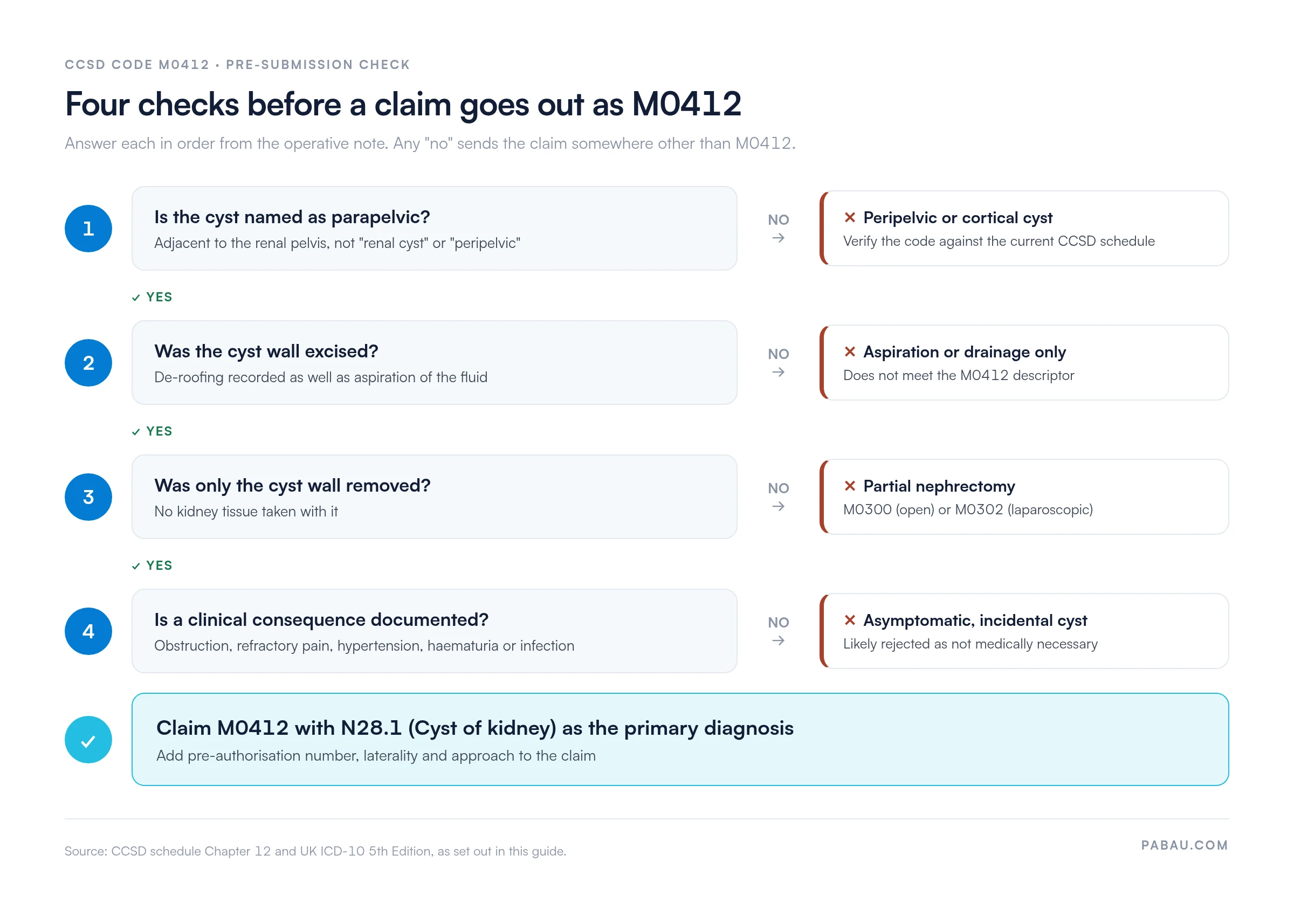
Before submitting M0412, run a two-step documentation check. First, confirm the operative note uses the word parapelvic, not just cyst or peripelvic. Then confirm both de-roofing and aspiration are documented as completed steps. If either element is missing, contact the surgeon for a supplementary clarification note before claim submission.
Each UK insurer sets its own rules for how bilateral and multi-clinician M0412 cases are billed. Four scenarios come up most often:
Rules for bilateral and multiple procedures vary between Bupa, AXA Health, Aviva, Vitality, WPA and other UK insurers. Check each insurer’s current fee schedule and benefit rules before submitting a complex theatre claim involving CCSD Code M0412.
UK private medical insurers expect pre-authorisation before elective surgery, and renal cyst surgery is no exception. Securing it before the procedure is scheduled prevents the costliest rejection, a claim refused in full after the patient has been treated.
A typical pre-authorisation submission for M0412 includes:
Bupa, AXA Health, Aviva, Vitality and WPA each issue an authorisation number against a named consultant and procedure code. Before surgery, also check that the patient’s policy covers the procedure and how much benefit remains. Cover for a symptomatic cyst can differ between policies, so confirm it for each patient rather than generalising from another insurer.
Pabau’s claims management software tracks pre-authorisations for UK private urology practices. Your team records authorisation numbers, expiry dates and submission timestamps against each patient record. Billing staff can then confirm the reference is still valid before a claim goes out.
The operative report is the primary audit document for M0412. Insurer claims reviewers assess it to confirm the procedure code is justified. A theatre note that is missing any of the following elements is likely to trigger a query or denial:
A short, templated operative note is a common cause of M0412 rejections. It typically omits the cyst type, the laterality or confirmation of both procedural steps. Practice managers should review theatre notes against this checklist before submission, not after a denial arrives.
Six denial patterns recur on M0412 claims. Each one can be caught before submission, which costs far less than an appeal.
A rejected M0412 claim is challenged with the insurer first and then externally. The steps below follow the UK route: the insurer’s internal appeal and complaints process, then the Financial Ombudsman Service.
UK private practices managing recurring rejections need each claim’s status in view. Pabau sends claims through Healthcode, validates them before submission and lists every claim with its current status. A rejected claim, and the appeal that follows, then stays visible while other billing work takes priority.
Many urology practices still key the procedure code, diagnosis and authorisation number into each insurer’s portal by hand. Pabau keeps them together on the patient record and attaches all three to one claim before it goes to the insurer.
Pabau’s digital forms capture laterality, cyst type and approach at the point of care, so the detail insurers check is already on the claim. When Bupa or AXA Health queries an M0412 claim, the authorisation, the operative note and the invoice sit in one place.

Pabau helps UK private urology practices track authorisation numbers, submit CCSD claims and manage rejections from one platform. Claims reach Bupa, AXA Health, Aviva or Vitality complete, so your billing team spends less time answering queries.

M0412 is a Major claim that turns on a few words in the operative report. Where the note says “parapelvic” and records both de-roofing and aspiration, the code holds. Where it says “renal cyst” or describes drainage alone, the insurer has grounds to query or refuse it. That wording is cheapest to settle before the consultant signs the note.
Practices that bill M0412 well keep the authorisation number, laterality and operative note with the claim from the day it is created. Book a demo to see how Pabau keeps them attached before the claim reaches Bupa, AXA Health or any other UK insurer.

Need guidance on CCSD billing rules across specialties? CCSD procedure code billing covers the code structure, chapter navigation, and insurer-specific submission requirements.
Billing another kidney procedure from Chapter 12? CCSD Code M0210 covers nephrectomy and excision of perirenal tissue, with the same UK insurer billing detail.
Taking tissue for diagnosis rather than de-roofing? CCSD Code M0814 covers open biopsy of a native kidney and what its claim needs.
CCSD Code M0412 covers de-roofing and aspiration of a renal parapelvic cyst. The surgeon excises part of the cyst wall and drains the cyst fluid in the same theatre session. Both steps must be performed and documented, because aspiration alone does not meet the descriptor.
Yes. UK private medical insurers such as Bupa, AXA Health, Aviva and Vitality expect pre-authorisation for M0412 as elective surgery. The request should include a clinical justification letter, imaging confirming the parapelvic cyst, the CCSD code and the ICD-10 code. Treating the patient without authorisation is the costliest rejection to recover from.
N28.1 (Cyst of kidney) is the primary ICD-10 diagnosis code paired with M0412. Add secondary codes such as N13.3 for hydronephrosis or R31 for haematuria when the clinical record documents those complications. They show the insurer the full indication for surgery.
Yes. The M0412 descriptor does not specify an approach, and Chapter 12 of the CCSD schedule lists no separate laparoscopic code for parapelvic cyst de-roofing. The operative report must still state the approach. Confirm the insurer’s rules before billing a laparoscopic case.
Parapelvic cysts arise from renal parenchyma adjacent to the pelvis and are what M0412 specifically describes. Peripelvic cysts arise from lymphatic channels within the renal sinus and may not be covered by the same code. Using the wrong term in the operative note, or failing to specify cyst type, is a leading cause of M0412 denials.
Most M0412 rejections trace back to five problems. The operative report does not name the cyst as parapelvic, or it documents aspiration without de-roofing. Pre-authorisation is missing or expired, laterality differs between the theatre note and the claim, or the ICD-10 code does not match. Each has a specific corrective action at the appeal stage.