

HCPCS Code L0472: Hyperextension TLSO billing guide
HCPCS code L0472: Official descriptor and device definition HCPCS code L0472 des...

Last Updated: Nov 5, 2026
L9112 is the CCSD code for surgical insertion of a central venous dialysis line. It covers a dialysis line placed through a surgical exposure of the vein, to give a patient access for haemodialysis.
A percutaneous insertion is coded L9113, a tunnelled Hickman line L9110, and removal of a dialysis line L9114. CCSD lists all three as unacceptable combinations with L9112. Pre-authorisation and fees follow each UK insurer's own rules.
Let Pabau's smart automation suggest the right codes, reduce claim denials, and keep your practice compliant—effortlessly.
Automate repetitive tasks and focus on what matters most—your patients.
Reduce coding errors and ensure compliance with the latest regulations.
Clean claims, fewer denials, and faster reimbursements.
Powerful insights and reporting to help your practice thrive.
HIPAA compliant SOC 2 certified GDPR-compliant Trusted by 4,000+ clinics worldwide

CCSD Code L9112 is the UK private-sector code for surgical insertion of a central venous dialysis line, in Chapter 9, sub-chapter 9.6.0.
A percutaneous insertion is L9113, a tunnelled Hickman line is L9110, and removal of a dialysis line is L9114.
CCSD lists L9110, L9113 and L9114 as unacceptable combinations with L9112, though each insurer decides whether to apply that rule.
Pre-authorisation and fees depend on the patient’s insurer, so check Bupa, AXA Health, Aviva or Vitality rules before the procedure.
CCSD Code L9112 is the code for surgical insertion of a central venous dialysis line. It describes a line placed through a surgical approach to give a patient access for haemodialysis.
CCSD stands for Clinical Coding & Schedule Development. The CCSD Group maintains the procedure schedule that UK private medical insurers use, including Bupa, AXA Health, Aviva and Vitality. CCSD is a coding schedule, not a fee tariff. Each insurer sets its own fees against the codes.
L9112 sits in Chapter 9, the vascular system, under sub-chapter 9.6.0 Non-specific. Three neighbouring codes in that sub-chapter describe other ways of placing or removing a central line. Choosing between them is the main coding decision on this procedure. Codes from the other chapters sit in our CCSD code library.
L9112 describes a surgical insertion, so the operative note should show an open approach to the vein. The usual steps are:
If the line went in through a needle and guidewire without a surgical exposure, the note describes a percutaneous insertion. That procedure has its own code, L9113.
Four codes in sub-chapter 9.6.0 cover central line work, and each describes a different procedure. Read the operative note against the table below before you pick one.
The CCSD schedule lists L9110, L9113 and L9114 as unacceptable combinations with L9112. In practice, you would not normally bill any of them on the same claim as L9112. The schedule’s list for L9112 covers some other line-insertion codes too, so check it in full before you add a second code. The decision path below puts the code choice and the combination check together.
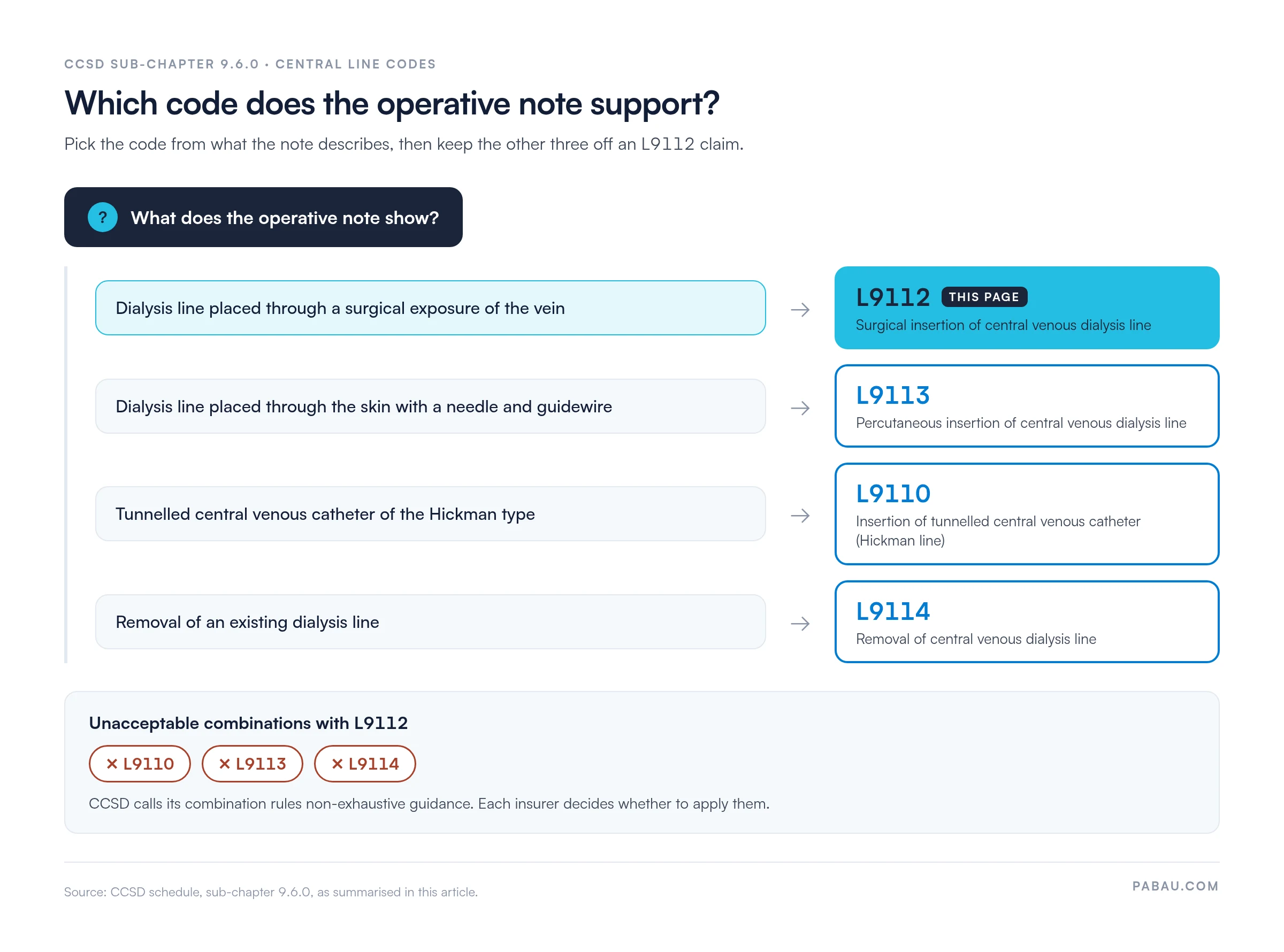
CCSD describes its combination rules as non-exhaustive guidance. Each insurer decides whether to adopt a given combination, so confirm with the insurer if a case seems to need two of these codes. For how CCSD codes are organised across the schedule, see Pabau’s Bupa CCSD code guide.
UK insurers expect diagnoses coded in WHO ICD-10, not the US ICD-10-CM edition. The codes below are common reasons for placing a dialysis line. Use the one that matches the documented indication.
A complication code such as T82.4 often travels with the underlying kidney diagnosis. Check the insurer’s submission template for how many diagnosis codes it accepts and in what order.
Whether L9112 needs pre-authorisation, and what evidence goes with the request, is set by the patient’s insurer. Bupa, AXA Health, Aviva and Vitality each apply their own rules. Contact the insurer before a planned insertion and record the authorisation reference it gives you.
Insurers commonly ask for evidence along these lines:
Urgent insertions for acute kidney failure may not allow time for a request beforehand. Ask the insurer how it handles urgent cases, and document the clinical urgency in the notes. Bupa’s code search portal is one place to check a code and its guidance notes before you apply.
The operative note is the main evidence that the line went in surgically, as L9112 describes. A note that reads like a percutaneous insertion invites a query about whether L9113 was the right code.
Most L9112 rejections trace back to the code choice or the paperwork. Check these points before submission:
Healthcode is the main e-claims platform for UK private healthcare, used by insurers including Bupa, AXA Health, Aviva and Vitality. The submission steps for L9112 are:
CCSD publishes codes, not fees. Each insurer sets its own fee for L9112, so check the current schedule for the patient’s insurer before you invoice. The AXA Health specialist procedure codes portal is one example of an insurer’s own source.
CCSD has no CPT-style modifiers. What the procedure involved is carried by the code descriptor itself, which is why the surgical-versus-percutaneous choice matters.
Code from the operative note, not the booking. A procedure booked as a surgical insertion can end up percutaneous on the day. If it did, the claim should carry L9113 rather than L9112.
Renal and vascular teams often keep the operative note, the consent form and the insurer’s authorisation reference in different places. The claim is then keyed into Healthcode by hand, which is how a missing reference or a mismatched code reaches the insurer.
Pabau, the practice management platform we build, keeps treatment notes, digital consent forms and medical questionnaires in the patient’s Client record. The team can note the insurer’s authorisation reference in that same record. Surgeons can document the approach and tip position in a digital clinical form, so the note supports L9112 before anyone starts the claim.
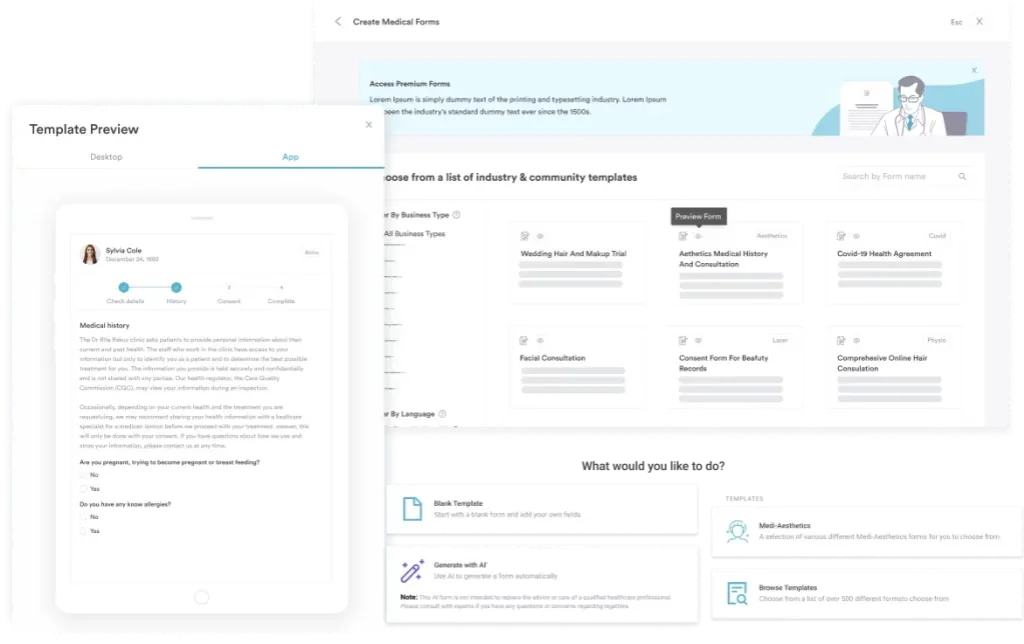
With Pabau’s private practice claims management, the claim goes to Healthcode from the same system, and your team tracks its status there. Patient details already in the record carry into the claim, so nobody retypes them into a second portal.

Pabau keeps operative notes and consent forms in the patient’s record and sends the claim to Healthcode. Each L9112 submission leaves with its paperwork in one place.

What decides an L9112 claim is how the line went in. A surgical exposure is L9112, a needle-and-guidewire insertion is L9113, and a tunnelled Hickman line is L9110.
So settle the code from the operative note, not the theatre list, and keep L9110, L9113 and L9114 off the same claim. Then check the patient’s insurer for its authorisation and fee rules before you submit.
Book a demo to see how Pabau keeps clinical records and Healthcode claims together for dialysis access procedures.

Coding the fistula side of dialysis access? CCSD Code L7423 covers ligation of an arteriovenous fistula for dialysis.
Working through other Chapter 9 vascular codes? CCSD Code L6800 covers repair of a limb artery.
Coding aortic surgery? CCSD Code L2200 explains revision of a prosthesis of the abdominal aorta.
Handling cerebral vascular work? CCSD Code L3380 covers reinforcement of an aneurysm of a cerebral artery.
Coding congenital heart procedures? CCSD Code L0620 covers creation of a communication between the pulmonary artery and aorta.
CCSD Code L9112 covers the surgical insertion of a central venous dialysis line, giving a patient access for haemodialysis. CCSD is the procedure schedule UK private medical insurers use, maintained by the Clinical Coding and Schedule Development Group. L9112 sits in Chapter 9, sub-chapter 9.6.0 Non-specific.
That depends on the patient’s insurer. Bupa, AXA Health, Aviva and Vitality each set their own pre-authorisation rules and evidence requirements. Contact the insurer before a planned insertion, record the authorisation reference, and ask how it handles urgent cases.
A separate anaesthetist bills their own fee under the applicable CCSD anaesthetic code, apart from the surgeon’s L9112 fee. Whether imaging guidance can be billed separately depends on the insurer’s rules, so check with the insurer first.
The most frequent causes are choosing L9112 for a percutaneous or Hickman insertion, and adding L9110, L9113 or L9114 to the same claim. Other causes are a missing authorisation reference, a diagnosis that does not match the notes and an operative note without the surgical approach.



