HCPCS code P9058: Red blood cells, leukocytes reduced, CMV-negative, irradiated
HCPCS code P9058: Official descriptor and key attributes HCPCS code P9058 report...

Last Updated: Oct 26, 2026
L6800 is the CCSD code for open surgical repair of a limb artery, such as the femoral, popliteal or tibial artery. Surgeons bill it for direct repair, patch angioplasty, formal arteriotomy closure or anastomosis revision of the existing vessel.
CCSD is the procedure schedule UK private medical insurers use, and claims usually go through Healthcode. Bypass grafts and endovascular work take other codes, so the operative report has to show an open repair.
Let Pabau's smart automation suggest the right codes, reduce claim denials, and keep your practice compliant—effortlessly.
Automate repetitive tasks and focus on what matters most—your patients.
Reduce coding errors and ensure compliance with the latest regulations.
Clean claims, fewer denials, and faster reimbursements.
Powerful insights and reporting to help your practice thrive.
HIPAA compliant SOC 2 certified GDPR-compliant Trusted by 4,000+ clinics worldwide

CCSD Code L6800 covers open surgical repair of a limb artery only: direct repair, patch angioplasty and arteriotomy closure. Bypass grafting and endovascular approaches use different CCSD codes.
UK private medical insurers such as Bupa, AXA Health and Aviva set their own pre-authorisation rules for elective limb artery repair. Check the patient’s policy before surgery.
Mismatched ICD-10 codes are a common cause of L6800 claim rejections. The atherosclerosis codes in the I70 series are the usual pairings for elective cases.
Pabau’s claims management software raises the L6800 invoice against the patient’s insurer and sends the claim to Healthcode without retyping.
CCSD Code L6800 is the UK private medical insurance code for open surgical repair of a peripheral limb artery. Insurer fee schedules list L6800 in chapter 9, the vascular system. Its L prefix follows the OPCS-4 chapter for arteries and veins.
The official descriptor is “Repair of limb artery.” It covers interventions where a vascular surgeon directly repairs an arterial wall or lumen through an open approach.
Four broad techniques fall within the code’s scope. Direct primary repair involves suturing a lacerated or otherwise damaged arterial wall after debridement. Patch angioplasty uses a vein or synthetic patch to widen a narrowed segment without rerouting flow.
Arteriotomy closure is the closure of a planned arterial incision after an intraluminal procedure such as embolectomy. Anastomosis revision reopens a prior anastomosis on a limb artery that has narrowed or come apart. All four use an open approach to restore an existing limb artery, rather than create a new conduit around it.
L6800 covers open surgical techniques that restore an existing limb artery’s integrity without rerouting blood flow through a new conduit. The arteries most commonly involved are the femoral (common and superficial), popliteal, anterior tibial, posterior tibial, and peroneal. Each of these vessels is accessible through an open approach under general or regional anaesthesia.
Included techniques under CCSD Code L6800:
All four techniques share the key coding criterion: The surgeon works directly on the native arterial wall through an open incision. The artery named in the operative report determines the clinical specificity of the ICD-10 pairing selected alongside L6800.
Document the specific artery by its anatomical name in the operative report, not just as ‘peripheral artery’. Insurers use the named vessel to confirm that L6800 is the right code and not a bypass graft code. ‘Repair of right superficial femoral artery via patch angioplasty’ supports L6800; ‘peripheral vascular procedure’ does not.
L6800 does not cover every vascular procedure on a limb artery. The categories below sit outside its scope and are billed another way.
The bypass graft boundary is the most consequential exclusion. A bypass creates a new conduit, typically reversed great saphenous vein or a PTFE graft. That conduit routes blood around an occluded segment, so it is not a repair.
Billing L6800 for a bypass is a coding error that insurers pick up at review, leading to rejection or a request for operative notes.
Open repair and endovascular repair are distinct procedures with different CCSD codes. L6800 applies to open repair only. Percutaneous transluminal angioplasty (PTA) and stent placement are billed under separate CCSD codes.
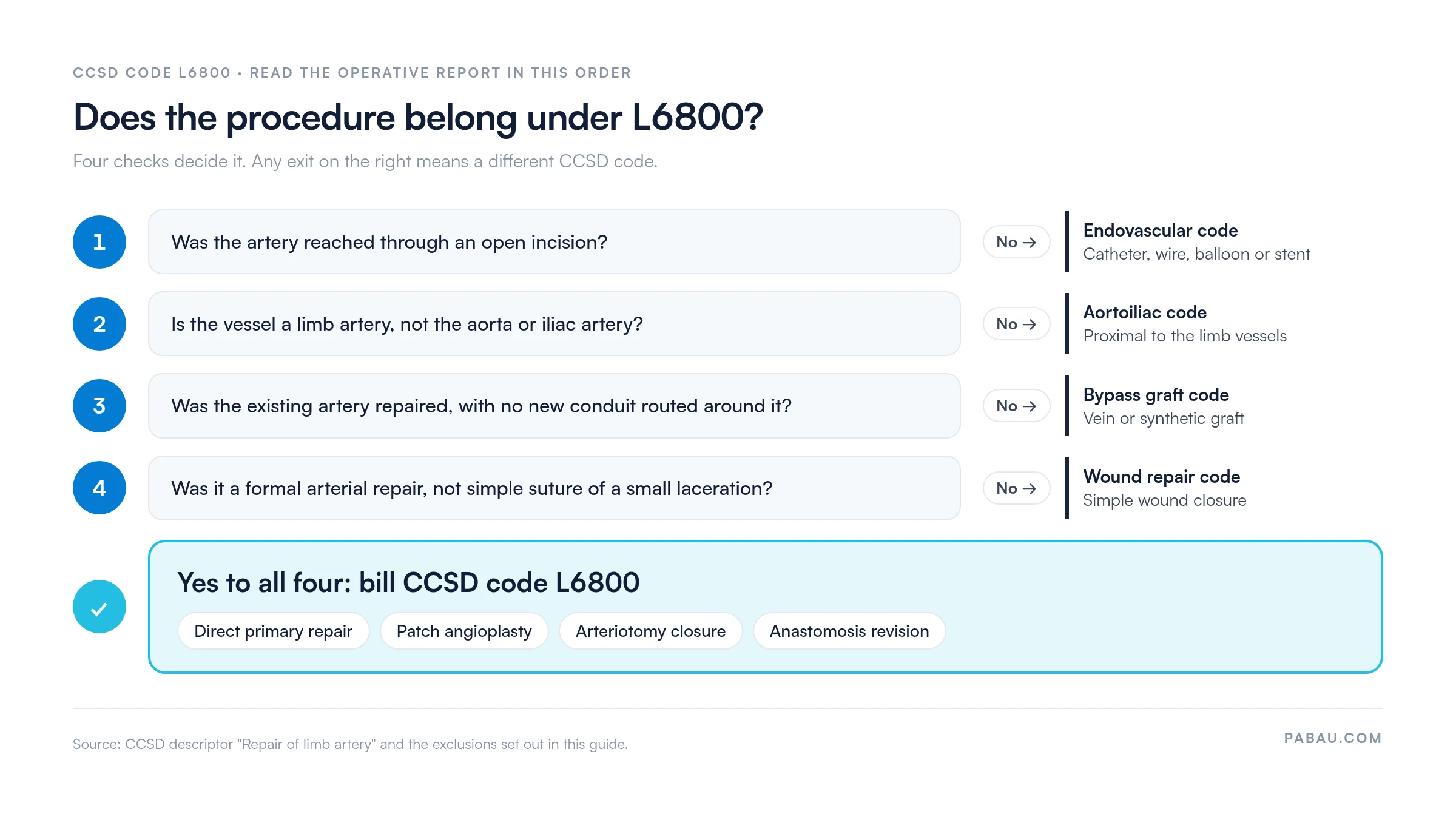
The operative report is the deciding document. If the surgeon records an arteriotomy and direct work on the vessel wall through an open incision, the procedure qualifies for L6800. If the report describes catheter access, wire passage, balloon inflation or stent deployment with no open incision, an endovascular code applies.
Hybrid procedures that combine both techniques in one session need both codes. The insurer’s rules on multiple procedures then decide how each one is paid. The decision path below runs the open-approach test alongside the other exclusions, in the order a coder reads the report.
L6800 sits among the chapter L vascular codes. Coders often need to tell it apart from neighbouring codes for bypass grafting, endovascular work and aortoiliac surgery. The table below shows the codes most often confused with L6800 and the key difference for each. For the full schedule, see the CCSD code list.
Every CCSD L6800 claim needs an ICD-10 diagnosis code to show medical necessity. The right pairing depends on the clinical indication. Peripheral arterial disease accounts for most elective limb artery repairs, while traumatic injury drives most emergency cases. The WHO ICD-10 browser is the authoritative reference for code descriptions and hierarchy.
A mismatch between the diagnosis code and the surgical technique is a common rejection trigger. Pairing I70.2 with a traumatic repair signals inconsistency to insurer reviewers. So does a trauma S code when the underlying diagnosis is PAD. Confirm the primary indication first, then check the ICD-10 code matches the pre-authorisation request.
An L6800 claim stands or falls on the operative report. Insurer claims reviewers read operative notes to confirm that the code describes what was performed. The operative report must contain each of the following.
The major UK private medical insurers all use the CCSD schedule as the basis for procedure reimbursement. Each one sets its own fee for L6800, so the same claim can pay differently across insurers. For Bupa’s insurer-specific rules, see the guide to Bupa CCSD codes.
The table below shows where to check each insurer’s current fee. Use the insurer’s own portal, because fee schedules change and third-party summaries lag behind.
Pre-authorisation rules for elective limb artery repair vary by insurer and by the member’s policy. There is no blanket rule across UK private medical insurers, so check the patient’s cover before you schedule the procedure.
For an elective case, the pre-authorisation request typically includes the proposed CCSD code (L6800) and the supporting ICD-10 code. It also carries the consultant’s clinical rationale and relevant imaging, such as duplex ultrasound or CT angiography confirming the lesion.
Emergency cases can’t wait for approval, so notify the insurer as soon as possible after surgery. The notification window differs by insurer, so check each one’s rules.
Healthcode is the main electronic billing platform for UK private practice, and most major insurers receive claims through it. A few insurers still take claims by email or through their own portal.
Check that the treating consultant is recognised by the patient’s insurer before you book an elective L6800 case. Insurers match each claim to the consultant’s provider registration and GMC number. A claim from an unrecognised consultant can fail before anyone reads the operative notes.
CCSD codes don’t use CPT-style modifiers. Each insurer applies its own rules when one claim carries several procedures or practitioners. Four situations come up most often with L6800.
Bilateral repairs attract the most insurer queries. If both limbs are repaired in one session, the claim must show two separate arterial repairs. Bill only one, and only one is paid. Bill both without separate notes for each limb, and expect a rejection.
Most L6800 rejections fall into five categories. Each has a specific root cause and a fix in the documentation or coding.
The wrong-code error matters most, because it can prompt an insurer audit rather than a simple correction request. If a bypass code went in by mistake for a direct repair, resubmit with L6800. Add a written explanation and the original operative notes. Correcting it before the insurer raises a query usually resolves it faster.
In many private vascular practices, the operative report lives in one system, the invoice in another and claim status in a spreadsheet. Each hand-off is a chance to key the wrong code or miss an insurer deadline.
Pabau’s practice management platform keeps that work on one patient record. Add the patient’s insurer and policy to the client card, and invoices go to the right insurer at its own price list. Pabau’s claims management software then pre-fills the claim and sends it to Healthcode. Insurers that aren’t on Healthcode get the claim by email.
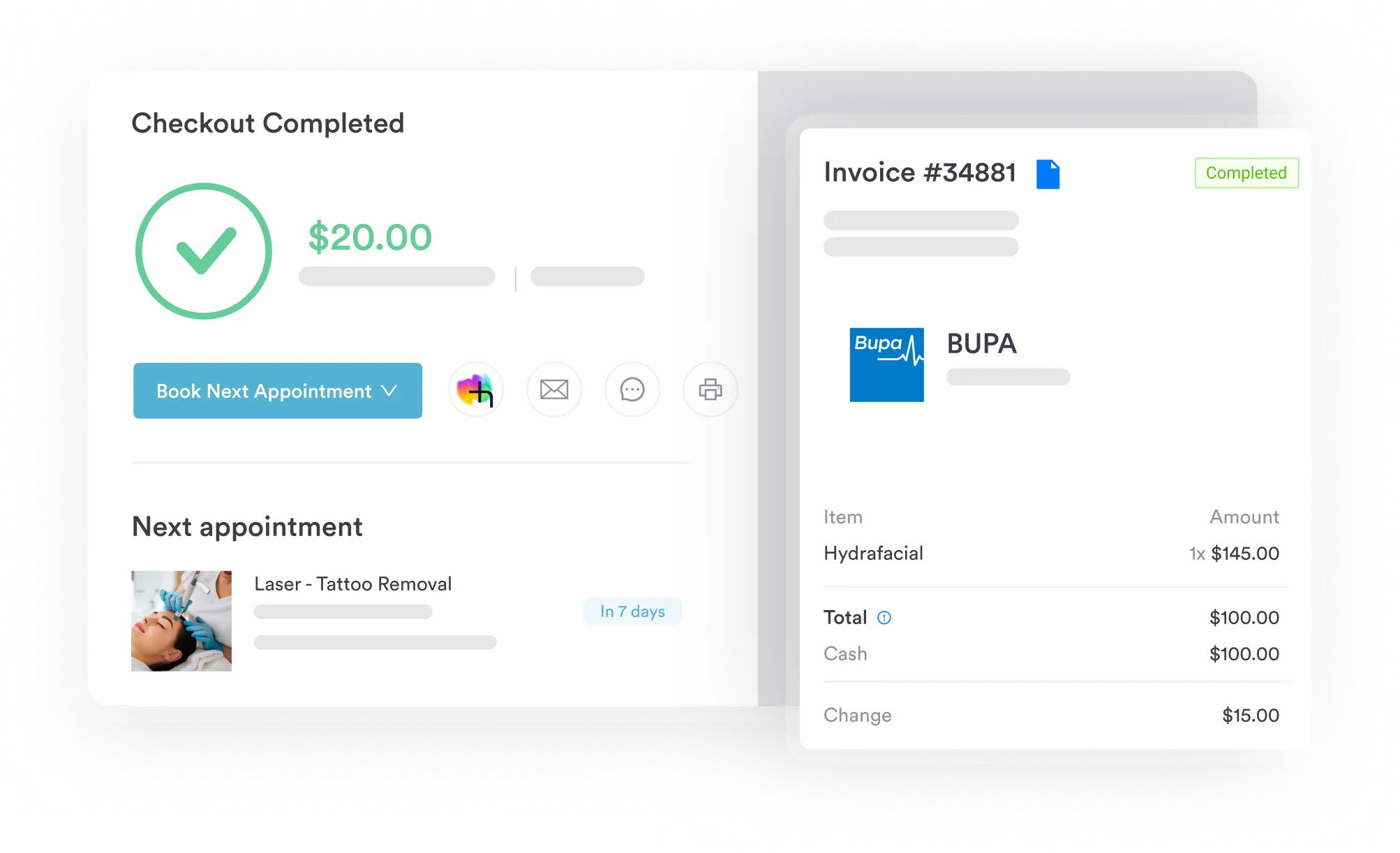
Every claim then moves through clear stages: Pending, Submitted, Processing, Paid or Error. Your billing team can filter by insurer and chase a queried L6800 claim before it ages past the resubmission deadline.

Pabau links each L6800 invoice to the patient’s insurer and operative report, then sends the claim to Healthcode. Your team tracks every claim to payment from one dashboard.

L6800 claims turn on two decisions. Use the code only for an open repair of an existing limb artery, never a bypass or an endovascular procedure. Then pair it with an ICD-10 code that matches the documented indication.
Get those two right, secure pre-authorisation for elective cases, and most rejections never happen. The rest come down to an operative report that names the artery and the technique.
To see how Pabau sends vascular claims to Healthcode with the insurer and operative details attached, book a demo with the team.

Coding emergency aortic repair? CCSD code L1880 walks through repair of a leaking aneurysm of the aortic arch.
CCSD Code L6800 covers open surgical repair of a limb artery in UK private practice. That includes direct primary repair, patch angioplasty, arteriotomy closure and anastomosis revision of the femoral, popliteal and tibial arteries. It applies only to open procedures, not bypass grafting or endovascular approaches.
L6800 covers repair of an existing artery. A bypass graft code covers a new conduit, made from vein or synthetic graft, that routes blood around a blocked or damaged segment. If the operative report describes a new conduit, a bypass code applies. If the existing vessel wall was repaired, L6800 applies.
I70.2 (atherosclerosis of arteries of extremities) is the usual pairing for elective PAD cases. I72.4 (aneurysm of artery of lower extremity) suits aneurysm repair. S75.0 or S85.0 cover traumatic femoral or popliteal artery injury. The diagnosis code must match the documented clinical indication, not the procedure technique.
The most common reasons are a bypass code billed instead of L6800 (or vice versa) and missing pre-authorisation on an elective case. Operative notes that don’t name the artery or the technique cause rejections too. So does an ICD-10 code that conflicts with the documented procedure. Bilateral repairs billed without separate notes for each limb come next.
It can, but each UK insurer sets its own rules for bilateral and multiple procedures. Check the patient’s insurer before billing L6800 twice. The operative report must name each artery and describe the repair technique for each limb separately.
No. L6800 applies to open surgical repair only. Percutaneous transluminal angioplasty and arterial stenting are billed under separate CCSD codes. If the operative report describes catheter access, balloon inflation or stent deployment with no open arteriotomy, L6800 is not the correct code.