HCPCS code P9058: Red blood cells, leukocytes reduced, CMV-negative, irradiated
HCPCS code P9058: Official descriptor and key attributes HCPCS code P9058 report...

Last Updated: Oct 26, 2026
L2200 is the CCSD code for revision of prosthesis of abdominal aorta. It covers redo surgery on an existing abdominal aortic graft or stent graft to treat a complication such as endoleak, migration, limb occlusion or infection.
The code applies only when a prosthesis is already in place, and it covers open and endovascular revision alike. First-time repairs use other codes in the CCSD L-series.
Let Pabau's smart automation suggest the right codes, reduce claim denials, and keep your practice compliant—effortlessly.
Automate repetitive tasks and focus on what matters most—your patients.
Reduce coding errors and ensure compliance with the latest regulations.
Clean claims, fewer denials, and faster reimbursements.
Powerful insights and reporting to help your practice thrive.
HIPAA compliant SOC 2 certified GDPR-compliant Trusted by 4,000+ clinics worldwide

CCSD Code L2200 covers revision of an existing abdominal aortic prosthesis, not first-time aortic repair.
Primary indications include endoleak (Types I, II, III), graft migration, limb occlusion, infection, and pseudoaneurysm.
The operative report must explicitly confirm this is a revision procedure, including the nature of the complication, approach used, and prosthesis details.
Bupa lists L2200 as a Cash Value code with a £3,137 surgeon fee in its February 2026 schedule. Other UK insurers set their own fees.
Pabau’s claims management software keeps the CCSD code, the diagnosis and the authorisation number on one claim record and submits it through Healthcode.
CCSD Code L2200 is the UK private medical insurance code for surgical revision of an abdominal aortic prosthesis. The Clinical Coding and Schedule Development (CCSD) Group maintains the schedule, and Grant Thornton UK LLP administers it.
L2200 sits among the L-prefixed CCSD codes for arterial surgery. Bupa’s schedule lists it under Great Vessels in chapter 8 and again under Abdominal Vessels in chapter 9. Our library of CCSD codes covers the neighbouring vascular codes in the same detail.
The official descriptor for L2200 is “Revision of prosthesis of abdominal aorta.” Two points follow directly from that descriptor. First, “prosthesis” means an artificial graft or device. That covers synthetic tube grafts from open repair and the stent grafts (endografts) placed during EVAR.
Second, “revision” establishes that a primary procedure has already been performed. L2200 does not apply to the original placement of an aortic prosthesis.
The code belongs to a cluster of CCSD L-series codes covering aortic surgery. Knowing where L2200 sits in that cluster helps coders avoid using it in place of an initial repair code or a thoracic aortic code. The table in the related codes section below maps the most relevant neighbours.
Revision of an abdominal aortic prosthesis is performed when a previously placed graft develops a complication that cannot be managed conservatively. The vascular surgeon must re-access the aorta, assess the failed or failing prosthesis, and either repair, replace, or extend it. The surgical complexity can range from a short endovascular re-intervention to a full open redo operation.
The indication documented in the operative report must match the ICD-10 code submitted with L2200. The following are the most clinically common reasons a revision is performed:
Each indication produces a different clinical picture and requires a different approach. Open revision involves laparotomy or retroperitoneal exposure and direct graft manipulation. Endovascular revision typically uses additional stent graft components, cuff extensions or embolisation coils under fluoroscopic guidance.
The L2200 descriptor does not specify approach. Open and endovascular revisions can both be submitted under it, provided the operative report accurately describes what was done.
Knowing the scope of L2200 prevents both under-billing and unbundling. Under-billing misses separately billable procedures, while unbundling splits out components that the code already includes. The table below summarises what is typically bundled into L2200 and what may be billed separately.
Unbundling risk is highest when multiple vascular procedures are performed in the same session. Take a revision performed alongside a femoral-femoral bypass, for example.
Both codes may be supportable, but the operative report must describe each procedure as distinct and independently necessary. Bupa applies the CCSD unbundling combinations and pays only the highest-value code in an unbundled combination.
L2200 is one of several CCSD L-series codes covering aortic and major vascular surgery. Choosing the wrong one is a common source of queries on these claims.
Four questions about the prior graft and the site of surgery settle most choices, as the path below shows. The table after it lists Bupa’s February 2026 category and fee for each code.
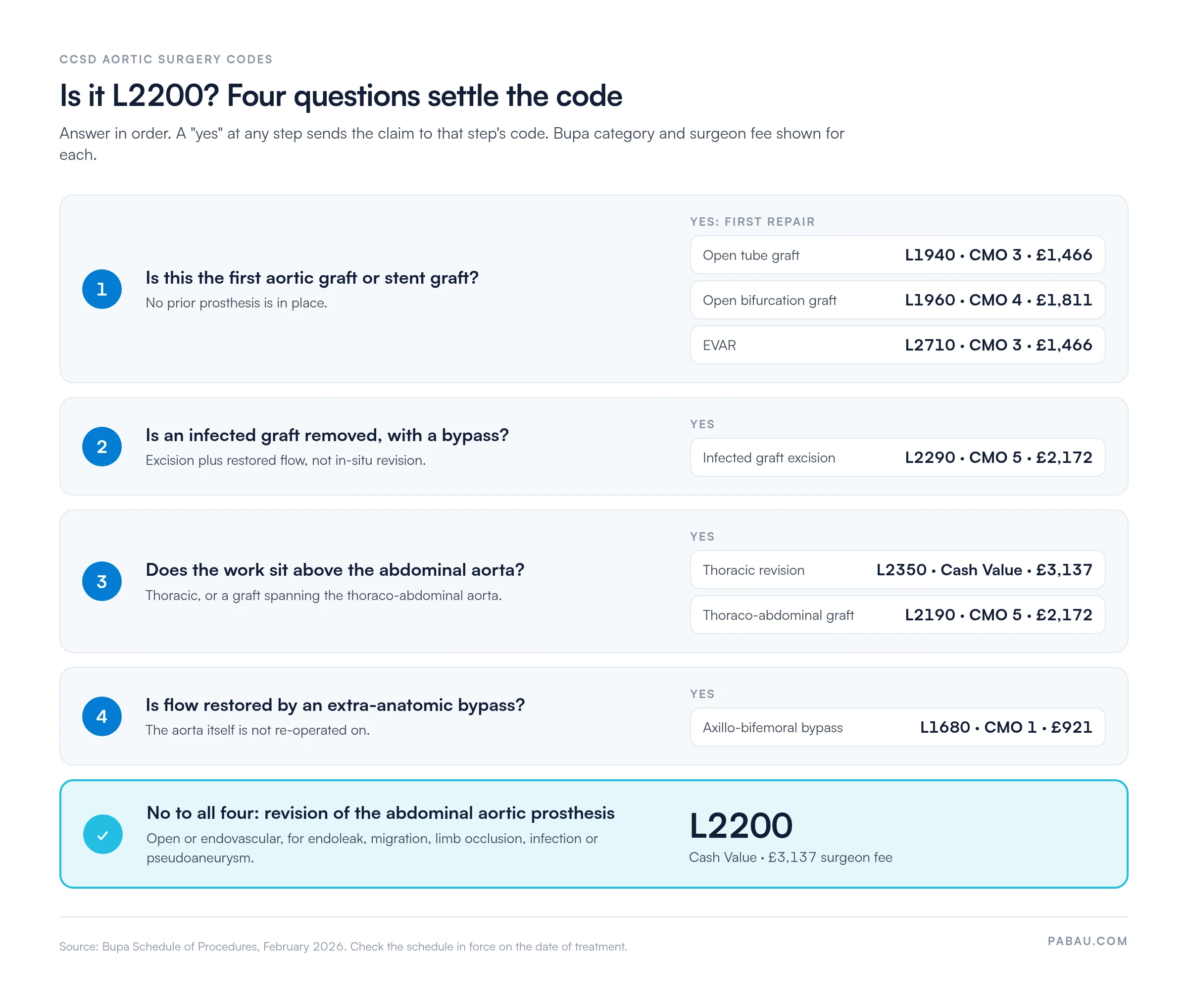
Always check codes against the current CCSD schedule before submitting. Bupa updates its fees regularly, so the figures above are a February 2026 snapshot. Submitting a revision under an initial repair code is a reliable way to trigger an insurer query.
Check the CCSD code and the insurer’s fee against the versions in force on the date of treatment. The CCSD Group updates the schedule, and each insurer updates its own fees. Keeping the current Bupa schedule bookmarked on the billing desk prevents invoicing a superseded figure.
UK private medical insurers expect an ICD-10 diagnosis that supports the medical necessity of the procedure. For L2200, the diagnosis code must confirm a complication of the existing prosthesis. Check code specificity in the WHO ICD-10 browser before submission, particularly for the T82 complication codes.
The diagnosis code must match the operative report. If the report documents Type I endoleak causing seal failure, T82.3 is the appropriate primary code. A non-specific complication code, used when the operative findings are clearly documented, invites an insurer query. Select the most specific applicable code, then add Z95.8 as a secondary code where it helps confirm the revision context.
The operative report is the single most important document for an L2200 claim. Insurers reviewing a vascular revision claim look for specific elements before approving payment. A report that omits the revision-versus-initial distinction is almost certain to draw a request for more information.
The operative report must contain all of the following to support L2200:
Bupa may ask for a funding request form or a medical report before it confirms cover. The patient must consent to that report under the Access to Medical Reports Act 1988, so a clear pre-operative record speeds up the answer.
UK private medical insurers expect treatment to be pre-authorised before it starts. The patient contacts their insurer with the L2200 code and description, and the insurer issues an authorisation number for the invoice. Bupa, AXA Health, Aviva, VitalityHealth and WPA each run their own pre-authorisation process.
Emergency revisions need particular care. Acute graft thrombosis presenting with limb ischaemia is a typical example. Most UK health insurers leave emergency treatment to the NHS, so a funded claim depends on the insurer confirming cover before surgery.
Supporting information insurers typically ask for includes the original operative report, recent CT angiography confirming the complication, and a clinical letter from the vascular surgeon. An open aortic revision often needs a critical care stay. Where Bupa is the payer, send its ITU/HDU funding request form so it can check that the stay is covered.
Revision of an abdominal aortic prosthesis is a major vascular procedure performed under general anaesthesia. The CCSD Group maintains the codes, not the prices. Fees for L2200 come from each insurer’s own fee schedule.
The following billing rules apply when you invoice L2200:
Coordinate the surgeon’s and anaesthetist’s invoices so both describe the same procedure. Our Bupa fee schedule guide shows how one insurer prices each code.
L2200 claims draw more queries than initial aortic repair claims, largely because revision procedures carry a higher documentation burden. The most frequent denial patterns with UK private medical insurers are as follows:
Use this checklist before submitting any L2200 claim:
Our Bupa CCSD codes guide explains how Bupa handles CCSD claim submissions in more detail.
Run a quarterly audit of the L2200 claims submitted in the period. Filter for denials and queries, and group them by insurer and reason. One recurring cause, such as a missing imaging attachment or an out-of-date fee, often explains most of them. Fix the root cause once and the denial rate drops.
Vascular billing teams often track a revision case across theatre notes, emails and insurer portals. When a redo operation is authorised at short notice, the authorisation number and the critical care approval are easy to lose.
Pabau, the practice management software we build for private practices, keeps the CCSD code, the ICD-10 diagnosis and the authorisation number on one claim record.
You submit the claim through Healthcode, the UK clearinghouse for private medical insurance claims, and track its status in the same place. Pabau doesn’t choose the code, so the revision, diagnosis and documentation checks above still apply.

Pabau connects operative notes, pre-authorisation records and claim workflows in one system. It helps vascular surgery practices billing UK private medical insurers reduce denials and get paid faster.

Billing L2200 correctly depends on one distinction above all others. The operative report must confirm that a revision is being performed on an existing aortic prosthesis, not a first-time repair.
Without that confirmation, a matching ICD-10 complication code and a valid authorisation number, UK private medical insurers have no basis for approval.
Settle the code, the diagnosis and the authorisation number before the claim leaves the practice. Pabau’s claims management software keeps them on one record and submits the claim through Healthcode. To see how it works for your practice, book a demo.

Coding emergency surgery on the aortic arch? CCSD code L1880 covers repair of a leaking aneurysm of the arch of the aorta.
Want to reduce claim denials across your practice? Claims management software explains how Pabau structures the billing workflow from documentation to submission.
CCSD Code L2200 is the UK private medical insurance code for revision of prosthesis of abdominal aorta. It applies when a vascular surgeon re-operates on a previously placed aortic graft, open or endovascular. The aim is to correct a complication such as endoleak, graft migration, or limb occlusion. It does not apply to the original placement of an aortic prosthesis.
Yes. The L2200 descriptor does not specify surgical approach. Open redo surgery and endovascular re-intervention, such as adding a cuff extension to seal an endoleak, can both be submitted under this code. The operative report must clearly describe the approach used.
The most commonly paired ICD-10 code is T82.3, mechanical complication of other vascular grafts, which covers endoleak and migration. T82.7 covers device infection, and T82.8 covers other complications. Z95.8 (presence of other cardiac and vascular implants and grafts) can be added as a secondary code to confirm the revision context. The primary code must match the documented indication in the operative report.
Bupa’s February 2026 Schedule of Procedures lists L2200 as a Cash Value code with a surgeon fee of £3,137. Bupa updates its schedule regularly, so check the fee in force on the date of treatment. AXA Health, Aviva, VitalityHealth and WPA each publish their own fees.
The most frequent denial reasons are missing pre-authorisation and an ICD-10 code that does not confirm a complication of an existing prosthesis. Operative report language that reads as an initial repair is another. Invoicing a fee from an out-of-date insurer schedule is another common trigger. A mismatch between the surgeon’s and anaesthetist’s invoices also draws queries.
The operative report must confirm the revision context: the prior prosthesis, the nature of the complication and the surgical approach. It should also give the device details and reference supporting imaging findings. The invoice must carry the insurer’s authorisation number. Insurers may also request the original operative report from the primary repair.
The closest codes are L1940, L1960 and L2710 for first-time open or endovascular repair, and L2190 for thoraco-abdominal graft replacement. L2290 covers excision of an infected aortic graft with bypass, and L2350 covers revision on the ascending and proximal descending aorta. L2200 applies only when an existing abdominal aortic prosthesis is revised.