CPT Code 19361: Latissimus dorsi flap breast reconstruction
CPT code 19361: Official descriptor and payment basics CPT code 19361 is the Cat...

Last Updated: Nov 18, 2026
L7580 is the CCSD code for repair of arteriovenous fistula. It covers open surgical revision of an existing fistula, most often a hemodialysis access fistula that has narrowed, clotted or formed a pseudoaneurysm.
The code sits in chapter 9, the vascular system, of the CCSD schedule used by UK private medical insurers, under reference FI.055. Creating a fistula is billed as L7420 or L7422, ligating a dialysis fistula as L7423, and repairing an acquired fistula as L7520.
Let Pabau's smart automation suggest the right codes, reduce claim denials, and keep your practice compliant—effortlessly.
Automate repetitive tasks and focus on what matters most—your patients.
Reduce coding errors and ensure compliance with the latest regulations.
Clean claims, fewer denials, and faster reimbursements.
Powerful insights and reporting to help your practice thrive.
HIPAA compliant SOC 2 certified GDPR-compliant Trusted by 4,000+ clinics worldwide

CCSD code L7580 covers open surgical repair of an existing arteriovenous fistula, not its creation or a purely percutaneous procedure.
Most L7580 operations restore hemodialysis access for patients with end-stage renal disease.
UK private insurers such as Bupa, AXA Health, Aviva and Vitality expect pre-authorization before the operation. A missing one is a leading cause of denial.
Creating a fistula (L7420 or L7422), ligating a dialysis fistula (L7423) and repairing an acquired fistula (L7520) each take their own CCSD code.
In Pabau’s practice software, the pre-auth reference, operative note and forms sit on the patient record, ready for the claim.
CCSD code L7580 is the code for repair of arteriovenous fistula, listed in chapter 9 (vascular system) under section 9.6.0 Non-specific. Its descriptor in the CCSD schedule reads “Repair of arteriovenous fistula”, under reference FI.055. It is a surgical code for open operative repair of an existing fistula, not for its first creation or its replacement.
The code captures the surgeon’s operative work to salvage a failing or failed access site. That work may be an anastomosis revision, a patch repair or an interposition graft. Anesthesia and facility fees are billed separately.
The CCSD updates its schedule periodically. Always confirm the descriptor against the edition in force on the date of the procedure, because scope and bundling rules can change between releases. Our UK private billing reference collects the other CCSD codes in one place.
An arteriovenous fistula is a surgically created connection between an artery and a vein, most often in the forearm or upper arm. It produces a high-flow vein segment that dialysis needles can reach. Over time, a fistula can fail through stenosis, thrombosis, pseudoaneurysm, infection or poor maturation.
Repair is distinct from creation. Creation makes the connection for the first time, while repair revisits an existing fistula whose function or safety is at risk. The operative note must make this clear, because private payers reject L7580 when the note reads like a creation.
An open repair works on the arterial inflow, the venous outflow, the anastomosis, and any aneurysmal or narrowed segment that is excised or bypassed. Duplex ultrasound mapping before surgery guides the plan, and payers usually review it during pre-authorization.
L7580 is justified when a documented complication threatens access function or patient safety. The UK Kidney Association (UKKA) vascular access guidelines recognize these indications.
Payers commonly ask for a pre-operative duplex ultrasound report on the specific pathology with the prior authorization request. Claims without imaging evidence are often declined for unproven medical necessity.
CCSD code L7580 covers open surgical approaches. Balloon angioplasty and stenting of the same fistula are percutaneous work that falls outside it. The closest schedule entry is L7110, percutaneous transluminal angioplasty of artery, +/- insertion of stent. Confirm in the schedule which code applies to a fistula before billing one. Submitting L7580 for a purely endovascular session is a coding error that payers audit.
When an open repair uses intraoperative fluoroscopy or on-table imaging, check whether the imaging is bundled under L7580 or needs a separate radiology code. The CCSD technical guide governs bundling, and its rules vary by edition.
Bundling rules decide which services sit inside L7580. Unbundling errors are among the most common denial triggers on these claims.
Confirm bundling rules against the CCSD edition in force on the date of service, which may not be the current one. Edition mismatches create disputes that delay payment by weeks.
Several chapter 9 codes sit alongside L7580 and are often confused with it. Picking the wrong one, or billing a component that is already bundled, leads to denials. The map below sorts them by what the surgeon did to the access.
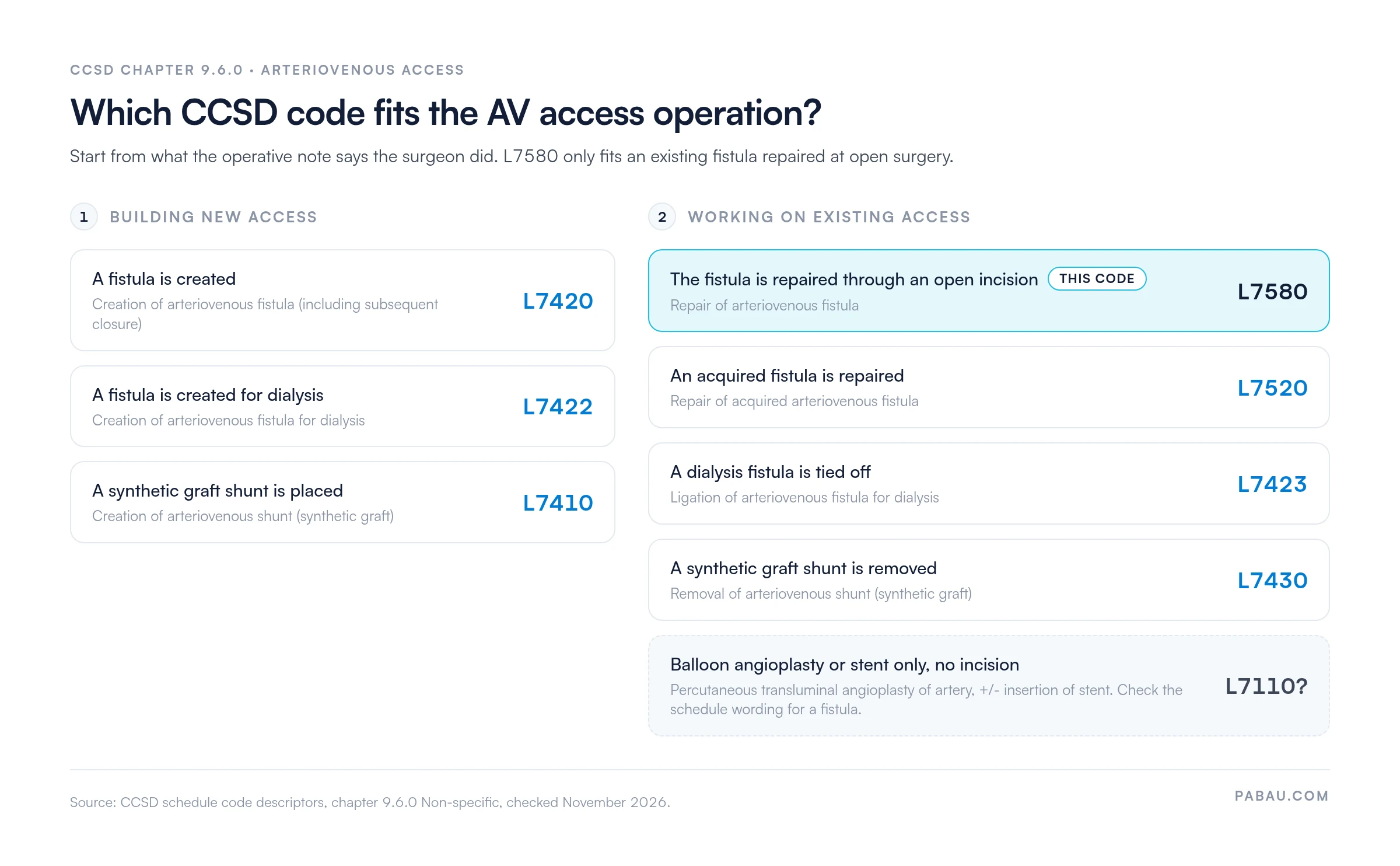
The two repair codes are the pair most often swapped. L7520 names an acquired fistula, while L7580 carries no such qualifier, so the operative note has to say which kind the surgeon repaired.
A dialysis fistula that is tied off instead of revised moves to L7423. New access built with a synthetic graft is L7410, and removing that graft later is L7430. Check each descriptor in the current CCSD schedule edition before submitting.
Bupa publishes its own code search on top of the schedule. Our guide to Bupa CCSD procedure codes covers its fee schedule and submission requirements.
UK private billing often meets NHS clinical coding, for example when the NHS funds a patient’s dialysis but the repair happens in a private hospital. Mapping L7580 to its OPCS-4 and ICD-10 equivalents keeps concurrent coding and mixed-pathway billing consistent.
OPCS-4 codes update annually, so check the edition in force on the date of service in the NHS Classifications Browser. The ICD-10 codes shown come from the NHS ICD-10 5th edition. Confirm them against the current UK release in the same tool.
A valid CCSD code L7580 claim needs a clinical record that lets a payer’s auditor reconstruct the procedure on their own. UK private insurers commonly request these documents on audit.
A practice can template operative summaries and pre-auth checklists so every field is complete before submission. One missing item, most often the duplex report or the indication statement, is enough for a payer to hold a claim for more information.
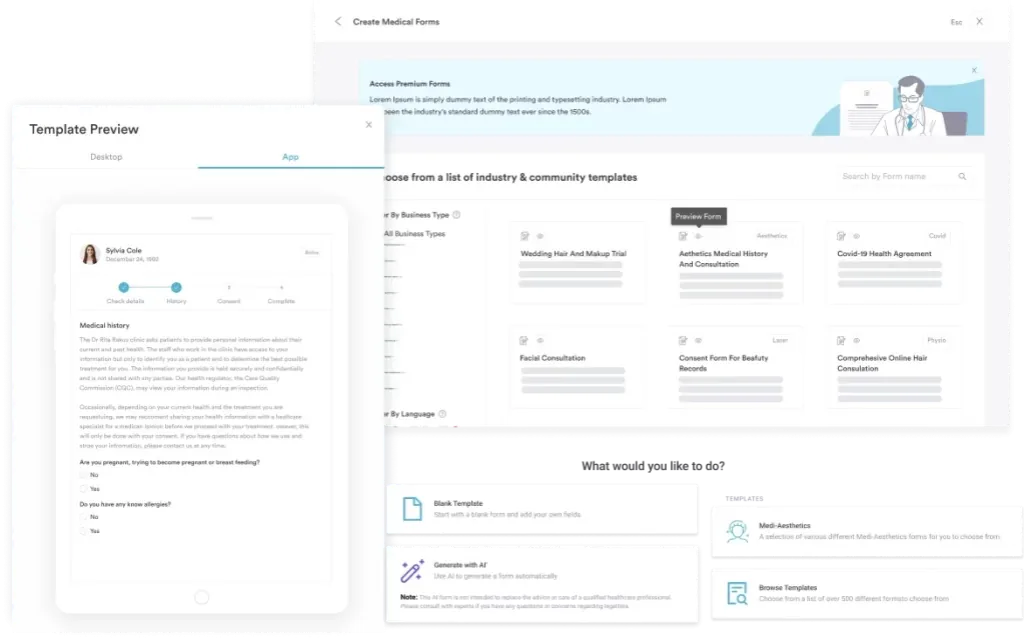
Every major UK private medical insurer treats vascular access surgery as a pre-authorization procedure. Operating without authorization is the leading cause of L7580 denials, and appeals rarely succeed unless the operation was a clinical emergency.
The table below summarizes the standard pre-auth requirements for the main payers. Requirements change with each policy year, so verify them with the insurer before submission.
L7580 claims are declined for predictable, preventable reasons. Knowing them before submission cuts the work of appeals.
Bilateral AV fistula repair on the same date is clinically rare, because most patients have a single access site. Where it happens, check the current CCSD schedule for bilateral guidance. CCSD multiple procedure rules commonly reduce the fee for subsidiary procedures in the same session, though the rate is insurer-specific. Confirm with each payer before billing two L7580 codes on one date.
A repeat repair of the same access site in a later operation is billed as a fresh L7580 claim with new pre-authorization. Document that it is a second repair event, not a continuation of the earlier admission, so the payer does not reject it as a duplicate.
L7580 billing has four points where errors usually enter: code selection, pre-auth tracking, documentation assembly and claim submission. When each one lives in a different inbox, spreadsheet or paper file, the claim is assembled from memory days after the operation.
Pabau, the practice management platform we build, keeps those steps on one patient record. With its claims management software, your team records pre-auth reference numbers and keeps operative notes and forms against the patient record. A missing authorization code triggers a warning on the case, and UK claims go out through Healthcode or Bupa.
That matters most for vascular teams treating repeat dialysis-access patients, where the same documentation set recurs across admissions. When a claim is denied, the pre-auth reference, operative note and imaging report are already in one place for the appeal.
Create a pre-authorization checklist template in your practice management system for every L7580 procedure. Include the referral date, duplex report date, documented indication, auth reference number and proposed CCSD code. Run the checklist before every admission, not after.

Pabau keeps pre-authorization references, operative notes and forms on the patient record, so your team submits L7580 claims with the evidence payers ask for.

Code L7580 only when the operative note shows an open repair of an existing fistula. A first-time creation, a ligation, an acquired fistula or a catheter-only session each points to a different code, and payers check for the swap.
The claims that pay first time are settled before the patient reaches the operating room. Pre-authorization is secured, the duplex report is on file, and the note names the approach. That checklist costs a few minutes per case, while a denied vascular claim can take weeks to overturn.
Book a demo to see how Pabau keeps pre-auth, notes and claims on one record for vascular and surgical teams.

Repairing an acquired fistula instead? CCSD code L7520 covers repair of an acquired arteriovenous fistula, the code most often confused with L7580.
Closing a dialysis fistula rather than saving it? CCSD code L7423 covers ligation of an arteriovenous fistula for dialysis.
Building access with a synthetic graft? CCSD code L7410 covers creation of an arteriovenous shunt with a synthetic graft.
Billing Bupa for vascular access surgery? Bupa CCSD procedure codes covers the Bupa fee schedule and submission requirements across the CCSD codebook.
Need another code from the schedule? CCSD codes reference collects Pabau’s UK private billing pages in one place.
CCSD code L7580 covers open surgical repair of an existing arteriovenous fistula. A vascular surgeon uses it when revising a fistula for stenosis, thrombosis, pseudoaneurysm or steal syndrome. It excludes first-time creation of a fistula and purely endovascular work such as balloon angioplasty.
Creation makes the arteriovenous connection for the first time and is coded L7420, or L7422 when it is for dialysis. L7580 applies only when an existing fistula is surgically revised because of a complication. Submitting L7580 for a first-time creation is a coding error that payers commonly audit.
The most common reasons are missing pre-authorization and L7580 billed for a purely endovascular session. Thin medical necessity evidence is the third, usually a missing duplex report or indication letter. A pre-submission documentation checklist prevents all three.
Sometimes, but bundling rules decide what can be billed separately. Thrombectomy or angioplasty done as part of an open repair may be bundled under L7580, so a separate code would be an unbundling error. Where they are distinct procedures, a concurrent code may apply. Check the current CCSD edition and multiple procedure rules before adding a second line item.
Dialysis access surgery spans several chapter 9 codes. L7422 covers creating a fistula for dialysis, L7410 a synthetic graft shunt, L7580 repair and L7423 ligation for dialysis. L7430 covers removing a synthetic graft, and percutaneous angioplasty is checked against L7110.
Open repair (L7580) needs a surgical incision to reach and revise the fistula. Endovascular work is done percutaneously through a catheter, with no open incision. The nearest schedule entry is L7110, percutaneous transluminal angioplasty of artery, +/- insertion of stent, so confirm the fistula code in the schedule. Payers reject L7580 when the note describes a catheter-based procedure.