CPT code 93503: Swan-Ganz catheter billing and modifiers
CPT code 93503: Official descriptor and procedure overview In the AMA CPT code s...

Last Updated: Oct 23, 2026
L0620 is the CCSD code for creation of communication between pulmonary artery and aorta. It covers the first-time surgical construction of an aortopulmonary shunt. This palliative operation increases blood flow to the lungs in babies with cyanotic congenital heart disease.
The code sits in the Great vessels section of CCSD Chapter 8, Thorax and intra-thoracic organs. It applies to direct aorta-to-pulmonary artery connections, such as Potts, Waterston and central shunts. A modified Blalock-Taussig shunt from the subclavian artery is coded separately as L0710.
Let Pabau's smart automation suggest the right codes, reduce claim denials, and keep your practice compliant—effortlessly.
Automate repetitive tasks and focus on what matters most—your patients.
Reduce coding errors and ensure compliance with the latest regulations.
Clean claims, fewer denials, and faster reimbursements.
Powerful insights and reporting to help your practice thrive.
HIPAA compliant SOC 2 certified GDPR-compliant Trusted by 4,000+ clinics worldwide

CCSD Code L0620 covers first-time surgical creation of a communication between the aorta and the pulmonary artery, not revision or takedown of an existing shunt.
A modified Blalock-Taussig shunt from the subclavian artery has its own code, L0710, so it is never billed as L0620.
Primary indications include pulmonary atresia, tetralogy of Fallot with severe outflow obstruction, and other duct-dependent cyanotic congenital heart lesions.
The operative report must name the vessels joined, the conduit material and size (where used), the surgical approach, and on- or off-bypass status.
Pabau, the practice management platform we build, keeps the operative note, the pre-authorisation reference and the claim on one patient record.
CCSD Code L0620 is the UK private healthcare billing code for the surgical creation of a communication between the pulmonary artery and aorta.
The official descriptor reads: Creation of communication between pulmonary artery and aorta. It captures the first, deliberate construction of an aortopulmonary connection, whether through a prosthetic conduit or a direct vessel-to-vessel anastomosis.
L0620 sits in the Great vessels section (8.10) of CCSD Chapter 8, “Thorax and intra-thoracic organs”. That section holds the other CCSD codes for surgery on the aorta and pulmonary arteries. Bupa, AXA Health, Aviva and Vitality all use the schedule.
Two points anchor correct code selection. First, L0620 describes creation, meaning the first-time construction of an aortopulmonary communication. Revision, takedown or ligation of an existing shunt is never billed as L0620.
Second, the code is defined by the two vessels joined: the aorta and the pulmonary artery. A shunt that starts from the subclavian artery is coded as L0710 instead.
Creating a communication between the pulmonary artery and aorta is a palliative cardiac operation. It increases blood flow to the lungs when the patient’s own pulmonary circulation can’t sustain adequate oxygenation. The usual cause is severe outflow obstruction or pulmonary atresia.
The new channel sends blood from the aorta back into the pulmonary circulation, which raises arterial oxygen saturation. That buys time until the patient is large enough, or stable enough, for definitive repair.
Coders should know the named techniques, because the operative report will use them. The vessels each technique joins decide whether L0620 applies.
The quickest check is to read which two vessels the operative note says were joined, as the chart below shows.
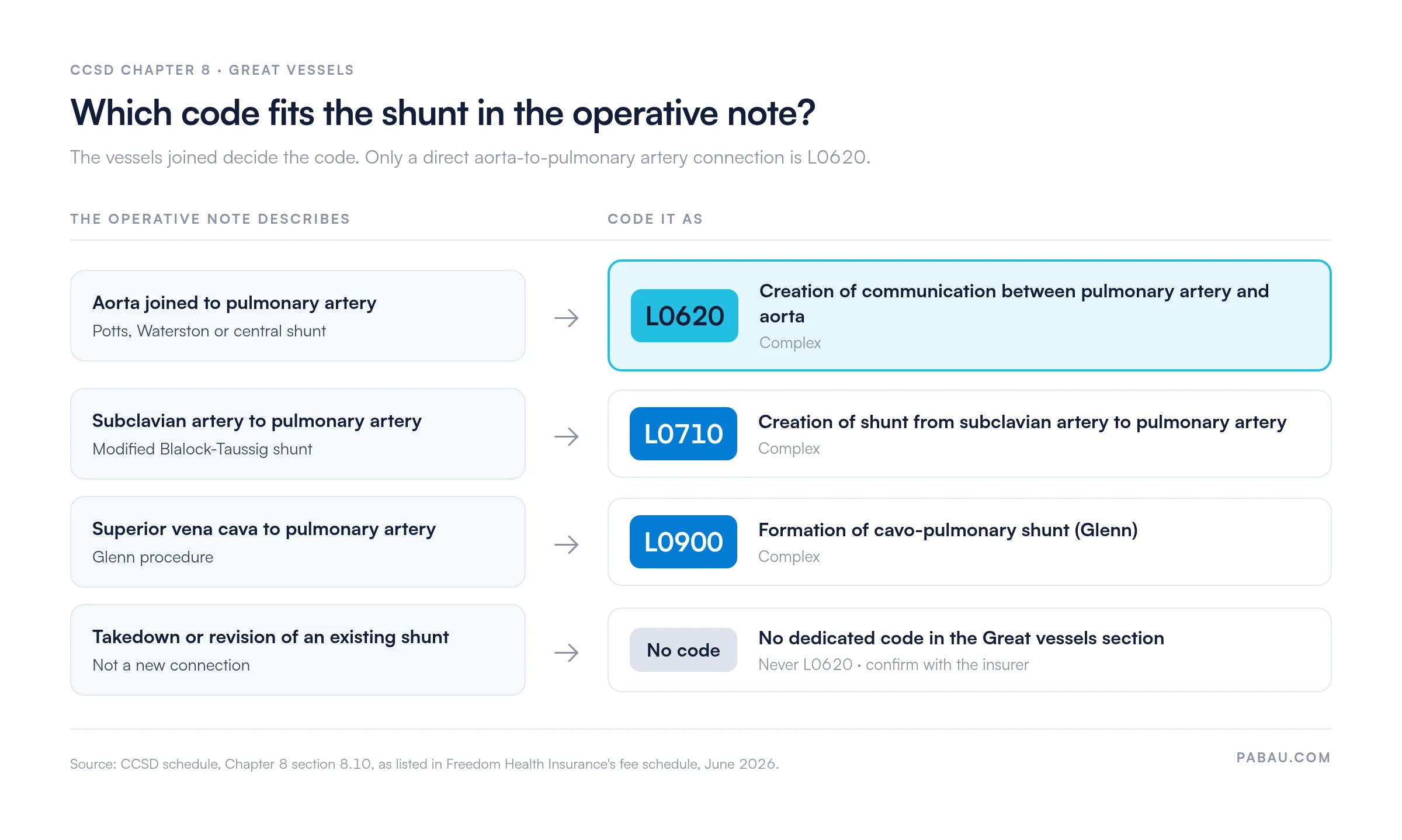
The operation may be performed via median sternotomy or lateral thoracotomy. It can be done on cardiopulmonary bypass (CPB) or off-pump, depending on the surgeon’s technique and the patient’s anatomy. The operative note must state which approach was taken, because both details affect documentation completeness for L0620 claims.
Surgical creation of a pulmonary artery-to-aorta communication is performed in cyanotic congenital heart disease, where pulmonary blood flow is severely restricted or absent. These are the principal clinical scenarios behind a CCSD Code L0620 claim.
In each case, the procedure is explicitly palliative. The operative report typically documents the preoperative oxygen saturation, the clinical urgency, and the planned staging toward definitive repair. Reference these details in the billing documentation, because they support the medical necessity of the claim.
For single-ventricle patients, the shunt is often the first of several staged operations. The later atrio-pulmonary connection, or Fontan-type procedure, is billed under its own code, L0610.
The most costly coding error with L0620 is selecting it for a revision or takedown of an existing shunt. The second is using it for a shunt that starts at the subclavian artery. The table below summarises the key distinctions within the Great vessels section.
Coding caution: The schedule runs from L0620 straight to L0710, with no dedicated code for taking down or revising a shunt. When a shunt is taken down during definitive repair, the repair code normally describes the whole intervention.
Check with the insurer before adding a second code. Before assigning L0620, confirm in the operative note that the shunt was newly constructed in that session.
UK insurers expect an ICD-10 diagnosis code alongside CCSD Code L0620 to establish medical necessity. The table lists the principal diagnosis codes most often submitted with L0620. The congenital heart defect driving the procedure is generally the principal diagnosis, with additional codes for any associated anomalies.
Always confirm codes against the current UK edition of ICD-10, the fifth edition that NHS England maintains for classification use. A mismatched or outdated diagnosis code is one of the most common avoidable denial triggers for this procedure.
A defensible CCSD Code L0620 claim rests on the operative report. Insurers and billing reviewers look for specific elements, because vague documentation on a procedure this complex is a denial risk. These elements must appear in the operative note.
Templates that prompt for operative detail at the time of dictation are more reliable than completing the documentation afterwards. They also reduce the risk that one of these elements is missing at submission.
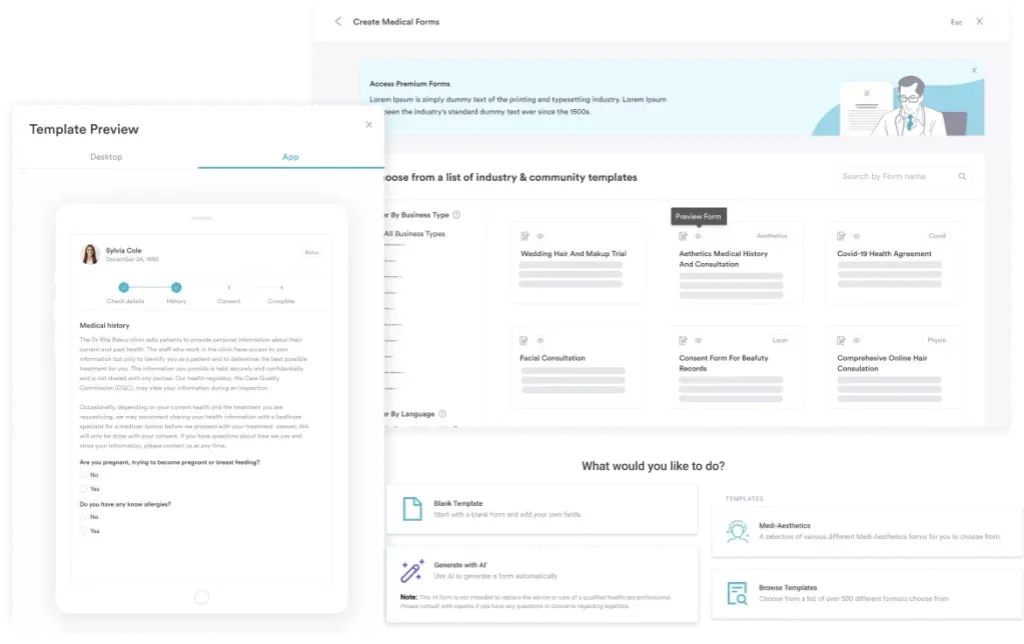
Build an operative note checklist for CCSD L0620 that prompts for vessel names, approach, bypass status and conduit details. Run it before submitting any claim. Incomplete operative reports are the leading preventable cause of denial for complex cardiac codes.
Most UK private medical insurers that accept CCSD billing require pre-authorisation for CCSD Code L0620. This is a major cardiac operation performed mainly in neonates, so authorisation is almost always in place before the patient reaches theatre. The billing team confirms that the authorisation reference on file matches the procedure code being submitted.
Pre-authorisation rules vary by insurer and policy, so check requirements directly with the insurer before each admission. The Healix fee schedule and the portals of Bupa, AXA Health, Vitality and WPA each publish their own prior-approval requirements for cardiac surgical codes.
CCSD defines the code, but each insurer sets its own fee for it and reviews that fee regularly. Freedom Health Insurance’s June 2026 schedule, for example, rates L0620 as Complex, with a £1,600 specialist fee and an £857 anaesthetist fee.
Look up the code on the CCSD official schedule, then check the fee in the relevant insurer’s own fee finder. Several factors affect what the insurer reimburses for an L0620 claim, even when the code is correct.
Denial patterns for CCSD Code L0620 are predictable. Most rejections stem from incomplete documentation or code-selection errors, not clinical disputes about medical necessity. Fixing these before submission is far cheaper than managing appeals.
Beyond avoiding denials, a few coding decisions affect how completely L0620 claims are paid and how well they stand up at audit.
Whether the surgeon used a prosthetic conduit (Gore-Tex PTFE graft) or a direct vessel-to-vessel anastomosis matters clinically and for the record. The operative note must make this explicit. A conduit-based shunt needs the graft size and material. A direct anastomosis needs the vessel diameters and the technique, such as end-to-side or side-to-side.
L0620 is sometimes performed as a re-do operation, for example creating a new shunt after a previous one has thrombosed. The documentation should then reflect the extra complexity of re-operative cardiac surgery. Check whether your insurer’s schedule recognises re-operative complexity through an additional code.
The operative note must state that this is a re-do procedure. It should also describe the extra technical challenges, such as adhesions, altered anatomy or prolonged bypass.
Neonatal cardiac bypass cases involve perfusion services and complex anaesthetic management. Those claims are separate from the surgeon’s L0620 claim, but they must reference the same operative episode. Before anyone submits, confirm with the anaesthetist and perfusionist that their claims match the surgeon’s principal code and operating date.
Building these checks into a medical billing compliance routine stops misaligned co-submissions from tripping automated edits. It also takes the work off the surgical team.
Review the CCSD technical guide (updated October 2025) before submitting any cardiac surgery claim that includes L0620. Rules on unacceptable combinations, assistant fees and multiple codes change between editions. An outdated rule applied to a current claim is a billing error, not a clinical one.
Many cardiac billing teams still assemble an L0620 claim by hand. The operative note sits in one system, the pre-authorisation number in an email, and the invoice somewhere else. Each handover is a chance for the vessel detail or the authorisation reference to drop out.
Pabau keeps those pieces on one patient record. Its claims management software raises the claim from the patient’s invoice and sends it through Healthcode to insurers such as Bupa, AXA Health and Vitality. Each pre-authorisation is stored as a case, so its reference follows the appointment through to the claim.
Claim validation checks for missing or invalid details before the claim leaves Pabau. If an insurer rejects it, Pabau flags the claim with the reason, so your team can correct and resubmit it without starting again.
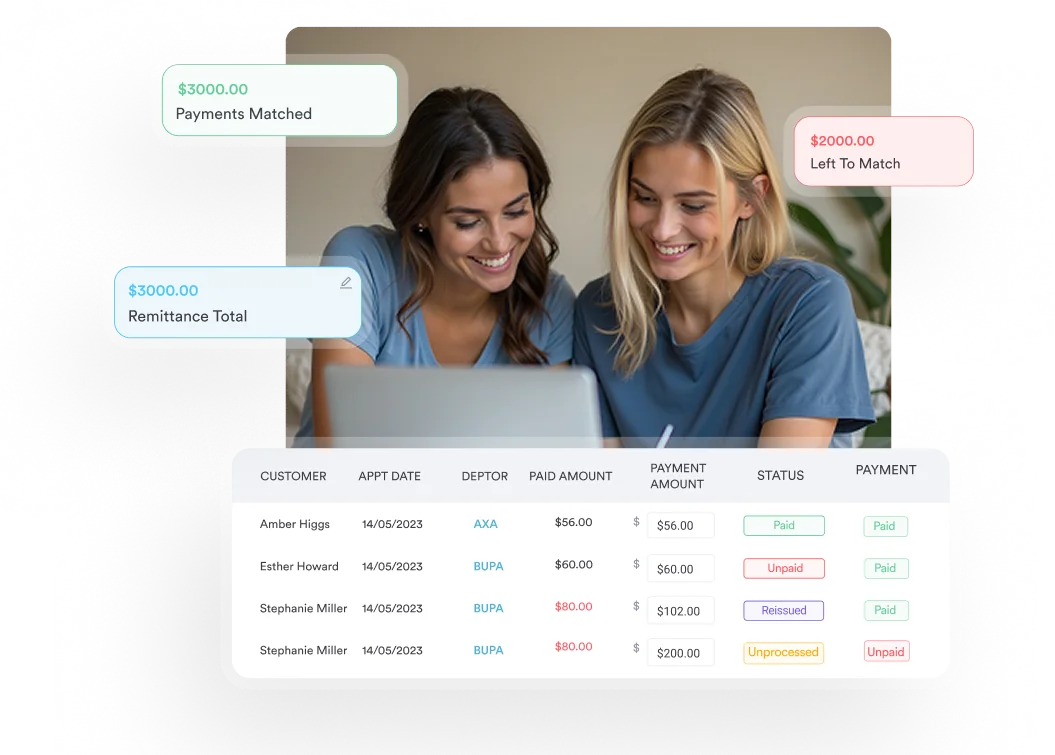

Pabau keeps operative notes, pre-authorisation references and insurer claims on one patient record. Claim validation flags a missing detail before the L0620 claim reaches the insurer.

Getting L0620 right comes down to the vessels the surgeon joined. A direct aorta-to-pulmonary artery connection is L0620. A subclavian route is L0710, and a takedown or revision is never L0620.
The fixes are cheap compared with an appeal. Build the operative note template around the six documentation elements, and check the pre-authorisation reference before every submission. Confirm each insurer’s multiple-code rules before adding a second code.
Book a demo to see how Pabau helps cardiac billing teams send complete L0620 claims to UK insurers.

Repairing the pulmonary artery itself rather than creating a shunt? CCSD code L1080 covers open repair of the pulmonary artery and when it replaces a shunt code.
Coding an arch defect in the same congenital patient? CCSD code L2360 explains repair of an interrupted aortic arch and its documentation rules.
Is the aorta and pulmonary artery a single common trunk? ICD-10 code Q20.0 covers common arterial trunk, a congenital defect of the same great vessels.
Billing adult aortic surgery as well as congenital work? CCSD code L1880 sets out open repair of a leaking aortic arch aneurysm for UK insurers.
CCSD Code L0620 covers surgical creation of a communication between the pulmonary artery and aorta. It is a palliative operation for neonates and infants with cyanotic congenital heart disease and severely restricted pulmonary blood flow. It does not cover revision or takedown of an existing shunt.
No. The CCSD Great vessels section has no dedicated takedown or revision code, and the schedule runs from L0620 straight to L0710. Using L0620 for a revised or removed shunt is the most common miscoding in this procedure class. Confirm with the insurer how a takedown at definitive repair should be billed.
The operative report must name the vessels anastomosed, the approach (sternotomy or thoracotomy), and whether cardiopulmonary bypass was used. It must also state the conduit material and size if a graft was used. A statement of palliative intent and the signed surgeon attestation complete it.
The leading reasons are incomplete operative documentation and the wrong code, such as a revision or an mBTS billed as L0620. Missing pre-authorisation, mismatched ICD-10 diagnosis codes and barred code combinations follow.
Yes, for most UK private medical insurers. Planned palliative shunt operations go through standard pre-authorisation. Emergency neonatal cases usually have an expedited or retrospective route, but the clinical urgency must be documented. Requirements vary by insurer and policy, so confirm with the insurer before each admission.
No. A modified Blalock-Taussig shunt joins the subclavian artery to the pulmonary artery. CCSD codes it as L0710, “Creation of shunt from subclavian artery to pulmonary artery”. L0620 is for direct aorta-to-pulmonary artery connections, such as Potts, Waterston and central shunts.