CCSD code T6830: Secondary repair of 1st stage flexor reconstruction
CCSD code T6830: Definition and clinical scope CCSD code T6830 is the billable p...

Last Updated: Nov 18, 2026
L7410 is the CCSD code for creation of arteriovenous shunt (synthetic graft). It covers the operation that joins an artery to a vein with a prosthetic tube, usually ePTFE, to give a patient long-term hemodialysis access.
The code sits in chapter 9, the vascular system, of the CCSD schedule used by UK private medical insurers, under reference FI.056. A native arteriovenous fistula is billed as L7420, and removal of a synthetic graft as L7430.
Let Pabau's smart automation suggest the right codes, reduce claim denials, and keep your practice compliant—effortlessly.
Automate repetitive tasks and focus on what matters most—your patients.
Reduce coding errors and ensure compliance with the latest regulations.
Clean claims, fewer denials, and faster reimbursements.
Powerful insights and reporting to help your practice thrive.
HIPAA compliant SOC 2 certified GDPR-compliant Trusted by 4,000+ clinics worldwide

CCSD code L7410 covers creation of an arteriovenous shunt with a synthetic graft, the hemodialysis access used when a patient’s veins won’t support a fistula.
A fistula made from the patient’s own vessels is billed as L7420, which includes its later closure. Removing a synthetic graft is billed as L7430.
CCSD is the UK private healthcare schedule, and each insurer sets its own fee for L7410.
Get the insurer’s authorization number before the operation, and check that the policy covers dialysis access for a chronic condition.
UK claims use the WHO edition of ICD-10, so end-stage kidney disease is N18.5, never the US code N18.6.
CCSD code L7410 is the code UK private insurers use for creation of an arteriovenous shunt with a synthetic graft. The schedule is set by the CCSD Group, which brings together four major UK private health insurers. They are Bupa, AXA Health, Aviva and Vitality.
The operation joins an artery to a vein with a prosthetic tube, most often expanded polytetrafluoroethylene (ePTFE). The graft gives a patient with kidney failure a durable site for hemodialysis needles.
Three features decide whether L7410 is the right code:
The CCSD Group updates its schedule over time, and each insurer publishes its own fee against each code. Our index of CCSD codes lists the other procedure codes we cover. A US practice reports the same graft operation as CPT code 36830, under the AMA code set and US payer rules.
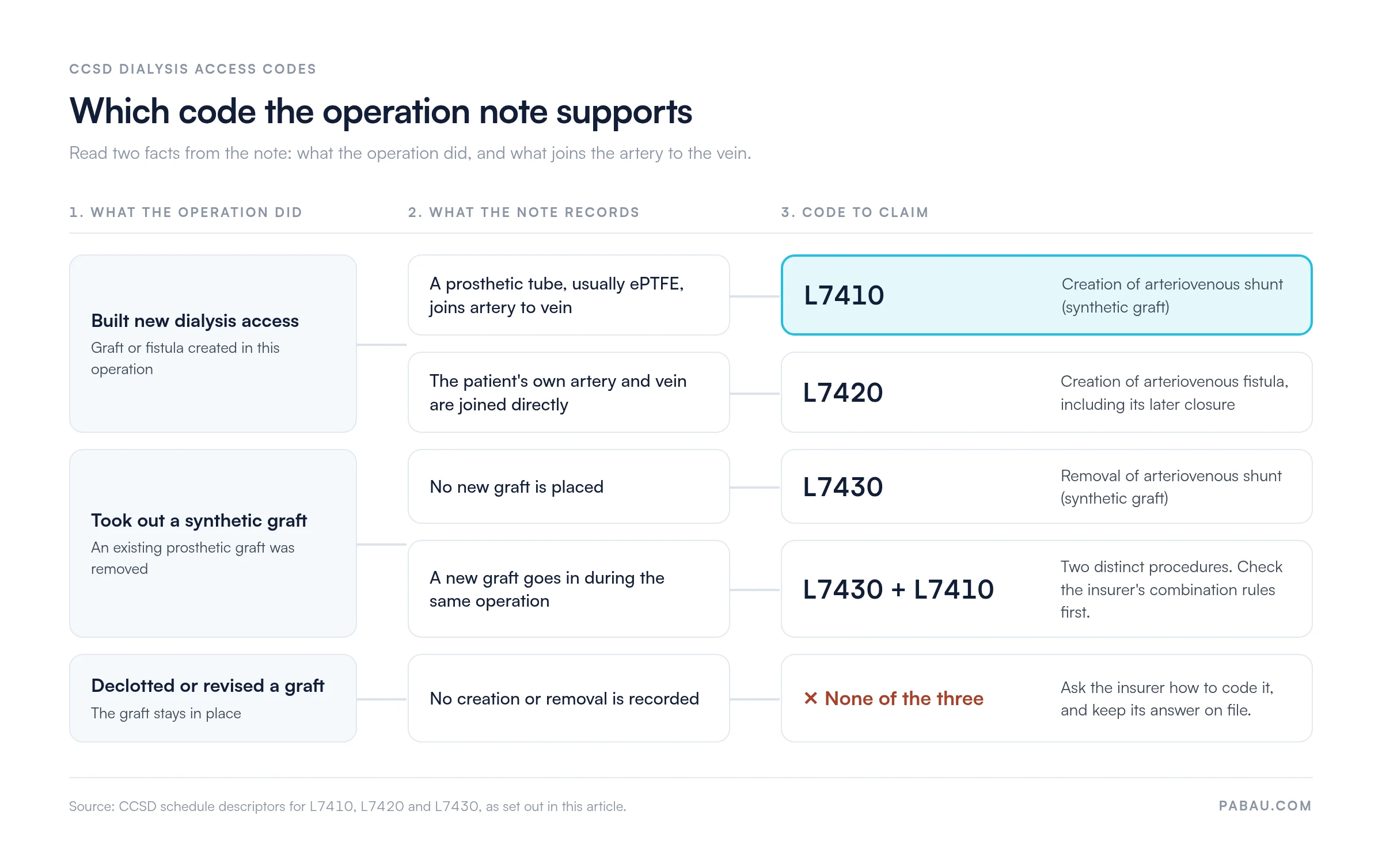
Three neighboring codes in the CCSD vascular chapter cover dialysis access, and the operation note decides between them. The table shows what each descriptor covers and the slip that leads to the wrong one.
The two access types are coded differently across their life. L7420 includes the fistula’s later closure in its own descriptor, so closing that fistula is not claimed again. A synthetic graft gets two codes instead. It is billed as L7410 when it goes in and as L7430 when it comes out.
If a failed graft is removed and a new one placed in the same operation, the note describes two distinct procedures. Check the insurer’s combination rules before both codes go on one invoice.
CCSD’s own record for L7410 cross-refers to two codes in its coding principles, L7430 and L6710. L6710 is biopsy of artery (including temporal) (as sole procedure). Its descriptor limits it to a biopsy done on its own, so a sample taken during shunt creation does not justify adding it.
None of the three access descriptors covers declotting or revising a graft that stays in place. Ask the insurer how it wants that work coded, and keep its answer on file. The diagram below traces each of these cases from the operation note to the code.
The operation runs in four stages, and the operation note should record each one to support the claim.
Surgeons choose a synthetic graft when the patient’s veins are too small or damaged for a fistula, or when earlier fistulas have failed. Timing plays a part too. A standard graft is usually ready for needling in two to three weeks, and some early-cannulation grafts within 24 to 72 hours. A native fistula usually needs six weeks or longer to mature.
L7410 fits a patient with end-stage kidney disease who needs hemodialysis access and is not a good candidate for a native fistula. The usual reasons are:
Kidney failure is a chronic condition, and UK private medical insurance is built mainly around acute care. Many policies limit cover for chronic conditions, so check what the patient’s policy says about dialysis access before you book. Patients without cover can self-pay against your own price list.
L7410 covers the whole operation to build the shunt. Graft tunneling, both anastomoses, control of bleeding and wound closure sit inside the code and are not claimed as extra lines.
These are billed separately where they are performed and documented:
Before you add a second code to an L7410 claim, find its own entry in the operation note. Insurers often query claims where two procedure codes rest on one narrative, and the query holds up payment.
The UK codes diagnoses in the WHO edition of ICD-10, which the NHS uses as its 5th edition. US guides quote ICD-10-CM instead, and the main code differs. End-stage kidney disease is N18.5 in the WHO edition, while N18.6 exists only in the US version.
Check each code in the WHO ICD-10 browser before submission. The diagnosis on the claim should match the referral letter and the operation note.
Most UK insurers expect planned surgery to be authorized before the operation date. The patient usually contacts the insurer, which issues an authorization number for the procedure.
Before you confirm the date, have these ready for the insurer:
Put the authorization number on the invoice. Bupa, for example, needs it on every surgical claim. Our guide to Bupa CCSD codes explains how Bupa’s procedure list and claims work.
Check the fee as well, using Bupa’s procedure code search or the insurer’s own schedule. A charge above the insurer’s fee leaves a shortfall the patient should agree to in writing beforehand.
If access is needed urgently, ask the insurer about retrospective authorization before you assume it will be granted. Note who you spoke to and what they agreed.
Insurers that query an L7410 claim want to see that a synthetic graft went in. The record should make that plain without a call to the surgeon.
In Pabau, the practice software we build, the pre-operative workup, consent and operation note sit on one patient record. Its clinical records let the billing team check the graft material without chasing the surgical team afterward.
Most rejected L7410 claims trace back to a short list of avoidable slips. Each one has a straightforward fix.
If a claim is still refused, follow the appeal process in the insurer’s current provider manual. Only work to a deadline you have confirmed there.
When a patient’s access history includes both fistulas and grafts, list each earlier operation with its date in the referral. Coders can then choose between L7410, L7420 and L7430 from the record rather than from memory.
In many vascular practices, the authorization number sits in an email, the operation note in another system, and the claim is typed by hand. Each handoff is a chance to lose the reference or pick the wrong access code.
Pabau keeps those steps on the patient record. Its claims management software sends claims electronically through Healthcode and to Bupa. The authorization code, dates and sessions sit on the patient’s case, with a warning when one is missing.
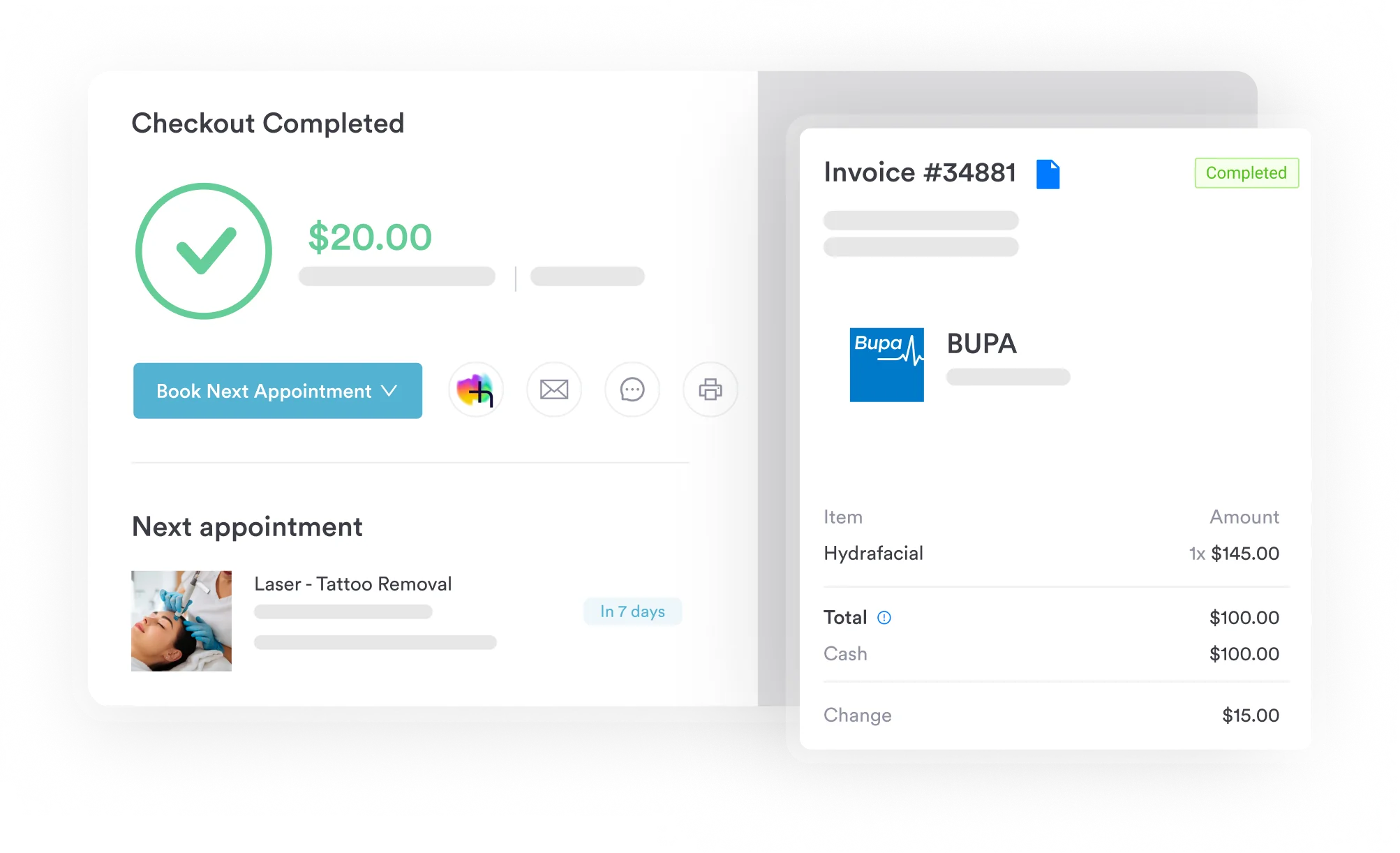
The result is fewer claims returned for a missing reference, and a clear view of what each insurer still owes. Your team spends less time on rework and more on patients.

Pabau stores authorization codes on the patient’s case and sends claims electronically through Healthcode and to Bupa. You see where each L7410 claim stands without phoning the insurer.

L7410 is simple to code once the operation note names the graft. Most queries come from a note that blurs graft and fistula, a missing authorization number, or a US diagnosis code on a UK claim.
Agree a standard operation-note template with your vascular surgeons, and check cover for chronic kidney disease before you book. Those two habits stop most L7410 claims from stalling. Book a demo to see how Pabau tracks authorizations and sends Healthcode claims from one patient record.

Coding other arterial surgery? CCSD code L7010 explains the code for open embolectomy of an artery.
Revising a bypass graft? CCSD code L6530 covers revision of a femoral bypass graft.
Billing transplant surgery for kidney patients? CCSD code M0103 explains the code for a third kidney transplant.
Checking Bupa fees before you invoice? Bupa procedure codes and fee schedule walks through Bupa’s recognized codes and fee tiers.
CCSD code L7410 covers creation of an arteriovenous shunt using a synthetic graft, usually ePTFE, for hemodialysis access. It includes tunneling the graft, both anastomoses and wound closure. Anesthesia and pre-operative vein mapping are billed separately.
L7410 is for a shunt built with a synthetic graft. L7420 is for an arteriovenous fistula made from the patient’s own artery and vein, and its descriptor includes the fistula’s later closure. The operation note decides which one applies.
L7430 covers removal of an arteriovenous shunt (synthetic graft). If a new graft is placed in the same operation, L7410 describes that part. Check the insurer’s combination rules before both codes go on one claim.
In the WHO edition of ICD-10 used in the UK, end-stage kidney disease is N18.5. Add Z99.2 when the patient already depends on dialysis. T82.5 applies when a failed earlier shunt or fistula is the reason for new access.
Yes, most UK private medical insurers expect planned surgery such as L7410 to be authorized first. Put the insurer’s authorization number on the invoice. Check too that the policy covers dialysis access, since many limit cover for chronic conditions.
CCSD codes form the UK private healthcare schedule, set by the CCSD Group of Bupa, AXA Health, Aviva and Vitality. Practices bill insurers against them, often electronically through Healthcode. Each insurer sets its own fee for each code.