ICD-10 Code Y76.0: Diagnostic obstetric and gynecological devices
ICD-10 Code Y76.0: Definition and billable status ICD-10 Code Y76.0 is a valid, ...

Last Updated: Oct 23, 2026
Billable Code Specific Code
Y77.3 is the billable ICD-10-CM code for surgical instruments, materials and ophthalmic devices (including sutures) associated with adverse incidents.
Let Pabau's smart automation suggest the right codes, reduce claim denials, and keep your practice compliant—effortlessly.
Automate repetitive tasks and focus on what matters most—your patients.
Reduce coding errors and ensure compliance with the latest regulations.
Clean claims, fewer denials, and faster reimbursements.
Powerful insights and reporting to help your practice thrive.
HIPAA compliant SOC 2 certified GDPR-compliant Trusted by 4,000+ clinics worldwide

ICD-10 code Y77.3 identifies surgical instruments, materials, and ophthalmic devices, including sutures, linked to adverse incidents.
Y77.3 is a billable ICD-10-CM external cause code, valid for the 2026 edition effective October 1, 2025.
Y77.3 must accompany a primary diagnosis code and cannot be sequenced as a standalone diagnosis.
Y77.1 is a non-billable header code, so a contact lens incident is reported as Y77.11 instead.
Practice management software like Pabau keeps external cause codes attached to the primary diagnosis at the point of care.
The table below captures the billing metadata for Y77.3. Verify it against the live CDC/NCHS ICD-10-CM web tool before submitting claims, because code attributes change with each annual update.
Y77.3 sits within the Y77 parent category, which groups adverse incidents linked to ophthalmic devices. Knowing where it falls in that hierarchy is what keeps coders from reaching for a sibling code. The AAPC ICD-10-CM lookup gives searchable access to the full Y77 range. Our quick diagnostic codes lookup covers the neighboring ICD-10 codes an ophthalmic claim tends to need.
Y77.3 is broader than it first appears. The phrase “surgical instruments, materials and ophthalmic devices (including sutures)” reaches every item that can be implicated in a post-operative adverse event. The same fourth-character pattern repeats across the device blocks, so a suture incident in neurological surgery takes ICD-10 code Y75.3.
The code applies when any of the following device types is identified as causally linked to the adverse incident:
Y77.3 does not cover contact lenses, which are reported as Y77.11 under the Y77.1 header. It also excludes prosthetic and implantable devices such as intraocular lenses, coded Y77.2. Diagnostic and monitoring devices belong in Y77.0, and ophthalmic devices outside the surgical field belong in Y77.8.
Device families outside ophthalmology carry their own categories. An imaging device implicated in the same incident is coded under Y78.8, not forced into a Y77 subcode. An instrument or suture used in an obstetric or gynecological procedure takes Y76.3.
The gastroenterology and urology block follows the same fourth-character pattern. An instrument or suture used in one of those procedures takes Y73.3.
Anesthesia equipment sits in its own block too. A monitoring device run by the anesthesia team during cataract surgery is coded Y70.0, not Y77.0.
The distinction matters because payers audit external cause codes. Confusing Y77.3 with Y77.2 is a documented denial trigger on ophthalmic claims. The routing below runs from the device named in the operative note to its subcode.
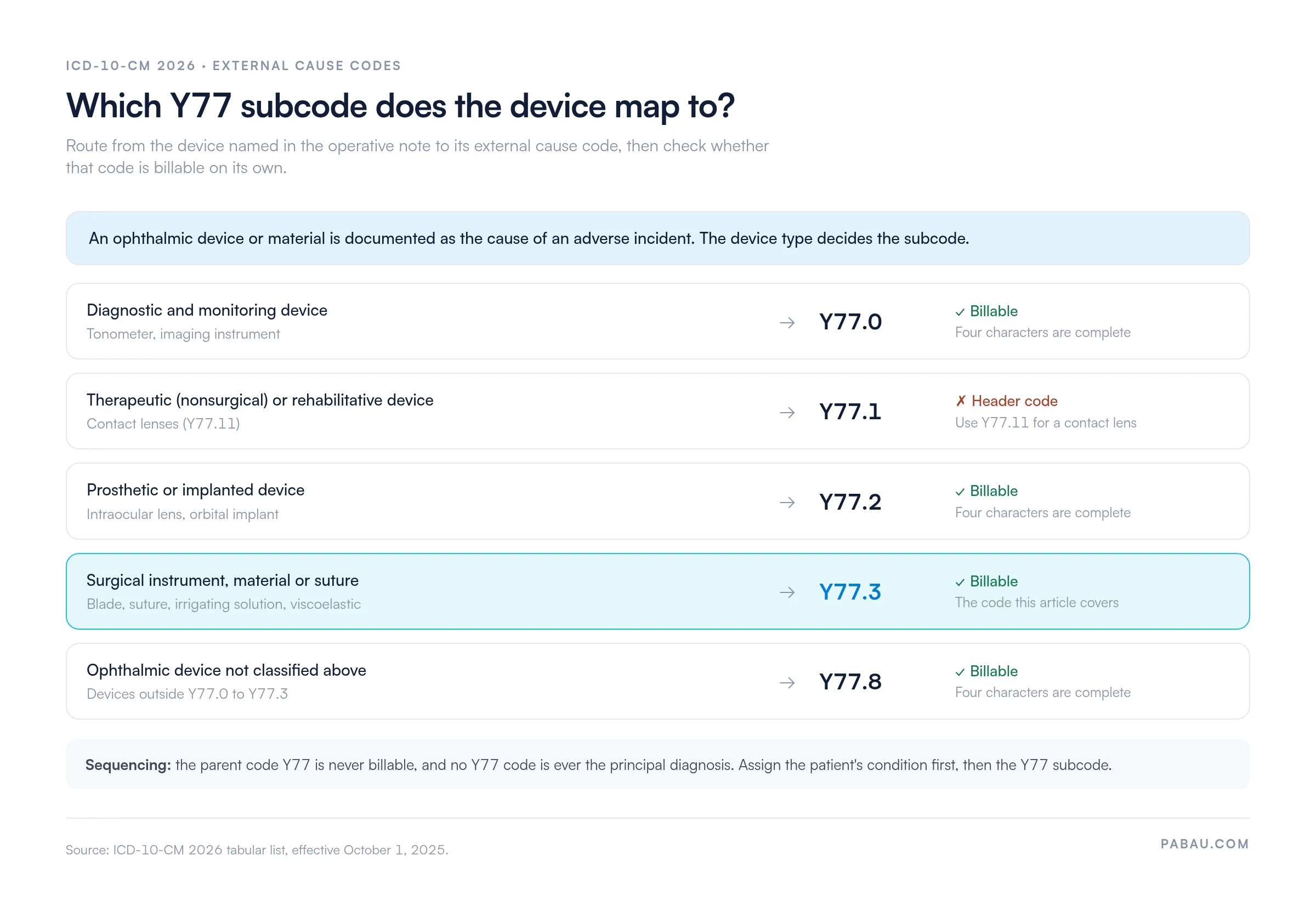
Naming the specific device in the operative record is what supports the Y77.3 selection. It also gives the billing team what it needs for denial management if the payer questions the claim later.
Chapter 20 placement is what governs how Y77.3 is sequenced on a claim. Reporting it as a principal diagnosis is one of the most common errors in ophthalmic coding. Four rules keep the sequence right.
The examples below show how Y77.3 applies in ophthalmic surgical settings. Each scenario pairs a primary diagnosis code with the external cause code.
An ICD-10-CM code is only as defensible as the documentation behind it. For Y77.3, auditors expect the operative or clinical record to establish a clear causal link between the device and the adverse event.
Thin documentation is the leading reason external cause codes get stripped from claims at audit. A structured post-operative note template reduces that risk, because it prompts the clinician for the device details a coder needs.

Clinicians and coders should confirm the operative or post-operative record includes all of the following before assigning Y77.3:
Documentation standards for external cause codes need a team approach. Surgeons write the incident narrative, clinical coders assign the code, and billing teams make sure the external cause code is submitted alongside the primary diagnosis. ICD-10-CM guidelines treat external cause codes as generally mandated for hospital inpatient claims and encouraged for outpatient surgical settings.
Flag any post-operative adverse event involving a surgical instrument or material immediately after the encounter. Document the device type, the incident description, and the causal link in the operative note before the patient leaves the facility. Retroactive documentation is harder to defend at audit and can delay claim adjudication by weeks.
The Y77 category rewards careful subcategory selection. The wrong code tells payers that the documentation may not support the device type involved. That is what triggers a medical necessity review.
The most common miscoding errors sit between Y77.3 and Y77.2. If an intraocular lens causes the complication, the correct code is Y77.2, not Y77.3. If the suture securing that lens causes the adverse reaction, Y77.3 applies instead. When a device and an instrument are both implicated, assign both codes and let the documentation guide sequencing.
External cause codes in the V00-Y99 range are generally exempt from Present on Admission (POA) reporting. Y77.3 carries a POA exempt designation, consistent with the rest of Chapter 20. Verify that status against the current CMS POA exempt code list before inpatient submission. CMS republishes the list each year alongside the new ICD-10-CM edition.
The WHO ICD-10 browser holds the international classification hierarchy, though US practices use the ICD-10-CM modification published by CDC/NCHS and CMS. The synonyms below appear in the ICD-10-CM alphabetic index and lead a coder to Y77.3 in the tabular list:
These phrases reflect the range of clinical language that turns up in operative reports. A coder who meets any of them in documentation can trace it back to Y77.3 through the index.
Most ophthalmic practices handle external cause codes by hand. A coder reads the operative note and picks the Y77 subcode. The billing team then has to attach it to the right primary diagnosis before the claim goes out. A subcode dropped at that step comes back weeks later as a denial.
Practice management software like Pabau moves that work to the point of care. Built-in ICD-10 code catalogues let clinical teams assign the primary and external cause codes while the operative note is still open. Pabau’s tools for cleaner claims management then carry both codes onto the claim, so neither one is re-keyed.
Claims go out electronically through Claim.MD, which reaches thousands of US payers and supports real-time eligibility verification alongside CMS-1500 and 837P submission. The practical outcome for an ophthalmic practice is fewer claims returned because an external cause code was missing or mismatched.

Pabau’s claims management tools help ophthalmic practices submit accurate external cause codes, track claim status in real time, and reduce denial rates. See how it works for your practice.

Omitting Y77.3, or sequencing it as a principal diagnosis, leaves the payer without the detail it needs to adjudicate a device-related adverse incident. More codes will not solve that. What solves it is an operative note that names the device and states the causal link, so the coder has something to code from.
Get that right and Y77.3 costs the practice nothing beyond a line in the note. Get it wrong and the claim returns for rework that costs far more than the documentation would have.
To see how Pabau keeps external cause codes attached to post-surgical claims, book a demo with our team.

Need a structured ophthalmic billing compliance reference? Medical billing compliance covers the documentation and submission standards that protect claims from audit.
Looking to streamline insurance credentialing for your ophthalmic practice? Getting credentialed with insurance companies walks through the enrollment steps that affect reimbursement eligibility.
Want to understand the full claim lifecycle beyond external cause codes? Clean claim best practices explains what makes a claim adjudicate on first submission.
ICD-10 code Y77.3 is a billable external cause code. It identifies adverse incidents associated with surgical instruments, materials, and ophthalmic devices, including sutures. The code sits in the Y77 parent category within Chapter 20 of ICD-10-CM. It is valid for the 2026 edition, effective October 1, 2025.
Yes. Y77.3 is a billable and specific ICD-10-CM code, valid for diagnosis and reimbursement. The parent code Y77 is not billable, but Y77.3 can be reported on claims. It must always accompany a primary diagnosis code, because an external cause code cannot stand alone.
Y77.3 is sequenced after the primary diagnosis code that describes the patient’s condition, such as a post-operative complication. It answers which device or material caused the adverse event, not what the patient’s condition is. Assign it at any encounter where the device-related incident remains clinically relevant.
Y77.11 covers adverse incidents involving contact lenses worn by the patient, such as a corneal abrasion from extended wear. Y77.3 covers surgical instruments, sutures, and materials used in the operative field. A reaction to a suture placed during eye surgery takes Y77.3. A separate contact lens complication in the same patient takes Y77.11.
External cause codes in the Chapter 20 range (V00-Y99), including Y77.3, are generally exempt from Present on Admission (POA) reporting. Confirm the current exemption in the annual CMS POA exempt code list before submitting inpatient claims. CMS publishes that list alongside each new ICD-10-CM edition.
Y77.3 applies wherever a suture used in ophthalmic surgery is identified as the causal or contributing element. Common examples include a retained suture causing corneal irritation, suture migration after glaucoma filtering surgery, and inflammatory reactions to non-absorbable suture material. The record must name the suture type and establish the causal link.
Y77.1 is the header for therapeutic (nonsurgical) and rehabilitative ophthalmic devices, so it stops one character short of the detail a payer needs. A contact lens incident is reported as Y77.11. Y77.0, Y77.2, Y77.3 and Y77.8 are complete at four characters and can be billed as they stand.