ICD-10 Code T87.81: Dehiscence of amputation stump
ICD-10 Code T87.81: clinical definition and scope of dehiscence ICD-10 Code T87....

Last Updated: Oct 7, 2026
Billable Code Specific Code
Y73.3 is the billable ICD-10-CM code for surgical instruments, materials and gastroenterology and urology devices (including sutures) associated with adverse incidents.
It is an external cause code, so it is never listed first. Report it after the code for the complication the device caused, such as a disrupted anastomosis or an accidental laceration. Y73.3 takes no 7th character, because the encounter type sits on the complication code. Assign it only when the record documents that the instrument, material, or suture failed.
Let Pabau's smart automation suggest the right codes, reduce claim denials, and keep your practice compliant—effortlessly.
Automate repetitive tasks and focus on what matters most—your patients.
Reduce coding errors and ensure compliance with the latest regulations.
Clean claims, fewer denials, and faster reimbursements.
Powerful insights and reporting to help your practice thrive.
HIPAA compliant SOC 2 certified GDPR-compliant Trusted by 4,000+ clinics worldwide

Y73.3 is a billable ICD-10-CM external cause code for adverse incidents involving gastroenterology and urology surgical instruments, materials, and sutures.
It is a complete code with no 7th character, so report it exactly as Y73.3.
Y73.3 is never first-listed, so sequence it after the code for the complication or injury the device caused.
Assign it only when the record documents a device breakdown or malfunction, not a technique error or a known risk of surgery.
External cause reporting is not a national requirement, so check state mandates and payer contracts for when it is expected.
ICD-10 code Y73.3 identifies a surgical instrument, surgical material, or suture used in gastroenterology or urology as the device involved in an adverse incident. It is a billable, specific external cause code in Chapter 20 of ICD-10-CM.
Y73.3 records how the harm happened. The complication itself gets its own code, usually from Chapter 19 or from the digestive or genitourinary chapters. Y73.3 then follows it to name the device.
The Chapter 20 note in the official tabular list says these codes are used secondary to a code that describes the nature of the condition. You can confirm the code and its notes in the CDC/NCHS ICD-10-CM files.
Category Y73 has only five valid subcodes, so a quick check against the CDC/NCHS ICD-10-CM browser tool catches most selection errors. The table below sets out the classification data for Y73.3. Neighboring Chapter 20 codes are in our searchable ICD-10-CM code library.
The Y70-Y82 block includes breakdown or malfunction of a medical device during use, after implantation, or in ongoing use. Y73.3 narrows that to surgical instruments, materials, and sutures used in gastroenterology and urology.
The descriptor sets the boundary, so treat these as examples and confirm the device’s role from the operative note:
The block carries two Excludes2 notes, and two further boundaries come from the category structure. Each one sends a different situation to another code.
The decision path below runs these boundaries in the order a coder meets them, from the operative note to the claim line.
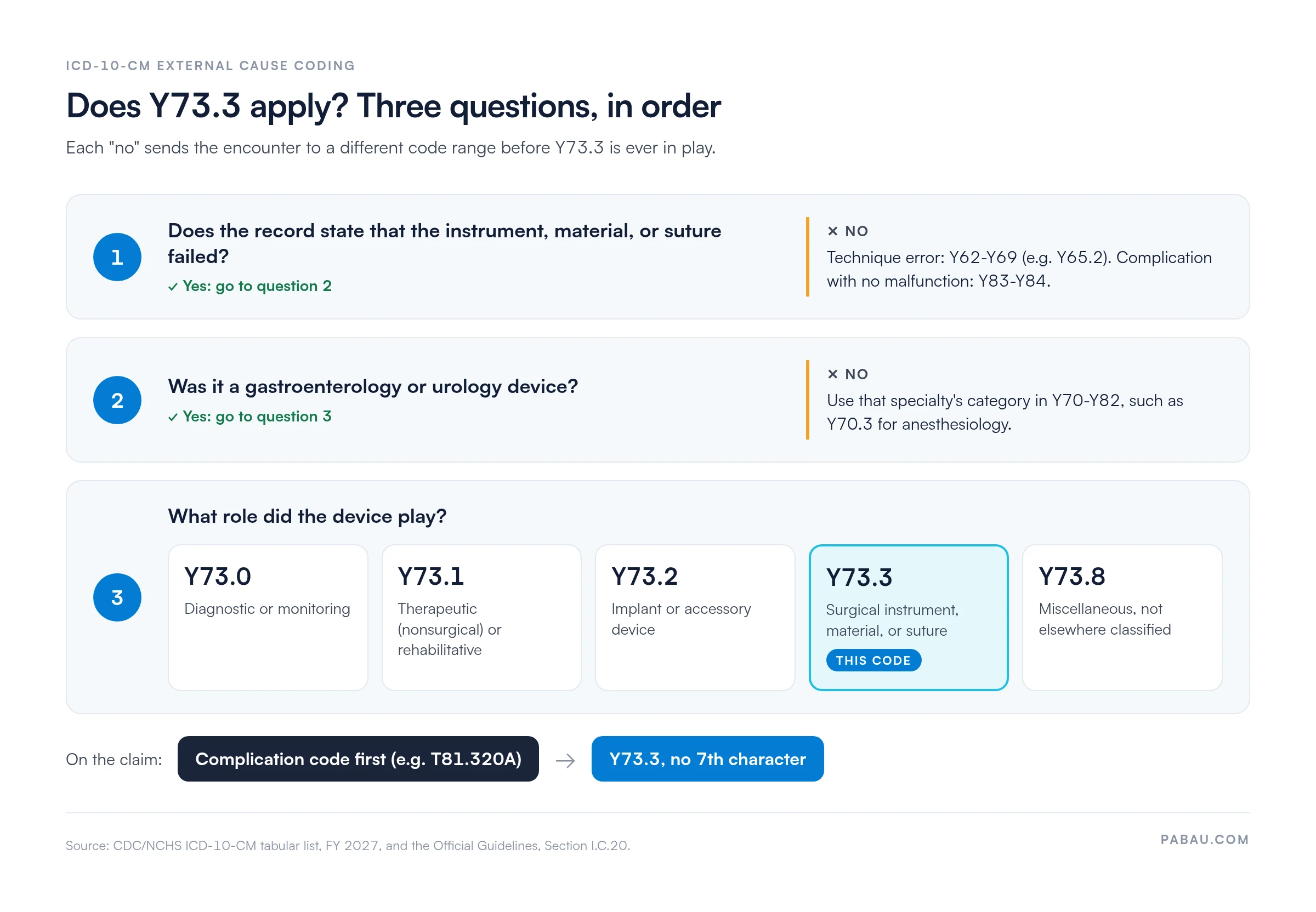
Each Y73 subcode turns on the role the device played when the incident happened. The table below lists every valid code in the category, as published in the FY 2027 tabular list.
Sutures are the case worth remembering. They stay in the body like an implant, yet the descriptor places them in Y73.3 rather than Y73.2.
Section I.C.20 of the ICD-10-CM Official Guidelines for Coding and Reporting governs external cause codes, including Y73.3. Three rules decide whether the code is used correctly.
External cause codes are always secondary. The first code describes the condition the device caused, such as a dehiscence, a hemorrhage, or an accidental laceration. Y73.3 follows it to identify the device. Our guide to medical billing fundamentals explains how sequencing works across a full claim.
Unlike most injury codes, Y73.3 never takes a placeholder X or a 7th character. The encounter type is carried by the complication code instead, for example T81.320A for an initial encounter. Adding A, D, or S to Y73.3 creates a code that does not exist.
There is no national requirement to report external cause codes. Report them when a state-based mandate or a particular payer requires them. The guidelines also encourage voluntary reporting, because the data supports injury research and prevention.
Before you assign Y73.3, find the sentence in the operative or procedure note that says the instrument, material, or suture failed. If the note only describes a complication, query the surgeon rather than inferring a device problem.
Guideline I.B.16 bases complication coding on the provider’s documentation of the relationship between the condition and the care. For Y73.3, the record should show four elements.
Coders cannot infer a malfunction from a poor outcome. An anastomotic leak after bowel surgery does not support Y73.3 unless the note says the staple line or suture material failed.
Payers check that a valid condition code leads the claim and that Y73.3 follows it. A code that points to an external cause can also prompt liability or coordination-of-benefits questions, so keep the device details ready.
A clearinghouse checks each claim’s format before it reaches the payer, which catches a malformed code before it costs a resubmission. After adjudication, electronic remittance advice (ERA 835 files) returns the payer’s adjustment reason codes. Your billing team can then see why a claim was reduced or denied.
Claims carrying Y73.3 tend to fail for a small set of reasons. Strong denial management workflows treat each one as preventable.
Each of these costs less to fix before submission than after it. Submitting a clean claim on the first pass keeps a device-related encounter out of the appeals queue.
Y73.3 always follows a code for the condition. The pairings below are examples, and the documented outcome decides which one applies.
Y65.2 can sit alongside these when a misadventure also occurred, because the Excludes2 note allows both codes on the same claim.
Coding Y73.3 correctly is a documentation job first. The operative note, the complication code, and the device details need to sit in one record, where the coder can find them.
Pabau, the clinical and billing software we build for practices, keeps the clinical note, invoice, and insurance claim on the same patient record. For US practices, Pabau’s Claim.MD integration submits electronic CMS-1500 claims and runs real-time eligibility checks before treatment.
Pabau’s claims management software updates each claim’s status from pending through submitted and processing to paid, or to an error that needs fixing. Validation checks run every time a claim is sent, so missing details such as membership numbers are caught before the payer sees them.

Pabau keeps clinical notes, invoices, and insurance claims on one patient record. US practices submit CMS-1500 claims through Claim.MD and track each one from pending to paid.

Y73.3 belongs on a claim only when the record shows a surgical instrument, material, or suture failing during gastroenterology or urology care. Without that statement, leave it off and query the provider.
When it does apply, the rules are short. Code the complication first, report Y73.3 without a 7th character, and choose the subcode by the device’s role. That extra minute at coding saves a resubmission and gives your safety data a clean device record.
Book a demo to see how Pabau keeps notes, claims, and remittances together for practices that bill insurance.

Want to understand the claim lifecycle for device-related codes? How a medical claims clearinghouse works explains the checks your claim passes through before it reaches a payer.
Looking to reduce denial rates across all ICD-10 code types? Denial management in healthcare outlines prevention steps that apply directly to external cause code errors.
Need a checklist for first-pass acceptance? What makes a clean claim covers the fields and codes payers check before they pay.
ICD-10 code Y73.3 identifies a surgical instrument, surgical material, or suture used in gastroenterology or urology as the device involved in an adverse incident. It is a billable external cause code, reported after the code for the resulting condition.
No. Chapter 20 external cause codes are never principal or first-listed diagnoses. List the code for the complication or injury first, then add Y73.3 to identify the device involved.
No. Y73.3 is a complete, billable code, so it never takes a placeholder X or a 7th character. The encounter type is shown by the 7th character on the complication code, such as T81.320A.
The device’s role decides the code. Y73.0 covers diagnostic and monitoring devices, Y73.1 covers therapeutic (nonsurgical) and rehabilitative devices, and Y73.2 covers implants and accessory devices. Y73.3 covers surgical instruments, materials, and sutures, while Y73.8 covers miscellaneous devices not classified elsewhere.
The record must name the instrument, material, or suture and state that it failed. It must also link that failure to the complication coded first. Coders cannot infer a malfunction from a poor outcome, so query the provider when the note is silent.
There is no national requirement to report external cause codes. Report Y73.3 when a state mandate or a payer requires it, and consider reporting it voluntarily for patient safety data.
Y73.3 follows a complication code that matches the documented outcome. Examples include T81.320A for a disrupted GI anastomosis, K91.71 or N99.71 for an accidental puncture during surgery, and K91.840 or N99.820 for postprocedural hemorrhage.