ICD-10 Code Y72.2: Prosthetic ENT devices and incidents
ICD-10 Code Y72.2: Quick reference ICD-10 Code Y72.2 is a supplementary external...

Last Updated: Nov 3, 2026
Billable Code Specific Code
Y78.0 is the billable ICD-10-CM code for diagnostic and monitoring radiological devices associated with adverse incidents. It covers incidents involving imaging equipment such as CT scanners, X-ray units and fluoroscopy systems. The device's purpose, not the type of fault, decides the code, and Y78.0 is always reported after the condition the incident caused.
Two errors commonly trigger denials. The first is listing Y78.0 as the principal diagnosis, which is not allowed for an external cause code. The second is documentation that names the outcome without naming the device.
Let Pabau's smart automation suggest the right codes, reduce claim denials, and keep your practice compliant—effortlessly.
Automate repetitive tasks and focus on what matters most—your patients.
Reduce coding errors and ensure compliance with the latest regulations.
Clean claims, fewer denials, and faster reimbursements.
Powerful insights and reporting to help your practice thrive.
HIPAA compliant SOC 2 certified GDPR-compliant Trusted by 4,000+ clinics worldwide

ICD-10 Code Y78.0 is a billable external cause code for adverse incidents involving diagnostic and monitoring radiological devices, such as CT scanners and fluoroscopy units
The fourth character of a Y78 code is chosen by device type, so a therapeutic device such as a linear accelerator belongs under Y78.1
Y78.0 belongs to ICD-10-CM Chapter 20 and is never the principal or first-listed diagnosis
Code the condition the incident caused first, then add Y78.0 to explain how it happened
ICD-10 Code Y78.0 is the billable ICD-10-CM code for an adverse incident involving a diagnostic or monitoring radiological device. The official descriptor is “Diagnostic and monitoring radiological devices associated with adverse incidents.” It covers imaging equipment such as CT scanners, X-ray units and fluoroscopy systems. Y78.0 has four characters and needs no further extension, so it is complete and reportable.
Y78.0 sits within the Y70-Y82 block of Chapter 20 of ICD-10-CM, which covers medical devices associated with adverse incidents in diagnostic and therapeutic use. Chapter 20 as a whole addresses external causes of morbidity, and codes within it are never used as principal diagnoses.
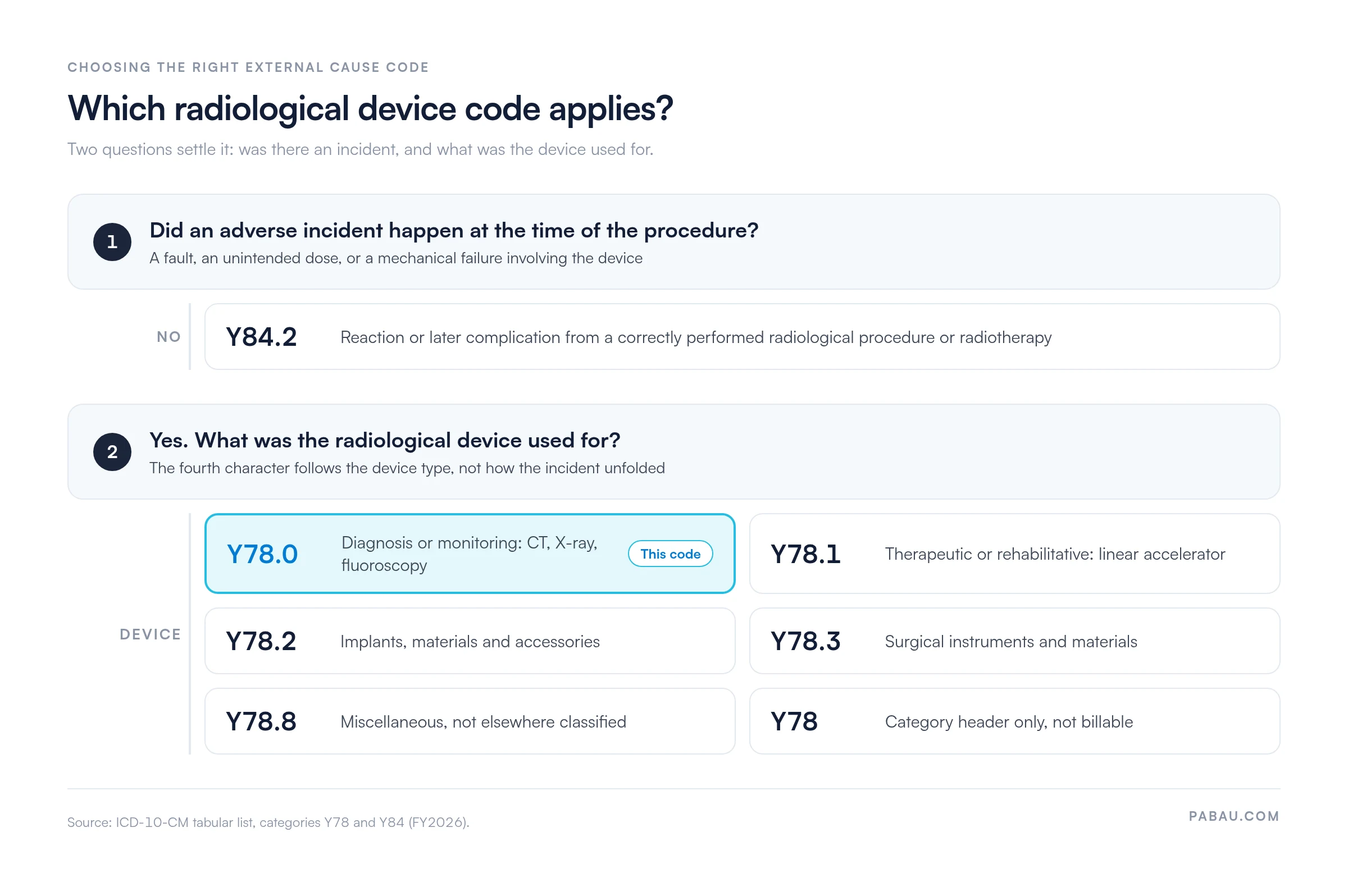
The Y78 category covers adverse incidents associated with radiological devices. Each code in the category names a different type of device. The fourth character depends on what the equipment is for, not on how the incident unfolded.
Y78.0 is correct when the device was used to diagnose or monitor the patient. If the device was delivering treatment, Y78.1 applies. Implanted materials and accessories go to Y78.2, and surgical instruments go to Y78.3. A radiological device that fits none of those types is reported with Y78.8. The parent code Y78 is not billable on its own.
The ICD-10-CM tabular list carries no Code First or Use Additional Code note at the Y78 category. The sequencing rules for external cause code Y78.0 come from the Chapter 20 section of the official guidelines instead.
When documenting a radiological device incident, the clinical record must identify three elements. Those are the device and its purpose, what went wrong, and the patient outcome. A chart entry that documents a radiation burn without naming the device involved does not support Y78.0. The coder needs all three elements in the same encounter note.
Y78.0 applies when a diagnostic or monitoring radiological device was involved in an adverse incident that harmed the patient. The scenarios below illustrate correct use.
Y78.0 does not apply to a therapeutic device. A linear accelerator that delivers an incorrect radiotherapy dose because of a hardware fault is a therapeutic device, so that incident takes Y78.1. A reaction to correctly delivered radiotherapy, with no incident at the time, is coded with Y84.2 instead.
Y78.0 is one of several codes that describe radiological device incidents. The distinctions matter because payers and auditors scrutinize external cause code specificity.
The most common mix-up is between Y78.0 and Y78.1. A radiation skin injury from a faulty fluoroscopy unit during a cardiac catheterization gets Y78.0. The same injury from a faulty linear accelerator during radiotherapy gets Y78.1. Once an incident is confirmed, the deciding factor is what the device was used for. The flow below walks through both questions in order.
Clinical documentation must contain specific elements before Y78.0 can be coded. Absent any one of these, the external cause code is not supported and should not be reported. The ICD-10-CM Official Guidelines for Coding and Reporting base code assignment on the provider’s documentation.
When documentation is incomplete, coders should submit a physician query before reporting Y78.0. A query is the standard route when the record leaves unclear which device was involved or how the incident happened. Practices should also check their medical billing compliance standards when setting up internal audits for device-related encounters.
ICD-10 Code Y78.0 is an external cause code, so its position on the claim is fixed by the official sequencing rules. A claim that breaks them is commonly rejected or returned for correction, and a pre-bill review is the surest place to catch it.
Sequencing rule: Y78.0 must never appear as the principal or only diagnosis. Section I.C.20 of the official guidelines states that an external cause code can never be a principal (first-listed) diagnosis. The condition caused by the device incident must be coded first.
Outpatient encounters: In outpatient settings, external cause codes are optional at most facilities but recommended for quality-of-care data and payer transparency. When reported, they follow the confirmed or probable diagnosis code for the visit.
Reporting requirements: The guidelines state there is no national requirement for mandatory external cause code reporting. Reporting is required only under a state-based mandate or when a particular payer requires it. Otherwise, providers are encouraged to report these codes voluntarily.
Medicare Administrative Contractors: MACs follow CMS external cause code policy. No Medicare benefit category covers Y78.0 on its own, and the primary condition code drives coverage determination and payment.
External cause codes in the Y78 range generate predictable denial patterns. Each error below comes with the correction step that clears it.
A structured denial management workflow that flags claims carrying only an external cause code can catch these errors before billing. Practices billing radiology encounters should also review the standard medical billing denial codes to spot patterns in device-related claims.
Set up a claim edit rule in your billing system that flags any claim where a Y78 code is the only diagnosis code. External cause codes never stand alone. This one edit stops the sequencing denial described above for every code in the Y78 category.
Section I.C.20 of the ICD-10-CM Official Guidelines for Coding and Reporting, published by CMS and the CDC, governs external cause code reporting. It sets out how Y78.0 is sequenced and reported across care settings. The key principles coders should know are summarized below.
The rule holds in every setting: the external cause supplements the primary condition and never replaces it. For coders new to the wider claim cycle, our guide to medical billing fundamentals covers how a claim moves from encounter to payment.
A sequencing error on a device-related claim often surfaces only when the remittance comes back. By then the encounter is weeks old, and rebuilding the device details means chasing the clinician who wrote the note.
Pabau, the practice management and billing platform we build, keeps the encounter note, the diagnosis codes and the claim in the same patient record. Its trackable claims management sends each claim through the Claim.MD clearinghouse integration and follows it after submission.
Your billing team sees when a radiology claim is accepted, rejected or paid without logging in to a separate portal. A returned claim can be corrected against the original note the same day, while the incident details are still easy to confirm.

Pabau’s Claim.MD integration submits your claims electronically and tracks each one through to payment. See how it fits radiological and specialist billing workflows.

ICD-10 Code Y78.0 is chosen by device type. It belongs on a claim when a diagnostic or monitoring device, such as a CT scanner, was involved in an incident that harmed the patient. Pick the fourth character from what the device was used for, and keep therapeutic equipment under Y78.1.
Two habits commonly trigger denials on this code: listing it first, and notes that never name the device. Fix both, and Y78.0 adds useful context without slowing payment. To see how Pabau’s claims management and Claim.MD integration submit and track radiology claims, book a demo.

Need to understand how claims clearinghouses validate ICD-10 code combinations? Claim.MD clearinghouse overview explains how electronic claim validation catches code-level errors before payer submission.
Want to reduce claim denials across your billing workflow? Electronic remittance advice explained covers how ERA data surfaces denial patterns and accelerates payment reconciliation.
Coding a device incident outside radiology? ICD-10 Code Y70.0 covers the matching code for diagnostic and monitoring anesthesiology devices.
>
ICD-10 Code Y78.0 is the billable external cause code for an adverse incident involving a diagnostic or monitoring radiological device. It belongs to Chapter 20 of ICD-10-CM. It is reported as a secondary code when equipment such as a CT scanner or fluoroscopy unit is involved in patient harm.
No. Y78.0 is an external cause code and cannot be reported as the principal or only diagnosis. A primary condition code describing the patient harm must always appear before Y78.0. Claims submitted with Y78.0 as the sole diagnosis are commonly rejected or returned for correction.
Y78.0 covers diagnostic and monitoring radiological devices, such as CT scanners and fluoroscopy units. Y78.1 covers therapeutic (nonsurgical) and rehabilitative radiological devices, such as a linear accelerator. The key distinction is what the device was used for.
No. Y78.0 covers diagnostic and monitoring devices only. An incident involving a radiotherapy device such as a linear accelerator is coded Y78.1. Implants and accessories go to Y78.2, surgical instruments to Y78.3, and other radiological devices to Y78.8.
No claim type requires it nationally. Reporting is required only where a state mandate or a particular payer asks for it. Outpatient and inpatient claims both report it as an additional code, never as the principal diagnosis. Without such a requirement, the ICD-10-CM Official Guidelines encourage voluntary reporting for injury research and prevention data.