ICD-10 code I27.20: Pulmonary hypertension, unspecified
ICD-10 code I27.20 covers PH with no stated type or cause ICD-10 code I27.20 is ...

Last Updated: Nov 18, 2026
Billable Code Specific Code
Y80.8 is the billable ICD-10-CM code for miscellaneous physical medicine devices associated with adverse incidents, not elsewhere classified. It records that a physical medicine device broke down or malfunctioned during use and played a part in the patient's injury or condition.
Y80.8 is a secondary external cause code and is never listed first. Coders reach it by elimination, once the device fits none of the four functional subcodes: diagnostic, therapeutic, prosthetic or surgical. Category Y80 has no unspecified code.
Let Pabau's smart automation suggest the right codes, reduce claim denials, and keep your practice compliant—effortlessly.
Automate repetitive tasks and focus on what matters most—your patients.
Reduce coding errors and ensure compliance with the latest regulations.
Clean claims, fewer denials, and faster reimbursements.
Powerful insights and reporting to help your practice thrive.
HIPAA compliant SOC 2 certified GDPR-compliant Trusted by 4,000+ clinics worldwide

ICD-10 code Y80.8 covers adverse incidents with miscellaneous physical medicine devices that fit none of the four functional subcodes, Y80.0 to Y80.3.
Y80.8 is a secondary external cause code, so the injury or condition the device caused is always listed first.
Category Y80 has no unspecified subcode, so a device the record can’t identify is coded to Y82.9.
A complication after device use without breakdown or malfunction belongs in Y83 to Y84 instead.
Chapter 20 codes are reported where a state mandate or payer requires them, and the guidelines encourage voluntary reporting elsewhere.
ICD-10 code Y80.8 is the external cause code for an adverse incident with a miscellaneous physical medicine device, not elsewhere classified.
The National Library of Medicine’s ICD-10-CM listing for Y80 shows five subcodes, and Y80.8 is the last of them. It records a device breakdown or malfunction during use, and it always follows the code for the harm.
In practice, Y80.8 is a fallback for device failures that fit none of the four named functions. On the claim, it tells the payer and your incident data what kind of equipment was involved.
Physical medicine devices are the equipment the FDA classifies under 21 CFR Part 890, its physical medicine devices regulation. That part covers items such as:
Being on that list puts a device in category Y80. It doesn’t settle the fourth character, though. A hot pack or a muscle stimulator treats the patient, so an incident with one points to Y80.1, not Y80.8.
The block’s own notes set the outer edges. Y70-Y82 includes breakdown or malfunction of medical devices during use. Two Excludes2 notes send other events elsewhere:
Each category from Y70 to Y78 splits its devices the same way, by what the device does. Y80 follows that pattern, so the fourth character answers one question. What was this device for?
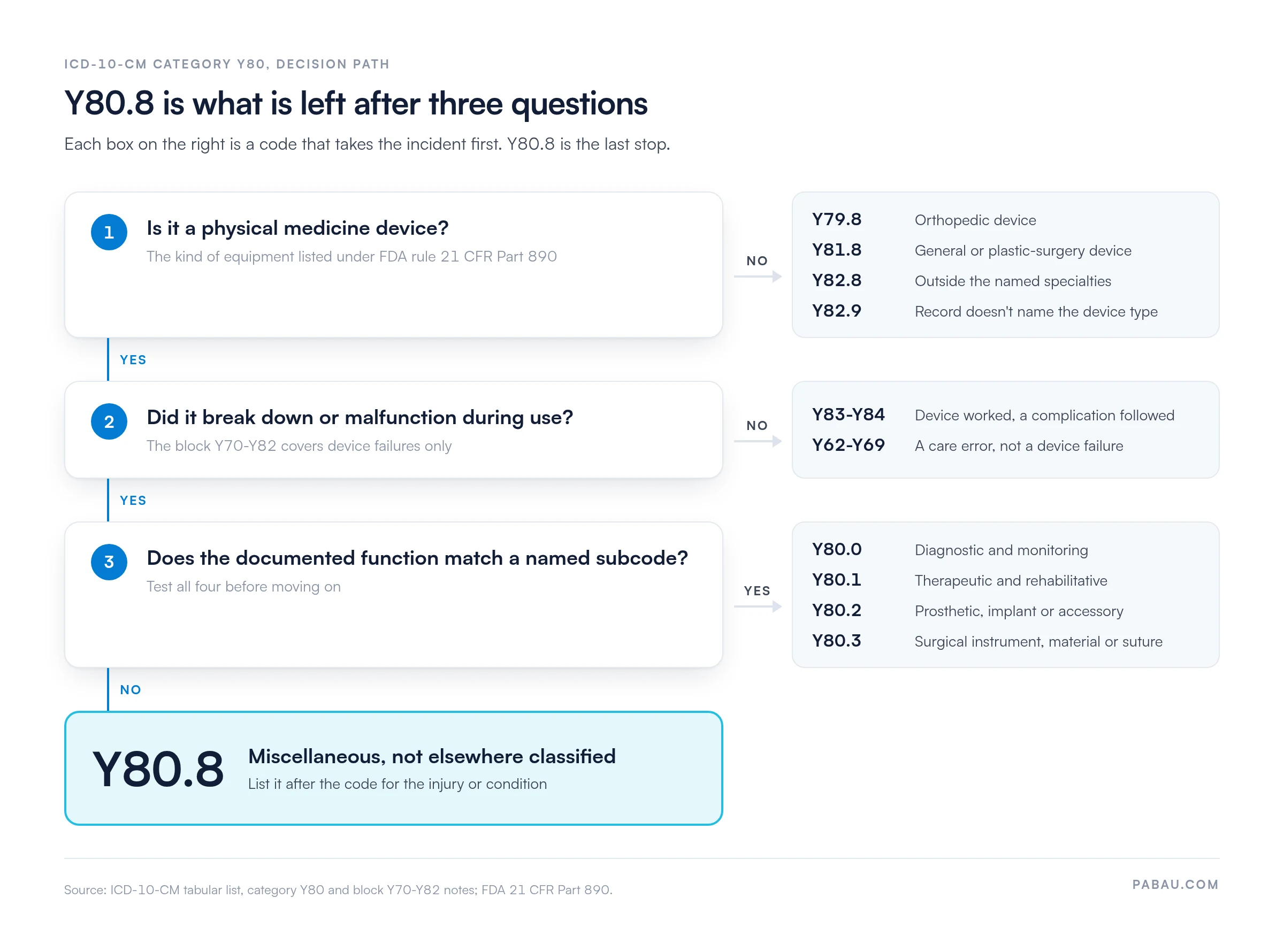
Run the decision in this order for every incident:
The decision path below puts those checks and their exits side by side, so you can see which code takes over at each “no”.
Neighboring codes share the same structure, so the mix-ups tend to happen across categories. This table shows where each one takes over.
The Y81.8 row deserves a second look. Some references attach general and plastic-surgery wording to Y80.8. A claim built on that mix-up describes the wrong kind of equipment entirely.
External cause codes are never the principal or first-listed diagnosis. The ICD-10-CM Official Guidelines apply that rule to all of Chapter 20, and Y80.8 is no exception.
Here’s how a Y80.8 claim moves from the chart to the payer:
Take an illustrative case. A therapist documents that a hot pack leaked during treatment and the patient developed a burn. The burn code goes first on the claim.
Now apply the elimination test. A hot pack is a treatment device, so the external cause is Y80.1. Y80.8 would take that same second slot only for a device whose documented function fits none of the four subcodes.
Most problems with this code come from order, validity or the wrong subcode. Here’s what each one looks like and how to fix it.
For the wider list of remark codes, see our guide to denial codes in medical billing. A denial management workflow turns each one into a fix your coders can repeat.
Run a quarterly audit of claims where a Chapter 20 code (V00-Y99) sits in the first diagnosis position. A repeat pattern in that 90-day lookback shows which coders need a refresher on external cause sequencing.
Each line you can tick removes a reason to resubmit. That’s what a clean claim comes down to.
On paper, the incident sits in a therapy note and the codes sit in a billing tool. Someone retypes one into the other, and that’s where Y80.8 slips into first place.
Pabau, the practice management platform we build, pre-fills the claim from the invoice. It then validates the claim for missing or invalid details before it goes to Claim.MD. That removes the retyping step where Y80.8 tends to slip into first place.
The Claim.MD clearinghouse connection adds eligibility checks before the visit and electronic remittance advice (ERA) after it. Our claims management software brings submission, eligibility and remittance into one workflow.
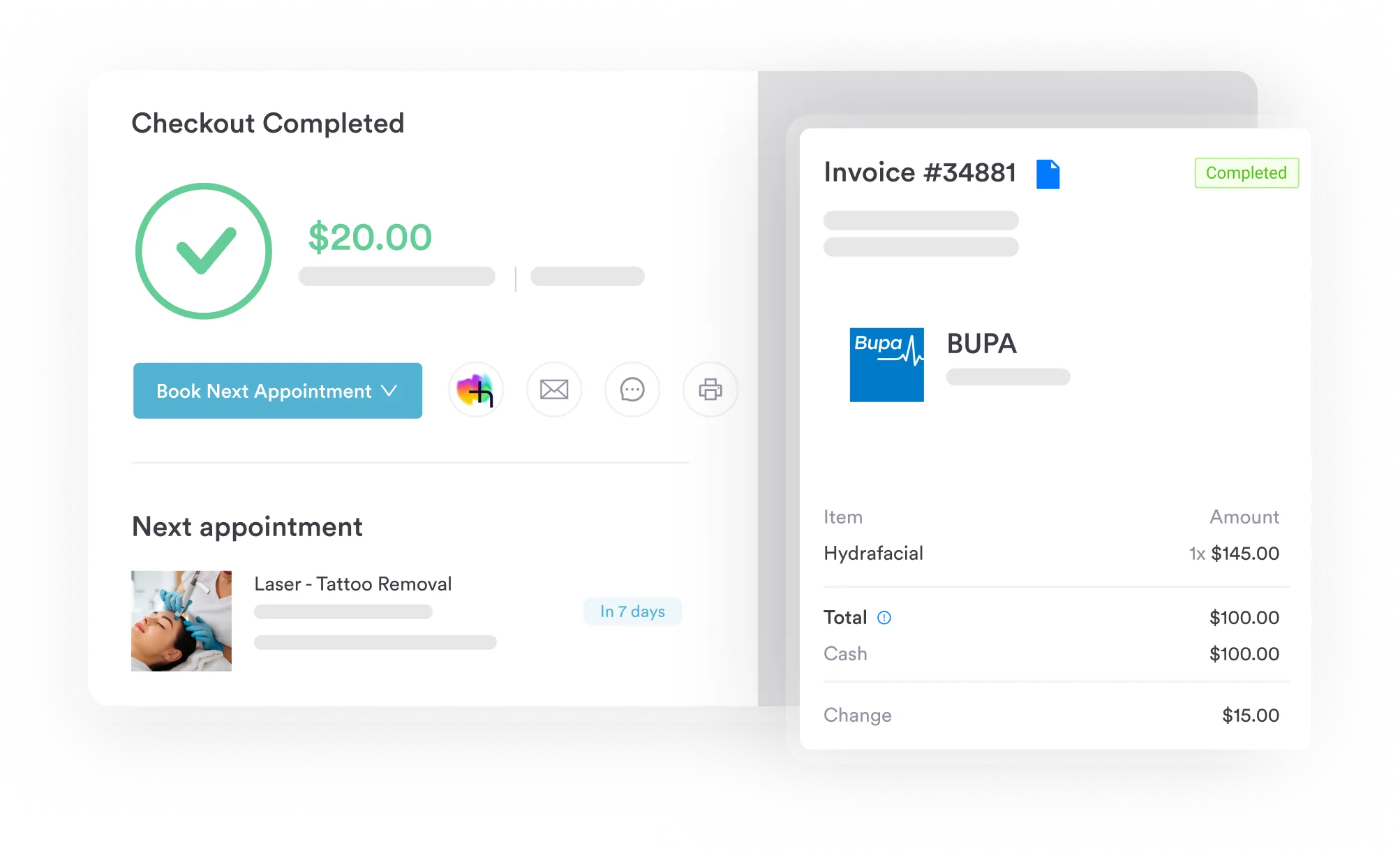

Pabau pre-fills each claim from the invoice and checks it for missing or invalid details. US claims go through Claim.MD, with eligibility checks and ERA built in.

Y80.8 earns its place on a claim only after four other codes have been ruled out. Treat it as the last stop in category Y80, and the decision becomes a short check your team can repeat.
The bigger risk is the mix-up this code invites. Code a physical medicine incident with surgical-device wording, and your incident data blames the wrong kind of equipment.
Start with the documentation, because the code can only be as specific as the note. Book a demo to see how Pabau raises each claim from the invoice and checks it before it goes out.

Need a broader grounding in medical billing compliance? Medical billing compliance fundamentals covers the documentation standards, audit triggers, and payer requirements that apply across all code types.
Trying to reduce denied claims systematically? Revenue cycle management explained outlines the end-to-end workflow from code assignment through final payment posting.
Looking for a clearinghouse integration guide? Claim.MD clearinghouse overview details how electronic claim submission, real-time eligibility, and ERA remittances work in practice.
No. ICD-10-CM has no national requirement to report Chapter 20 codes. You report them when a state mandate or a payer requires it, and the guidelines encourage voluntary reporting otherwise.
No. Category Y80 doesn’t use seventh characters, so Y80.8 is complete and billable at four characters. Adding an A, D or S makes the code invalid.
Yes, in structure. WHO’s ICD-10 also files Y80.8 under physical medicine devices, as miscellaneous devices not elsewhere classified. US claims still use the ICD-10-CM code and descriptor.
Yes, Y80.8 is in the current ICD-10-CM code set. Updates take effect each October 1, so check the new tabular list before coding into a new fiscal year.
Name the device and what it was used for. Describe how it broke down or malfunctioned, when it happened and the injury that followed. That lets the coder rule out Y80.0 to Y80.3.
Y80.8 covers miscellaneous physical medicine devices. Y81.8 covers miscellaneous general- and plastic-surgery devices. Pick the category from the device’s specialty first, then the subcode from its function.