

HCPCS code E0198: Water pressure pad billing guide
HCPCS code E0198 is a water pad for a standard mattress HCPCS code E0198 is the ...

Last Updated: Oct 13, 2026
Billable Code Specific Code
Y78.8 is the billable ICD-10-CM code for miscellaneous radiological devices associated with adverse incidents, not elsewhere classified. It identifies the radiological device as the external cause of a patient's injury or adverse effect, and it does not describe the injury itself.
The code sits in the external causes of morbidity chapter, V00-Y99, under category Y78. Assignment turns on specificity. Use Y78.8 only when Y78.0 through Y78.3 do not describe the device involved. It is always a secondary code, sequenced after the principal diagnosis.
Let Pabau's smart automation suggest the right codes, reduce claim denials, and keep your practice compliant—effortlessly.
Automate repetitive tasks and focus on what matters most—your patients.
Reduce coding errors and ensure compliance with the latest regulations.
Clean claims, fewer denials, and faster reimbursements.
Powerful insights and reporting to help your practice thrive.
HIPAA compliant SOC 2 certified GDPR-compliant Trusted by 4,000+ clinics worldwide

ICD-10 code Y78.8 is a billable, valid-for-submission external cause code effective October 1, 2025 (FY2026 edition).
Y78.8 covers radiological devices not elsewhere classified, and it is always paired as a secondary code with a principal diagnosis.
Sibling codes Y78.0 to Y78.3 capture specific radiological device categories, so use Y78.8 only when none of them applies.
Pabau’s claims management software supports ICD-10-CM code attachment and submission workflows for device-related encounters.
ICD-10 code Y78.8 is a specific, billable ICD-10-CM code valid for reimbursement submission. It is classified under the description “Miscellaneous radiological devices associated with adverse incidents.” Per the CDC/NCHS ICD-10-CM web tool, it became effective on October 1, 2025 for the FY2026 edition and has carried no revisions since.
This is an external cause code rather than a condition code. It does not describe the patient’s injury; it identifies the radiological device as the external agent. Because of that role, Y78.8 always travels with at least one principal diagnosis code that describes the adverse effect or injury.
Y78.8 functions as a supplementary external cause code under ICD-10-CM Chapter V00-Y99, which means it always follows the principal diagnosis and never leads it. The CMS ICD-10 coding guidance and the ICD-10-CM Official Coding Guidelines (Section I.C.20) establish the sequencing hierarchy for all codes in this chapter.
Y78.8 records why the encounter happened. The condition being treated belongs in the principal diagnosis code that sits ahead of it on the claim.
Payers that audit radiological device encounters look for the external cause code chain as evidence that the incident was documented accurately. Recording those codes as part of the clinical note, rather than bolting them on at submission, is what keeps the chain intact.
The ICD-10-CM “Applicable To” note for Y78.8 reads: “Radiological devices NEC associated with adverse incidents.” The NEC designator (not elsewhere classified) is the operative qualifier. Y78.8 applies only when no more specific subcategory under Y78 describes the device involved. Where a more specific code exists, that code must be used instead.
In practice, Y78.8 captures adverse incidents involving:
One question settles it. Does the device fit Y78.0 (diagnostic), Y78.1 (therapeutic), Y78.2 (prosthetic), or Y78.3 (surgical instruments)? If it does, use that more specific code. If it does not, Y78.8 is correct. The ladder below shows the check in order, with an example device class on each rung.
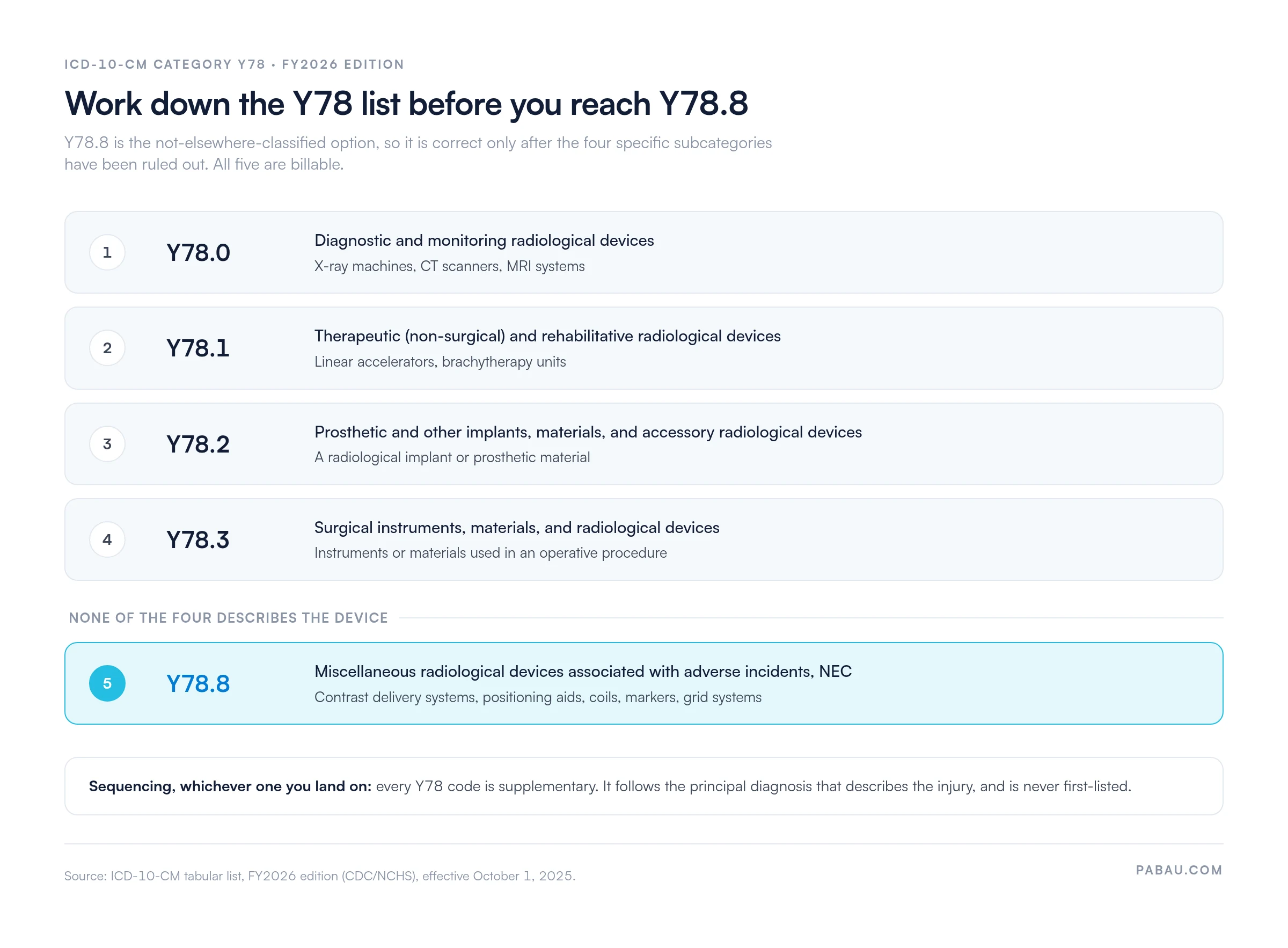
Y78 is the parent category covering all radiological devices associated with adverse incidents, sitting within the broader V00-Y99 external causes chapter. Selecting the wrong subcategory is a common coding error that can trigger audits, so the whole block is worth knowing. The AAPC ICD-10-CM code lookup lists the complete Y78 hierarchy alongside descriptions for each subcategory.
A neurological device in therapeutic or rehabilitative use routes to Y75.1 instead, outside the Y78 category. Obstetric and gynecological devices sit in Y76, where Y76.3 covers surgical instruments and sutures.
Y78 is one branch of a much larger tabular list. Other device categories in that list use the same subcode layout, so Y75.3 covers surgical instruments in neurological procedures. When the injury or the device sits outside this block, start from the full ICD-10-CM code index instead.
Each sibling code under Y78 targets a specific radiological device class. Use this table to select the most specific code before defaulting to Y78.8.
Cross-referencing the WHO ICD-10 browser against the US ICD-10-CM tabular confirms that the Y78 block mirrors the WHO parent classification. ICD-10-CM then adds its own US coding notes and Applicable To annotations on top.
The ICD-10-CM Official Coding Guidelines, Section I.C.20, govern all codes in Chapter V00-Y99. Coders applying Y78.8 must follow these rules consistently to avoid claim denials. Weak documentation around external cause codes is a leading driver of denied device-related claims.
Before defaulting to Y78.8, work through Y78.0, Y78.1, Y78.2, and Y78.3 in order. Document in the clinical record exactly which radiological device was involved and how it contributed to the adverse incident. That documentation is what supports Y78.8 over a more specific sibling code. It is also the first thing a payer auditor will check.
Once the correct code is assigned, it needs to reach the payer accurately. Claims carrying external cause codes like Y78.8 travel through a clearinghouse as part of the 837P professional claim or CMS-1500 form. Practices that file electronically can attach ICD-10-CM codes inside the billing workflow itself. A built-in CPT and ICD-10 catalog cuts manual entry errors on device-related encounters.
Consistent external cause code submission relies on a clean claim process. A medical claims clearinghouse validates the code combination before the claim reaches the payer. That catches sequencing errors, such as Y78.8 appearing as the first-listed code, before they turn into denials. After adjudication, the payer returns an electronic remittance advice (ERA/835) showing how the device-related codes were processed and paid.
Tracking acceptance rates on external cause codes gives a practice a usable proxy for documentation quality. A high rejection rate on Y78.8 submissions almost always traces back to a missing principal diagnosis rather than to the code.
Y78.8 has been part of the ICD-10-CM tabular list since US adoption of ICD-10-CM and has not undergone substantive revision. The FY2026 edition, effective October 1, 2025, carries the same description and Applicable To notes as prior years. Coders should confirm code status annually against the CDC/NCHS ICD-10-CM web tool when the new fiscal year edition takes effect each October.
Annual ICD-10-CM updates take effect each October 1. Build a routine October review into the compliance calendar, so any future change to the Y78 block gets caught before it affects live claims.
Set a recurring calendar reminder for September 15 each year to review the new ICD-10-CM tabular list before the October 1 effective date. Check the Y70-Y82 block for any additions or description changes. The CMS ICD-10 update files are published by early August, which gives coders six weeks to update charge masters and coding policies.
Attaching external cause codes like ICD-10 code Y78.8 consistently is a documentation discipline problem as much as a coding knowledge problem. When clinicians write up a device adverse incident in narrative notes while coders work from a separate billing system, the connection breaks. Practice management software like Pabau keeps the clinical record and the billing workflow in one system. The coder reads the same note that describes the incident.
Pabau’s audit-ready claims management lets practices attach ICD-10-CM diagnosis codes, external cause codes included, directly to the patient’s encounter record. Coders review the clinical documentation and the code assignment in one place instead of toggling between systems. That makes it far harder for a supplementary code like Y78.8 to be dropped before submission.
For radiology and multi-specialty settings, that consistency matters for payer compliance and for internal audit readiness alike.
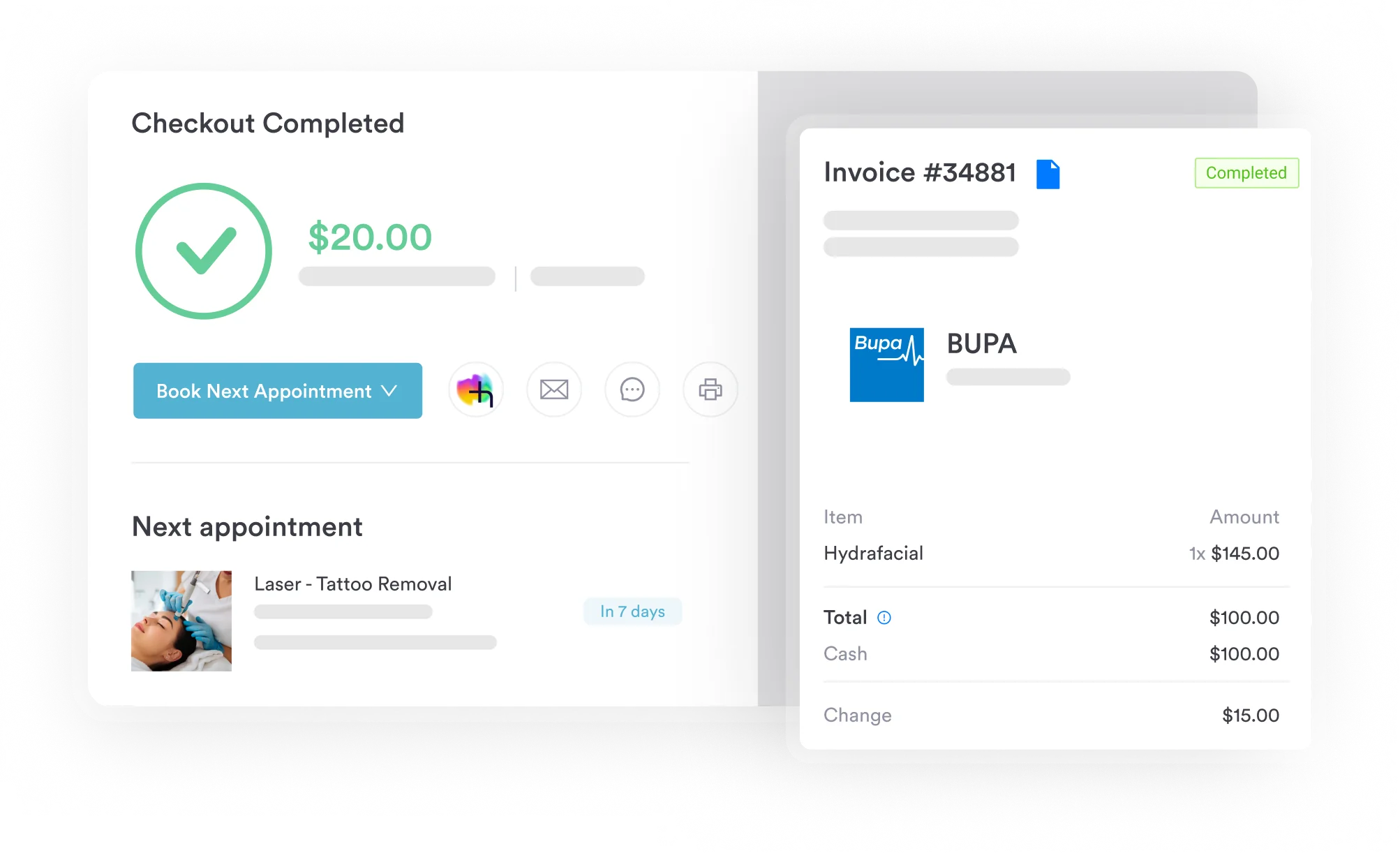
Pabau also integrates with the Claim.MD clearinghouse, which validates ICD-10-CM code combinations before claims reach payers. That layer catches the sequencing errors specific to external cause codes, such as a Y78.8 submitted without a principal diagnosis, before they turn into denials.

Pabau’s claims management software helps radiology and multi-specialty practices attach ICD-10-CM codes accurately and submit them without manual rework. See how it fits your coding workflow.

ICD-10 code Y78.8 is straightforward once its role is clear. It is supplementary, never principal, and correct only when no more specific Y78 sibling fits the device involved. The most common mistake is reaching for Y78.8 before ruling out Y78.0 through Y78.3. The second is submitting it without a principal diagnosis, which produces a predictable claim rejection.
Work the Y78 ladder in order, name the device in the clinical record, and sequence the code behind the diagnosis it supports. That routine is what keeps device-related claims moving and audits uneventful. To see how Pabau handles external cause code documentation for your practice, book a demo.

List Item #1
List Item #2
ICD-10 code Y78.8 is the billable ICD-10-CM diagnosis code for miscellaneous radiological devices associated with adverse incidents. It covers radiological devices not elsewhere classified (NEC) that caused or contributed to patient harm. It belongs to the External causes of morbidity chapter (V00-Y99) and functions as a secondary, supplementary code paired with a principal diagnosis.
Yes, Y78.8 is a billable, specific ICD-10-CM code valid for submission as of the FY2026 edition (effective October 1, 2025). It can be used on claims to indicate the external cause of a patient’s injury or adverse condition related to a miscellaneous radiological device.
Use Y78.8 when a radiological device caused or contributed to a patient’s adverse incident. It applies only where no more specific Y78 subcategory, Y78.0 through Y78.3, describes that device. It is always a secondary code, sequenced after the principal diagnosis code describing the actual injury or adverse effect.
Y78.0 covers diagnostic and monitoring radiological devices; Y78.1 covers therapeutic radiological devices; Y78.2 covers prosthetic and implant radiological devices; Y78.3 covers surgical instruments and materials. Y78.8 is the catch-all for any radiological device that does not fit those four specific categories. Always check the more specific codes before assigning Y78.8.
The parent category is Y78 (Radiological devices associated with adverse incidents), which sits within the broader External causes of morbidity chapter (V00-Y99) of ICD-10-CM. Y78 contains five subcategories: Y78.0, Y78.1, Y78.2, Y78.3, and Y78.8.
Y78.8 became effective October 1, 2025 under the FY2026 ICD-10-CM edition. No description or applicable-to changes were made from the prior year. Coders should verify status annually when CMS releases the updated tabular list each October.



