

ICD-10 Code S42.444P: Medial epicondyle fracture, right humerus
ICD-10 Code S42.444P: full descriptor and code validity ICD-10 Code S42.444P car...

Last Updated: Oct 13, 2026
Billable Code Specific Code
Y75.3 is the billable ICD-10-CM code for surgical instruments, materials and neurological devices (including sutures) associated with adverse incidents.
Coders confuse it most often with T85 codes, which cover postprocedural complications of implanted neurological devices. Those sit in a different timing and clinical context. Using Y75.3 where T85 applies, or the reverse, is a frequent cause of claim denials in neurosurgical billing.
Let Pabau's smart automation suggest the right codes, reduce claim denials, and keep your practice compliant—effortlessly.
Automate repetitive tasks and focus on what matters most—your patients.
Reduce coding errors and ensure compliance with the latest regulations.
Clean claims, fewer denials, and faster reimbursements.
Powerful insights and reporting to help your practice thrive.
HIPAA compliant SOC 2 certified GDPR-compliant Trusted by 4,000+ clinics worldwide

Y75.3 is a billable ICD-10-CM external cause code, so it is always sequenced as secondary and never as a standalone primary diagnosis.
The code applies only to adverse incidents during a neurological procedure, not to postoperative device complications, which belong under T85.
Missing operative report documentation of the specific instrument or device involved is the most common cause of Y75.3 claim denials.
Pabau’s claims management software supports accurate ICD-10 code pairing and documentation workflows, which reduces denial rates.
Before applying Y75.3, confirm the code’s basic attributes against the official ICD-10-CM tabular list. According to the CDC/NCHS ICD-10-CM web tool, the code is active and billable for the 2026 code year.
Y75.3 is an external cause code. It identifies a surgical instrument, material, or neurological device as the contributing factor in an adverse incident during a neurological procedure.
As noted in the AAPC ICD-10-CM code reference, “adverse incident” here means an unintended negative event attributable to the device or instrument itself. The neurological condition being treated is not what the code describes.
Three categories of events fall under this code:
The key word throughout is intraoperative. Y75.3 captures what went wrong during the procedure. Events that surface after the patient has left the operating room belong to a different code family. That boundary drives the most common coding error here.
Y75.3 falls within Chapter XX of ICD-10-CM, which covers external causes of morbidity. Reading the lineage from the top down stops coders from applying a parent code when a more specific one exists.
Chapter XX codes are always supplementary. The ICD-10-CM Official Guidelines for Coding and Reporting, Section I.C.20, treat external cause codes as context for the mechanism or source of an injury. They never function as the reason for a visit on their own.
Y75.3 is always a secondary code. External cause codes in the V00-Y99 range cannot be sequenced as the principal or first-listed diagnosis under any circumstances. A claim that lists Y75.3 as the sole or primary code will generate an edit and be returned or denied.
Correct sequencing needs a principal diagnosis first, usually the neurological condition or complication that led to the procedure. Y75.3 then follows it as a supplementary external cause code. Example pairings:
Some payers require external cause codes on neurological procedure claims involving device incidents. Omitting Y75.3 when documentation supports it can trigger a claim edit. Including it without a paired principal diagnosis guarantees one.
Y75.3 applies when a device, instrument, or material used during a neurological procedure contributes directly to an adverse outcome. The most common clinical scenarios include:
The common thread is that the adverse event is intraoperative and directly attributable to a specific device, instrument, or material. The operative report must name the item and describe the incident for the code to be defensible.
Y75.3 and T85 are the two most frequently confused codes in neurological device coding. The single deciding factor is timing. Y75.3 covers intraoperative adverse incidents, while T85 covers postprocedural complications of implanted devices that appear after the procedure ends.
The CMS ICD-10-CM coding guidelines support this through the T85 block’s tabular heading, which references complications of implants and grafts in a postoperative context.
A practical rule settles most cases. If the patient was still on the operating table when the device problem occurred, Y75.3 is likely correct. If the problem appeared after the patient left recovery, look to T85.
Before selecting Y75.3, confirm no other Y75 subcode better fits the documented incident. The Y75 category contains several subcodes, each targeting a different type of neurological device-related event. A device in therapeutic or rehabilitative use, rather than surgical use, points to Y75.1 instead.
The distinction between Y75.2 and Y75.3 catches many coders. Y75.2 covers implantable prosthetics, such as a cochlear implant being placed, while Y75.3 covers surgical instruments and procedural materials.
If a drill used to access the cochlea fractures, that is Y75.3. If the cochlear implant itself causes the adverse incident during insertion, Y75.2 may be more specific.
The Y70-Y82 block also holds neighboring categories for devices that are not neurological. An adverse incident involving intraoperative imaging belongs in the radiological category, where ICD-10 Y78.8 catches devices with no more specific subcode. A surgical instrument or suture incident during an obstetric or gynecological procedure is coded to Y76.3.
Two questions from the operative report settle the choice between Y75.3, its siblings, and T85. The diagram below runs both, from the timing of the incident to the item that was in use.
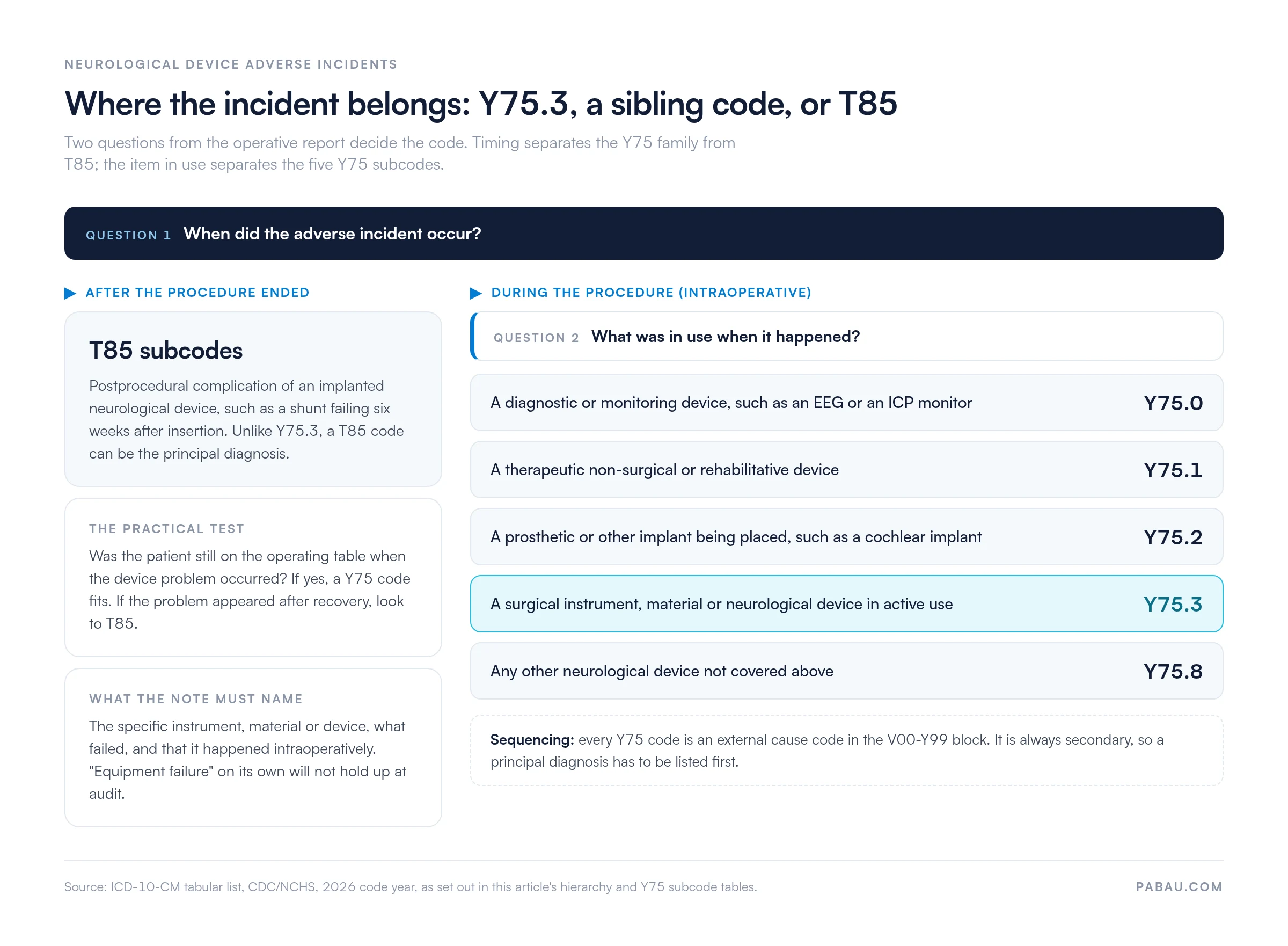
Check the operative report for two things before selecting a Y75 subcode. The first is whether the adverse incident involved a surgical instrument, a diagnostic device, or an implantable prosthetic. The second is whether the item was in use intraoperatively or had already been implanted at an earlier encounter. Those two answers almost always point to the correct subcode.
Y75.3 is only defensible when the operative report contains specific documentation linking the instrument or device to the adverse incident. Vague language like “intraoperative complication” is not sufficient. The following elements have to appear in the clinical record.
Practices running a high volume of neurosurgical claims lean on claims software for practices that flags external cause code requirements at charge entry. That check reduces the risk of submitting Y75.3 without adequate supporting documentation.
Y75.3 is a supplemental external cause code. It does not independently drive reimbursement, and no payment is attached to the code itself. Its role is to provide context that payers use for claims adjudication, utilization review, and audit.
CMS guidance under the ICD-10-CM Official Guidelines requires external cause codes when they add clinical context to a claim. Some commercial payers and state Medicaid programs flag neurological procedure claims involving device incidents when no external cause code is present.
The absence of Y75.3 where documentation supports it can trigger a medical necessity review or a request for records. Per-payer requirements vary:
Claim denials linked to ICD-10 code Y75.3 follow consistent patterns. Each denial reason maps to a documentation or coding error that is correctable before resubmission. Reading the remittance against the payer’s denial codes tells you which pattern applies before you write an appeal.
Most Y75.3 denials are correctable without writing a full clinical appeal. The process follows five steps. Learning to submit a clean claim on the first pass reduces how often you need any of them.
Y75.3 is active and billable for both FY2025 and FY2026. No revisions to the code’s descriptor, sequencing rules, or inclusion and exclusion notes have been published for the 2026 update cycle.
Verify current-year status against the official ICD-10-CM code list before applying any code. The Centers for Medicare and Medicaid Services releases annual updates on October 1, and those updates can affect code validity.
Practices managing high volumes of neurological procedure billing should connect code updates to the practice management workflow. That check keeps a retired or modified code from reaching a claim.
Most practices catch a Y75.3 sequencing error after the payer does. The coder builds the claim in one system, the operative report sits in another, and nobody compares the two until a remittance comes back.
Practice management software like Pabau holds the operative note and the claim on the same patient record. Coders read the surgeon’s description of the instrument failure while they build the diagnosis list. Y75.3 then goes out behind a principal diagnosis rather than in front of one.
Claims submit electronically from that same record, and remittances come back against it. When a payer returns a Y75.3 claim, the denial reason sits next to the operative note the appeal needs. The correction takes minutes instead of a records hunt.

Pabau helps neurology and surgical practices pair external cause codes correctly, validate documentation before submission, and track denial patterns through integrated claims management.

ICD-10 code Y75.3 is precise but unforgiving. The line between intraoperative and postoperative has to be clear in the operative report before the code is applied. The code itself can never stand alone as a primary diagnosis.
Getting both right protects the claim from automatic rejection and the practice from audit exposure. The work that makes it happen is documentation discipline at the operating table, not a coding decision made weeks later.
Pabau validates ICD-10 code combinations before claims reach the clearinghouse. A mis-sequenced external cause code gets caught in the practice rather than at the payer. Book a demo to see how neurological procedure billing runs from operative note to adjudication.

Need to understand how claim denials are managed at scale? Denial management in healthcare covers the workflows and tools practices use to identify, appeal, and prevent billing rejections.
Unsure how external cause codes affect your revenue cycle? Revenue cycle management fundamentals explains how ICD-10 coding fits into the end-to-end billing process.
Want the documentation standard behind an external cause code? Medical billing compliance sets out what auditors expect to find in the clinical record.
ICD-10 code Y75.3 is the billable external cause code for surgical instruments, materials and neurological devices associated with adverse incidents. It applies to incidents during a neurological procedure. Examples include a drill bit fracturing during craniotomy or a neurostimulator lead failing during placement.
Yes, Y75.3 is a billable ICD-10-CM code, valid for FY2025 and FY2026. It is classified as an external cause code, meaning it must be paired with a principal diagnosis and always sequenced as a secondary code. It cannot be submitted as the sole or primary diagnosis on a claim.
Y75.3 covers adverse incidents involving surgical instruments or neurological devices during a procedure (intraoperative). T85 covers complications of implanted neurological devices that manifest after the procedure ends (postoperative). If a shunt malfunctions during surgery, Y75.3 may apply; if it malfunctions six weeks later, T85 is the correct code family.
Y75.3 should be used when the operative report documents an intraoperative adverse incident involving a named surgical instrument, neurological device, or procedural material. The incident must occur during an active neurological procedure, not during recovery or a post-operative follow-up visit.
Claims with Y75.3 are most often denied because the code was sequenced as the primary diagnosis, which external cause codes can never be. Other frequent causes are a missing paired principal diagnosis, a postoperative event that belongs under T85, and an operative report that never names the device.
No. Y75.3 is an external cause code in the V00-Y99 block. The ICD-10-CM Official Guidelines for Coding and Reporting state that external cause codes may never be assigned as a principal or first-listed diagnosis. A claim listing Y75.3 in position 1 will be returned or denied by any payer system.




