ICD-10 code V43.42XS: Car boarding injury, sequela
ICD-10 code V43.42XS covers the late effects of a car boarding injury ICD-10 cod...

Last Updated: Oct 7, 2026
Billable Code Specific Code
V53.3XXS is the billable ICD-10-CM code for a sequela of a nontraffic pick-up truck or van collision. Its official descriptor reads: unspecified occupant of pick-up truck or van injured in collision with car, pick-up truck or van in nontraffic accident, sequela. It's an external cause code, so it explains how an old injury happened, not what you're treating.
The key fact is the setting. V53.3 covers crashes off a public highway only, such as in a private lot. On the claim, it follows the sequela condition and the S-coded injury. Below, you'll find the sequencing steps, sibling codes and a pre-submission checklist.
Let Pabau's smart automation suggest the right codes, reduce claim denials, and keep your practice compliant—effortlessly.
Automate repetitive tasks and focus on what matters most—your patients.
Reduce coding errors and ensure compliance with the latest regulations.
Clean claims, fewer denials, and faster reimbursements.
Powerful insights and reporting to help your practice thrive.
HIPAA compliant SOC 2 certified GDPR-compliant Trusted by 4,000+ clinics worldwide

V53.3XXS is an external cause code, so it can never be the first-listed diagnosis on a claim.
It covers an unknown-role pick-up or van occupant hurt in a nontraffic crash with a car, pick-up or van.
List the sequela condition first, then the original injury code with 7th character S, then V53.3XXS.
A crash on a public highway needs a traffic code instead, such as V53.9XXS.
The 7th character S applies once the acute phase has ended and the visit treats a late effect.
ICD-10 code V53.3XXS tells a payer how a patient’s old injury happened. The patient was riding in a pick-up truck or van when it hit a car, pick-up or van. The crash happened away from a public highway. The record doesn’t say whether the patient was driving or riding as a passenger.
Today’s visit treats a late effect of that injury, so the 7th character is S for sequela. It’s a supplemental code, which means it never goes first on a claim and never travels alone. The table below gives you the essentials at a glance.
Read the code from left to right and the scenario gets more specific. Misread one position, and you land on a sibling code.
The XX placeholders matter more than they look. Category V53 stops at four characters, but the 7th character must sit in position seven. Two X characters fill the space in between. Drop them, and the clearinghouse rejects the code as invalid.
The 4th character does two jobs at once. It records the person’s role, and it records that the crash was nontraffic. If the record confirms the patient was driving, use V53.0XXS. If it confirms they were a passenger, use V53.1XXS. Both of those are nontraffic codes as well.
The 7th character S marks a sequela encounter. The patient is being treated for a condition the earlier injury left behind, rather than for the injury itself.
Section I.B.10 of the ICD-10-CM Official Guidelines defines a sequela. It’s a residual effect that remains once an injury’s acute phase has ended. After a crash, typical examples include chronic cervical radiculopathy, post-traumatic knee instability and lasting nerve pain.
There’s no waiting period before a condition counts as a sequela. It can appear six weeks after the crash or six years later. The clinical record sets the link, and the calendar plays no part.
All three codes describe the same nontraffic collision. What changes is where the patient is in their care. Picking the wrong phase is a common reason these claims bounce.
So the switch from D to S follows clinical status, not time. The clinician must document that the acute phase has ended. The note also has to say that today’s visit treats a condition the injury caused.
V53.3XXS applies only to a nontraffic accident. That setting is part of the code itself, so there’s no separate qualifier to add.
ICD-10-CM treats a traffic accident as one on a public highway, meaning any road open to public traffic. A nontraffic accident happens entirely somewhere else. Think of a private parking lot, a driveway, a farm lane or a closed work site.
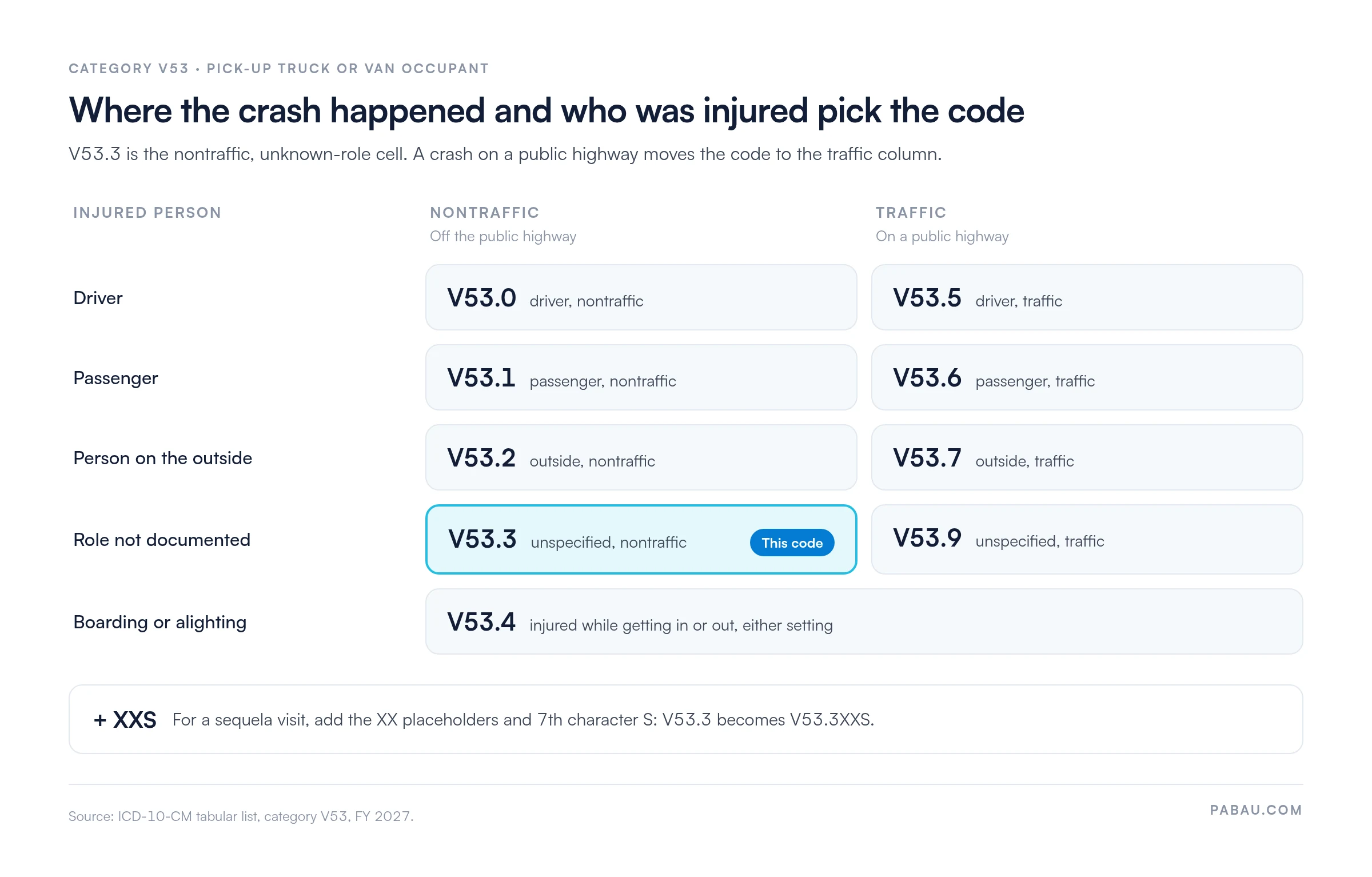
If the collision happened on a public highway, V53.3XXS is the wrong code. Use V53.9XXS when the occupant’s role is unknown. For a documented driver, passenger or person on the outside, use V53.5XXS, V53.6XXS or V53.7XXS.
The grid below maps every V53 subcategory, including V53.4 for someone hurt while boarding or alighting.
The setting also shapes who pays. Personal injury protection (PIP) and auto liability policies may treat a crash off a public road differently. Terms vary by carrier and state. So check the policy wording before you name a primary payer, and note the crash location for coordination of benefits.
Most mix-ups come from three details: the injured person’s vehicle, their role, and the crash setting. These are the codes coders most often reach for by mistake.
The injured person’s vehicle sets the category first, and the other vehicle comes second. If a pick-up or van occupant collided with a heavy transport vehicle or bus, the code moves to V54. A collision with a motorcycle moves it to V52. Check the accident report or police narrative before you pick a category.
Sequela claims follow a fixed order under guideline I.B.10. Getting it right is part of medical billing basics for any practice that treats crash injuries.
A patient was hurt when their van hit a car on a private farm lane. Fourteen months later, they come in with cervical radiculopathy. Their original neck sprain has healed. The note links the radiculopathy to the crash but doesn’t say who was driving.
So the claim lists M54.12 for the radiculopathy first. The sprain comes next as S13.4, with XXS added for the sequela. V53.3XXS goes last as the external cause.
Audit the note before you code a sequela visit. It should confirm the acute phase has ended and describe the current condition. It also needs a statement linking that condition to the collision. Without the linking statement, a denial is hard to appeal.
Good documentation is what turns a sequela visit into a clean claim. Before coding, confirm the record holds each of these items.
Missing items create audit risk. Liability carriers often ask for records on crash-related claims, especially when treatment runs for many months.
Payer and state requirements for external cause codes vary. Many liability and PIP carriers request them, and CMS doesn’t require them nationally. Here’s how the main payer types tend to treat V53.3XXS.
V53.3XXS denials follow familiar patterns. Building good denial management workflows before claims go out beats appealing afterward.
Track these on the remittance using claim adjustment reason codes (CARCs). The common denial codes on these claims include CO-11, CO-16 and CO-22.
Run through these checks before the claim leaves your practice. Each one heads off a denial from the table above.
For that last check, our guide to insurance eligibility verification covers what to confirm before the visit.
Yes, V53.3XXS is valid and billable in FY 2027, which took effect on October 1, 2026. You can confirm it in the CMS ICD-10-CM files.
CMS and the National Center for Health Statistics (NCHS) update ICD-10-CM every October 1. Check your codes once a year in the CDC/NCHS ICD-10-CM tool or AAPC Codify. Code lists cached from earlier years go stale quickly.
ICD-11 is in use internationally, but it isn’t mandated for US billing as of FY 2027. For now, V53.3XXS remains the US standard under ICD-10-CM.
Set a reminder for each summer, when CMS releases the next fiscal year’s ICD-10-CM files. That gives you time to review your external cause code lists and billing templates before October 1.
Many practices still build sequela claims by hand. Someone copies codes from the note, checks the payer, and hopes the order survives the clearinghouse.
Pabau, the practice management platform we build, pre-fills the claim from the patient record. Its ICD-10-CM and CPT lookup libraries let your team find codes like V53.3XXS without leaving the claim. Before you can send it, our claims management software checks that required fields are complete.
In the US, claims go out through Claim.MD, with eligibility checks before submission. ERA posting and claim-status tracking then show where each crash-related claim stands. That means less time chasing liability payers and more time with patients.
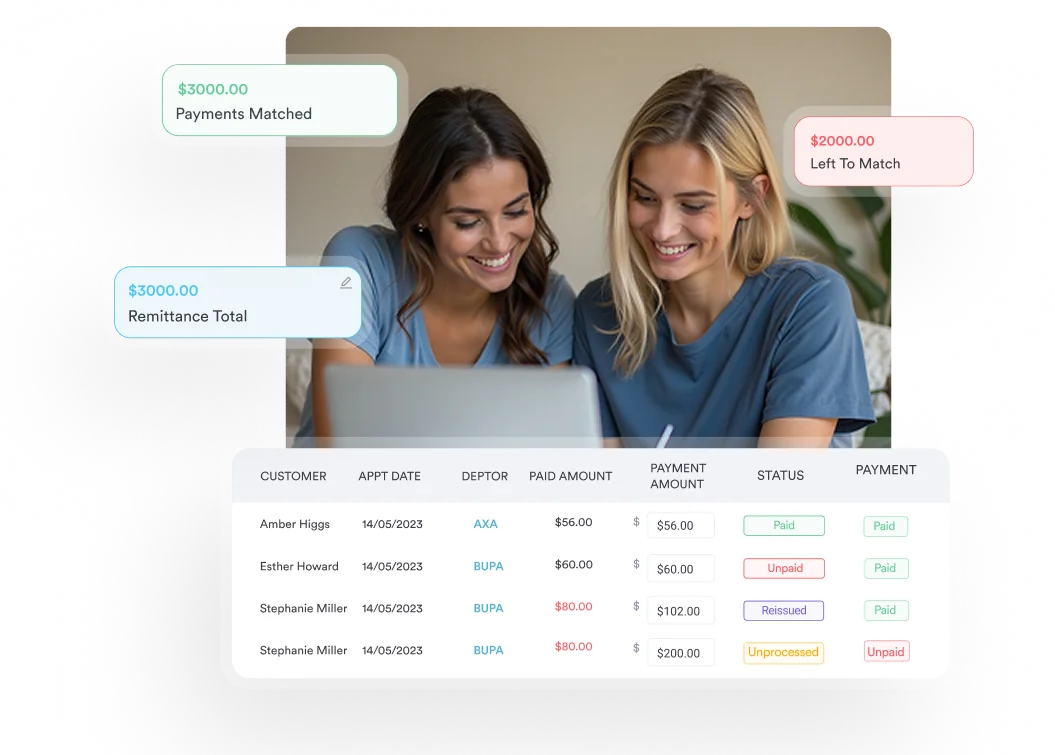

Pabau pre-fills claims from the patient record, checks required fields, and submits through Claim.MD with eligibility checks and ERA posting. See how it fits a crash-injury caseload.

V53.3XXS rarely decides on its own whether a claim pays. The codes around it do. Settle the crash setting first, because a public-highway crash belongs in V53.9 or one of its traffic siblings.
Then lock in the order: condition, injury code with S, then V53.3XXS. Do your notes prompt for the crash location and the causal link? If not, update the template before the next sequela visit. Book a demo to see how Pabau keeps crash-injury claims complete from note to payment.

Need a primer on what happens after a claim leaves your practice? Revenue cycle management explained covers the full lifecycle from patient intake to final payment posting.
Struggling to interpret ERA remittances on liability claims? Electronic remittance advice guide breaks down ERA segments, CARC codes, and reconciliation workflows.
Want to understand how clearinghouses process ICD-10-coded claims? Medical claims clearinghouse overview explains how 837P files are validated and routed to payers.
Curious where your diagnosis codes sit inside an electronic claim? What is an 837 file? walks through the claim format payers read.
Use a code from category V43, car occupant injured in collision with car, pick-up truck or van. The injured person’s vehicle sets the category, so V53 applies only when that person was in the pick-up or van.
No. Place of occurrence (Y92), activity (Y93) and external cause status (Y99) codes are reported only at the initial encounter. A sequela visit carries the V53 code with 7th character S, without those three.
No. Category V53 is on the POA-exempt list, so inpatient claims don’t need an indicator for it. The sequela condition and injury codes still need their own.
Yes, report as many as you need to describe the event. When several apply, abuse, terrorism and cataclysmic event codes come before transport accident codes like V53.3XXS.
Yes. Report it on each visit that treats the residual condition, as long as the record still ties it to the crash.