

ICD-10 code S61.201A: Open wound of left index finger without nail damage
ICD-10 code S61.201A covers a left index finger wound of unstated type ICD-10 co...

Last Updated: Oct 16, 2026
Billable Code Specific Code
V85.9XXS is the billable ICD-10-CM code for unspecified occupant of special construction vehicle injured in nontraffic accident, sequela. Use it when a patient hurt on a bulldozer or similar machine off a public road now has a lasting condition from that injury. It fits only when the record doesn't say whether they were driving, riding, or outside the cab.
The code explains how the injury happened, never what the patient has now. List it first, or pick the wrong seventh character, and the claim is likely to be denied. Below, you'll find the code's structure, its V85 neighbors, the documentation payers look for, and a pre-submission check.
Let Pabau's smart automation suggest the right codes, reduce claim denials, and keep your practice compliant—effortlessly.
Automate repetitive tasks and focus on what matters most—your patients.
Reduce coding errors and ensure compliance with the latest regulations.
Clean claims, fewer denials, and faster reimbursements.
Powerful insights and reporting to help your practice thrive.
HIPAA compliant SOC 2 certified GDPR-compliant Trusted by 4,000+ clinics worldwide

V85.9XXS is an ICD-10-CM external cause code for a lasting condition left by a nontraffic special construction vehicle accident.
Use it only when the record doesn’t say whether the patient was the driver, a passenger, or riding outside.
The S seventh character means sequela, while active injuries take A (initial encounter) or D (subsequent encounter).
It’s never the principal diagnosis, so it follows the residual condition code and the healed injury’s S code.
Pabau’s claims management checks claims for missing required details before sending and flags denied claims for rework.
ICD-10 code V85.9XXS is the billable code for the sequela of an unspecified occupant of a special construction vehicle injured in a nontraffic accident. Put simply, someone was hurt on a bulldozer or similar machine away from a public road. The injury healed, but it left a lasting condition, and that condition brings them to your practice today.
The code sits in category V85, inside the V80-V89 block (other land transport accidents) of Chapter 20, External Causes of Morbidity. The code is valid in the current ICD-10-CM release.
As an external cause code, V85.9XXS explains how the original injury happened. It never says what the patient has now. That job belongs to the code you list first, such as chronic pain, neuropathy, or post-traumatic arthritis. Here are the code’s key facts at a glance.
V85.9XXS has seven characters, and each one carries meaning. The decimal point doesn’t count as a character. The two X placeholders aren’t optional, either. Leave them out and the clearinghouse rejects the code as invalid.
The placeholder rule isn’t unique to V85. Whenever a code has fewer than six characters but needs a seventh, the official guidelines fill each empty slot with an X placeholder. Under the CMS ICD-10-CM guidelines, V85.9S is an invalid code and fails front-end edits.
A sequela is a lasting condition caused by an earlier injury, once the acute phase is over. The S seventh character says exactly that. The construction vehicle accident is behind the patient, but they now live with a condition it caused.
Sequela coding pairs codes in a set order, per the CDC/NCHS ICD-10-CM Official Guidelines (Section I.C.19.a, with external cause guidance in I.C.20). The residual condition goes first. The healed injury’s code follows with S as its seventh character, and V85.9XXS adds the cause.
There’s no time limit, either. The S code still applies to an accident from 20 years ago, as long as the note links today’s condition to it.
The ICD-10-CM tabular list names six inclusion terms for category V85: bulldozer, digger, dump truck, earth-leveller, mechanical shovel, and road-roller. These machines exist to move earth or prepare surfaces. Carrying people on public roads isn’t their main job.
Four boundaries settle most borderline cases:
The “.9” occupant subcategory applies when the record doesn’t say whether the patient was the driver, a passenger, or riding outside. Where the record does say, use V85.5XXS for the driver and V85.6XXS for a passenger (V85.0XXS and V85.1XXS apply only to traffic accidents).
Defaulting to .9 when the note clearly says “driver” lowers specificity. It also invites an audit query you could have avoided.
V85.9XXA, V85.9XXD, and V85.9XXS describe the same accident and the same occupant. Only the seventh character changes, and it reflects the phase of care at the visit you’re coding.
The most frequent error runs both ways. Coders keep using A or D after the injury has healed, or they switch to S while the patient is still recovering.
The fix is to follow the provider’s words. Once the note reads “prior injury, resolved” or “sequela of…”, switch to the S character. If the provider hasn’t stated that the injury healed, query them first.
V85 has nine subcategories, split by traffic versus nontraffic accident. Each one takes three seventh-character variants (A, D, S). Coders most often slip on the setting or the occupant’s role when the record is thin.
The chart below walks through the two questions in order, from the vehicle type to the setting and role.
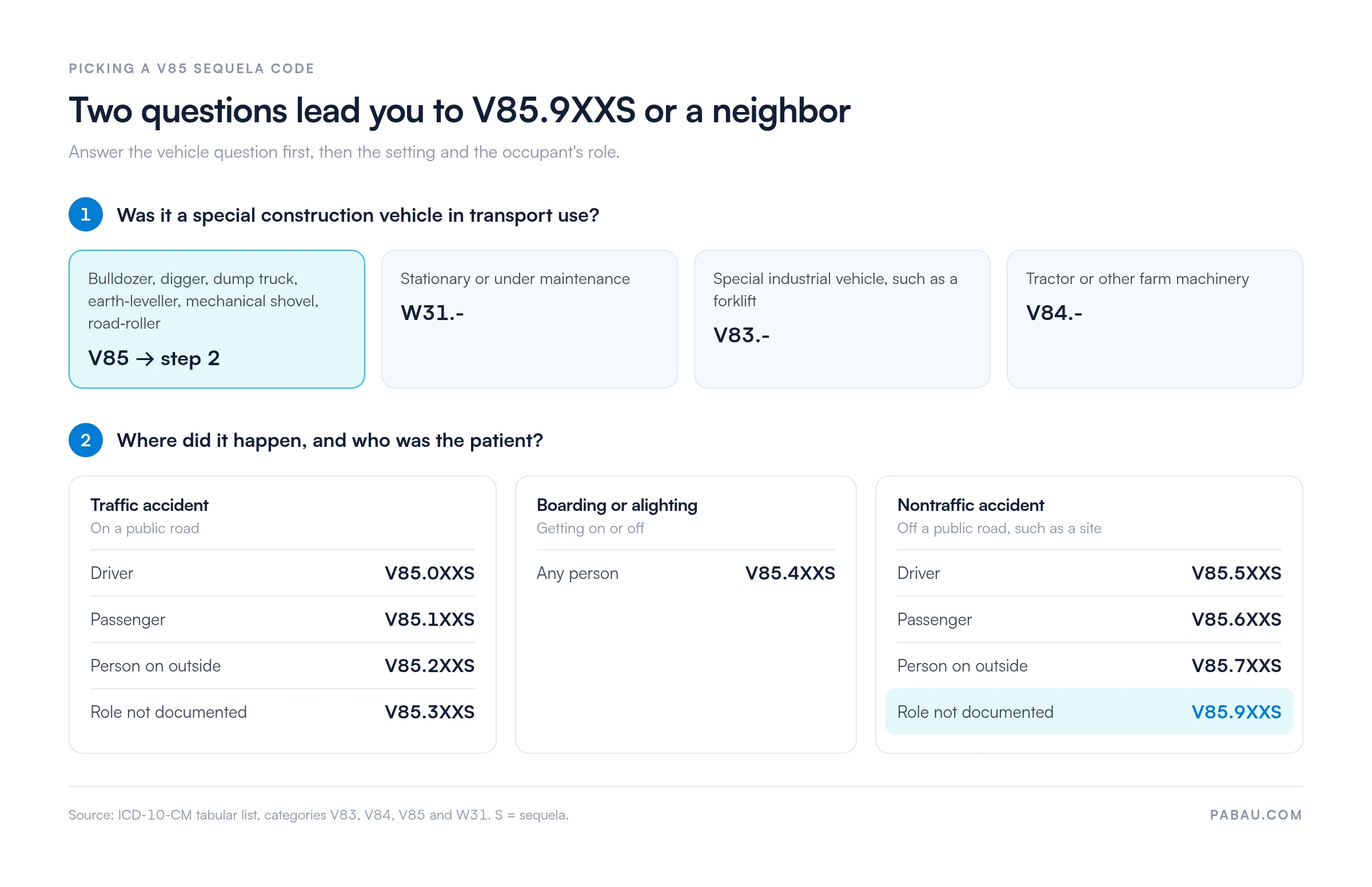
ICD-10-CM Official Guideline I.C.20.a says external cause codes are never the principal or first-listed diagnosis. V85.9XXS explains why the injury happened, so another code has to name the condition. Our overview of medical billing fundamentals shows how a coded visit becomes a claim.
Here’s how a typical sequela claim reads, line by line:
Place of occurrence (Y92) and activity (Y93) codes work differently. The guidelines assign them only once, at the initial encounter for treatment. So they don’t normally belong on a sequela claim.
Before you submit, confirm the code is still valid in the AAPC ICD-10-CM lookup or the CDC/NCHS tabular list.
Payers and auditors deny V85.9XXS claims most often when the note doesn’t link the current condition to the original accident. Meeting medical billing compliance standards here takes four elements in the record:
Workers’ compensation carriers often add their own requirements, and these vary by state and carrier. Check each payer’s edit policy before submission rather than assuming one standard covers them all.
Flag sequela claims for a documentation check before submission. Look for wording like ‘late effect of prior injury’ or ‘sequela of [accident date]’ before you assign the S character. A missing causal statement is the easiest denial to prevent at the coding stage.
V85.9XXS falls in the V85 category, which is on the CMS POA-exempt list for inpatient claims. Leave the POA field blank for exempt codes, per CMS guidance.
There’s no national requirement to report external cause codes. State reporting rules and individual payers can still ask for them, though. Here’s what to expect from the main payer types:
V85.9XXS denials follow predictable patterns. Here are the five most common, with the corrective action for each.
A structured denial management workflow catches most of these before submission. The denial codes on your remittances show which pattern drives the most volume at your practice.
When a claim does deny, electronic remittance advice speeds up the review. Claim adjustment reason codes (CARCs) and remark codes (RARCs) arrive with the payment, so corrected claims go out sooner.
Run a monthly denial report filtered by the V85 prefix. If sequela-related denials keep recurring, audit whether providers use ‘sequela of prior injury’ wording consistently. A documentation template for construction accident follow-ups fixes most root causes within one billing cycle.
A clean claim goes through without the payer asking for more. For V85.9XXS, that means ticking off five points:
If the fourth point fails, you need a different V85 code, not a query. Go back to the chart above and follow the documented setting and role.
Sequela claims rarely fail on the code itself. They fail on a missing first-listed diagnosis, a dropped placeholder, or a note without a causal statement. Those slips multiply when someone rebuilds the claim by hand from a chart in another system.
Pabau, the practice management platform we build, keeps the visit note, invoice, and claim on one patient record. Its claims management software runs background checks for missing required details before a claim is sent. Real-time eligibility checks (270/271) confirm coverage before the visit.
Pabau sends claims to thousands of US payers through Claim.MD. ERA/835 remittances come back into the same system, and denied claims are flagged for rework. So your billing team corrects and resubmits from one queue instead of chasing paper.

Pabau checks claims for missing details before they’re sent and verifies eligibility in real time. Denied claims are flagged for rework across thousands of US payers.

Most V85.9XXS problems are settled before anyone opens the claim form. If the note says the injury has healed and ties today’s condition to the site accident, the coding follows naturally.
The trade-off worth remembering is specificity. V85.9XXS is right only when the record doesn’t say who was driving. If a quick provider query can answer that, the more specific code is worth the short wait.
Want sequela claims checked for missing details before they reach the payer? Book a demo to see how Pabau takes a claim from the visit note to the remittance.

Need help managing claim denials across code types? Denial management in healthcare covers systematic workflows for tracking, routing, and resolving payer rejections.
Want to understand how clearinghouses process ICD-10 claims? Claim.MD clearinghouse guide explains how electronic claims are validated, edited, and transmitted to payers.
Looking for revenue cycle context for external cause codes? Revenue cycle management fundamentals provides the end-to-end workflow from encounter to payment posting.
No. Forklifts are special industrial vehicles, coded to category V83. V85 is reserved for special construction vehicles such as bulldozers, diggers, dump trucks, and road-rollers.
There’s no national requirement for mandatory ICD-10-CM external cause reporting. Report V85.9XXS when a state mandate or payer policy asks for it. It’s also useful whenever it helps a payer decide who covers treatment.
V85 codes cover a construction vehicle in transport use. If the machine was stationary or under maintenance, the W31 family applies instead. W31.83XS is the sequela code for contact with a special construction vehicle.
Not directly. Payment rests on the sequela condition code and the service billed. V85.9XXS adds context that helps workers’ compensation and liability payers decide who pays.
There’s no time limit. If the provider links the current condition to the construction vehicle accident, the S character applies, even 20 years later.



