ICD-10 code T87.52: Necrosis of amputation stump, left upper extremity
ICD-10 code T87.52 at a glance: Left arm, not left leg ICD-10 code T87.52 is the...

Last Updated: Oct 26, 2026
Billable Code Specific Code
V55.0XXD is the billable ICD-10-CM code for a pick-up truck or van driver injured in a collision with a train or railway vehicle. The crash happened off the public road, and the visit is a subsequent encounter.
It is an external cause code from Chapter 20, so it is always reported after the injury code. Use it for routine follow-up once active treatment has ended. If the record doesn't place the crash off the public road, ICD-10-CM presumes a traffic accident and V55.5XXD applies instead.
Let Pabau's smart automation suggest the right codes, reduce claim denials, and keep your practice compliant—effortlessly.
Automate repetitive tasks and focus on what matters most—your patients.
Reduce coding errors and ensure compliance with the latest regulations.
Clean claims, fewer denials, and faster reimbursements.
Powerful insights and reporting to help your practice thrive.
HIPAA compliant SOC 2 certified GDPR-compliant Trusted by 4,000+ clinics worldwide

V55.0XXD codes a pick-up truck or van driver hurt in a collision with a train, off the public road, at a follow-up visit.
It is always a secondary code, listed after the injury code that explains why the patient is being seen.
Nontraffic means the crash happened entirely off a public highway. If the record names no place, ICD-10-CM presumes a traffic accident and V55.5XXD applies.
The 7th character D marks routine care after active treatment ends, and it should follow the injury code’s phase of care.
Place, activity and status codes (Y92, Y93, Y99) belong on the initial encounter only, so they don’t repeat on the follow-up claim.
ICD-10 code V55.0XXD identifies a pick-up truck or van driver injured in a collision with a railway train or railway vehicle. The crash happened away from the public road, and the visit is a subsequent encounter.
The code sits in Chapter 20, External causes of morbidity (V00-Y99). Codes in this chapter record how an injury happened, while the injury itself is coded from another chapter. So V55.0XXD always follows an injury code, such as a fracture or a concussion.
Picture a private crossing on a farm. A pick-up stalls on the rails, and a freight train clips it. Weeks later, the driver comes back for a fracture check. That follow-up visit is where V55.0XXD belongs.
Each of the seven characters answers a different question about the crash. Walk through them in order, and the code almost checks itself.
Both placeholders are mandatory. V55.0D is not a valid code, so claim scrubbers stop it before a payer ever sees it.
The 4th character carries two facts at once. It says who the patient was, and it says where the crash happened.
ICD-10-CM defines a nontraffic accident as one that occurs entirely in any place other than a public highway. A traffic accident happens on the public highway, including a crash with a vehicle partly on it.
Here is the catch. The classification assumes a vehicle accident happened on the public highway unless another place is specified. A note that says only “van hit by train” therefore codes to V55.5XXD, the traffic version.
Use this checklist before you settle on V55.0XXD. Every point should be visible in the record.
Change one fact and the code moves. A streetcar or tram collision goes to V56. A heavy goods vehicle moves to V65, and a car to V45. Construction plant such as a bulldozer sits in V85, outside this block entirely. Before you switch, check the new category in our ICD-10-CM guides for coders.
Inside V55 itself, the grid below maps the two deciding facts, driver and place, to the right follow-up code.
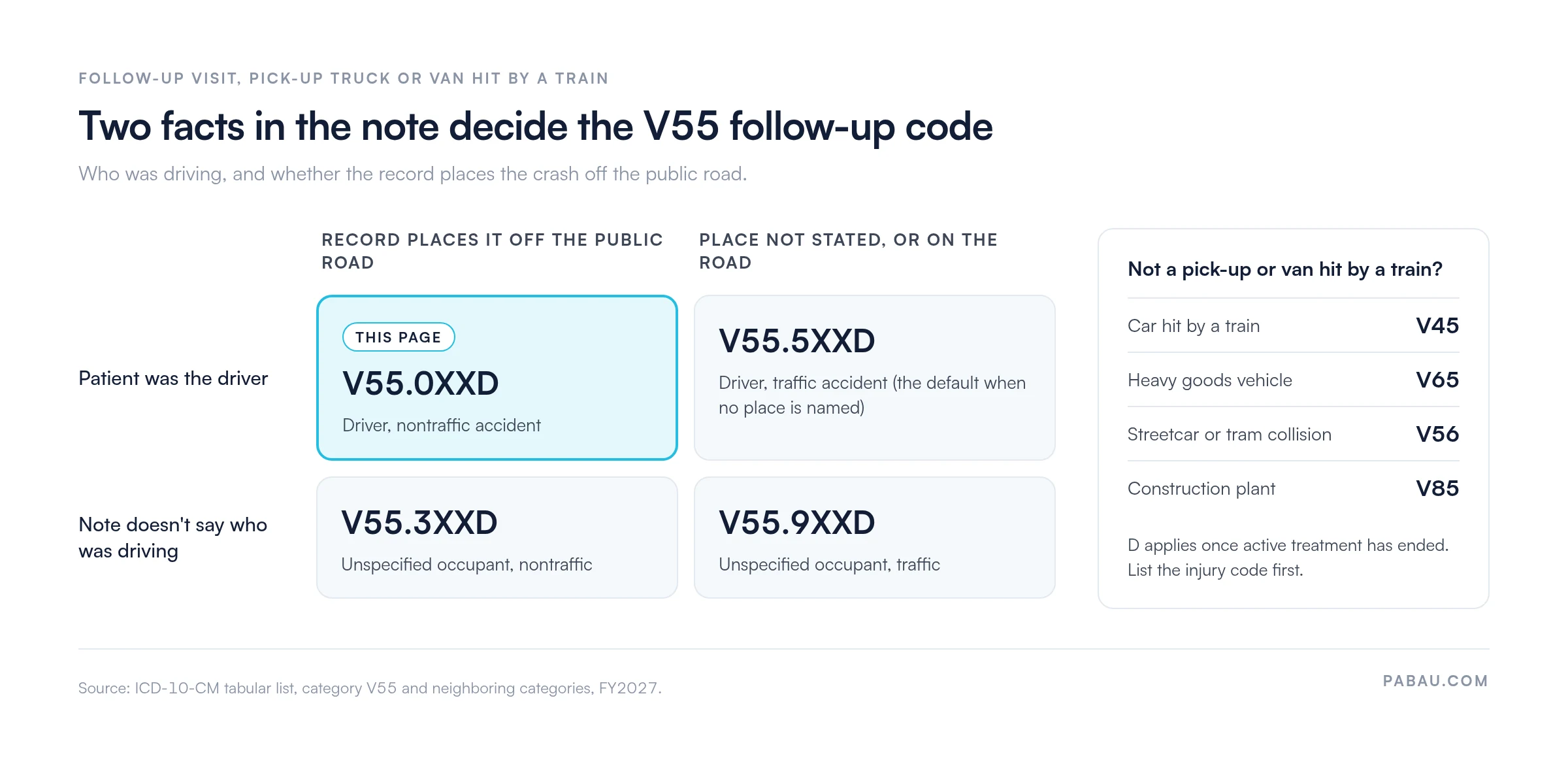
When a note only says the van was struck by a train, ask the provider where it happened. One line in the history, such as “private siding at the depot”, supports V55.0XXD instead of V55.5XXD.
Category V55 splits by the patient’s position and by traffic status. Codes V55.0 to V55.4 cover nontraffic accidents and boarding, while V55.5 to V55.9 cover traffic accidents.
There is no V55.8 in the ICD-10-CM tabular list. If the record doesn’t say who was driving, V55.3 or V55.9 is the defensible choice. Coding the driver without that detail claims more than the note supports.
The 7th character describes the phase of care. A second visit can still take A if active treatment continues, so the visit count doesn’t decide it.
The official guidelines say the external cause 7th character should match the injury code’s encounter phase. Fracture codes add their own values, such as G for delayed healing and K for nonunion. At those visits, the external cause code still takes D.
A courier drives a cargo van across an ungated crossing inside a rail freight yard. A shunting locomotive strikes the passenger side. The emergency department treats a right tibial shaft fracture and several right rib fractures.
Six weeks later, he sees an orthopedic practice for a routine fracture check. Both fractures are healing as expected. The claim for that visit lists the codes in this order.
Notice what is missing. The emergency claim carried Y92.85 (railroad track) and Y99.0 (civilian activity done for income or pay). Guidelines assign place, activity and status codes once, at the initial encounter. So they stay off this follow-up claim.
The same rule applies to the transport section’s “use additional code” notes. Codes for an airbag injury (W22.1-) or phone use (Y93.C-) are captured where they apply, not repeated by default.
A train striking a van delivers heavy force, so injuries rarely come alone. Code each injury still being treated at the visit, then add V55.0XXD once.
Strong medical billing habits capture the full injury picture. Coding only the most serious injury undersells the visit and can weaken medical necessity.
Most problems with this code come from six avoidable slips. Each one has a simple fix.
Track these by code family rather than claim by claim. Good denial management turns a repeated V55 rejection into one fix at the source.
A quick review before the claim leaves catches nearly every error above. Work down the list in order.
Pass all five and the claim is ready to go as a clean claim.
Does the note need to name the vehicle? Yes. “Pick-up”, “van”, “minivan” or “SUV” all fit this block. A plain “truck” fits too, unless the record shows a heavy goods vehicle, which moves to V65.
Who should document the location? The provider, ideally in the history of present illness. An accident report helps you ask the right question, but the code rests on the provider’s note.
Does workers’ compensation change the code? No. V55.0XXD stays the same whoever pays. Work status is captured once with Y99.0 at the initial encounter, and the payer may ask for its own forms.
How long should source records be kept? Follow your state’s retention rules and your payer contracts. Keeping the accident details with the chart supports billing compliance if the claim is audited.
Most of the work on a V55.0XXD claim happens in the note. The rest is getting the claim out cleanly and spotting it quickly when it comes back.
Pabau, the practice management platform we build, ties each claim to the visit that produced it. Its claims management software pre-fills the CMS-1500 from the invoice and validates required details before the claim is sent.
For US practices, claims go out through the Claim.MD clearinghouse integration. Eligibility checks, claim-status tracking and ERA posting stay in the same system. Pabau doesn’t choose codes for you, but a rejected claim appears next to its encounter, so your team corrects it fast.

Pabau sends claims through the Claim.MD clearinghouse and tracks them through to remittance. Rejections show up beside the visit, so follow-up claims get corrected quickly.

V55.0XXD rewards one habit: read the location before you read the vehicle. Driver, van and train are usually clear in the note. “Off the public road” is the detail that often goes unrecorded, and ICD-10-CM fills that silence with traffic.
So treat a missing location as a query, never a guess. Put the injury code first, keep D in step with the injury’s phase, and leave Y92, Y93 and Y99 on the first claim.
Clean follow-up claims also depend on what happens after you press send. Book a demo to see how Pabau tracks injury claims from submission to remittance.

Need to understand how claim denials are tracked and resolved? Denial management in healthcare covers the workflow for identifying, appealing and preventing recurring denials.
Want a primer on how clearinghouse submission works? Our Claim.MD clearinghouse guide explains the electronic claim pathway from practice to payer.
Looking for guidance on compliant claim documentation? Medical billing compliance requirements outlines the documentation standards that keep injury claims audit-ready.
Use category V45, car occupant injured in collision with railway train or railway vehicle. V45.0- covers the driver in a nontraffic accident, and V45.5- covers the driver in traffic. Pick-up trucks, vans, minivans and SUVs stay in V55.
No. There is no national requirement to report ICD-10-CM external cause codes. They become mandatory only under a state reporting mandate or a payer’s own rule. The official guidelines still encourage voluntary reporting because the data supports injury research.
Use category V81, occupant of railway train or railway vehicle injured in transport accident. V55 applies only to people in or on the pick-up truck or van, or boarding or alighting it.
No. ICD-10-CM treats a streetcar, including a tram, as its own vehicle type. A pick-up or van colliding with one codes to V56. Subway and elevated trains do count as railway vehicles, so they stay in V55.