



ICD-10 Code S42.444P: Medial epicondyle fracture, right humerus
ICD-10 Code S42.444P: full descriptor and code validity ICD-10 Code S42.444P car...

Last Updated: Oct 13, 2026
ICD-10 Code K37 is the billable ICD-10-CM diagnosis code for unspecified appendicitis, valid for claims through fiscal year 2026.
oders assign it when the record names appendicitis but does not say whether it is acute, chronic, recurrent, or complicated.
FY2026 runs from October 1, 2025 through September 30, 2026. The sections below cover the code’s billable status, the K35-K38 sibling codes, the documentation that rules K37 in or out, and its MS-DRG grouping.

K37 is a billable ICD-10-CM code for appendicitis when the record does not specify acute, chronic, or complication status.
A documented acute episode moves the claim to a K35 subcode, and a stated chronic or recurrent episode moves it to K36.
Missing complication documentation is the most common reason K37 is assigned where a K35 subcode was available.
K37 as a principal diagnosis with an appendectomy groups to MS-DRGs 397 through 399 under the FY2026 grouper.
Pabau’s claims management software flags unspecified diagnosis codes before submission, so coding staff can revisit the record first.
ICD-10 Code K37 designates unspecified appendicitis, a billable and specific code in the ICD-10-CM digestive system chapter (K00-K95). It took effect on October 1, 2025 under the FY2026 edition and is valid for claims through September 30, 2026. The code sits in the K35-K38 category, which covers diseases of the appendix.
The CDC/NCHS ICD-10-CM web tool is the authoritative source for confirming K37’s billable status each fiscal year. ICD-10-CM codes are revalidated annually rather than formally added. A coder who last checked K37 in FY2024 should confirm it against the FY2026 release before submitting claims.
The ICD-10-CM code range K35-K38 covers all appendix-related diagnoses, and K37 sits at the least specific end of it. Payers expect the highest specificity the record supports, so assigning K37 where a K35 subcode fits can trigger a medical necessity review.
The CMS ICD-10 codes page publishes the official tabular list and alphabetical index each fiscal year. Cross-referencing both is the fastest way to confirm which K35 subcode an operative note or pathology report supports. Our wider ICD-10-CM codes reference covers neighboring categories in the same format, for codes outside the K35-K38 range.
The ICD-10-CM alphabetical index includes several terms that map to K37. Coders searching for any of these clinical expressions should arrive at unspecified appendicitis when no further detail is documented.
“NOS” is the term to recognize here. When a physician writes “appendicitis” without qualifying it as acute, chronic, recurrent, or complicated, the ICD-10-CM index directs the coder to K37.
K37 is correct when the medical record contains no language supporting a more specific code. The ICD-10-CM Official Guidelines for Coding and Reporting require codes at the highest level of specificity the documentation supports. Reach for K37 only after reviewing the full record. It has to show no acute qualifier, no peritonitis, no abscess, and no statement of chronic or recurrent status.
One common scenario makes K37 legitimately correct. The emergency department record says “appendicitis” with no further characterization, the patient is transferred, and no operative or pathology report has arrived. If the operative report later documents acute inflammation, the coder should ask whether an amended claim is warranted. The AAPC Codify ICD-10-CM lookup carries the full code hierarchy and coding notes for these distinctions.
Those distinctions read as a sequence of questions about the record, and the order they are asked in decides the code.
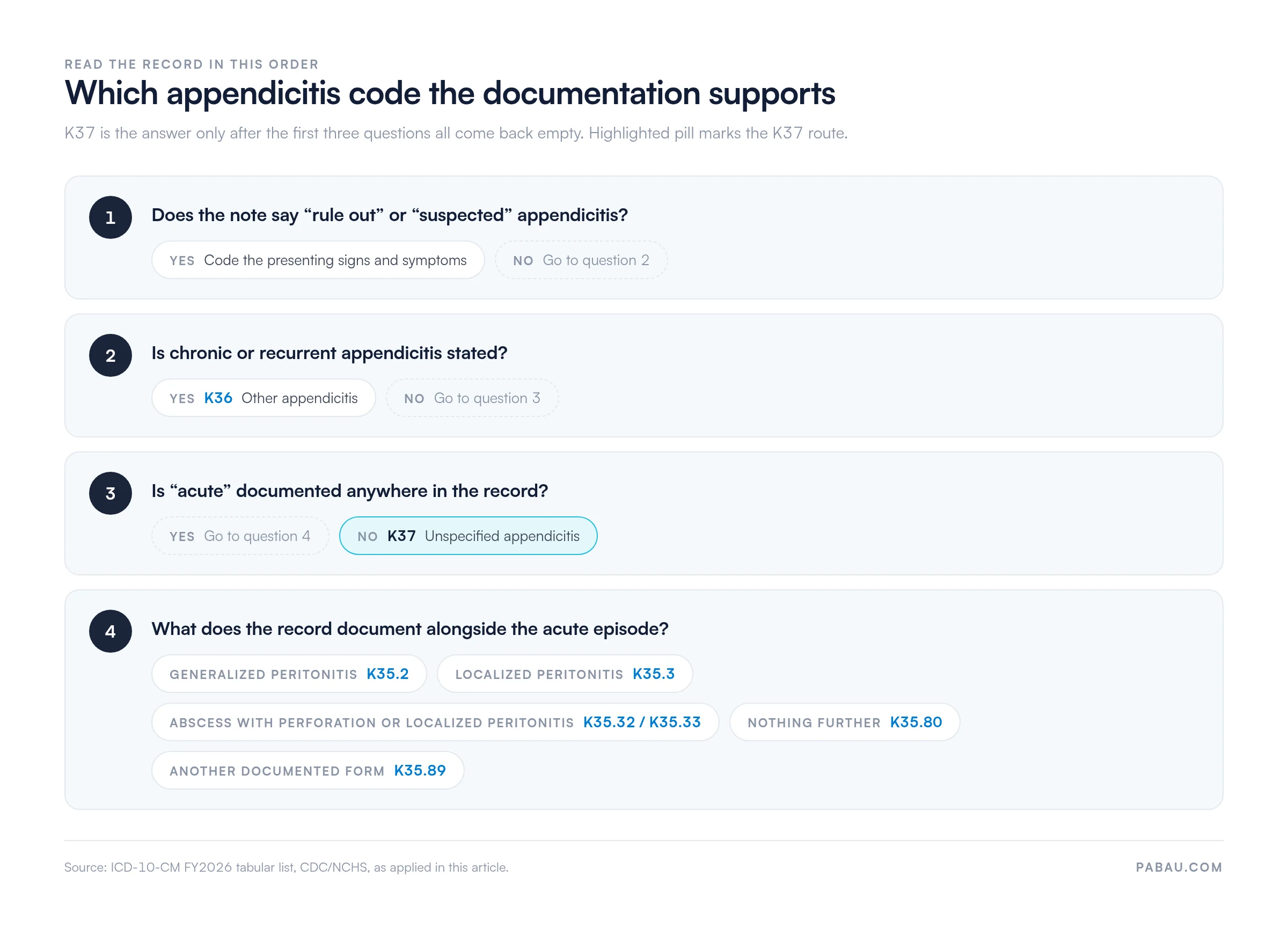
Accurate K37 assignment depends on what is absent from the record as much as on what is present. Before assigning the code, confirm that all of the following are missing from the inpatient and outpatient documentation.
When documentation is ambiguous, the ICD-10-CM Official Guidelines support querying the treating physician. A query is preferable to defaulting to an unspecified code when the clinical context suggests a more specific diagnosis.
For outpatient encounters, coders should not code a condition to a higher level of certainty than the physician documented. If the record says “rule out appendicitis,” K37 is wrong, and the presenting signs and symptoms are coded instead.
MS-DRG assignment for K37 depends on whether a procedure was performed and on the patient’s complications and comorbidities. The appendectomy DRGs 338 through 343 were deleted effective FY2024. Under the FY2026 grouper (MS-DRG v43.0), an inpatient stay with K37 as principal diagnosis and an appendix procedure groups to MS-DRGs 397 through 399.
Without a qualifying appendix procedure, the stay groups to a medical digestive-system DRG instead of one of these three. Check the active assignment against the CMS MS-DRG definitions manual before finalizing an inpatient claim, since relative weights change each fiscal year.
The appendix is a small, finger-shaped pouch attached to the large intestine in the lower right abdomen. Appendicitis occurs when the appendix becomes inflamed, typically due to a blockage. Classic signs include right lower quadrant pain that migrates from the umbilicus, nausea, vomiting, and low-grade fever.
“Unspecified” status arises in several ways. A patient may present with symptoms consistent with appendicitis and be discharged before the workup finishes. An outpatient may be diagnosed on clinical assessment alone, with no imaging or operative confirmation.
In retrospective coding, the documentation on hand may never characterize the inflammation beyond the word “appendicitis.” Documentation is usually captured at a different point in the care pathway than coding. That timing explains most missing detail, rather than any shortfall in the standard of care.
Four error patterns account for most K37 corrections that turn up in payer audits and denial-management reviews of appendicitis claims.
Systematic denial management workflows catch these patterns before claims are submitted. Practices that track K37 denial rates by provider can see which physicians consistently underdocument appendicitis type, which turns claim corrections into targeted physician education.
Run a monthly report filtering all appendicitis claims by ICD-10-CM code. Compare the ratio of K37 claims to K35 claims against your own prior quarters. A rising K37 share is a cue for a chart audit. Most appendicitis cases that reach surgery carry enough documentation for a specific K35 subcode.
Practice management platforms with ICD-10-CM support reduce K37 over-use by surfacing specificity alerts at the point of code selection. Pabau is practice management software, and its claims management software sits in the same billing workflow. An unspecified diagnosis code can be flagged there before the claim leaves the practice. Coding staff re-read the record instead of finding the error in a denial.
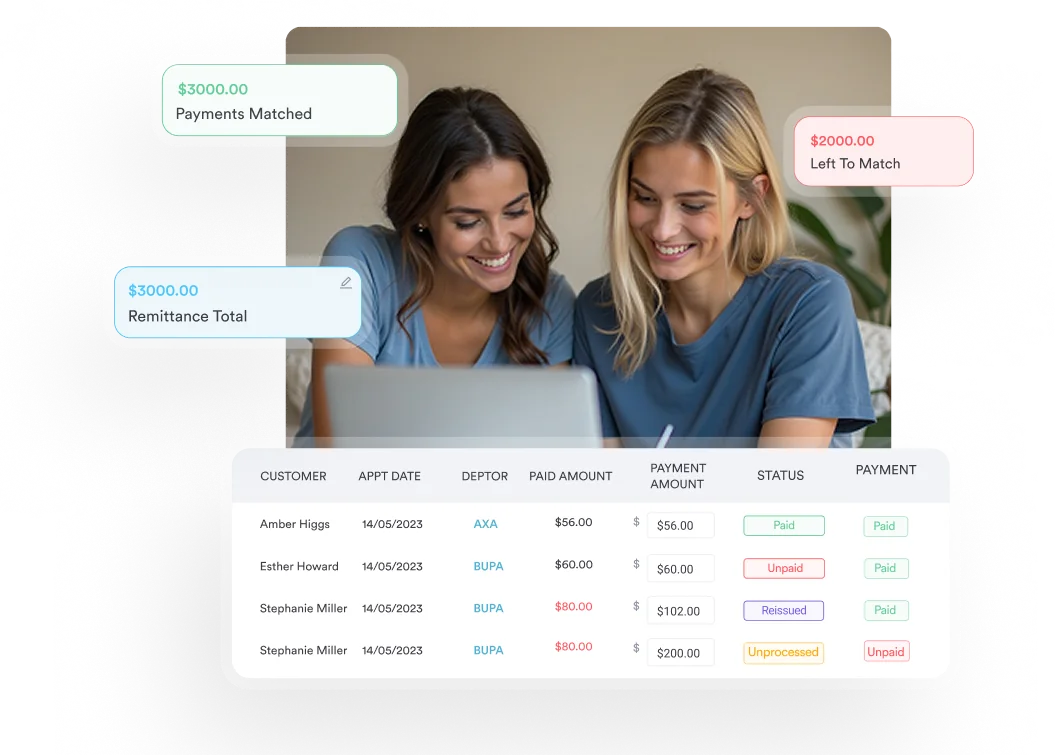
Clean appendicitis claims depend on matching the ICD-10-CM code to every available document, including operative reports, pathology reports, and imaging reads. Pabau routes claims through Claim.MD, its US clearinghouse partner, which performs real-time eligibility verification and claim validation before submission to thousands of US payers.
That validation layer is where unspecified-code flags catch a K37 the documentation does not support. Tight revenue cycle work for surgical practices depends on the loop between documentation and code selection staying short. When billing staff and clinicians work in one platform, fewer unspecified-code denials reach the payer.
A clean appendicitis claim carries the specific code level the record supports, the matching CPT procedure code, and any comorbidity codes that affect DRG weighting. The ICD List code lookup tool provides DRG grouper data that billers can cross-reference before submitting an inpatient K37 claim.

Pabau’s claims management software flags unspecified ICD-10-CM codes at submission and routes claims through Claim.MD for real-time validation across thousands of US payers. See how it fits your surgical billing workflow.

K37 is the right code when the record genuinely offers no further detail, and it is over-used in practice. Most post-surgical appendicitis claims carry enough in the operative report or pathology note to support a K35 subcode. Assigning K37 by default leaves the practice exposed to medical necessity denials and compliance risk.
Build the habit of reading the operative and pathology reports before choosing the code. Pabau’s claims management software surfaces unspecified-code alerts before submission and routes claims through Claim.MD’s validation layer. Book a demo to see how the full appendicitis billing workflow runs in one platform.

Need to understand the full US clearinghouse process? Medical claims clearinghouse explained covers how payer routing and claim validation work from submission to ERA.
Managing denials after an appendicitis claim rejection? Denial codes in medical billing explains the most common CARC denial reasons and how to respond to each one.
Want to verify K37 eligibility before the patient visit? Insurance eligibility verification outlines how real-time eligibility checks reduce coverage-related claim rejections.
Checking whether an appendicitis claim will pass first time? What a clean claim is sets out the fields a payer checks before it accepts a submission.
Building the coding side of your compliance program? Medical billing compliance covers the audit trail payers expect behind a specific diagnosis code.
ICD-10 Code K37 is the billable ICD-10-CM diagnosis code for unspecified appendicitis. Use it when the documentation does not say whether the appendicitis is acute, chronic, recurrent, or complicated. It is valid for FY2026 claims from October 1, 2025 through September 30, 2026. The CDC/NCHS ICD-10-CM release is the official source.
Yes, K37 is a billable and specific ICD-10-CM code valid for reimbursement. It is a leaf-level code in the tabular list, with no further hierarchy beneath it. That satisfies payer requirements for a specific diagnosis code on the claim.
K37 covers appendicitis with no qualifying detail, while K35 and its subcodes require documentation of acute onset and, where applicable, peritonitis or abscess. Use K35.80 when the record says “acute appendicitis” with nothing further documented. Use K37 only when no qualifier appears anywhere in the record after a full review.
Use K37 only after confirming the complete medical record contains no acute qualifier. It must also carry no peritonitis or abscess documentation and no statement of chronic or recurrent status. Legitimate K37 scenarios include incomplete ED workups at the time of discharge coding, clinical-only diagnoses without imaging, and transfer cases where operative notes are unavailable.
No. When a physician explicitly documents “chronic appendicitis” or “recurrent appendicitis,” the correct code is K36 (Other appendicitis). K37 applies only when no type of appendicitis is specified at all. If the record says “chronic,” K36 is required regardless of whether K37 might seem like a simpler choice.
K37 is appropriate precisely when the documentation lacks specificity. The prerequisite is a full record review confirming no acute qualifier, no peritonitis or abscess, and no statement of chronic or recurrent appendicitis. For post-surgical cases, that review must include the operative report and pathology report before defaulting to K37.




