

CCSD code G5100: Bypass of duodenum billing guide
CCSD code G5100 bills a bypass that leaves the duodenum in place CCSD code G5100...

Last Updated: Oct 16, 2026
K0839 is the HCPCS Level II code for a power wheelchair, group 2 very heavy duty, single power option, sling/solid seat/back. Its patient weight capacity is 451 to 600 pounds.
Medicare is the primary payer for most power wheelchair claims, and CMS applies strict coverage, documentation, and prior authorization rules to this category.
Let Pabau's smart automation suggest the right codes, reduce claim denials, and keep your practice compliant—effortlessly.
Automate repetitive tasks and focus on what matters most—your patients.
Reduce coding errors and ensure compliance with the latest regulations.
Clean claims, fewer denials, and faster reimbursements.
Powerful insights and reporting to help your practice thrive.
HIPAA compliant SOC 2 certified GDPR-compliant Trusted by 4,000+ clinics worldwide

HCPCS code K0839 covers a group 2 very heavy duty power wheelchair, single power option, for a patient weight capacity of 451 to 600 pounds.
Medicare bills K0839 under the 13-month capped rental rule, after which ownership transfers to the beneficiary automatically.
K0839 sits on the CMS Required Prior Authorization List for power mobility devices, so an affirmed decision must be in hand before delivery.
The KX modifier is required on every K0839 claim to attest that documentation meets the applicable Local Coverage Determination criteria.
Pabau’s claims management software tracks DME claim status and denial patterns across payers in one place.
HCPCS code K0839 is the billing code for a power wheelchair, group 2 very heavy duty, single power option, sling or solid seat and back. Its patient weight capacity is 451 to 600 pounds. The code sits in the K0800-K0899 series. That series is part of the HCPCS Level II code set CMS maintains for durable medical equipment and supplies (DMEPOS).
The “group 2” designation signals a mid-tier power wheelchair with a powered seating system limited to one powered feature (the “single power option”). “Very heavy duty” is a specific weight band in this family, not a general description. The frame is rated for a patient weighing 451 to 600 lb. The sling or solid seat and back specification describes the upholstery type. That detail matters for claim accuracy, because a captain’s chair or a rehab-configured seating system carries a different code.
The official CMS long descriptor reads: Power wheelchair, group 2 very heavy duty, single power option, sling/solid seat/back, patient weight capacity 451 to 600 pounds. Every element of that descriptor has to match the device the supplier delivered.
The table below shows the key attributes coders and suppliers need when setting up HCPCS code K0839 in a billing system or verifying a claim.
Medicare covers a group 2 very heavy duty power wheelchair under the DMEPOS benefit when the beneficiary meets both clinical and weight-based eligibility criteria. Coverage is governed by the Power Mobility Devices Local Coverage Determination, LCD L33789. The DME Medicare Administrative Contractors (MACs) issue it, together with a related policy article. Suppliers should confirm the current effective version with their MAC before billing, because LCDs are revised periodically.
The patient must satisfy all of the following criteria:
Meeting all seven criteria does not guarantee approval. MAC medical directors apply clinical judgment when reviewing documentation, and marginal cases often result in additional development requests or denials. The weight band is the clearest bright line in the whole policy. A patient who weighs 450 lb or less falls into the heavy duty codes rather than K0839. A patient above 600 lb falls into the extra heavy duty codes.
Medicare reimburses power wheelchairs under a 13-month capped rental model, not as a purchase. The supplier bills a monthly rental amount for months 1 through 13. After the 13th continuous rental month, ownership transfers automatically to the beneficiary and no further rental payments are made.
Fee schedule amounts for HCPCS code K0839 vary by state. They also vary by whether the service location is rural, non-rural, or a former competitive bidding area. CMS publishes the DMEPOS fee schedule files quarterly. Pull the exact allowable for your state from those files rather than relying on published approximations. The area adjustments move the amount materially.
The table below shows the payment parameters that apply to K0839. Retrieve the current state-specific dollar amounts from the CMS DMEPOS fee schedule files before you quote a figure to a patient.
Suppliers must continue to hold the rental claim open and re-bill each month for the rental duration. A missed rental month may interrupt the capped rental period, which is one of the more costly mistakes in power wheelchair billing.
Incomplete documentation is the leading cause of K0839 claim denials. Medicare requires a specific set of records in the supplier’s file before the device is delivered, not at the point of billing. Assembling documentation after the fact during an audit is nearly impossible and almost always results in a recoupment demand.
Build the documentation checklist into order intake, before the wheelchair leaves the warehouse. The required records for a K0839 claim include:
One form you no longer need is the Certificate of Medical Necessity. CMS discontinued CMNs and DME Information Forms for dates of service from 1 January 2023. A claim submitted with one attached is rejected outright. The medical record and the standard written order carry that evidence now.
Capture every record above with its date, and a MAC audit becomes a retrieval task rather than a reconstruction.
Run a pre-delivery checklist for every K0839 order. Confirm the standard written order is signed and dated. Check the face-to-face note is on file and the patient weight sits inside the 451 to 600 lb band. Then check PDAC verification, the affirmed prior authorization, and the proof-of-delivery form. A single missing item leaves the claim indefensible if it is audited.
K0839 is one of the power mobility device codes on the CMS Required Prior Authorization List. It has been on that list nationwide since 1 September 2018. Prior authorization is a condition of payment for these codes, so an affirmed decision has to be in hand before the supplier delivers the chair. Traditional Medicare and Medicare Advantage run that process differently, and confusing the two is a common billing error.
Under the CMS Prior Authorization Program for DMEPOS, the supplier submits the request to the DME MAC. The MAC returns an affirmed or non-affirmed decision before delivery. CMS updates the list of codes subject to mandatory prior authorization periodically, so check the current CMS prior authorization required list before ordering.
An incomplete prior authorization request is nearly as harmful as no request at all. The review clock restarts on resubmission, and the chair still cannot be delivered in the meantime.
Billing K0839 correctly requires the right code, the right modifiers, and a complete claim form. The steps below reflect standard Medicare DMEPOS claim submission practice.
Modifier selection is where most K0839 billing errors occur. The KX modifier is non-negotiable for Medicare claims; omitting it results in an automatic denial. The table below covers the modifiers most frequently used with HCPCS code K0839.
The KX modifier carries a compliance obligation: by appending it, the supplier attests that the required documentation exists. Billing KX without that documentation in place is a false attestation. It invites a denial on review, and the denial codes a MAC returns point straight back at the missing record. Only append KX when the full documentation set is in the file.
Audit your K0839 claims monthly: pull every open rental claim and verify the billing month matches the rental month sequence. A skipped month in the rental chain can disrupt the 13-month capped rental clock. That extends your billing obligation and creates an overpayment risk on months already collected.
The group 2 single power option and multiple power option family spans codes K0835 through K0843. Selecting the wrong code because of a patient weight error or a miscounted power option is one of the most common DME billing mistakes. Claims software for suppliers keeps the submitted code beside the order it came from, so a mismatch is visible before the claim goes out.
The weight bands in this family do not overlap, which makes the documented weight the fastest way into the right code. The matrix below shows which code each band leaves you with.
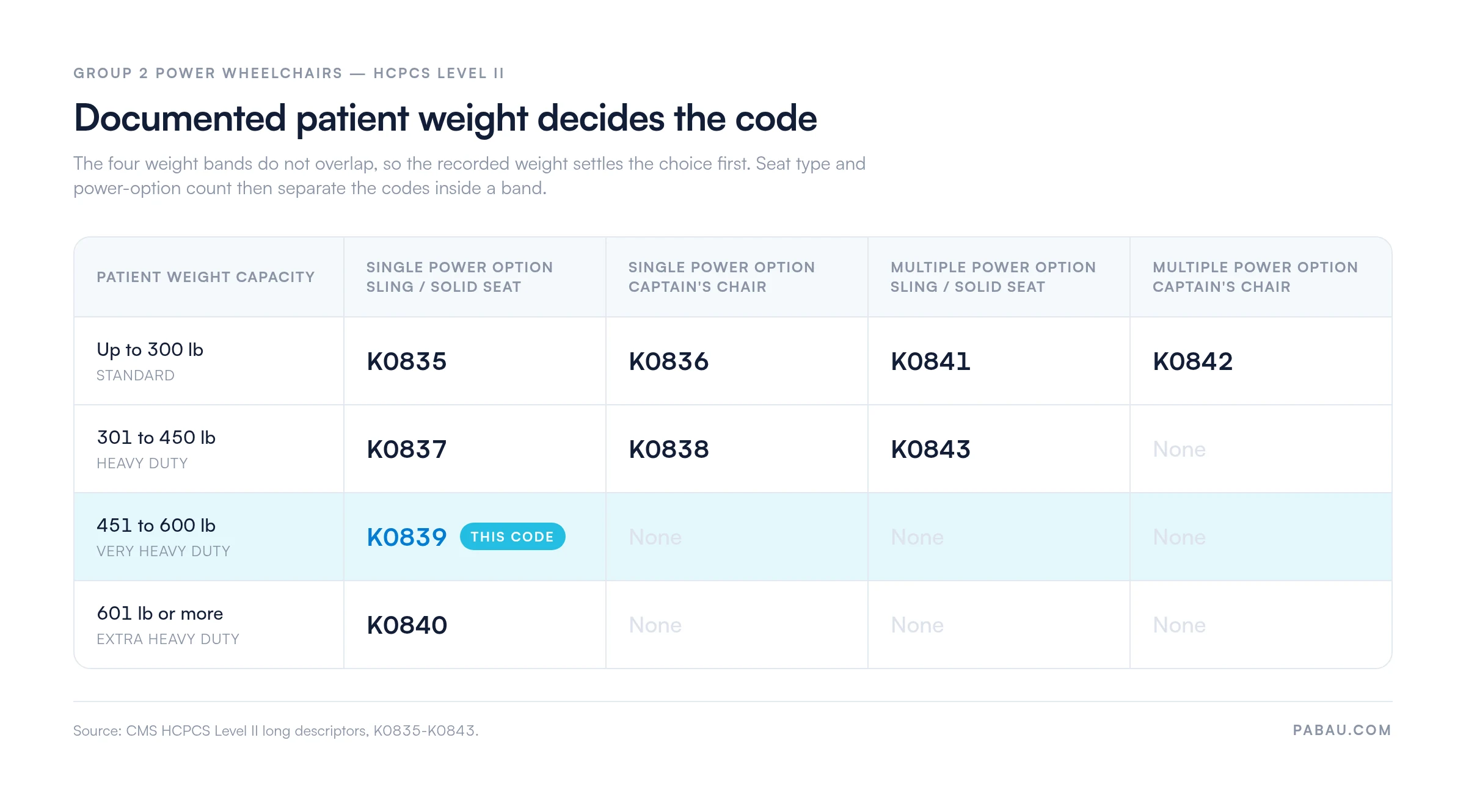
The table below compares K0835 through K0843, the codes most commonly confused with K0839 in practice.
Work the decision in one order. Check the documented patient weight first, then the seat type, then count the power options. Up to 300 lb points to K0835, K0836, K0841, or K0842. The 301 to 450 lb band points to K0837, K0838, or K0843. A weight of 451 to 600 lb points to K0839, and 601 lb or more points to K0840.
Within each band, the seat type separates the sling or solid seat and back codes from the captain’s chair codes. The power option count then separates the single option codes from the multiple option codes. K0839 is the only group 2 code for the 451 to 600 lb band. A correctly documented weight in that range resolves the choice on its own. Confirm the match through PDAC product verification before you order.
Most DME suppliers run the 13-month rental clock off a spreadsheet. The delivery date lives in one system, the prior authorization decision in another, and the monthly claims in a third. A skipped rental month then surfaces weeks later, on a remittance advice.
Pabau, practice management software for healthcare practices, holds the whole order against one patient record. The standard written order, the face-to-face note, the proof of delivery, and each month’s claim status sit in the same file. A coder checking month 7 can see what was billed in month 6 without leaving the record.
The payoff shows up when a MAC requests records. Instead of rebuilding the file from email threads and a shared drive, the supplier answers from one patient record. The rental history is already in date order.

Pabau’s claims management tools help DME suppliers follow K0839 rentals month by month. They keep the supporting documentation with the patient record and show claim status across payers from one dashboard.

HCPCS code K0839 is a narrow, specific code: group 2 very heavy duty power wheelchair, single power option, patient weight capacity 451 to 600 pounds. Every element of that description must match the device delivered and the documentation in the supplier’s file, or the claim will not survive review.
Four billing mechanics trip up most suppliers new to this code. The 13-month capped rental rule, mandatory prior authorization, the KX modifier, and pre-delivery documentation all have to be handled before the chair moves. Suppliers who get the pre-delivery file right rarely end up arguing with a MAC afterwards.
To see how Pabau tracks DME rentals and claim status inside one patient record, book a demo.

Need to understand how claim denials work across DME codes? Denial management in healthcare covers the end-to-end process for identifying, appealing, and preventing common denial patterns.
Want a cleaner claims submission workflow? Submitting a clean claim explains every field-level requirement that prevents automatic rejections on first pass.
Looking for broader billing compliance guidance? Medical billing fundamentals walks through the full revenue cycle from charge capture to payment posting.
HCPCS code K0839 covers a power wheelchair, group 2 very heavy duty, with a single power option and a sling or solid seat and back. Its patient weight capacity is 451 to 600 pounds. It is a HCPCS Level II durable medical equipment code billed to Medicare for patients who need a powered mobility device at home.
Medicare pays K0839 as a 13-month capped rental. The monthly allowable varies by state and by rural, non-rural, or former competitive bidding area status. Pull your specific rate from the quarterly CMS DMEPOS fee schedule files rather than a national average.
K0839 requires a patient weight capacity of 451 to 600 pounds. That band is written into the official CMS descriptor and is a hard eligibility criterion. A patient at 450 lb or below falls into the heavy duty codes K0837 or K0838. A patient above 600 lb falls into the extra heavy duty code K0840.
All three are group 2 single power option codes, and the patient weight band separates them. K0837 and K0838 cover 301 to 450 lb, while K0839 covers 451 to 600 lb. K0837 and K0839 have a sling or solid seat and back, and K0838 has a captain’s chair.
The group 2 multiple power option codes are K0841, K0842, and K0843, not K0836 or K0838. K0841 and K0842 cover a weight capacity up to and including 300 pounds, and K0843 covers 301 to 450 lb. There is no group 2 multiple power option code for the 451 to 600 lb band that K0839 serves.



