ICD-10 Code S53.013D: Anterior subluxation of unspecified radial head
ICD-10 Code S53.013D: Quick reference summary Use the table below as your first ...

Last Updated: Nov 6, 2026
Billable Code Specific Code
T32.73 is the billable ICD-10-CM code for corrosions involving 70-79% of body surface with 30-39% third degree corrosion. It is complete at five characters, with no 7th character to add.
The code turns on two numbers in the note. One is the share of the body with chemical injury of any degree. The other is the share of the whole body corroded to full thickness. T32.73 reports that extent, so it usually follows a T51-T65 toxic effect code for the chemical and T20-T25 codes for the corroded sites.
Let Pabau's smart automation suggest the right codes, reduce claim denials, and keep your practice compliant—effortlessly.
Automate repetitive tasks and focus on what matters most—your patients.
Reduce coding errors and ensure compliance with the latest regulations.
Clean claims, fewer denials, and faster reimbursements.
Powerful insights and reporting to help your practice thrive.
HIPAA compliant SOC 2 certified GDPR-compliant Trusted by 4,000+ clinics worldwide

T32.73 is a billable ICD-10-CM code for chemical corrosions covering 70-79% of body surface, with 30-39% of the body corroded to third degree.
It is a complete five-character code, and category T32 takes no 7th character, so T32.73A, T32.73D and T32.73S do not exist.
The note needs two explicit percentages, total corrosion extent and the third-degree share of the whole body, usually worked out with the Rule of Nines.
When sites are documented, the T51-T65 toxic effect code comes first, then the T20-T25 site codes, with T32.73 added to report extent.
A third-degree share of 28% belongs on T32.72 and 41% on T32.74, so check the fifth character against the note before you submit.
ICD-10 code T32.73 is a billable ICD-10-CM code for FY 2026. It reports corrosions involving 70-79% of body surface with 30-39% third degree corrosion, its official full descriptor.
The code sits in Chapter 19 (Injury, poisoning and certain other consequences of external causes, S00-T88). It is complete at five characters, so it goes on the claim exactly as written, with no 7th character added.
Verify billable status against the current fiscal year edition of the ICD-10-CM tabular list. According to the CMS ICD-10-CM codes page, the code set changes through an annual update cycle. A retired or revised code can affect prior-year claims differently from current ones.
The neighboring T32 codes, and the T20-T25 site codes that travel with them, sit in our ICD-10-CM code archive.
T32.73 packs two separate clinical measurements into five characters. That is what makes it precise, and it is also why the documentation behind it has to be exact.
The fifth character counts third-degree corrosion as a share of the whole body surface. A coder who reads it as a share of the corroded area alone will pick the wrong band.
Here is how that plays out. A patient has 74% of the body corroded, and half of that area is full thickness. Half of 74% is 37% of the whole body, so the fifth character is 3. Read the half as 50%, and the claim lands on T32.75 instead.
That is why the note has to state the third-degree figure as its own percentage of the whole body. Leaving it to be inferred from a severity description invites exactly this slip.
The code stops at the fifth character. Category T32 has no 7th-character extension, unlike most injury codes in Chapter 19, so T32.73A, T32.73D and T32.73S are not valid codes. The encounter character belongs on the companion codes instead. The T51-T65 toxic effect code and each T20-T25 site code take A, D or S.
The Rule of Nines is the standard clinical method for estimating total body surface area, and it produces the two percentages that support T32.73. It divides the adult body into regions worth about 9% of TBSA, or a multiple of 9%.
The Lund and Browder chart gives more precise estimates, particularly for children, whose head and leg proportions differ from an adult’s. Either method works for ICD-10-CM documentation, provided the result is stated as a percentage in the physician note.
For T32.73, the note must carry two separate figures. The first is the total extent of chemical injury across all regions, which must fall within 70-79%. The second is the share of the whole body corroded to full thickness, which must fall within 30-39%.
A note that says only “extensive chemical burns to trunk and extremities” cannot support this code. Auditors and payer medical reviewers look for both numbers in writing.
The T32.7 subcategory holds eight codes that differ only in the fifth character, the share of the whole body that is third degree. A wrong fifth character moves the claim into a different severity band, which is either undercoding or upcoding.
The T31 versus T32 distinction matters just as much. T31 covers burns by extent, where the source is thermal or radiation. T32 covers corrosions by extent, where the source is chemical.
Both categories use the same extent structure, but they cannot be swapped. A chemical splash injury codes to T32.73, not T31.73, however similar the presentation looks. The AAPC ICD-10-CM code lookup and the official tabular list both separate thermal burns from chemical corrosions at the category level.
Guideline I.C.19.d of the ICD-10-CM Official Guidelines covers burns and corrosions, and the tabular note on T32 sets where T32.73 sits. T32 is the primary code only when the site of the corrosion is unspecified.
When sites are documented, the codes around it follow the order shown below.
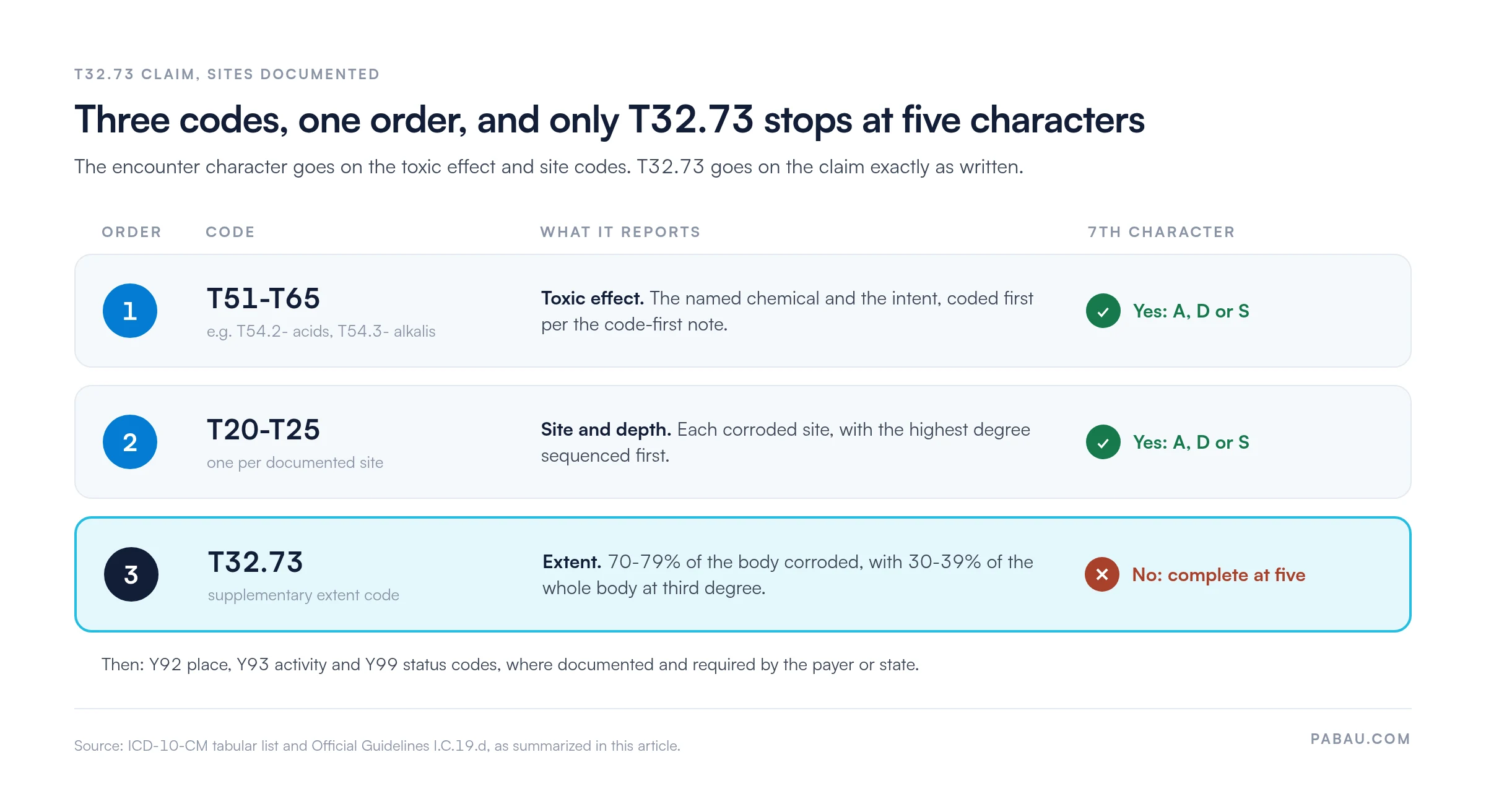
The toxic effect code already records intent, such as accidental or assault. No separate external cause code for intent is needed on top of it.
Document the specific chemical in the physician note, not just the category. “Hydrochloric acid splash” points the coder to T54.2- for corrosive acids. “Chemical exposure” leaves them guessing between acids, alkalis and other agents, which is the kind of note that prompts a query.
With the order settled, the claim itself is a short build. Doing it in the same sequence each time keeps the extent code supported.
Two errors undo an otherwise well-built T32.73 claim. The first is a wrong fifth character. A third-degree share of 28% belongs on T32.72, and a share of 41% belongs on T32.74.
The second is a note with no percentages at all. Without them, the coder has no basis for the fourth and fifth characters, and the chart goes back to the physician as a query.
Run through these points on every T32.73 claim before it leaves the practice. Each one supports submitting a clean claim on the first pass.
The ICD-9-CM predecessor to T32.73 is 948.73. It covered burns of any degree involving 70-79% of body surface with 30-39% third degree. ICD-9-CM grouped chemical burns with thermal ones, so the code never separated corrosions from burns.
A crosswalk cannot tell a chemical injury from a thermal one, because 948.73 never recorded the difference. Retrospective review for litigation, quality reporting or audit response has to go back to the original clinical note to confirm the cause.
The CDC/NCHS ICD-10-CM official lookup tool reflects this split. Code from the documented cause every time, and treat the crosswalk output as a starting point only.
Corrosion claims at this extent can draw payer medical review across Medicare, Medicaid and commercial plans. These are the errors to rule out before a claim goes out.
Tracking these reasons through a denial management workflow shows which ones recur, so physician education can target them.
Most of those denials trace back to the chart, so this section is for physicians and CDI specialists as much as coders. Each element below has to be recorded before the encounter closes. A CDI query cannot reconstruct a percentage that was never assessed.
Build a structured assessment into your corrosion encounter template, with one field for total TBSA and one for third-degree TBSA. A note that records both values at the point of care covers the documentation T32.73 and the rest of category T32 depend on.
A corrosion case at this extent produces a long code set, and the claim is often typed up away from the chart. Each retyped field is one more place for the third-degree figure or the agent code to slip.
Pabau, the practice management platform we build, keeps billing next to the patient record. Its claims management software supports insurance billing and submits claims through integrated clearinghouses, such as Claim.MD in the US.

Pabau’s custom medical forms can hold separate fields for total body surface and third-degree surface. Both figures are captured at the visit, so the coder works from a note that already carries the numbers T32.73 depends on.

Pabau supports insurance billing and submits claims through integrated clearinghouses such as Claim.MD. T32.73 cases move from the visit record to the payer without a second system.

T32.73 is simpler on the claim than it is in the chart. The code goes on exactly as written, and the hard work is done before a coder ever opens the note.
So put the effort where the denials start. Capture the total and the full-thickness figures as two separate fields at the visit, and the fifth character follows from the numbers without a query.
The cost is a slightly longer assessment on every corrosion case, which is far cheaper than a claim that comes back. Book a demo to see how Pabau carries a corrosion case from the visit record to a submitted insurance claim.

Same third-degree share, one extent band lower? ICD-10 code T32.63 covers 60-69% of body surface with 30-39% third degree.
Same third-degree share, one extent band higher? ICD-10 code T32.83 covers 80-89% of body surface and the codes it needs alongside it.
Need a framework for managing claim denials on complex codes? Denial management in healthcare walks through the workflows that reduce rework on high-scrutiny claims.
Want to understand how clearinghouses validate your submissions? Medical claims clearinghouse explained covers how clearinghouses screen claims before payer adjudication.
New to the billing side of injury codes? Medical billing fundamentals explains how a coded encounter becomes a paid claim.
T32.73 reports chemical corrosions covering 70 to 79 percent of total body surface. Within that, 30 to 39 percent of the whole body is corroded to third degree. It sits in category T32 and is complete at five characters.
Yes. The fourth character counts body surface involved by corrosion of any degree, first degree included. Only the fifth character is limited to third-degree areas. A clinical TBSA used to plan fluid resuscitation may leave superficial areas out, so check which figure the note gives.
Query the physician for one stated figure. A range such as 70-80% straddles T32.7 and T32.8, so it supports neither fourth character. The same applies to the third-degree share, where 25-35% splits T32.72 from T32.73.
Only when the corroded sites are unspecified. Once the note documents sites, the T51-T65 toxic effect code and the T20-T25 site codes lead. T32.73 then follows as a supplementary code for extent.
ICD-9-CM 948.73 covered burns of any cause, chemical included, at 70-79% of body surface with 30-39% third degree. ICD-10-CM splits it into T31.73 for burns and T32.73 for corrosions. Confirm the cause in the original note before choosing.