ICD-10 Code V92.00XS: Drowning and submersion, merchant ship sequela
ICD-10 Code V92.00XS: Definition and official code description The ICD-10-CM Tab...

Last Updated: Nov 2, 2026
Billable Code Specific Code
T32.63 is the billable ICD-10-CM code for corrosions involving 60-69% of body surface with 30-39% third degree corrosion. It records how much of the body a chemical burn covers and how much of the body surface is full thickness.
T32.63 is complete at five characters and takes no 7th character, so it is reported as T32.63 on every claim. The chemical, the intent and the burn sites go on separate T51-T65 and T20-T25 codes, which carry the encounter character instead.
Let Pabau's smart automation suggest the right codes, reduce claim denials, and keep your practice compliant—effortlessly.
Automate repetitive tasks and focus on what matters most—your patients.
Reduce coding errors and ensure compliance with the latest regulations.
Clean claims, fewer denials, and faster reimbursements.
Powerful insights and reporting to help your practice thrive.
HIPAA compliant SOC 2 certified GDPR-compliant Trusted by 4,000+ clinics worldwide

ICD-10 code T32.63 covers chemical corrosions over 60-69% of body surface, with 30-39% of the body surface third degree.
T32.63 is billable and complete at five characters. It takes no 7th character, so T32.63XA, T32.63XD and T32.63XS are not valid codes.
Both axes, total TBSA and the third-degree share, must be documented by the provider before T32.63 can be assigned.
When sites are documented, the T51-T65 toxic effect code and the T20-T25 site codes lead, and T32.63 follows as a supplementary code.
Pabau, the billing and EHR software we build, keeps diagnosis codes, documentation and claim submission in one workflow for burn care practices.
ICD-10 Code T32.63 is a valid, billable ICD-10-CM diagnosis code for corrosions involving 60-69% of body surface with 30-39% third degree corrosion. It sits in Chapter 19 (Injury, poisoning and certain other consequences of external causes). Its category is T32, corrosions classified according to extent of body surface involved.
Report the code exactly as T32.63, on every encounter. Unlike the site-specific corrosion codes in T20-T25, T32 codes carry no placeholder X and no A, D or S extension. A string such as T32.63XA is not a valid ICD-10-CM code and fails code-validity edits. Verify the descriptor and any coding notes in the CDC/NCHS ICD-10-CM web tool.
T32.63 encodes two clinical measurements at once, which makes it precise and documentation-heavy. The fourth character (6) records the total body surface affected by corrosion of any depth: 60% to 69%. The fifth character (3) records how much of the body surface has third-degree corrosion: 30% to 39%.
A worked example: a patient with a sulfuric acid exposure has corrosion over 65% of the body surface. The provider documents full-thickness corrosion over 33% of the body surface. Both figures fall within range, so T32.63 is correct. At 25% third degree, the code becomes T32.62, because the documentation drives the code.
TBSA is estimated by the treating provider, and coders take the figure from the note. Two methods are standard in burn care: the Rule of Nines and the Lund-Browder chart. ICD-10-CM notes that T31 and T32 percentages follow the Rule of Nines, and providers may adjust them for infants and children.
For T32.63, the provider’s note must confirm a total corrosion TBSA between 60% and 69%. It must also show third-degree corrosion covering 30% to 39% of the body surface. A note that says only “approximately 60% burns” can’t support T32.63, so query the provider before you assign it.
T32.63 sits within the T32.6 subcategory, where the fourth character fixes total TBSA at 60-69% and the fifth character records the third-degree share. The neighbors differ by a single digit, so a misread depth figure lands the claim on the wrong code.
Corrosions in ICD-10-CM are injuries caused by chemical agents, not by heat, radiation, or electricity. The ICD-10-CM Official Guidelines for Coding and Reporting define corrosions as burns resulting from a chemical source. The T32 category applies when the causative agent is a chemical. A flame or scald burn at the same extent and depth codes to T31.63 instead.
ICD-10-CM Official Guidelines section I.C.19.d governs burn and corrosion coding. Four of its rules decide where T32.63 sits on a claim and which codes around it carry the encounter character. The chart after the list puts all four in claim order.
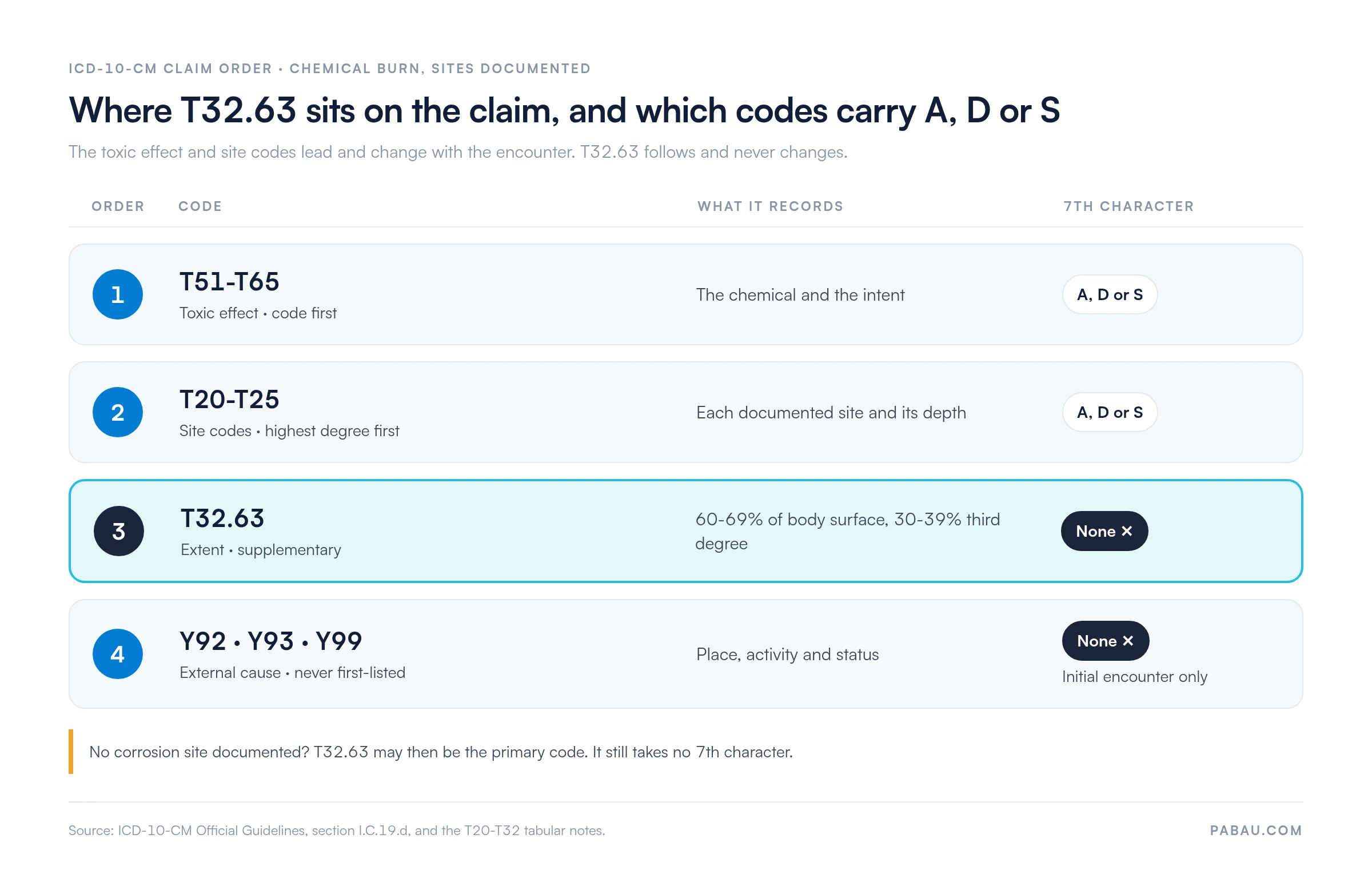
Categories T31 and T32 sit outside the 7th character rule that governs most of Chapter 19. The encounter type still matters, but it is recorded on the other codes in the claim.
Use A while the patient receives active treatment, D for routine care during healing, and S for sequela such as scarring or contracture. Those characters go on the site and toxic effect codes, never on T32.63. On a sequela visit, code the late effect first and follow it with the site code carrying S.
Check whether your encoder or billing system auto-appends characters to T32 codes. Some systems treat every Chapter 19 code as needing an X placeholder and a 7th character. Run a test claim to confirm the system outputs T32.63, not T32.63XA.
T32.63 tells the payer how much of the body was affected and how deeply. It does not name the chemical or how the injury happened. Section I.C.19.d.9 says an external cause code should be used with burns and corrosions, and on a corrosion two kinds of code share that job.
Report Y92, Y93 and Y99 once, at the initial encounter. The T51-T65 code stays on later claims with the matching 7th character. External cause codes are never the principal or first-listed diagnosis. Reporting rules for Y codes vary between Medicare, Medicaid, commercial plans and state injury programs, so confirm each payer’s requirement.
A complete clinical record for T32.63 contains six documentation elements. When one is missing, the payer has grounds to deny or downcode the claim. Current code files and guidelines are on the CMS ICD-10 codes page.
Coders handling T32.63 claims benefit from a structured medical billing compliance review that flags missing elements before submission, not after a denial.
T32.63 describes a major corrosion injury, so the procedures billed with it reflect burn center care. Knowing the usual CPT companions helps billers check claim completeness and anticipate National Correct Coding Initiative (NCCI) edits. Medical billing workflows for burn care typically span several CPT families across one inpatient stay.
Check current NCCI edits before billing any CPT pair with T32.63. Payer bundling rules mean some combinations need a modifier, while others are bundled by policy. The AAPC Codify ICD-10-CM lookup offers crosswalk tools that link diagnosis codes to CPT codes.
Major corrosion admissions group to the Medicare burn MS-DRGs. Cases with a skin graft fall into MS-DRGs 927-929, and cases without one into 933-934. Mechanical ventilation over 96 hours, inhalation injury and CC/MCC status also affect the assignment. DRG weights change every year, so confirm current figures in the CMS IPPS final rule tables before quoting a rate.
T32.63 claims fail when the record or the code set around them doesn’t hold together. The code needs two documented measurements, correctly sequenced site codes, and the external cause detail each payer expects. Effective denial management workflows start by checking each of these before submission.
A pre-submission check that compares sequencing, both TBSA axes and the external cause codes against the record catches most of these denials. Submitting a clean claim on the first pass matters most on high-acuity burn claims, where rework can delay payment by weeks.
Build a five-point check for T32.63 claims. (1) The chart names a chemical agent. (2) Total TBSA sits between 60% and 69%. (3) Third-degree corrosion covers 30% to 39% of the body surface. (4) The toxic effect and site codes lead and share one 7th character. (5) T32.63 goes on the claim with no extension.
On a major corrosion case, the codes, the TBSA figures and the claim often live in different places. Billers then rebuild the code set by hand from notes, which is where sequencing slips and missing Y codes creep in. An integrated revenue cycle management process tracks authorization status, diagnosis codes and payer edits in one workflow.
Pabau keeps clinical documentation, diagnosis codes and billing in one system, so billers work from the same record as the clinician. It submits CMS-1500 claims through Claim.MD to thousands of payers and checks insurance eligibility before the visit.
Rejected claims land in Pabau’s claims management workflow flagged “Needs action.” Billers correct the sequencing or the missing Y code and resubmit. Payments then settle straight from the ERA file.

Pabau connects your clinical documentation to Claim.MD’s clearinghouse for eligibility checks before the visit, electronic claim submission and ERA processing. See how it handles high-acuity ICD-10 claims like T32.63.

Treat T32.63 as the fixed point on a corrosion claim and spend your checking time on the codes around it. Before you submit, confirm the provider documented both TBSA figures and named the chemical. Then confirm the toxic effect and site codes lead the claim with the right encounter character.
Get those pieces right and T32.63 does its one job, telling the payer how extensive the injury was. Get them wrong and no extension on T32.63 will rescue the claim. Book a demo to see how Pabau keeps documentation and diagnosis codes aligned on complex burn claims.

Need guidance on handling burn claim denials? Denial management in healthcare covers workflows for tracking, appealing, and preventing payer denials on complex injury claims.
Want to understand how T32.63 claims move through the clearinghouse? 837 electronic claim files explains the EDI transaction format that carries ICD-10 diagnosis codes to payers.
Looking for a structured approach to clean claim submission? Medical claims clearinghouse guide outlines how clearinghouses validate diagnosis codes and reject incomplete submissions before payer review.
ICD-10 Code T32.63 is the billable ICD-10-CM diagnosis code for corrosions involving 60-69% of body surface with 30-39% third degree corrosion. It belongs to category T32, which classifies chemical burn injuries by the extent of body surface involved.
Yes. T32.63 is billable and complete at five characters, and it is reported exactly as T32.63. Categories T31 and T32 take no 7th character, so T32.63XA, T32.63XD and T32.63XS are not valid codes.
T32.63 is for chemical corrosions, while T31.63 is for thermal burns at the same extent and depth. The causative agent decides the category: a sulfuric acid exposure maps to T32, and a flame burn maps to T31. Assigning T31.63 to a chemical injury is a category error that can trigger a denial.
A T51-T65 toxic effect code naming the chemical and the intent is coded first, ahead of the T20-T25 site codes. Y92 for place, Y93 for activity and Y99 for status are reported once, at the initial encounter. Payer requirements for the Y codes vary.
No. T32.63 reads the same on every claim that reports it. The encounter type goes on the T20-T25 site codes and the T51-T65 code instead. Use D for routine healing care and S for late effects such as scarring.
All T32.6 codes cover corrosions involving 60-69% of body surface. They differ in the fifth character, which records the third-degree share. T32.60 covers 0-9%, T32.61 covers 10-19%, T32.62 covers 20-29%, and T32.63 covers 30-39%, up to T32.66 for 60-69%.