ICD-10 Code S49.011P: Salter-Harris physeal fracture, right humerus, malunion
ICD-10 Code S49.011P: Quick reference ICD-10 Code S49.011P is the billable code ...

Last Updated: Oct 15, 2026
Billable Code Specific Code
T31.73 is the billable ICD-10-CM code for burns involving 70-79% of body surface with 30-39% third degree burns.
The code carries two measurements at once. One is the total burned surface area, the other is the share of that surface which is full-thickness. Both percentages must appear in the physician's record before the claim goes out, or the correct code will be a sibling of T31.73.
Let Pabau's smart automation suggest the right codes, reduce claim denials, and keep your practice compliant—effortlessly.
Automate repetitive tasks and focus on what matters most—your patients.
Reduce coding errors and ensure compliance with the latest regulations.
Clean claims, fewer denials, and faster reimbursements.
Powerful insights and reporting to help your practice thrive.
HIPAA compliant SOC 2 certified GDPR-compliant Trusted by 4,000+ clinics worldwide

T31.73 applies when burns cover 70-79% of body surface and third-degree burns cover 30-39% of it.
Both percentages must appear in physician documentation. A single TBSA figure with no depth breakdown will not support T31.73.
Valid seventh characters are A (initial encounter), D (subsequent encounter), and S (sequela) only.
Site-specific burn codes (T20-T25) and external cause codes must be coded alongside T31.73.
Practice management software like Pabau handles ICD-10 workflows and electronic claim submission for burn billing.
ICD-10 Code T31.73 is a fully specified, billable ICD-10-CM code valid for FY2026 claims.
Its official descriptor reads Burns involving 70-79% of body surface with 30-39% third degree burns. The code sits in Chapter 19 of the ICD-10-CM Tabular List, which covers injury, poisoning and certain other consequences of external causes.
It belongs to the T31 category, which classifies burns by the percentage of body surface involved rather than by anatomical site. You can verify current-year billability using the CDC/NCHS ICD-10-CM web tool.
T31 codes are additive to the site-specific burn codes in categories T20 through T25, never a replacement for them. Coding T31.73 alone, with no companion site code, is one of the most common reasons these claims come back denied.
T31.73 encodes two distinct clinical measurements on a single claim line. The first axis is total body surface area. Burn injury of any depth must affect 70 to 79 percent of the patient’s body surface for this code to apply.
The second axis is burn depth. Of the patient’s total body surface, 30 to 39 percent must carry third-degree burns. Full-thickness burns destroy both the epidermis and the dermis, and they often extend into subcutaneous tissue. Both figures carry equal weight in code selection.
Third-degree burns are clinically distinct. Skin appears white, brown, or charred. Sensation is absent because nerve endings are destroyed, and spontaneous healing without grafting is not possible. Documenting depth per body region is therefore both a clinical necessity and a coding requirement.
Two methods are accepted for estimating TBSA, and physicians must name the method used in the record.
Neither method is mandated by ICD-10-CM. The physician record must still document which one was used, the percentage arrived at, and the breakdown by depth. A chart note reading only “extensive burns” cannot support T31.73.
The T31.7x sub-category covers every burn in the 70 to 79 percent TBSA band. Eight sibling codes share that first-axis value, and the only differentiator is the third-degree sub-percentage. A burn documented at 50 to 59 percent third-degree involvement codes to T31.75 instead. Selecting the wrong sibling is the most common specificity error in this band.
Correct assignment of ICD-10 Code T31.73 follows five sequential steps. Skipping one is where claims fail, particularly on payer audits for high-acuity burn admissions. The CMS ICD-10 codes page publishes updated tabular instructions and coding guidelines each fiscal year.
The ICD-10-CM tabular list instructs coders to use additional codes alongside T31.73. Submitting the TBSA code without its companions leaves the claim incomplete and exposed on audit.
Run a companion-code checklist before submitting any T31.73 claim. Confirm the record supports at least one T20-T25 site code and an external cause code from X00-X19. Add a place of occurrence code, plus inhalation injury if documented. Missing any of these creates an audit exposure and a common denial trigger. Build the checklist into your burn billing workflow.
The three most common wrong-code selections around T31.73 involve one step in the wrong direction, on either the TBSA axis or the third-degree axis. The map below plots each neighbour against the figure that separates it from T31.73.
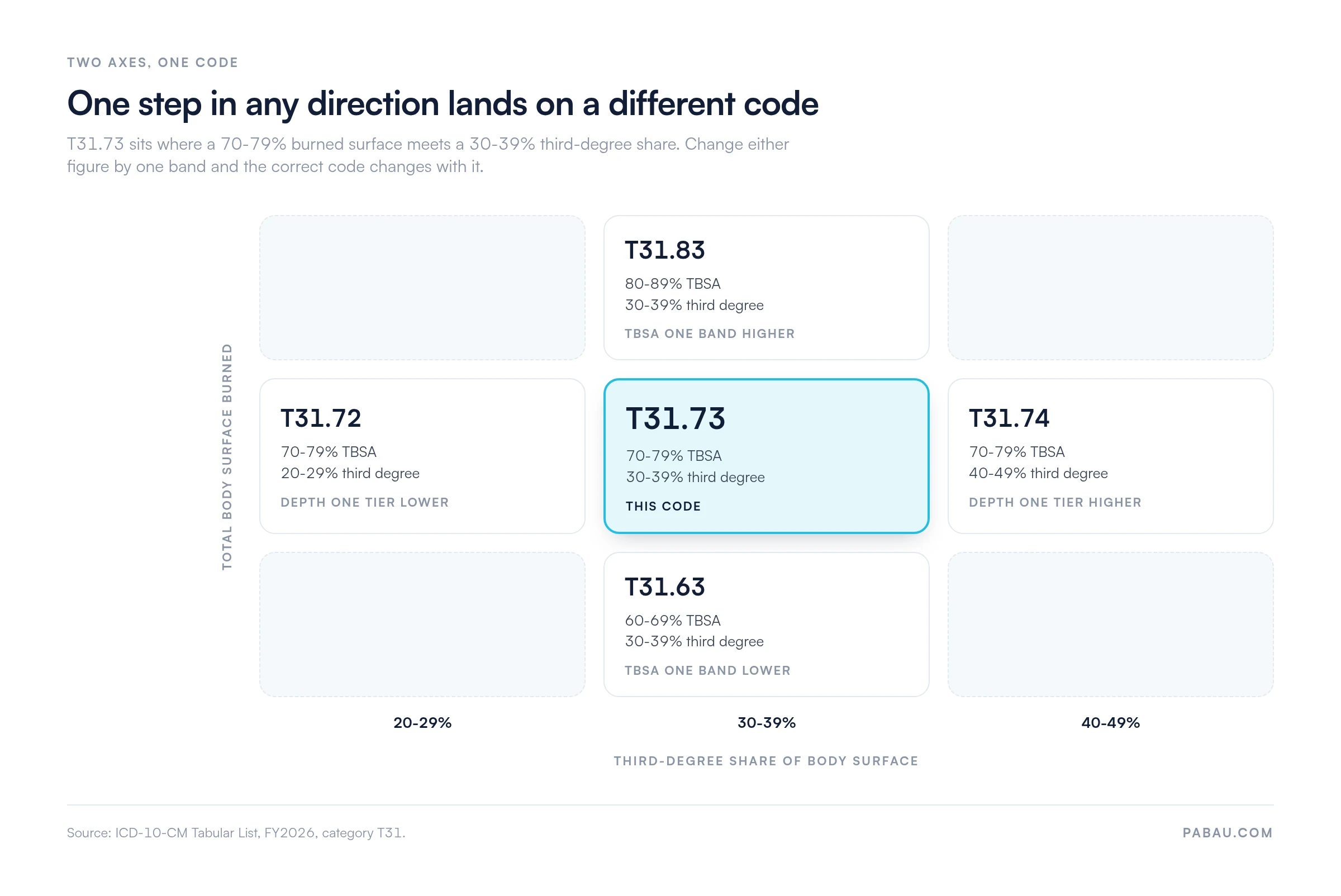
The table sets out the same four neighbours with the documentation detail that separates each one. Use AAPC’s ICD-10-CM lookup to cross-reference sibling codes when documentation falls near a boundary.
T30 (burn of body surface, site unspecified) is appropriate only when documentation genuinely lacks enough information to assign a more specific code. T31.73 requires explicit numeric documentation of both TBSA and third-degree sub-percentage. If those figures are absent, query the physician before defaulting to T30.
Querying is always preferable. Unspecified codes attract payer scrutiny, and they may not support inpatient admission medical necessity for a burn injury of this severity.
T31.73 claims are high-value, and auditors treat them accordingly. Payers look for specific documentation elements, and a missing element is a preventable denial. The wider rules on medical billing compliance apply to every inpatient claim at this level of acuity.
AHA Coding Clinic guidance emphasizes that TBSA documentation must reflect the physician’s assessment at the time of the encounter. A retrospective estimate does not qualify. Burn wounds evolve, so depth percentages documented on day one may differ from those recorded on day three. Each encounter stands on its own documentation.
Burns involving 70 to 79 percent TBSA usually require inpatient admission, often at a designated burn center. Most major payers treat this as presumptive medical necessity for inpatient level of care. Prior authorization is still a processing requirement for commercial plans and some Medicare Advantage products.
Facilities billing T31.73 should obtain authorization before or at the time of transfer to a burn center, rather than relying on retrospective approval. Medicare fee-for-service does not require prior authorization for inpatient hospital admissions, but post-payment audits for high-severity burn DRGs are common.
The supporting clinical documentation must include the burn center assessment, daily wound care notes, and operative reports for any debridement or grafting performed.
T31.73 claims get denied for two broad reasons: specificity errors in the code itself, and documentation that never reached the record. Most are preventable. Building code-specific denial rules into billing review catches them before submission.
Every denial comes back with a CARC code attached to the remittance. The denial codes reference explains the ones payers return most often on complex inpatient claims, and what each one asks you to correct.
T31.73 is a diagnosis code. Procedure coding for burn-related interventions is separate, using ICD-10-PCS for inpatient work and CPT for outpatient or professional billing. The diagnosis and the procedure codes must align clinically. A skin graft CPT code submitted with a low-acuity burn diagnosis triggers a clinical logic edit.
Common procedures associated with 70-79% TBSA burns and their coding context:
ICD-10-PCS is used for inpatient procedure coding. Burn surgeons and coding teams at burn centers typically work closely. Operative reports then carry the detail ICD-10-PCS requires for root operation, body part, and approach specificity.
Retrospective billing, legacy record review, and some payer crosswalk tools still reference ICD-9-CM codes. The transition from ICD-9 to ICD-10 took effect on October 1, 2015. Claims billed before that date used the ICD-9-CM code set, which structured burn coding differently.
For crosswalk work, map T31.73 against the CMS General Equivalence Mappings file. GEMs is the payer-approved reference for moving between the two code sets. Third-party crosswalk tools are useful for a first pass, but confirm every result against GEMs before it goes on a claim. ICD-10 gained far more burn-coding specificity by adding the dual-axis structure that T31.73 uses.
A burn admission coded to T31.73 rarely leaves the practice as a single line. The claim carries the TBSA code, site codes from T20-T25, an external cause code, a place of occurrence code, and often an inhalation injury code. Assembling that by hand, across several encounters, is where the figures start to drift apart.
Pabau is an all-in-one practice management system with software for billing teams built into it. Diagnosis codes attach to the encounter record that already holds the clinical note. The coder then builds the claim from the documentation rather than from memory.
Claims go out electronically to US payers, and the remittance advice comes back into the same record. Burn claims at this TBSA level often return remark codes tied to DRG assignment rather than to the code itself. Reading the remittance in context tells the billing team whether to correct a code or query the physician.

Pabau supports multi-code burn injury claims with built-in ICD-10 diagnosis code workflows, electronic claim submission, and real-time remittance processing. See how it fits your billing team.

T31.73 rewards documentation discipline more than coding skill. Two percentages, a named calculation method, and the correct placeholder and seventh character all have to be in place. So does a full set of companion codes covering site, cause, and any inhalation injury.
Get one of those elements wrong and the claim shifts to a sibling code, comes back denied, or turns into an audit finding. The fix sits upstream. Query the physician while the patient is still in front of them, rather than reconstructing percentages weeks later from a chart.
Book a demo to see how Pabau assembles multi-code burn claims and tracks each one through to remittance.

Need guidance on managing complex billing claim workflows? Claims management software from Pabau supports multi-code submission and real-time denial tracking for high-acuity diagnoses.
Want to understand how clearinghouses process ICD-10 burn claims? Medical claims clearinghouse overview explains how electronic claim routing works for complex inpatient codes.
Dealing with recurring denials on injury coding? Denial management in healthcare covers structured approaches to reducing claim rejection rates across coding categories.
ICD-10 Code T31.73 is the diagnosis code for burns covering 70 to 79 percent of total body surface area. Of that surface, 30 to 39 percent must be third-degree, or full-thickness, burns. The code requires a seventh character and must be reported alongside site-specific burn codes and external cause codes.
Yes. T31.73 is a fully specified billable ICD-10-CM code valid for FY2026 claims. It must be appended with one of three valid seventh characters: A for an initial encounter, D for a subsequent encounter, or S for sequela. The code cannot be submitted without one.
Both codes cover burns in the 70-79% TBSA band. T31.72 applies when the third-degree sub-percentage is 20-29%, and T31.73 applies when it is 30-39%. The only differentiator is the documented third-degree percentage in the physician record.
The physician record must state the total TBSA as a number in the 70-79% range. It must also carry a separate figure showing that 30-39% of the body surface is third-degree. Name the calculation method used, either Rule of Nines or Lund-Browder, and document burn depth by anatomical region. Descriptive language without percentages is insufficient.
Per ICD-10-CM tabular instructions, T31.73 requires site-specific burn codes from T20-T25 for each anatomical area involved. It also requires an external cause code from X00-X19 identifying the burn mechanism, and a place of occurrence code from Y92. Inhalation injury codes such as T59.- or J70.5 are added when documented.
The two codes cover the same 70-79% TBSA band and differ only on burn depth. T31.70 applies when third-degree burns cover 0-9% of body surface, and T31.73 applies when they cover 30-39%. If the record carries no depth breakdown at all, query the physician rather than defaulting to T31.70.