ICD-10 Code D25.9: Leiomyoma of uterus, unspecified
ICD-10 Code D25.9: Definition and quick reference ICD-10 Code D25.9 is the billa...

Last Updated: Nov 24, 2026
Billable Code Specific Code
T32.77 is the billable ICD-10-CM code for corrosions involving 70-79% of body surface with 70-79% third degree corrosion. It is complete at five characters, and no seventh character applies.
The code records extent, not site. Report it with the site-specific T20-T25 corrosion codes when the site is known, and as the primary code only when the site is unspecified. The chart must state both the total TBSA and the third-degree percentage.
Let Pabau's smart automation suggest the right codes, reduce claim denials, and keep your practice compliant—effortlessly.
Automate repetitive tasks and focus on what matters most—your patients.
Reduce coding errors and ensure compliance with the latest regulations.
Clean claims, fewer denials, and faster reimbursements.
Powerful insights and reporting to help your practice thrive.
HIPAA compliant SOC 2 certified GDPR-compliant Trusted by 4,000+ clinics worldwide

ICD-10 code T32.77 reports corrosions covering 70-79% of total body surface, with 70-79% of the body surface corroded to third degree.
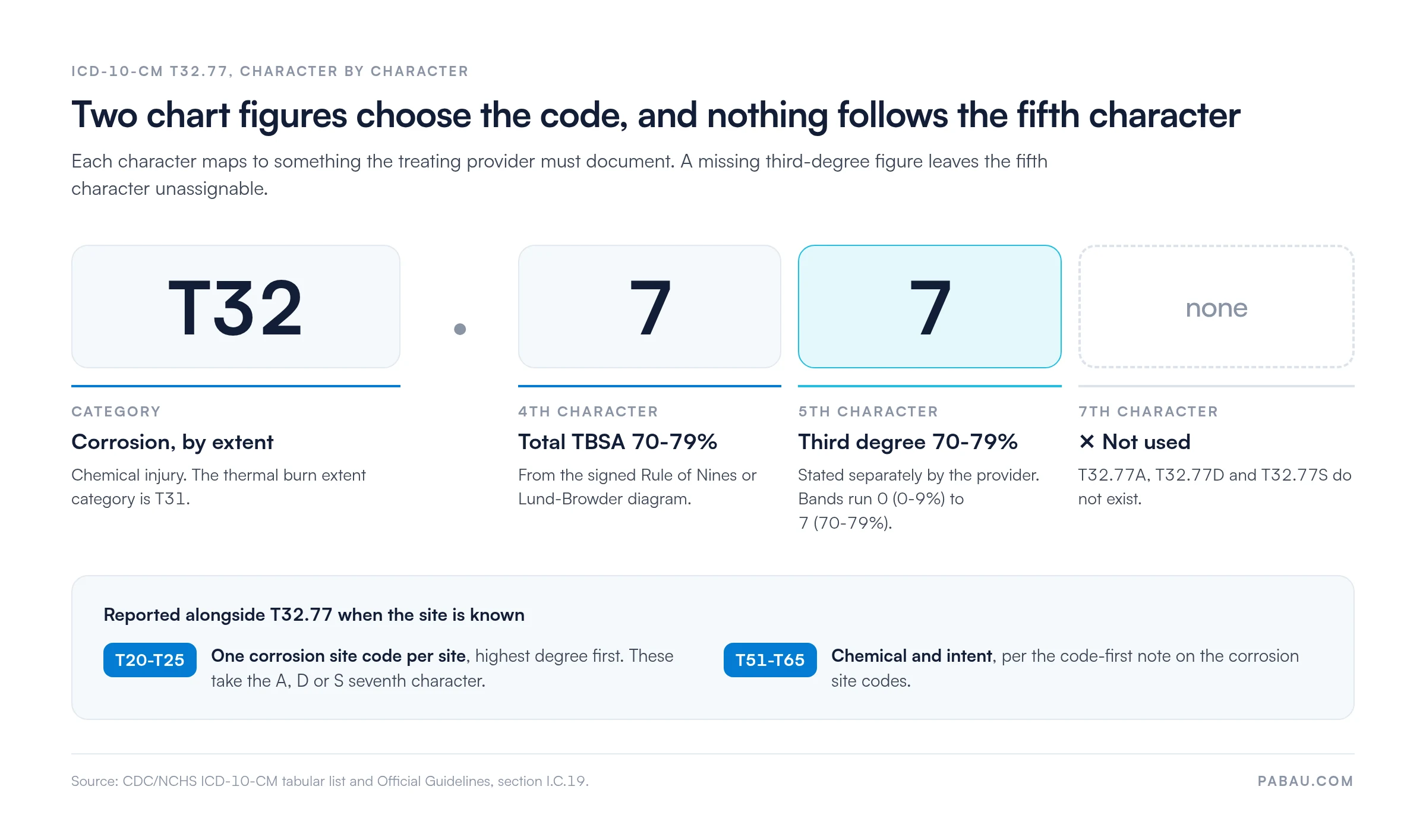
T32.77 is a complete, billable five-character code. Category T32 takes no seventh character, so T32.77A, T32.77D and T32.77S do not exist.
The chart must state two figures: the total TBSA and the third-degree TBSA. Without the third-degree figure, the fifth character cannot be assigned.
T32.77 records extent, not site. Report it with the site-specific T20-T25 corrosion codes when the site is known, and lead with it only when the site is unspecified.
Most T32.77 denials trace back to a wrong fifth digit, a missing site code, or a chemical injury coded to the thermal burn family.
ICD-10 code T32.77 classifies corrosions involving 70-79% of total body surface area (TBSA), with 70-79% third degree corrosion. You can confirm the code and its descriptor in the CDC/NCHS ICD-10-CM browser tool. In practice, the third-degree figure means nearly all of the corroded skin is full thickness.
The code sits in Chapter 19 of ICD-10-CM, under category T32. That category classifies corrosions by how much body surface they involve, not by where they are. Patients at this extent need burn center admission, fluid resuscitation, and staged excision and grafting.
Yes. T32.77 is a complete, valid code at five characters, and you report it exactly as written. Category T32 has no seventh-character extension. Appending A, D or S creates a code that does not exist, and the claim will reject.
The confusion comes from the companion codes. The site-specific corrosion codes in T20-T25 do take a seventh character, under Guideline I.C.19.a. So a claim can carry a site code ending in A next to a bare T32.77, and both are correct.
Subcategory T32.7 covers every corrosion with 70-79% total TBSA involvement. The fifth character records how much of the body surface is third-degree corrosion. T32.77 is the top band, because the third-degree figure cannot exceed the total.
Picking the wrong fifth digit misstates severity. Coding T32.74 when the record shows 72% third degree understates the injury, and the DRG and audit trail follow it. A chart showing 65% third degree belongs to T32.76 instead. The breakdown below shows which documented figure sets each character of the code.
T32 answers “how much?” rather than “where?” The site comes from the T20-T25 range, which separates burn and corrosion codes by body region and depth. You can look up each of those site codes in our diagnostic codes guide.
Burns come from heat, electricity, friction or radiation, and their extent codes sit in T31. Corrosions come from chemical agents, and their extent codes sit in T32. Coding a chemical injury as a thermal burn sends the claim to T31.77 instead of T32.77.
That error changes more than one line. Corrosion site codes carry a code-first note for T51-T65, which names the chemical and the intent. A thermal burn claim carries none of that, so the record and the claim stop matching. Medical billing fundamentals covers how these code families flow onto a claim.
T32.77 needs two figures from the treating clinician: the total TBSA involved and the third-degree TBSA. A note reading “extensive burns” or “75% TBSA” does not support the code. Without the third-degree figure, the fifth digit cannot be chosen.
The Rule of Nines gives each body region a share of 9% or a multiple of it. Each arm is 9%, each leg 18%, the front and back of the trunk 18% each, and the head 9%. The perineum adds 1%.
The clinician sums the affected regions to reach the total. For T32.77 the total must fall between 70% and 79%. The note must also state how much of the body surface is third degree.
The Lund-Browder chart adjusts head and leg proportions by age, so it is more precise for children. The official guidelines allow the same adjustment, letting providers change percentage assignments for infants and children.
Whichever method the clinician uses, the result belongs in a dated, signed body diagram or its written equivalent. The coder cannot estimate TBSA independently.
Flag charts where the physician noted total TBSA but left the third-degree figure blank. Query before you code, because T32.77 depends on both numbers. One query at admission costs far less than a post-payment audit.
Burns and corrosions follow the same rules under Section I.C.19.d of the ICD-10-CM Official Guidelines for Coding and Reporting. Getting the order right is part of clean claim submission.
Corrosion site codes carry a code-first instruction for T51-T65, the toxic effect codes that name the chemical and the intent. The guidelines also call for external cause codes on burns and corrosions.
There is no national mandate to report external cause codes. Many payers and state trauma registries still require them, so check the contract.
The specificity of a T32 code is a documentation problem before it is a coding problem. If the chart lacks the elements below, the coder cannot assign T32.77 with confidence.
T32.77 claims attract close scrutiny because they imply catastrophic injury and long inpatient stays. These cases group to the burn MS-DRGs, 927 through 935. Skin grafting, mechanical ventilation over 96 hours, and complications decide which one applies.
Payers set their own notification and authorization rules for inpatient burn care. Confirm what the plan expects before the claim goes out.
Effective denial management workflows for T32.77 put a documentation checklist into admission. A missing TBSA figure then gets queried at admission, long before a retrospective coding review finds it.
Set a T32 review checkpoint at discharge for inpatient admissions. Check for a signed TBSA diagram, both percentages, the named chemical and a site code for each documented site. A query answered at discharge costs less than working a denial.
On a T32.77 case, the figures that decide the code live in clinical notes, body diagrams and physician queries. Coders often chase them across systems before a claim can go out.
Pabau, a practice management and billing platform, keeps that record in one place. Clinicians complete notes and forms against the patient record, so the TBSA figures and the named chemical sit where the billing team can see them.
When the codes are set, Pabau’s claims management software sends the claim through the Claim.MD clearinghouse and tracks its status. Rejections come back to the same record, so the team can correct and resubmit quickly.


Pabau keeps clinical notes, forms and claims on one patient record. Your billing team sees the TBSA figures behind T32.77 and tracks every claim to payment.

T32.77 is a low-volume, high-stakes code. It is complete at five characters, so the work sits in the record, not in an extension. Get the two percentages in writing before you code.
Then check the pairing. A known site needs its own T20-T25 corrosion code, and a chemical injury stays in the corrosion family with its T51-T65 code. A practice that checks these at discharge rarely works a T32.77 denial.
Book a demo to see how Pabau keeps burn documentation and claims on one record for your billing team.

Need a broader overview of ICD-10 medical billing workflows? Medical billing fundamentals explains how diagnosis codes flow from documentation to claim submission and payment.
Concerned about claim rejections on complex diagnosis codes? Denial management in healthcare covers the strategies billing teams use to prevent and recover denials systematically.
Looking for clean claim submission best practices? Clean claim submission outlines exactly what a complete, payable claim requires at the payer level.
Want to understand the clearinghouse behind Pabau’s claim submissions? The Claim.MD clearinghouse guide explains how electronic claims are validated and routed to 4,000+ US payers.
ICD-10 Code T32.77 is the billable ICD-10-CM code for corrosions involving 70-79% of body surface with 70-79% third degree corrosion. It sits in Chapter 19, category T32. It is complete at five characters, and no seventh character applies.
Burns come from heat, electricity, friction or radiation, and their extent codes sit in T31. Corrosions come from chemical agents, and their extent codes sit in T32. Both use T20-T25 for site, with separate burn and corrosion subcategories. Coding a chemical injury as a burn moves the claim into the wrong family.
Only when the site of the corrosion is not specified. When the record names the sites, report a T20-T25 corrosion code for each one and sequence the deepest first. T32.77 then follows as an additional code that records the extent.
All three cover corrosions of 70-79% of body surface. T32.77 means 70-79% third degree corrosion, and T32.76 means 60-69%. T32.70 means 0% to 9% third degree corrosion. Use the code that matches the third-degree percentage the physician documented.
Requirements vary by payer and contract. These cases group to the burn MS-DRGs, 927 through 935, depending on grafting, ventilation and complications. That puts them under audit scrutiny. Confirm the plan’s notification and authorization rules, and make sure both TBSA figures are in the record before you submit.