ICD-10 Code Y76.0: Diagnostic obstetric and gynecological devices
ICD-10 Code Y76.0: Definition and billable status ICD-10 Code Y76.0 is a valid, ...

Last Updated: Oct 23, 2026
Billable Code Specific Code
T32.83 is the billable ICD-10-CM code for corrosions involving 80-89% of body surface with 30-39% third degree corrosion.
The code has been valid for submission since October 1, 2015, the start of FY2016. It carries unchanged into the FY2026 edition of the CMS ICD-10-CM code set, effective October 1, 2025. Neither its description nor its billable status changed in that update.
The code stacks two separate percentages. The first is how much body surface the corrosion covers. The second is how much of that surface is full-thickness.
Let Pabau's smart automation suggest the right codes, reduce claim denials, and keep your practice compliant—effortlessly.
Automate repetitive tasks and focus on what matters most—your patients.
Reduce coding errors and ensure compliance with the latest regulations.
Clean claims, fewer denials, and faster reimbursements.
Powerful insights and reporting to help your practice thrive.
HIPAA compliant SOC 2 certified GDPR-compliant Trusted by 4,000+ clinics worldwide

ICD-10 code T32.83 covers corrosions of 80-89% of body surface with 30-39% third degree corrosion, and it has been valid since October 1, 2015
T32.83 is billable and valid for reimbursement, but always pair it with a site-specific T20-T25 code and an external cause code
TBSA and the third-degree percentage are two separate axes. The 80-89% figure is total body surface involved, and the 30-39% is the full-thickness subset
Pabau’s claims management software supports accurate code submission and claim validation, so high-acuity burn cases reach payers with complete documentation
T32.83 describes an extremely severe chemical injury. The code carries two distinct percentage qualifiers, and confusing them is a common coding error that affects DRG assignment.
The first qualifier, 80-89%, is the total body surface area (TBSA) affected by corrosion of any depth. The second qualifier, 30-39%, is the portion of that TBSA with third degree (full-thickness) corrosion. That means chemical destruction has penetrated through the epidermis and dermis.
These are not the same figure expressed two ways. They are two separate measurements taken on one injury.
Clinically, a patient coded T32.83 has chemical corrosion covering nearly all of their body surface. Roughly one-third of that surface carries the most severe, tissue-destroying level of injury. These cases are associated with critical care admissions, skin grafting, and high mortality risk.
According to the WHO ICD-10 classification framework, corrosions are chemically induced injuries. They are distinct from thermally caused burns, which are coded under T31.
Accurate TBSA estimation determines whether T32.83 or a sibling code applies. The Rule of Nines is the standard method used in emergency and burn unit settings.
To reach the 80-89% TBSA threshold for T32.83, coders need documentation showing involvement of nearly all major body regions. The treating physician’s notes must quantify TBSA, because coders cannot estimate it themselves. The CDC/NCHS ICD-10-CM lookup tool shows the full tabular structure of the T32 series.
The T32 category classifies corrosions by extent rather than site. That is the structural difference between the T20-T25 codes, which are site-specific, and T32, which is extent-based. T32.83 belongs to the T32.8x subcategory, covering corrosions of 80-89% total body surface.
The final character in T32.8x defines how much of that 80-89% TBSA has third degree involvement. The table below sets the sibling codes side by side.
Selecting the wrong final character creates a mismatch between the documentation and the code. Each step up the T32.8x ladder signals greater injury severity, and it typically maps to a higher-weighted DRG.
Review the physician’s documentation for the explicit third-degree percentage before assigning T32.83 rather than T32.82 or T32.84. You can check current code descriptions against the AAPC ICD-10-CM code lookup.
T32.83 cannot stand alone on a claim. Per ICD-10-CM Official Guidelines, corrosion coding requires a complete code set that identifies both the extent and the anatomical site of injury. Missing companion codes is one of the most common reasons corrosion claims deny.
Three categories of code are required alongside T32.83. The diagram below shows the stack, and where each one sits on the claim.
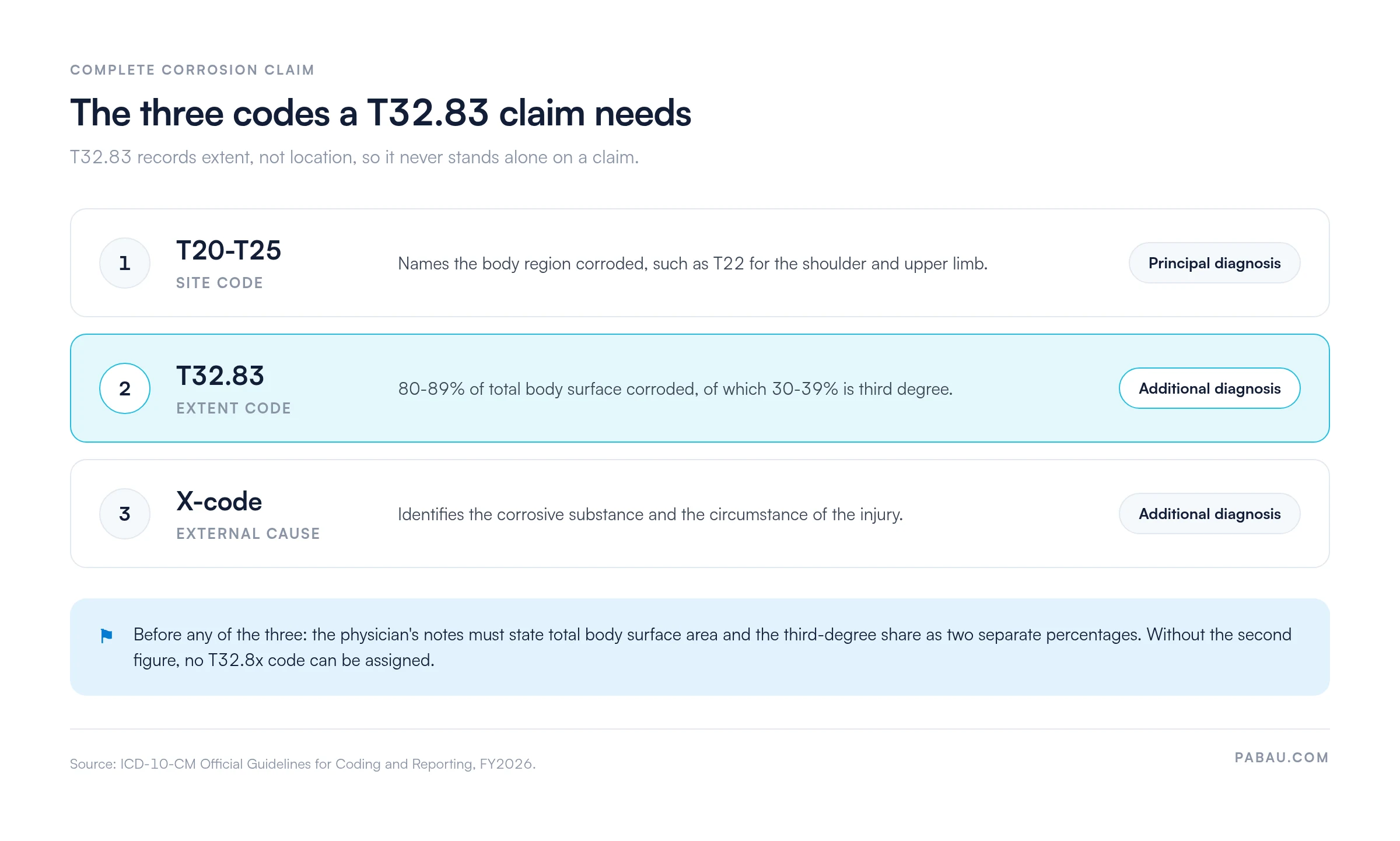
Flag encounters where the physician’s notes document TBSA but do not specify the percentage of third degree involvement. Coders cannot assign T32.83 without a documented third-degree percentage. Query the treating physician before submission rather than coding from an incomplete record.
Third degree corrosion is full-thickness chemical tissue destruction. It penetrates through the entire dermis and can reach subcutaneous tissue, unlike first degree (superficial) or second degree (partial thickness) injury. There is no sensation in the affected area, because the nerve endings are destroyed.
For T32.83, the qualifier means 30 to 39% of the patient’s total body surface has sustained that full-thickness destruction. The rest of the involved surface is corroded to a shallower depth.
The third-degree percentage matters for reimbursement because DRG groupers factor injury severity into case weighting. Within the same total TBSA band, a higher third-degree percentage generally produces a higher case weight. That weight drives payment on inpatient burn cases.
Undercoding the third-degree component by one tier understates severity. Using T32.82 where the documentation supports T32.83 pays less than the case warrants. Assigning the correct tier protects both compliant billing and appropriate payment.
Coders new to burn coding often ask when to use T31 instead of T32. The answer is the causative agent.
The physician’s clinical notes must document the causative agent explicitly. Injuries from contact with sulfuric acid are a corrosion, coded in the T32 series. Had the same patient touched a hot surface, the coding would move to T31.
Mixing the two series is a coding error even where the injury pattern looks similar. The distinction is addressed directly in the ICD-10-CM Official Guidelines for Coding and Reporting, published annually by NCHS and CMS.
T32.83 typically surfaces on inpatient burn unit claims and trauma center encounters. At this severity level, DRG assignment is tied directly to TBSA documentation and third-degree coding accuracy.
Medicare, Medicaid, and commercial carriers all process high-acuity burn claims. Each sets its own requirements for corrosion claim submission. Four considerations decide how a T32.83 claim lands.
For a clean claim, review the full code set before submission: the T20-T25 site code sequenced first, then T32.83, then the external cause code. A complete and correctly sequenced claim reduces the risk of a technical denial for missing diagnosis codes.
Working through the clean claim requirements is a practical first step for any high-acuity burn encounter.
Build a corrosion coding checklist for your burn unit. Confirm the TBSA percentage from the physician’s notes, then confirm the third-degree percentage separately. Assign the T32.8x code, the T20-T25 site code, and the external cause code. Submit all three code categories together on every initial encounter claim.
High-acuity burn and corrosion claims attract payer scrutiny because the resource costs are significant. Three documentation problems account for most T32.83 claim trouble.
A pre-submission audit is where all three turn up. Re-read the physician’s notes for both percentages, then confirm the site code and the external cause code are on the claim.
When a denial does come back, check it against the medical billing denial codes reference. That tells the team whether the problem is sequencing, a missing companion code, or documentation too thin to support T32.83.
Most burn and trauma billing teams assemble a T32.83 claim by hand. A coder reads the physician’s notes, checks both percentages, then looks up the site code. The external cause code comes from a separate reference. Any of those steps can be skipped when the unit is busy.
Practice management software like Pabau keeps every diagnosis code on the encounter itself. The extent code, the site code, and the external cause code travel together, so nobody rebuilds the set at submission time. Pabau’s software for billing teams then carries the claim through to the payer.
Claims submitted from Pabau run through its Claim.MD clearinghouse integration, which validates CMS-1500 claims across thousands of US payers before transmission. For a burn unit, that means a T32.83 claim gets checked while the coder can still fix it.

Pabau’s claims management tools help practices submit complete, accurate claims for complex diagnostic codes like T32.83. Pair ICD-10 codes with the right companion codes and get paid faster.

Finding T32.83 is the easy part of a corrosion claim. The work sits in the documentation. Both percentages must appear separately in the physician’s own notes, and the rest of the claim follows from that.
Query the physician when a percentage is missing, rather than coding to the nearest tier. One tier down costs the case weight the encounter earned. One tier up will not survive an audit. Book a demo to see how Pabau keeps the site, extent, and external cause codes on one claim.

Does the documentation support a higher third-degree tier? ICD-10 code T32.84 covers the same 80-89% body surface with 40-49% third degree corrosion.
Want to understand how denials affect your revenue cycle? Revenue cycle management fundamentals explains how accurate diagnostic coding connects to payment at every stage of the billing workflow.
Looking for a clearinghouse that validates ICD-10 claims before submission? Medical claims clearinghouse guide explains how electronic claim validation works and what to look for in a clearinghouse partner.
ICD-10 code T32.83 is used to diagnose and bill for chemical corrosions covering 80-89% of total body surface area. Of that surface, 30-39% has third degree (full-thickness) corrosion. It is a billable, specific ICD-10-CM code, valid since October 1, 2015 and current in the FY2026 edition.
Yes, T32.83 is a billable and specific ICD-10-CM code valid for submission and reimbursement. It cannot be submitted alone. A T20-T25 site-specific corrosion code and an external cause code must accompany it for a complete claim.
Burns (T31 series) are caused by thermal agents such as heat, flame, or radiation. Corrosions (T32 series) are caused by chemical agents such as acids, alkalis, or other corrosive substances. The physician’s documentation must identify the causative agent. Coders use that to determine which series applies.
TBSA is calculated using the Rule of Nines. It assigns 9% to the head and neck and 9% to each arm. Each side of the trunk is 18%, each leg is 18%, and the perineum is 1%. Coders rely on the treating physician’s documented percentage and cannot estimate TBSA themselves. For T32.83, the physician must document 80-89% total TBSA involvement.
T32.83 requires a site-specific corrosion code from T20-T25 to document the anatomical location. It also requires an external cause code identifying the corrosive substance and circumstance. The T20-T25 site code is typically the principal diagnosis. T32.83 and the external cause code follow as additional diagnoses.
No. T32.83 has been a valid ICD-10-CM code since October 1, 2015, the start of FY2016. It carries into the FY2026 edition, effective October 1, 2025, with no change to its description. CMS refreshes the code set each October.