ICD-10 Code Y76.0: Diagnostic obstetric and gynecological devices
ICD-10 Code Y76.0: Definition and billable status ICD-10 Code Y76.0 is a valid, ...

Last Updated: Oct 23, 2026
Billable Code Specific Code
T32.72 is the billable ICD-10-CM code for corrosions involving 70-79% of body surface with 20-29% third degree corrosion. It is complete at five characters and takes no seventh character. On a claim, it adds the injury's total extent to the site and toxic-effect codes that describe it.
It sits in category T32, which organizes corrosions by the extent of body surface affected, not by site. The fourth character sets the total body surface band, and the fifth sets the third-degree band. Coders often confuse T32.72 with T32.71 and T32.73, because a single digit separates them.
Let Pabau's smart automation suggest the right codes, reduce claim denials, and keep your practice compliant—effortlessly.
Automate repetitive tasks and focus on what matters most—your patients.
Reduce coding errors and ensure compliance with the latest regulations.
Clean claims, fewer denials, and faster reimbursements.
Powerful insights and reporting to help your practice thrive.
HIPAA compliant SOC 2 certified GDPR-compliant Trusted by 4,000+ clinics worldwide

T32.72 reports corrosions covering 70-79% of body surface, with 20-29% of body surface at third degree.
T32.72 is a complete, billable five-character code, so it never takes a seventh character or an X placeholder.
T32.72 is the primary code only when the corrosion site is unspecified. Otherwise, it supplements the T20-T25 site codes.
Encounter status lives on the site codes and the T54 toxic-effect code, which carry their own seventh characters.
A clean claim needs a documented total and third-degree percentage that fall inside the 70-79% and 20-29% bands.
ICD-10 code T32.72 reports corrosions involving 70-79% of body surface with 20-29% third degree corrosion. It is a billable ICD-10-CM code, and it is complete at five characters.
The code sits in Chapter 19 (S00-T88), the injury and poisoning chapter. Most injury codes there need a seventh character for the encounter. However, categories T31 and T32 are exceptions. So T32.72 never takes A, D or S, and no X placeholder is added.
You can confirm the code and its notes in the CDC/NCHS ICD-10-CM browser tool.
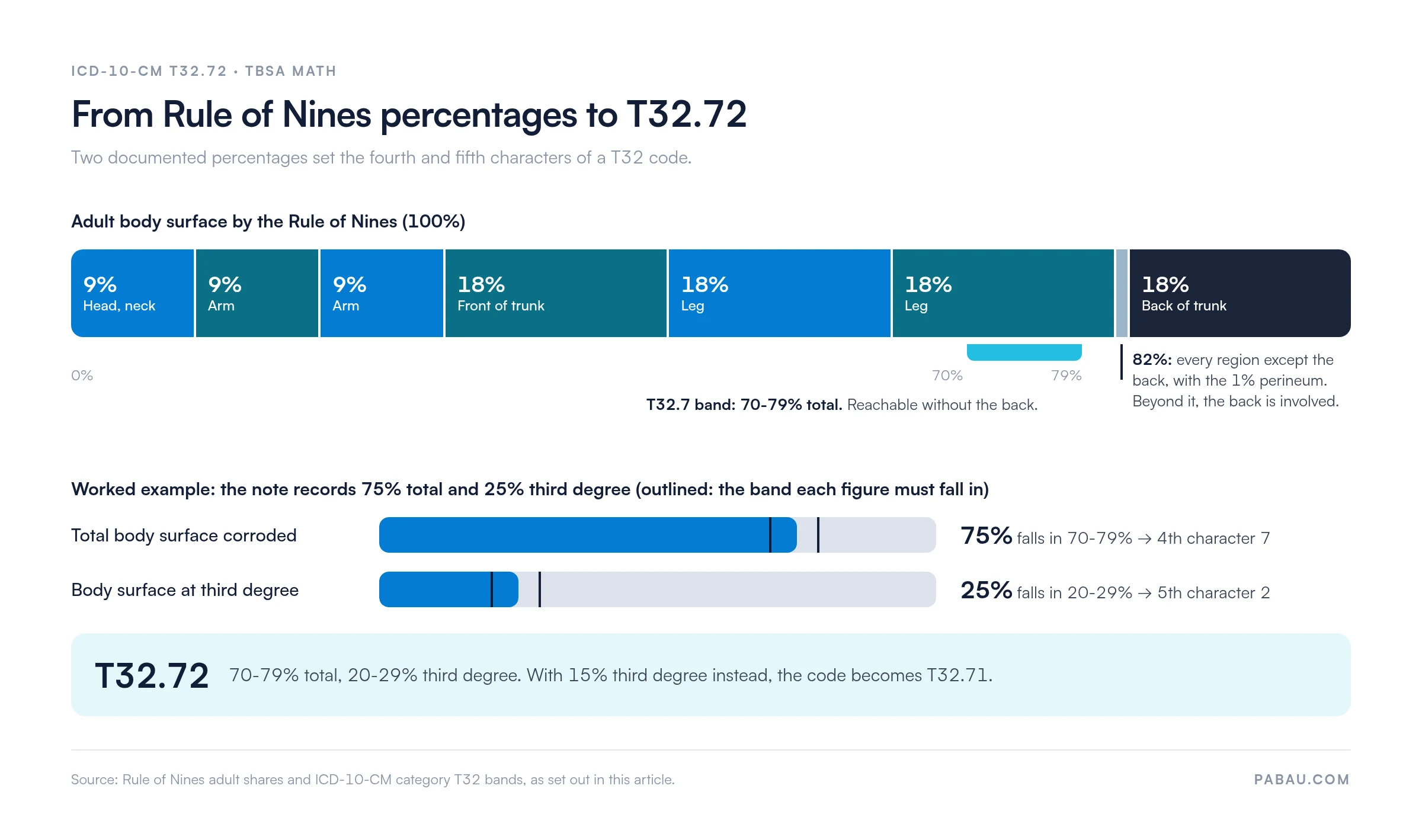
Category T32 records two percentages. The fourth character gives the total body surface corroded, in 10% bands. Then the fifth character gives the share of body surface at third degree.
Within T32.7, the third-degree area can never be larger than the 70-79% total. That is why the subcategory stops at T32.77.
Say the record shows 75% total with 25% at third degree. T32.72 fits. If it shows 75% with 15% at third degree, T32.71 fits instead. One digit in the note moves one digit in the code.
ICD-10-CM separates burns from corrosions by cause. Heat, flames, hot liquids, steam and friction cause burns. Acids, alkalis and other caustic chemicals cause corrosions.
Both sit in the same block, T20-T32. The cause shows up in the subcategory you choose and in the extent category you add.
So a sodium hydroxide injury takes the corrosion subcategories in T20-T25, such as T21.7- for third-degree corrosion of the trunk. Its extent code comes from T32, never T31.
T32.72 needs two numbers in the record. The total body surface area (TBSA) corroded must sit at 70-79%. The third-degree area must sit at 20-29%. Clinicians estimate both with one of two standard methods.
The Rule of Nines gives fixed shares to adult body regions. The head and neck count 9%, and each arm counts 9%. The front and back of the trunk count 18% each, and each leg counts 18%. The perineum adds 1%.
For example, both legs plus the front of the trunk add up to 54%. The head, arms, legs, front of the trunk and perineum reach 82% together, so totals beyond 82% always involve the back.
The Lund-Browder chart adjusts those shares for age. It suits children better, because their heads are larger and their legs smaller in proportion.
Whichever method the team uses, the note should state the method, the total, the third-degree share and each region involved. If one is missing, expect a coding query.
Write the numbers out in full: “Rule of Nines applied, 72% total body surface involved, 24% third-degree corrosion.” A note that only says “extensive chemical burns” cannot support any T32 code.
T32.72 tells the payer how much skin is involved. Other codes tell it where, what caused it and how it happened. Like most medical billing for injuries, one code rarely tells the full story.
The site categories carry a code-first note for T51-T65, so the toxic-effect code leads. T32.72 is the primary code only when the record leaves the site unspecified. When sites are documented, it supplements the T20-T25 codes.
Official guidelines advise adding the extent code once third-degree involvement reaches 20% of body surface. T32.72 always meets that bar, so pairing it with the site codes is the safe default.
Build the set from the discharge summary and the operative notes. The admitting diagnosis alone rarely holds every site.
A corrosion admission passes through several hands before payment. Each step below is a point where the claim can stall.
Medicaid programs vary by state, and some pay burn stays per diem rather than by DRG. Confirm your state’s method as part of revenue cycle management for burn cases. Keeping those rules current is part of medical billing compliance.
Most T32.72 problems trace back to the note or to the codes around it. A solid denial management routine catches them, but prevention is cheaper.
If a denial does arrive, the reason code points to the fix. Our guide to denial codes in medical billing explains how to read them.
Use these checks on every corrosion claim to send a clean claim the first time.
A corrosion claim carries many codes, and each one comes from a different part of the record. Retyping them into a billing form is where errors creep in.
Pabau, the practice management and billing platform we build, pre-fills the claim from the invoice, using insurer details stored on the patient record. Its claims management software validates required claim fields. Claims then go out through the Claim.MD clearinghouse, with eligibility checks, ERA posting and status tracking in one place.
Your coder still decides whether T32.72 fits the note. Pabau takes away the retyping and chasing around that decision, so your team spends its time on the record.

Pabau pre-fills the claim from the invoice, using insurer details stored on the patient record. It validates required fields and submits through Claim.MD, so your team spends less time fixing rejections.

T32.72 is one of the simpler codes on a corrosion claim, as long as it stays at five characters. The hard work sits in the record: two clear percentages, a named chemical and a code for every site.
So start with your documentation template. If it prompts for the method, the total and the third-degree share, most T32 errors never reach coding. Book a demo to see how Pabau pre-fills each corrosion claim from the invoice, using insurer details stored on the patient record.

Need a clearinghouse that handles complex injury claims? How Claim.MD clearinghouse works explains the submission, eligibility, and ERA workflow that supports complex burn and corrosion cases.
Want to understand how denials are classified? Reading electronic remittance advice covers how to interpret CARC denial reasons on 835 remittances for injury claims.
Building a cleaner ICD-10 coding workflow? Superbill documentation guide walks through how to structure the superbill so diagnosis codes and external cause codes are captured at the point of care.
No. T32.72 is complete at five characters, because T31 and T32 are exceptions to the Chapter 19 seventh-character rule. Put encounter status on the site codes and the T54 code instead.
Only when the record does not specify the corrosion site. When sites are documented, list the T54 toxic-effect code and the T20-T25 site codes first. T32.72 then follows as the extent code.
Use the corrosion subcategories in T20-T25 for external body surface, chosen by site and depth. Use T26-T28 for the eye and internal organs. Each site code takes its own seventh character, such as T21.71XA.
All three cover 70-79% of body surface. The fifth character sets the third-degree share: 10-19% for T32.71, 20-29% for T32.72 and 30-39% for T32.73.
Query the provider before you code. T32.70 means 0-9% third degree, so it is not a stand-in for a missing figure. Code from the addendum once the percentage is recorded.