ICD-10 code S61.201A: Open wound of left index finger without nail damage
ICD-10 code S61.201A covers a left index finger wound of unstated type ICD-10 co...

Last Updated: Oct 16, 2026
Billable Code Specific Code
T32.74 is the billable ICD-10-CM code for corrosions involving 70-79% of body surface with 40-49% third degree corrosion. A corrosion is a chemical injury, so the code never applies to a flame or scald burn.
The code carries two measurements at once. Its fourth character records total body surface involved, and its fifth character records how much of that surface is third degree. Read one figure for the other and the claim lands on the wrong sibling code. T32.74 also travels with company, because payers expect an anatomic-site code and an external-cause code naming the chemical alongside it.
Let Pabau's smart automation suggest the right codes, reduce claim denials, and keep your practice compliant—effortlessly.
Automate repetitive tasks and focus on what matters most—your patients.
Reduce coding errors and ensure compliance with the latest regulations.
Clean claims, fewer denials, and faster reimbursements.
Powerful insights and reporting to help your practice thrive.
HIPAA compliant SOC 2 certified GDPR-compliant Trusted by 4,000+ clinics worldwide

T32.74 is billable under the 2026 ICD-10-CM edition, effective for dates of service from October 1, 2025.
The record has to carry two separate figures: total body surface of 70-79%, and third degree surface of 40-49%.
The fourth character reports total extent and the fifth character reports the third degree share.
Corrosions are chemical injuries, so a note describing flame or scald damage rules this code out.
Pabau pre-fills the claim from the encounter record and keeps an ICD-10 code library on the same screen.
ICD-10 code T32.74 is the billable ICD-10-CM diagnosis code for corrosions involving 70-79% of body surface with 40-49% third degree corrosion. It took effect on October 1, 2025, under the 2026 edition of the CMS ICD-10-CM tabular list. Medicare, Medicaid and most commercial payers process it as submitted.
It also needs no seventh character. Plenty of T-chapter injury codes demand an encounter-stage qualifier of initial, subsequent or sequela, and a missing one sends the claim straight back. T32.74 is complete as written, which removes that failure point entirely.
A complete code line is not the same as a clean claim, though. T32.74 reports extent and nothing else, so a payer still expects an anatomic-site code and an external-cause code beside it. Submit the extent code alone and an edit fires before anyone reads the chart.
T32.74 sits three levels deep in the ICD-10-CM hierarchy, and only the deepest level is billable. Send a parent code instead of the full five characters and the claim returns as non-specific. That is a rework ticket rather than a denial you can appeal, so it costs a cycle either way.
The AAPC Codify ICD-10-CM lookup confirms T32.7 as a header only. Every billable code in the subcategory sits at the fifth-character level, running T32.70 through T32.77.
T32.74 asks for two measurements at once, and they are not interchangeable. The first is how much body surface the corrosion covers at any depth. The second is how much of that surface is full thickness.
Fourth character, the 7 in T32.7x: total corrosion coverage runs 70-79% of body surface, counting every depth together.
Fifth character, the 4 in T32.x4: of that total, 40-49% of body surface is third degree. Third-degree corrosion destroys every layer of skin and can reach subcutaneous tissue.
Both figures come from the rule of nines in adults. The head and neck take 9%, and so does each arm. Each leg and each trunk surface take 18%, and the perineum takes 1%. Pediatric patients get the Lund-Browder chart instead, since it adjusts for a proportionally larger head and shorter legs. According to the CDC/NCHS ICD-10-CM web tool, the note should record which method produced the figure, so an auditor can follow the arithmetic.
Laid side by side, the eight codes in the subcategory make the pattern plain.
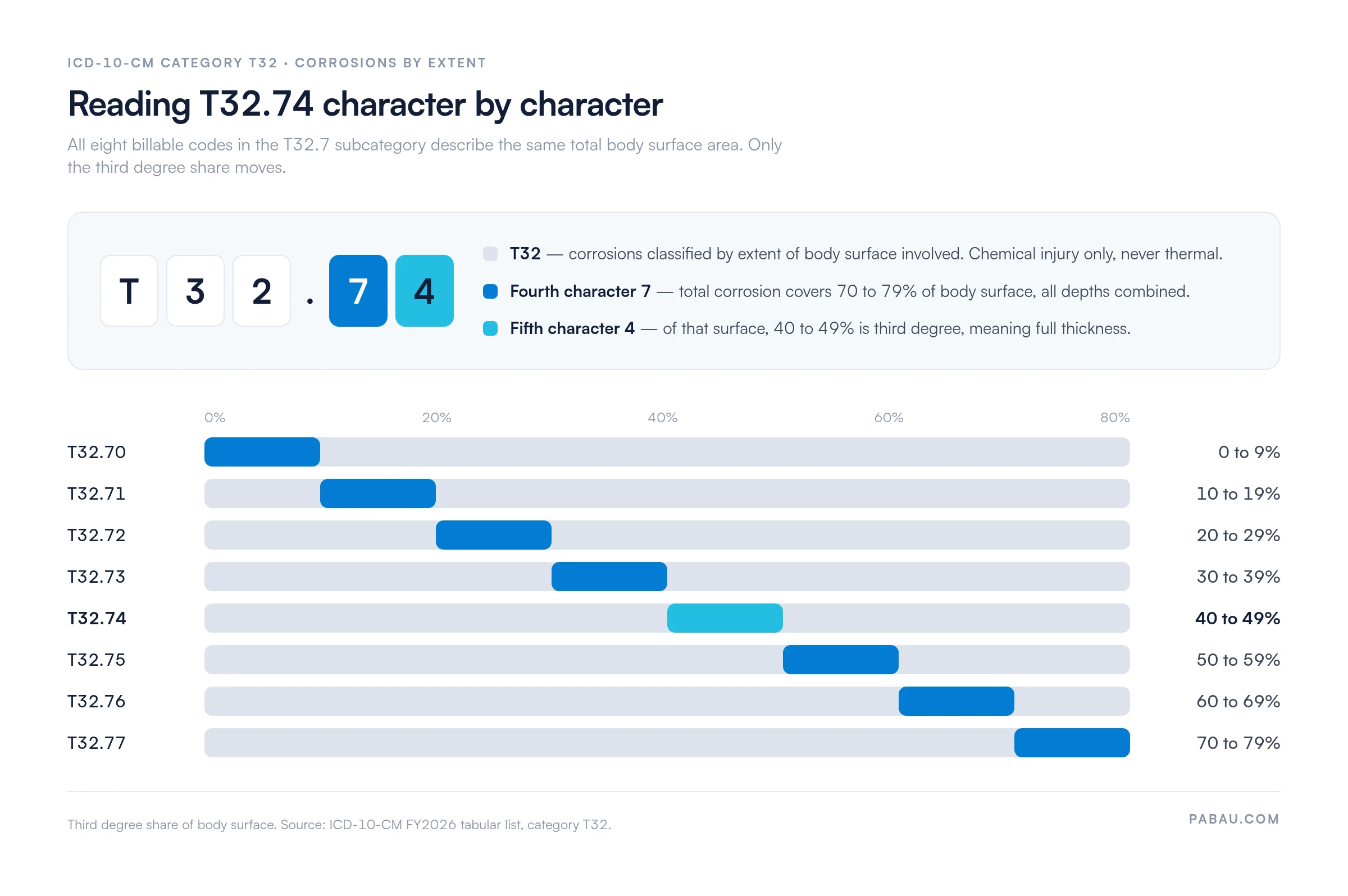
The fifth character is what separates T32.74 from its neighbors, not the fourth. A patient with 75% of body surface involved but only 20% third degree codes to T32.72, even though the total is identical.
Confusing total surface with third-degree surface is the most frequent error in this subcategory. Both numbers therefore have to appear separately in the note before anyone assigns the fifth character.
A corrosion is a chemical injury and a burn is a thermal one, and the cause in the record sorts them. The numeric ranges do not. Anatomic-site injuries run T20-T28 for both, with T29 covering multiple body regions.
The descriptors inside each category say whether the injury is a burn or a corrosion. Only the extent codes split by mechanism: T31 for burns, T32 for corrosions. Section I.C.19.d of the ICD-10-CM Official Guidelines, “Coding of Burns and Corrosions”, sets out the rules for both.
Picking T32.74 where the record describes a flame or a scald is a coding error, and it surfaces on audit rather than at submission. Corrosion coding only holds up when the chemical itself is named in the documentation.
The T32.7 subcategory holds eight billable codes. Each carries the same 70-79% total body surface and differs only in the fifth character, which reports the third degree share. Coders on major corrosion cases move between them as the depth assessment gets revised.
Severity reads as a straight ladder here, and T32.74 sits in the middle of it, with roughly half of the involved surface full thickness. Two rungs higher, ICD-10 code T32.76 keeps the same 70-79% total but reports 60-69% third degree.
Our full ICD-10-CM code index carries the anatomic-site and external-cause codes that travel with it.
Clinicians rarely write the word “corrosion”. The phrasings below all describe what T32.74 covers, and each should land on it during code assignment. None of them is an alternate code.
The WHO ICD-10 browser classifies corrosions in parallel with burns, across the same anatomic and severity axes. So a note reading “chemical burn” should be read as a corrosion, provided a chemical agent is named as the cause.
Section I.C.19.d of the ICD-10-CM Official Guidelines for Coding and Reporting, “Coding of Burns and Corrosions”, governs the whole T32 category. Five points do most of the work on a T32.74 chart.
What those five points add up to is simple enough. T32.74 is almost always part of a code cluster. Practices handling these cases should build a code-set template with the anatomic, extent and external-cause slots already in it.
Five elements have to be in the chart before T32.74 is defensible. Payer audit teams request records on major corrosion cases as a matter of routine, and a missing element is a clawback waiting to happen.
The dual-measurement structure is what makes corrosion documentation different from most of the code set. A single-sentence extent note is rarely enough. Structured wound assessment tools and burn flow sheets, which capture both metrics in separate fields, produce the records that survive review.

Run a five-point check before any T32.7x claim goes out. Does the note record total body surface, and third degree surface, as two separate figures? Is the chemical named? Is there at least one anatomic-site corrosion code, and an external-cause code? A missing element is the most common reason these claims come back for additional information instead of paying on first submission.
A corrosion claim rarely fails at the point a payer reviews it. Three checkpoints upstream decide whether it pays on the first pass.
That third checkpoint is what a clean claim rate measures. Switching clearinghouses will not move it. Every element on the list above starts in the clinical record, so the chemical has to be caught while the chart is still open.
A corrosion case often lives in three places at once. The burn flow sheet sits in the chart. The codes sit in a lookup tool or a spreadsheet. The claim gets typed into a third screen. Every hop is a chance to lose the third-degree figure.
Practice management software like Pabau treats this as a records problem rather than a billing one. Its claims management workspace pre-fills the claim from the encounter record, so patient, provider and visit details carry across untyped. A built-in code lookup library then lets the coder find T32.74 and its neighbors without leaving the claim.
Required-field checks hold the claim until the record is complete. The coder sees an empty field while the chart is still open, rather than reading about it on a remittance advice three weeks on. For a burn unit running high-acuity cases, that difference is measured in whole billing cycles.

Pabau pre-fills claims from the encounter record and keeps an ICD-10 code library on the same screen. Coders work T32.74 cases without switching systems.

T32.74 is rarely the whole answer. A corrosion covering 70-79% of body surface with 40-49% full thickness needs the extent code. It also needs at least one anatomic-site code, plus an external-cause code naming the chemical. Assemble that set at the encounter and the claim usually clears on the first pass.
The habit worth forming is narrow. Ask the clinical team for two numbers rather than one, and ask while the chart is still open. Retrofitting a third-degree percentage weeks later rarely works, and an auditor can see the retrofit.
Coding accuracy on cases like this depends less on the code book than on where the documentation lives. Book a demo to see a corrosion case travel from encounter note to submitted claim without a second system in the way.

Need to understand how claims clear between the practice and the payer? Medical claims clearinghouse explains how electronic claim routing and validation works before reimbursement is issued.
Dealing with corrosion claim denials? Denial management in healthcare covers the most common denial reasons and the appeal workflows that resolve them fastest.
Want to verify insurance eligibility before the encounter? Insurance eligibility verification outlines real-time eligibility checks that confirm coverage before the patient arrives.
Code both. Thermal injuries take a T31 extent code and chemical injuries take T32, and each gets its own anatomic-site codes from T20-T28. Sequence the code for the most severe injury first. The record has to name both mechanisms for the pairing to hold up on review.
No. One T32 code reports the total extent for the episode, so a second one contradicts the first. Multiple anatomic-site codes are expected and normal. If the depth assessment is revised, replace the extent code rather than adding another.
The treating clinician. A coder cannot derive body surface figures from a wound description, and estimating them is not a coding decision. Where the note gives depth but no percentages, send a documentation query. Waiting for the answer costs less than a retracted claim.
T32.74 reports the extent assessed during the acute episode. It carries no seventh character, so it cannot record an encounter stage on its own. Later encounters track that stage on the anatomic-site codes instead, using the seventh character for subsequent care or sequela.