ICD-10 Code Y76.0: Diagnostic obstetric and gynecological devices
ICD-10 Code Y76.0: Definition and billable status ICD-10 Code Y76.0 is a valid, ...

Last Updated: Oct 23, 2026
Billable Code Specific Code
O77.8 is the billable ICD-10-CM code for labor and delivery complicated by other evidence of fetal stress. It covers specified evidence such as electrocardiographic or ultrasonic findings during labor, and the record must name that evidence.
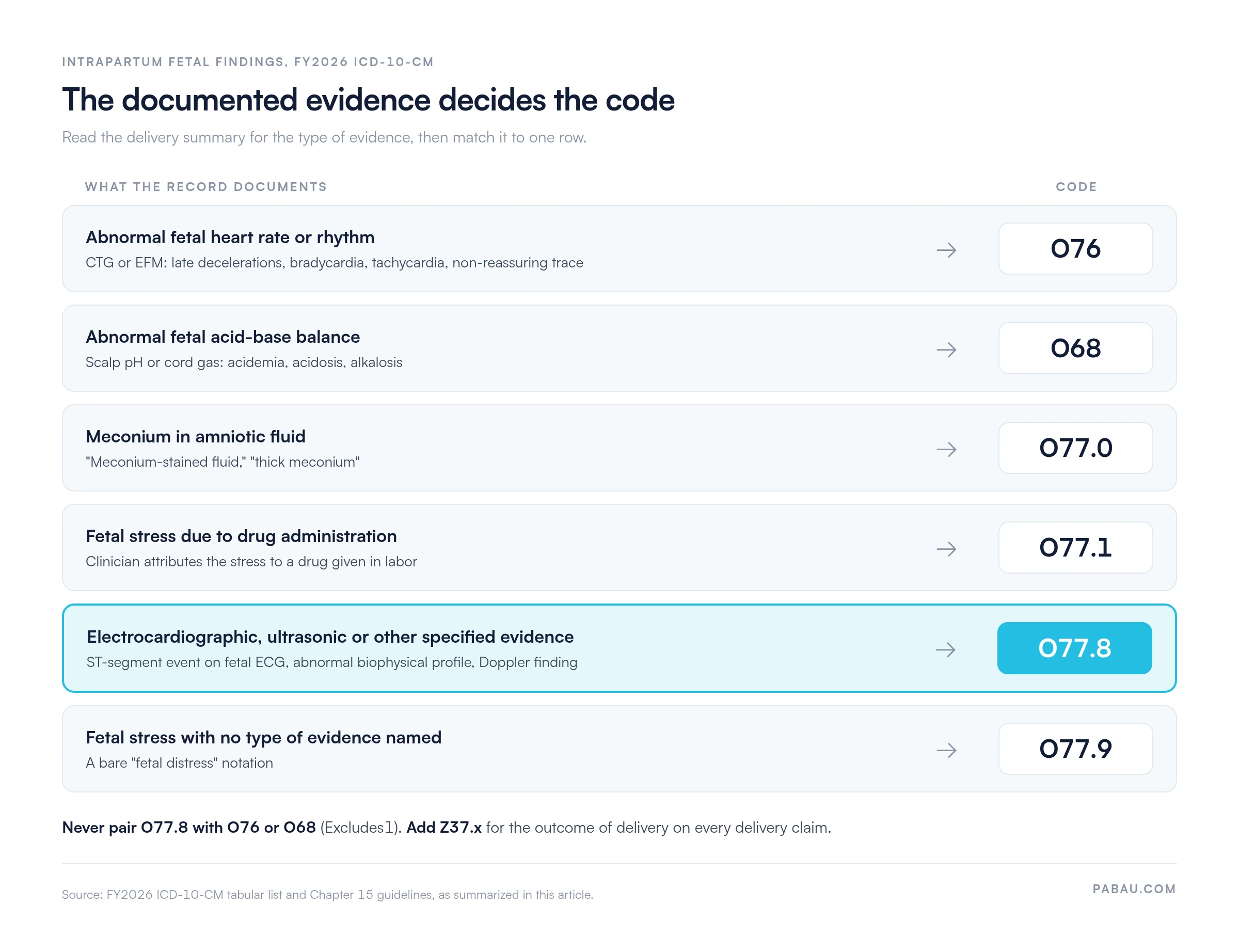
Abnormal fetal heart rate or rhythm on a CTG or EFM trace belongs under O76. Fetal acidemia on scalp pH or cord gas belongs under O68, and meconium belongs under O77.0. O77.8 carries Excludes1 notes for both O76 and O68, so a CTG finding is never coded to O77.8.
Let Pabau's smart automation suggest the right codes, reduce claim denials, and keep your practice compliant—effortlessly.
Automate repetitive tasks and focus on what matters most—your patients.
Reduce coding errors and ensure compliance with the latest regulations.
Clean claims, fewer denials, and faster reimbursements.
Powerful insights and reporting to help your practice thrive.
HIPAA compliant SOC 2 certified GDPR-compliant Trusted by 4,000+ clinics worldwide

O77.8 is a valid, billable ICD-10-CM code for FY2026. It covers electrocardiographic, ultrasonic and other specified evidence of fetal stress during labor.
Abnormal fetal heart rate or rhythm on CTG or EFM, such as late decelerations, bradycardia or tachycardia, goes to O76, never O77.8.
O68 covers fetal acid-base findings only, such as acidemia on scalp pH or cord gas. O77.8 carries Excludes1 notes for both O76 and O68.
O77.8 is never reported alone on a delivery claim. Chapter 15 guidelines always require an outcome of delivery code (Z37.x) as well.
Pabau’s claims management software runs eligibility and validation checks before submission, then sends obstetric claims through Claim.MD to thousands of US payers.
ICD-10 Code O77.8 is the billable FY2026 code for labor and delivery complicated by other evidence of fetal stress. That evidence includes fetal ECG or ultrasound findings. Heart rate findings go to O76 instead, and acid-base findings go to O68.
The table below lists the attributes coders check before submitting an O77.8 claim. CMS and NCHS confirm descriptor wording and billability with each annual update, so check the current tabular too.
O77.8 applies when the record documents intrapartum fetal stress through specified evidence that no more specific code captures. The FY2026 ICD-10-CM tabular lists two inclusion terms for it:
What O77.8 does not cover matters just as much. Each of the following findings has its own code and must never be coded as O77.8:
The map below sorts each type of documented evidence to its code, with O77.8 highlighted.
Chapter 15 guidelines also require the fetal stress to complicate the labor or delivery episode. An incidental finding does not qualify. The clinician must have acted on it, for example by changing the management plan, for the code to be supported.
Knowing the full code path prevents a common selection error. Coders who look up “fetal stress” in the alphabetic index land in category O77 and must then find the correct subcategory. The table below maps the complete hierarchy alongside the sibling subcategories.
According to the CMS ICD-10-CM annual update files, coders should always select the most specific subcategory supported by documentation. O77.9 is the code of last resort. Use it only when the record documents fetal stress but gives no detail about the type of evidence.
O77.8 carries its own Excludes1 notes in the FY2026 ICD-10-CM tabular. An Excludes1 note means the excluded condition is never coded here and never reported with O77.8. The notes point to two separate codes:
O68 has its own Excludes2 note that sends fetal heart rate or rhythm abnormality to O76. A CTG finding therefore belongs under O76, not O68 or O77.8. Two sibling codes in the O77 category also take priority when the record supports them:
Verify excludes notes for the current fiscal year against the official CDC/NCHS ICD-10-CM release. Instructional notes can change between annual updates.
Three codes split intrapartum fetal findings by the type of evidence. O76 takes heart rate and rhythm findings, and O68 takes acid-base findings. O77.8 takes other specified evidence, such as fetal ECG or ultrasound findings. The documented evidence decides the code, not the coder’s preference.
When the record documents both a heart rate finding and an acid-base result, report O76 and O68 together if both affected management. O68’s Excludes2 note allows both codes when both conditions are present. Do not add O77.8 to either, because its Excludes1 notes bar both O76 and O68.
All four codes live in the O77 category, so the distinction is about what type of evidence appears in the record. Check for meconium first (O77.0), then drug causation (O77.1), then other specified evidence (O77.8). Use O77.9 only when the record is silent on the type of evidence.
Accurate medical billing compliance for O77.8 depends on the record containing three elements that go beyond a generic “fetal distress” notation.
Structured delivery note templates that prompt the provider to name the evidence type cut O77.8 query letters and claim rejections. The American College of Obstetricians and Gynecologists (ACOG) recommends that delivery summaries explicitly name the fetal monitoring interpretation and any clinical actions taken in response.
O77.8 follows the ICD-10-CM Chapter 15 obstetric sequencing rules. Chapter 15 codes take sequencing priority over codes from other chapters, and every delivery also needs a Z37.x code.
O77.8 is a valid, billable ICD-10-CM code for FY2026 submission across Medicare, Medicaid, and commercial payers. The practical billing realities coders face vary by payer and MAC jurisdiction, so check payer-specific LCD/NCD guidance before assuming universal coverage rules.
Most O77.8 denials trace back to one of five avoidable errors. Obstetric coding teams can build a check for each one into their denial management in healthcare.
O77.8 commonly appears on claims alongside procedure codes for the monitoring or intervention that identified or responded to the fetal stress. The table below lists common CPT pairings. Verify each against the current AMA CPT book and your MAC’s fee schedule before submission, because coverage and descriptors change.
On every claim, link each CPT procedure to the ICD-10-CM diagnosis that drove it. A cesarean billed with O77.8 needs a delivery summary that names the fetal ECG or ultrasound finding behind the decision.
Today many obstetric practices check eligibility by phone and find a missing detail only when a denial comes back. Pabau’s claims management software runs real-time eligibility checks before the delivery is billed. Pabau integrates with Claim.MD, a US clearinghouse, supporting thousands of US payers.
Validation checks run in the background each time a claim is sent, so missing membership numbers or authorization codes are caught first. Remittances post back against the original claim, so a denied O77.8 claim shows up next to the delivery it billed.
Before finalizing any obstetric claim with O77.8, run the completed code set through your clearinghouse’s claim-scrubbing tool. Check three things. First, a Z37.x outcome code is present. Second, O77.8 does not appear alongside O76 or O68. Third, any CPT fetal monitoring code has a matching diagnosis linkage. Catching all three before submission avoids the most common O77.8 denial patterns.
This pre-submission check is the core of submitting a clean claim. It cuts rework time and protects reimbursement on high-complexity delivery admissions.

Pabau runs eligibility and validation checks before each claim goes out. Submit clean obstetric claims to thousands of US payers through Claim.MD.

ICD-10 Code O77.8 is the right code only when the record names electrocardiographic, ultrasonic or other specified evidence of fetal stress. Heart rate and rhythm findings on CTG or EFM belong under O76. Acid-base findings belong under O68, and meconium belongs under O77.0. The code is valid and billable for FY2026 when the documentation names the evidence, places it in labor and shows a management response.
Most O77.8 denials start in the delivery summary, so the fix starts with the provider’s wording rather than the coder’s. Pabau then runs eligibility and validation checks before each claim goes out through Claim.MD. To see how the workflow runs end to end, book a demo.

Need to understand how clearinghouse claim validation works? How Claim.MD clearinghouse works with Pabau explains real-time eligibility, 837P submission, and ERA reconciliation for US obstetric practices.
Want a denial code reference for obstetric remittance advice? Denial codes in medical billing covers CARC codes and how to read payer rejection messages on obstetric claims.
Looking for revenue cycle guidance beyond single-code selection? What is revenue cycle management covers the full end-to-end billing workflow from eligibility check through final payment posting.
Billing the cesarean that fetal stress prompted? CPT code 59514 covers cesarean delivery only and how to pair it with the diagnosis behind it.
ICD-10 Code O77.8 is the billable code for labor and delivery complicated by other evidence of fetal stress. It covers specified intrapartum evidence such as electrocardiographic or ultrasonic findings. It excludes meconium (O77.0), drug-induced stress (O77.1), heart rate or rhythm abnormalities (O76) and acid-base abnormalities (O68).
Yes. O77.8 is a billable, valid ICD-10-CM code for FY2026 and has been a billable subcategory since its introduction in the O77 category. It is accepted by Medicare, Medicaid, and commercial payers. Verify billability annually against the CMS ICD-10-CM tabular list, as code status is confirmed with each fiscal year update.
O77.0 applies when meconium in the amniotic fluid is the documented evidence of fetal stress during labor. O77.8 applies when the evidence is electrocardiographic, ultrasonic or otherwise specified, and is not meconium. A heart rate finding on CTG goes to O76 rather than either code. Both O77.0 and O77.8 sit in the O77 category.
O76 covers abnormal fetal heart rate or rhythm complicating labor and delivery, such as late decelerations, bradycardia, tachycardia or a non-reassuring trace. O77.8 covers other evidence of fetal stress, such as fetal ECG or ultrasound findings. O77.8 carries an Excludes1 note for O76, so a heart rate finding is never coded to O77.8.
Use O68 when the record documents an abnormality of fetal acid-base balance, such as acidemia, acidosis, alkalosis or metabolic acidemia. These findings usually come from a fetal scalp pH or umbilical cord gas result. O68 does not cover heart rate findings, which its Excludes2 note sends to O76. The WHO version of ICD-10 uses O68 for fetal stress more broadly, but that version does not apply to US claims.
Chapter 15 guidelines require an outcome of delivery code (Z37.x) on every delivery encounter, and a missing one alone can trigger a denial. When a cesarean delivery results from the fetal stress, the appropriate delivery method code is reported alongside O77.8. No “use additional code” instructional note appears at the O77.8 subcategory level itself, but the Z37.x requirement is inherited from the chapter-level guideline.
The record must contain a provider or midwife statement naming the specific type of fetal stress evidence, not just “fetal distress.” It must place the finding in the intrapartum period and show that it affected clinical management. A bare “fetal distress” notation supports O77.9, not O77.8. Clinician attribution is required. Coders cannot infer the diagnosis from monitoring data without a provider’s documented assessment.