ICD-10 Code Y76.0: Diagnostic obstetric and gynecological devices
ICD-10 Code Y76.0: Definition and billable status ICD-10 Code Y76.0 is a valid, ...

Last Updated: Oct 23, 2026
Billable Code Specific Code
P91.2 is the billable ICD-10-CM code for neonatal cerebral leukomalacia. It includes periventricular leukomalacia (PVL), an injury to the white matter beside the lateral ventricles that is seen most often in preterm infants.
Assignment turns on the provider documenting leukomalacia or PVL, not on an imaging finding alone. Because PVL is often confirmed weeks after birth, P91.2 frequently appears on a follow-up claim rather than the birth record.
Let Pabau's smart automation suggest the right codes, reduce claim denials, and keep your practice compliant—effortlessly.
Automate repetitive tasks and focus on what matters most—your patients.
Reduce coding errors and ensure compliance with the latest regulations.
Clean claims, fewer denials, and faster reimbursements.
Powerful insights and reporting to help your practice thrive.
HIPAA compliant SOC 2 certified GDPR-compliant Trusted by 4,000+ clinics worldwide

P91.2 is the billable ICD-10-CM code for neonatal cerebral leukomalacia, and its one inclusion term is periventricular leukomalacia (PVL).
Neonatal cerebral depression is P91.4, not P91.2, and acquired periventricular cysts of newborn have their own code, P91.1.
Assign P91.2 only when the provider documents leukomalacia or PVL, never from an ultrasound report of periventricular echogenicity alone.
PVL is often confirmed weeks after birth, and the perinatal rules let P91.2 follow the patient past the 28-day perinatal period.
Pabau’s claims management software sends claims through its Claim.MD integration and tracks denials, so a rejected P91.2 claim gets worked before it ages.
ICD-10 code P91.2 is the billable ICD-10-CM code for neonatal cerebral leukomalacia, an injury to the brain’s white matter that originates in the perinatal period. The tabular lists one inclusion term under it: periventricular leukomalacia. Per the CMS ICD-10-CM code files, P91.2 is valid for HIPAA-covered transactions in the FY2026 code set.
Periventricular leukomalacia affects the white matter beside the lateral ventricles. It is seen most often in preterm infants, whose white matter is especially vulnerable to reduced blood flow, low oxygen, and inflammation. Over time the damaged tissue can soften and leave scarring or small cavities.
The diagnosis is usually built from imaging and the provider’s interpretation of it:
The coding point that matters most is that P91.2 describes a structural white matter injury. It does not describe the functional state of a depressed newborn, which ICD-10-CM codes to P91.4.
P91.2 sits in category P91, “Other disturbances of cerebral status of newborn,” within Chapter 16 (P00-P96). The descriptors below come from the FY2026 ICD-10-CM tabular.
Check the current fiscal year in the CDC/NCHS ICD-10-CM browser tool, which updates each October. Descriptors and billable status can change between releases. For codes outside Chapter 16, start from our searchable ICD-10-CM code library.
P91.2 carries a short set of instructional notes, and most of them sit at the chapter level rather than on the code itself.
The index routes “Leukomalacia, cerebral, newborn” and its “periventricular” subterm to P91.2. Leukomalacia outside the newborn context does not index to this code.
Most P91.2 errors come from reaching for a neighboring code with a similar-sounding name. The table shows where each one applies.
The two codes describe related findings, and the tabular carries no Excludes1 note between them. When the provider documents both PVL and acquired periventricular cysts, both codes can be reported. When the record names only one, code only that one.
P91.4, neonatal cerebral depression, describes how a newborn is functioning, not a lesion on imaging. A depressed newborn may later be found to have PVL, but that finding needs its own documentation. Report P91.4 for the depressed state and P91.2 for the white matter injury, each only when documented.
HIE and PVL can coexist in the same infant, especially after a hypoxic event. The tabular carries no Excludes note that keeps P91.2 off a claim with a P91.6- code. Each diagnosis needs its own provider documentation, and HIE codes need a stated severity to avoid P91.60.
The provider, not the coder, establishes the diagnosis. These elements in the medical record support P91.2:
Radiology wording causes most documentation queries. A report describing “periventricular echogenicity” or a “flare” is a finding, not a diagnosis of PVL. If the treating provider has not documented leukomalacia, query them before assigning P91.2.
When a cranial ultrasound report mentions periventricular echogenicity, flare, or white matter changes, check whether the neonatologist has documented PVL in their own note. If not, send a query and record the response. Coding P91.2 from the radiology report alone is a common audit finding.
ICD-10-CM Official Guidelines Section I.C.16 governs P91.2. Where the code sits on the claim depends on which encounter you are coding.
Guideline I.C.16.a.6 sets the test for a clinically significant condition. It must require evaluation, treatment, diagnostic procedures, a longer stay or more nursing care, or carry future health care implications. PVL that triggers serial imaging or neurodevelopmental follow-up meets that bar.
Timing explains why P91.2 so often lands on a follow-up claim. Cystic changes may appear weeks after birth, and MRI often waits until term-equivalent age. The chapter’s includes note keeps P91.2 valid when the diagnosis is made after day 28. The path below runs from the provider’s note to the claim position on each encounter.
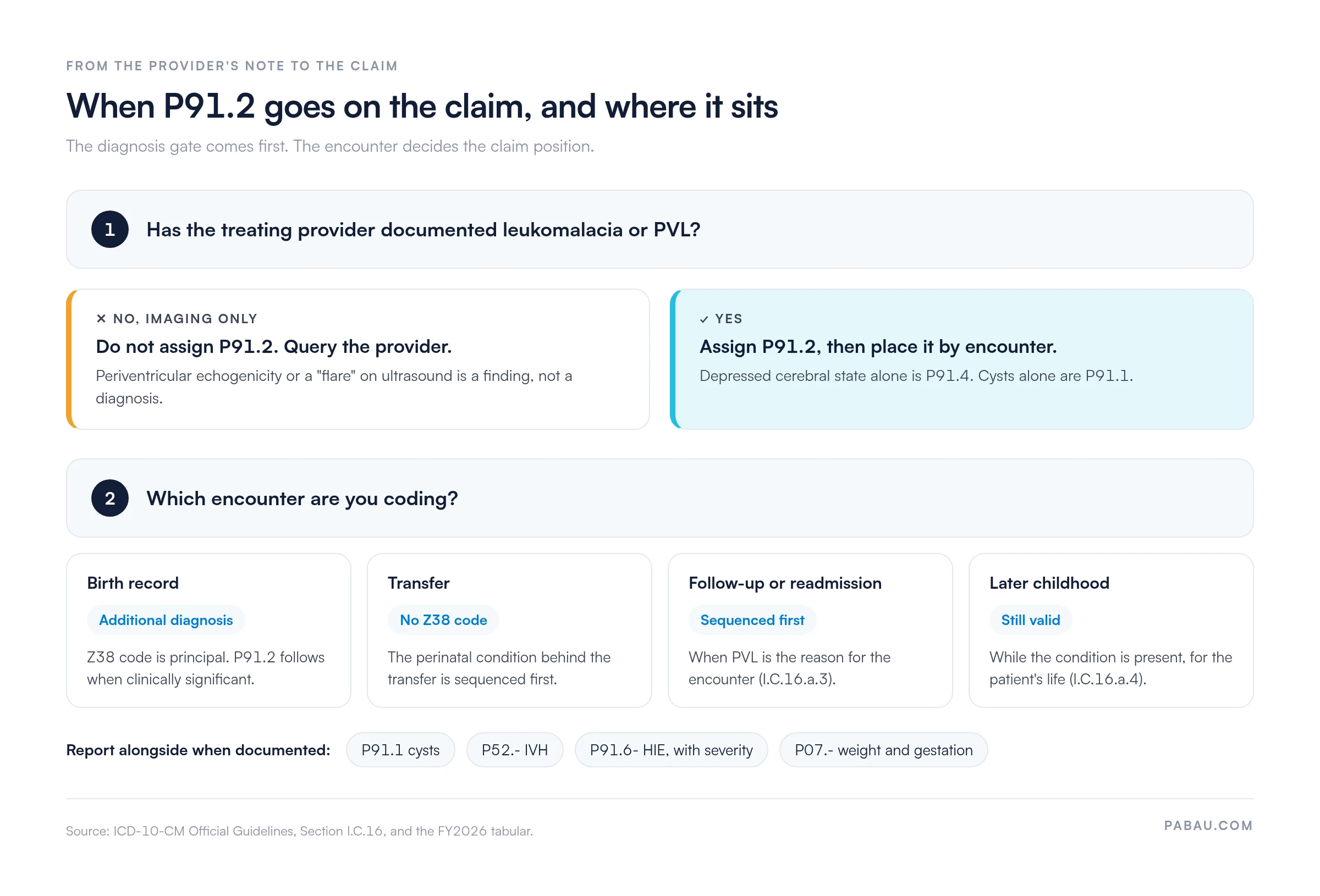
P91.2 rarely appears alone on a NICU or follow-up claim. These companion codes are verified against the FY2026 tabular.
One trap catches coders trained on WHO ICD-10. Birth asphyxia is P21 in the WHO classification, where P21.1 is “Mild and moderate birth asphyxia.” ICD-10-CM never adopted P21, so asphyxia of newborn NOS goes to ICD-10 code P84 on a US claim.
Medicaid covers a large share of NICU admissions, and state Medicaid plans and managed care organizations set their own review criteria. CMS sets the national baseline, but local policies vary.
Claims carrying P91.2 hold up best when the record answers three payer questions:
Pabau’s billing software integrates with Claim.MD to support electronic claim submission for US providers. The integration handles 837P claims, real-time eligibility checks, and electronic remittance advice. See how denial management workflows can catch sequencing and documentation errors before submission.
Five patterns account for most P91.2 rejections and audit findings.
Most neonatology and pediatric billing teams code P91.2 from a chart, an imaging report, and a separate claims tool. That split is where the provider’s wording gets lost and the wrong P91 code goes out.
Pabau keeps clinical notes, coding, and claims in one system. Its denial-tracking claims software submits through the Claim.MD integration, checks eligibility before the claim leaves, and posts remittance data back to the patient’s record.
When a payer rejects a P91.2 claim, the denial sits next to the note that supports the code. Your team can correct the code or answer the payer without hunting across systems.

Pabau connects clinical documentation to claims submitted through Claim.MD, with eligibility checks and denial tracking in one place. See how it keeps P91.2 claims tied to the provider’s documented diagnosis.

P91.2 is a narrow code with one job: recording a white matter injury of perinatal origin. Getting it right means trusting the provider’s diagnostic term over the radiology wording, and keeping it apart from P91.4 and P91.1.
Because PVL often surfaces weeks after birth, expect P91.2 on follow-up claims more often than on the birth record. Build your query and sequencing checks around that timing, and the denials tied to this code become rare.
Book a demo to see how Pabau keeps perinatal coding and claims tied to the documentation that supports them.

Need a broader overview of the claims submission process? Claim.MD clearinghouse overview explains how electronic claims reach payers and what happens at each stage.
Want to understand how 837 files are structured? 837 file guide covers the EDI transaction format used for NICU and other institutional claims.
Looking to reduce denials across your billing operation? Denial codes in medical billing explains CARC reason codes and how to respond to each denial type.
ICD-10 code P91.2 is the billable ICD-10-CM code for neonatal cerebral leukomalacia. Its inclusion term is periventricular leukomalacia (PVL). It sits in category P91, “Other disturbances of cerebral status of newborn,” in Chapter 16.
The ICD-10-CM code for periventricular leukomalacia in a newborn is P91.2. The tabular lists periventricular leukomalacia as the inclusion term under P91.2, neonatal cerebral leukomalacia.
No. Neonatal cerebral depression is P91.4. P91.2 is neonatal cerebral leukomalacia, a structural white matter injury, while P91.4 describes a depressed functional state in the newborn.
Yes, when the provider documents both. P91.1 is acquired periventricular cysts of newborn, and the tabular carries no Excludes1 note between it and P91.2.
Yes. Guideline I.C.16.a.4 lets a perinatal code continue for the life of the patient if the condition is still present. P91.2 also applies when PVL is first diagnosed after day 28.
Not on the birth record, where a Z38 code is always principal. On a follow-up encounter or a transfer admission for PVL, P91.2 can be sequenced first.